Malaysia Aluminum Based Strips Market Size, Share & Growth Rate
The Malaysia Aluminum Based Strips Market was estimated at USD 475 Million in 2025 and is projected to reach USD 619 Million by 2032, growing at a CAGR of 3.9% from 2026 to 2032. This growth trajectory is primarily driven by an expanding automotive sector that increasingly adopts aluminum strips to enhance vehicle lightweighting. Additionally, the demand for aluminum strips in flexible packaging, particularly in the food and beverage industries, underscores the material's versatility and performance attributes.
Malaysia Aluminum Based Strips Market Year-wise Growth Rate and Key Drivers
This graph highlights how the Malaysia Aluminum Based Strips Market has steadily grown over the years, supported by major growth factors.
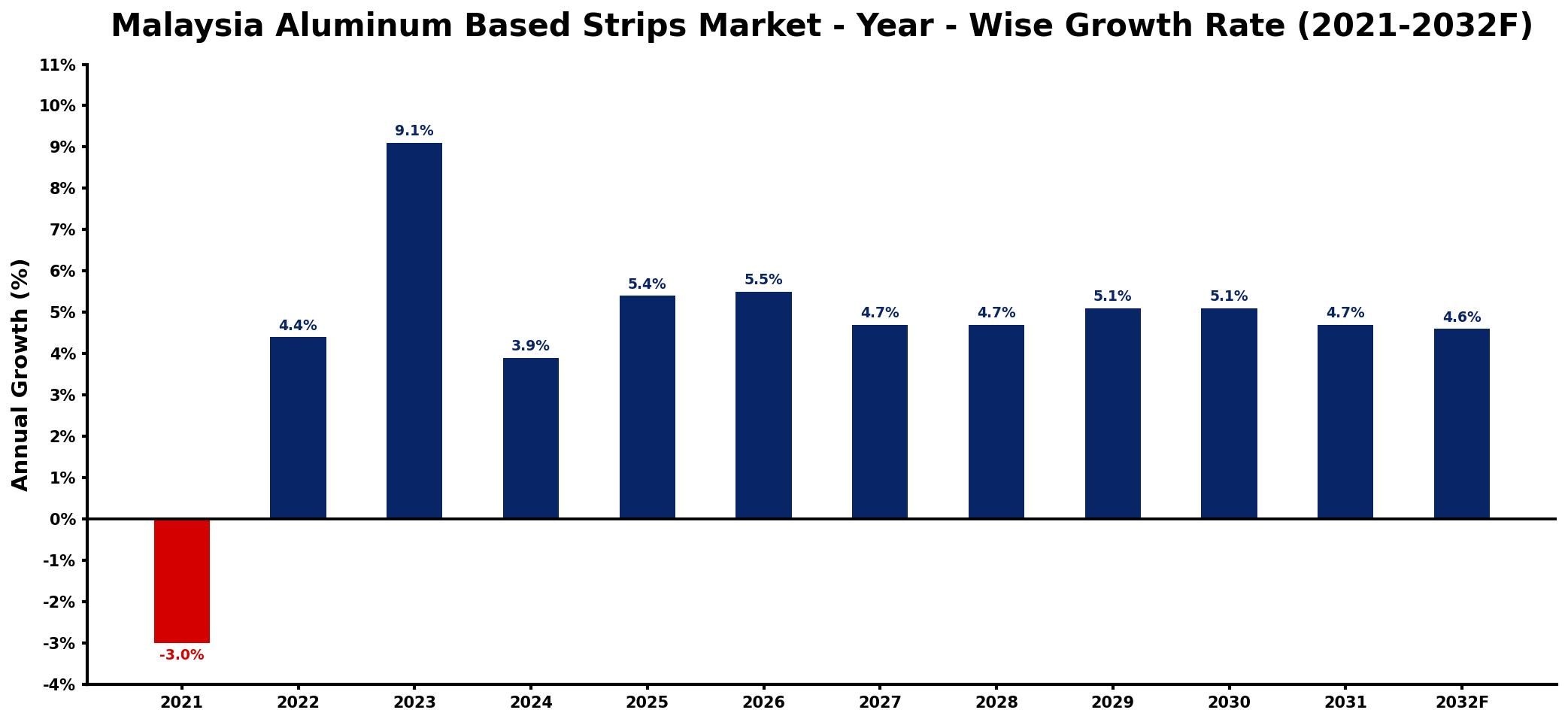
The table below presents the year‑wise growth rates along with the key drivers influencing the market
| Year | Growth Rate | Major Drivers |
| 2021 | -3.0% | decreased construction projects nationwide |
| 2022 | 4.4% | rising demand from automotive sector |
| 2023 | 9.1% | growth in renewable energy investments |
| 2024 | 3.9% | expansion of infrastructure developments |
| 2025 | 5.4% | increased consumer electronics production |
| 2026 | 5.5% | surge in export opportunities abroad |
| 2027 | 4.7% | growing interest in lightweight materials |
| 2028 | 4.7% | enhanced recycling initiatives nationwide |
| 2029 | 5.1% | stronger regulations promoting sustainability |
| 2030 | 5.1% | evolving trends in packaging solutions |
| 2031 | 4.7% | increased automation in manufacturing |
| 2032 | 4.6% | emerging applications in construction |
Note: Market size estimations and growth projections presented in this report are based on 6Wresearch's proprietary forecasting methodology, utilizing the latest available industry data, government publications, and primary research inputs.
Malaysia Aluminum Based Strips Market Synopsis
In recent years, the aluminum-based strips market in Malaysia has emerged as a critical player in the country's industrial landscape. The increasing use of these strips across a variety of applications, including automotive components and electrical cables, has highlighted their importance in enhancing efficiency and functionality.
As the manufacturing and construction sectors thrive, the demand for quality aluminum strips continues to rise. Companies in this space are focusing on innovation and quality to maintain their competitive edge and respond to the growing consumer preference for sustainable and lightweight materials.
Malaysia Aluminum Based Strips Market Key Takeaways
- The market is benefitting from an upsurge in automotive lightweighting initiatives, bolstering demand for aluminum strips.
- Flexible packaging trends in the food and beverage sector are significantly driving market growth due to aluminum's barrier properties.
- The electronics industry's expansion, particularly in battery and component manufacturing, is creating new opportunities for aluminum strip applications.
- Price volatility in the aluminum market poses ongoing challenges for local manufacturers in terms of profitability.
- Quality control and adherence to environmental regulations are essential for sustaining competitiveness in this market.
Evaluation of Restraints in Malaysia Aluminum Based Strips Market
The Malaysia aluminum-based strips market faces several restraints that could potentially hinder its growth. Notably, global oversupply can lead to fluctuating prices, adversely impacting profit margins for local players. Furthermore, ensuring consistent quality in strip production, including uniform thickness and surface finish, remains a critical challenge. As manufacturers navigate increasingly stringent environmental regulations, compliance can elevate production costs, thereby affecting market competitiveness. This necessitates a proactive approach to innovation and efficiency to mitigate these challenges.
Malaysia Aluminum Based Strips Market Trends
Several trends are currently shaping the Malaysian aluminum-based strips market. A notable shift towards lightweight and sustainable materials in manufacturing processes is increasingly influencing product development. As industries adapt to consumer preferences for environmentally friendly solutions, aluminum strips are gaining popularity for their recyclability. Moreover, advancements in production technologies are improving the efficiency of aluminum strip manufacturing, which is expected to lead to reduced costs and enhanced product offerings.
Malaysia Aluminum Based Strips Market Opportunities
The market presents numerous growth and investment opportunities, particularly in sectors such as automotive and packaging. As car manufacturers seek to improve fuel efficiency through lightweight components, aluminum strips will become essential. Additionally, the push for innovative packaging solutions driven by sustainability goals opens avenues for aluminum-based strips to replace traditional materials. Investing in R&D to develop new applications and enhance production techniques could yield significant returns for industry players.
Government Initiatives in the Malaysia Aluminum Based Strips Market
The Malaysian government has been proactive in supporting the aluminum industry through various policies and initiatives aimed at enhancing local manufacturing capabilities. Programs promoting industrial innovation and investment in green technologies align with global sustainability targets. Furthermore, public spending on infrastructure development directly benefits the aluminum strips market by boosting demand in construction applications.
Future Insights of the Malaysia Aluminum Based Strips Market
Looking ahead to the period between 2026 and 2032, the Malaysia aluminum-based strips market is expected to thrive, driven by continued growth in the automotive and construction sectors. As regulations surrounding sustainability become more stringent, there will be an increased emphasis on lightweight materials that meet these standards. Additionally, advancements in production technology and a commitment to quality will ensure that Malaysian manufacturers remain competitive on a global scale, paving the way for future innovations in aluminum strip applications.
Malaysia Aluminum Based Strips Market Latest Developments (2025 - 2026)
Recent developments in the Malaysian aluminum-based strips market indicate a strong focus on technological advancements and sustainability. Companies are increasingly adopting innovative production techniques to enhance quality while reducing environmental impact. Additionally, collaborations between industry stakeholders are fostering research efforts that aim to expand the applications of aluminum strips across various sectors.
Malaysia Aluminum Based Strips Market - Key Attractiveness of the Report
- 10 Years of Market Numbers
- Historical Data Starting from 2022 to 2025
- Base Year: 2025
- Forecast Data until 2032
- Key Performance Indicators Impacting the Market
- Major Upcoming Developments and Projects
Key Highlights of the Report:
- Malaysia Aluminum Based Strips Market Outlook
- Market Size of Malaysia Aluminum Based Strips Market, 2025
- Forecast of Malaysia Aluminum Based Strips Market, 2032
- Historical Data and Forecast of Malaysia Aluminum Based Strips Revenues & Volume for the Period 2022-2032F
- Malaysia Aluminum Based Strips Market Trend Evolution
- Malaysia Aluminum Based Strips Market Drivers and Challenges
- Malaysia Aluminum Based Strips Price Trends
- Malaysia Aluminum Based Strips Porter's Five Forces
- Malaysia Aluminum Based Strips Industry Life Cycle
- Historical Data and Forecast of Malaysia Aluminum Based Strips Market Revenues & Volume By Product for the Period 2022-2032F
- Historical Data and Forecast of Malaysia Aluminum Based Strips Market Revenues & Volume By Width <6mm for the Period 2022-2032F
- Historical Data and Forecast of Malaysia Aluminum Based Strips Market Revenues & Volume By Width from 6 to 10mm for the Period 2022-2032F
- Historical Data and Forecast of Malaysia Aluminum Based Strips Market Revenues & Volume By Width >10mm for the Period 2022-2032F
- Historical Data and Forecast of Malaysia Aluminum Based Strips Market Revenues & Volume By Application for the Period 2022-2032F
- Historical Data and Forecast of Malaysia Aluminum Based Strips Market Revenues & Volume By Medical for the Period 2022-2032F
- Historical Data and Forecast of Malaysia Aluminum Based Strips Market Revenues & Volume By Automotive for the Period 2022-2032F
- Historical Data and Forecast of Malaysia Aluminum Based Strips Market Revenues & Volume By Electronics for the Period 2022-2032F
- Historical Data and Forecast of Malaysia Aluminum Based Strips Market Revenues & Volume By Others for the Period 2022-2032F
- Malaysia Aluminum Based Strips Import Export Trade Statistics
- Market Opportunity Assessment By Product
- Market Opportunity Assessment By Application
- Malaysia Aluminum Based Strips Top Companies Market Share
- Malaysia Aluminum Based Strips Competitive Benchmarking By Technical and Operational Parameters
- Malaysia Aluminum Based Strips Company Profiles
- Malaysia Aluminum Based Strips Key Strategic Recommendations






































