Malaysia Aluminum Foil Tape Market Size, Share & Growth Rate
The Malaysia Aluminum Foil Tape Market was estimated at USD 295 Million in 2025 and is projected to reach USD 386 Million by 2032, growing at a CAGR of 3.9% from 2026 to 2032. This positive trajectory is largely fueled by robust growth in construction and infrastructure projects, where aluminum foil tape is essential for insulation and sealing. Additionally, the automotive industry's increasing reliance on high-performance insulation materials further propels market demand, showcasing the diverse applications of aluminum foil tape.
Malaysia Aluminum Foil Tape Market Year-wise Growth Rate and Key Drivers
This graph highlights how the Malaysia Aluminum Foil Tape Market has steadily grown over the years, supported by major growth factors.
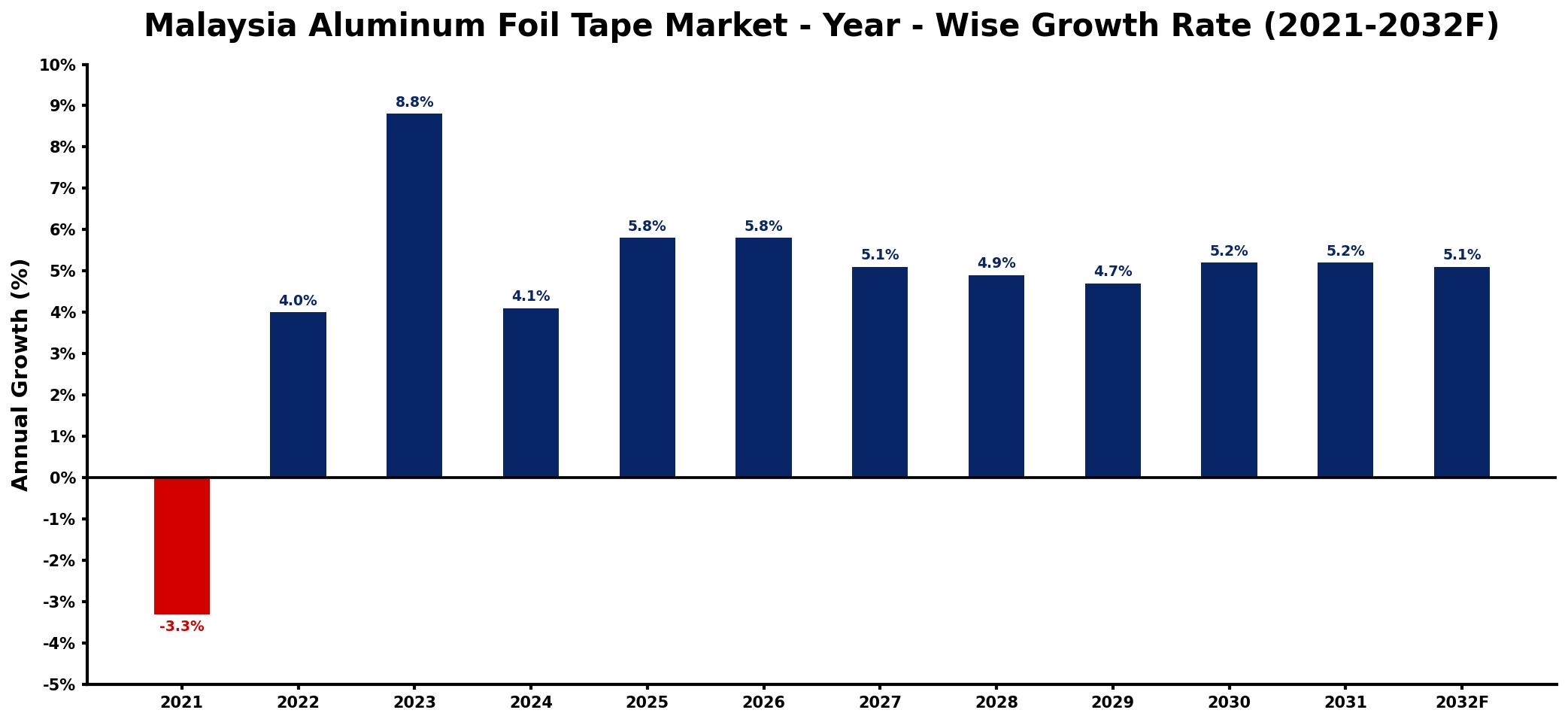
The table below presents the year‑wise growth rates along with the key drivers influencing the market
| Year | Growth Rate | Major Drivers |
| 2021 | -3.3% | Construction sector faced downturn |
| 2022 | 4.0% | Rising energy efficiency regulations |
| 2023 | 8.8% | Increased industrial manufacturing activities |
| 2024 | 4.1% | Growing demand from HVAC sector |
| 2025 | 5.8% | Expansion of renewable energy projects |
| 2026 | 5.8% | Technological advancements in applications |
| 2027 | 5.1% | Surge in automotive production rates |
| 2028 | 4.9% | Boost in consumer electronics sales |
| 2029 | 4.7% | Investments in infrastructure development |
| 2030 | 5.2% | Growing interest in packaging solutions |
| 2031 | 5.2% | Increased focus on sustainable materials |
| 2032 | 5.1% | Rising demand for insulation products |
Note: Market size estimations and growth projections presented in this report are based on 6Wresearch's proprietary forecasting methodology, utilizing the latest available industry data, government publications, and primary research inputs.
Malaysia Aluminum Foil Tape Market Synopsis
Recent momentum in the Malaysian aluminum foil tape market highlights a recovery phase, particularly following the challenges posed by the COVID-19 pandemic. As sectors adapt and invest in sustainable construction and efficient insulation solutions, the market is poised for sustained growth driven by evolving industrial needs.
Looking ahead, the outlook remains favorable, with construction and automotive industries continuing to innovate and seek out high-quality adhesive solutions. As manufacturers focus on product innovation and quality control, they will likely address growing customer requirements across various sectors, enhancing their competitive edge.
Malaysia Aluminum Foil Tape Market Key Takeaways
- The market is poised for growth, driven by increased construction and automotive applications.
- Product innovation and quality assurance are critical to maintaining competitive advantages.
- Demand dynamics are increasingly influenced by sustainability trends in construction and manufacturing.
- Supply chain challenges due to global aluminum shortages may affect market pricing and availability.
- The evolving regulatory landscape presents opportunities for market expansion and innovation.
Evaluation of Restraints in Malaysia Aluminum Foil Tape Market
The Malaysian aluminum foil tape market faces notable restraints that could hinder its growth trajectory. A significant challenge stems from the global shortage of aluminum, which not only impacts production capabilities but can also lead to escalating material costs. Additionally, maintaining rigorous quality control is paramount, particularly for tapes used in critical applications like HVAC systems and insulation. This necessity emphasizes the importance of consistent adhesive performance. Moreover, competition from alternative materials, such as PVC and cloth tapes, demands continual product development to differentiate aluminum foil tape offerings in an increasingly crowded marketplace.
Malaysia Aluminum Foil Tape Market Trends
Several trends are currently shaping the Malaysian aluminum foil tape market. A shift towards energy efficiency and sustainability in construction practices is prompting increased demand for high-performance insulation solutions. Moreover, advancements in adhesive technology are leading to the development of aluminum foil tapes with enhanced durability and thermal conductivity. The automotive sector is also experiencing a transformation as electric vehicles become more prevalent, creating additional demand for reliable insulation solutions that support performance and safety.
Malaysia Aluminum Foil Tape Market Opportunities
There are significant opportunities for growth in the Malaysian aluminum foil tape market, particularly in the realms of product development and innovation. As industries pursue more sustainable and efficient solutions, manufacturers have the chance to leverage technology to create specialized products that meet specific needs. Additionally, expanding applications in emerging sectors such as renewable energy and smart building technologies present untapped potential for aluminum foil tape, allowing businesses to diversify their offerings and enhance market reach.
Government Initiatives in the Malaysia Aluminum Foil Tape Market
The Malaysian government is actively promoting policies that encourage sustainable construction and energy-efficient technologies. Initiatives aimed at enhancing infrastructure development and supporting green building certifications are vital in driving demand for high-quality aluminum foil tape. Public spending in infrastructure projects continues to rise, creating a favorable environment for manufacturers and suppliers in this market. Moreover, programs incentivizing innovation in adhesive technologies could further catalyze market growth and development.
Future Insights of the Malaysia Aluminum Foil Tape Market
From 2026 to 2032, the Malaysia aluminum foil tape market is expected to evolve significantly, with advancements in product technology and growing industrial applications driving demand. As environmental concerns become more prevalent, the industry will likely shift towards developing eco-friendly alternatives that maintain performance without compromising on quality. Additionally, continuous investment in infrastructure and construction projects will sustain a healthy market environment, positioning aluminum foil tape as a critical component across diverse sectors.
Malaysia Aluminum Foil Tape Market Latest Developments (2025 - 2026)
In recent months, the Malaysian aluminum foil tape market has seen significant developments, driven by innovations in adhesive technologies and heightened focus on sustainability. Manufacturers are increasingly introducing products that enhance thermal efficiency while reducing environmental impact. Collaborative efforts among industry stakeholders aim to streamline supply chains and address challenges related to material shortages, further enhancing market resilience and adaptability.
Malaysia Aluminum Foil Tape Market - Key Attractiveness of the Report
- 10 Years of Market Numbers
- Historical Data Starting from 2022 to 2025
- Base Year: 2025
- Forecast Data until 2032
- Key Performance Indicators Impacting the Market
- Major Upcoming Developments and Projects
Key Highlights of the Report:
- Malaysia Aluminum Foil Tape Market Outlook
- Market Size of Malaysia Aluminum Foil Tape Market, 2025
- Forecast of Malaysia Aluminum Foil Tape Market, 2032
- Historical Data and Forecast of Malaysia Aluminum Foil Tape Revenues & Volume for the Period 2022-2032F
- Malaysia Aluminum Foil Tape Market Trend Evolution
- Malaysia Aluminum Foil Tape Market Drivers and Challenges
- Malaysia Aluminum Foil Tape Price Trends
- Malaysia Aluminum Foil Tape Porter's Five Forces
- Malaysia Aluminum Foil Tape Industry Life Cycle
- Historical Data and Forecast of Malaysia Aluminum Foil Tape Market Revenues & Volume By Type for the Period 2022-2032F
- Historical Data and Forecast of Malaysia Aluminum Foil Tape Market Revenues & Volume By 0.05mm-0.08mm for the Period 2022-2032F
- Historical Data and Forecast of Malaysia Aluminum Foil Tape Market Revenues & Volume By 0.1mm-0.15mm for the Period 2022-2032F
- Historical Data and Forecast of Malaysia Aluminum Foil Tape Market Revenues & Volume By Others for the Period 2022-2032F
- Historical Data and Forecast of Malaysia Aluminum Foil Tape Market Revenues & Volume By Application for the Period 2022-2032F
- Historical Data and Forecast of Malaysia Aluminum Foil Tape Market Revenues & Volume By HVAC for the Period 2022-2032F
- Historical Data and Forecast of Malaysia Aluminum Foil Tape Market Revenues & Volume By Automotive for the Period 2022-2032F
- Historical Data and Forecast of Malaysia Aluminum Foil Tape Market Revenues & Volume By Electronics for the Period 2022-2032F
- Historical Data and Forecast of Malaysia Aluminum Foil Tape Market Revenues & Volume By Architecture for the Period 2022-2032F
- Historical Data and Forecast of Malaysia Aluminum Foil Tape Market Revenues & Volume By Others for the Period 2022-2032F
- Malaysia Aluminum Foil Tape Import Export Trade Statistics
- Market Opportunity Assessment By Type
- Market Opportunity Assessment By Application
- Malaysia Aluminum Foil Tape Top Companies Market Share
- Malaysia Aluminum Foil Tape Competitive Benchmarking By Technical and Operational Parameters
- Malaysia Aluminum Foil Tape Company Profiles
- Malaysia Aluminum Foil Tape Key Strategic Recommendations






































