Malaysia Alunite Market Size, Share & Growth Rate
The Malaysia Alunite Market was estimated at USD 228 Million in 2025 and is projected to reach USD 296 Million by 2032, growing at a CAGR of 3.8% from 2026 to 2032. This growth trajectory is largely driven by the increasing demand for alunite in alumina production and as a key component in potash fertilizers. As Malaysia's agricultural sector expands and sustainability becomes a priority, the utilization of locally sourced alunite is likely to see a substantial boost.
Malaysia Alunite Market Year-wise Growth Rate and Key Drivers
This graph highlights how the Malaysia Alunite Market has steadily grown over the years, supported by major growth factors.
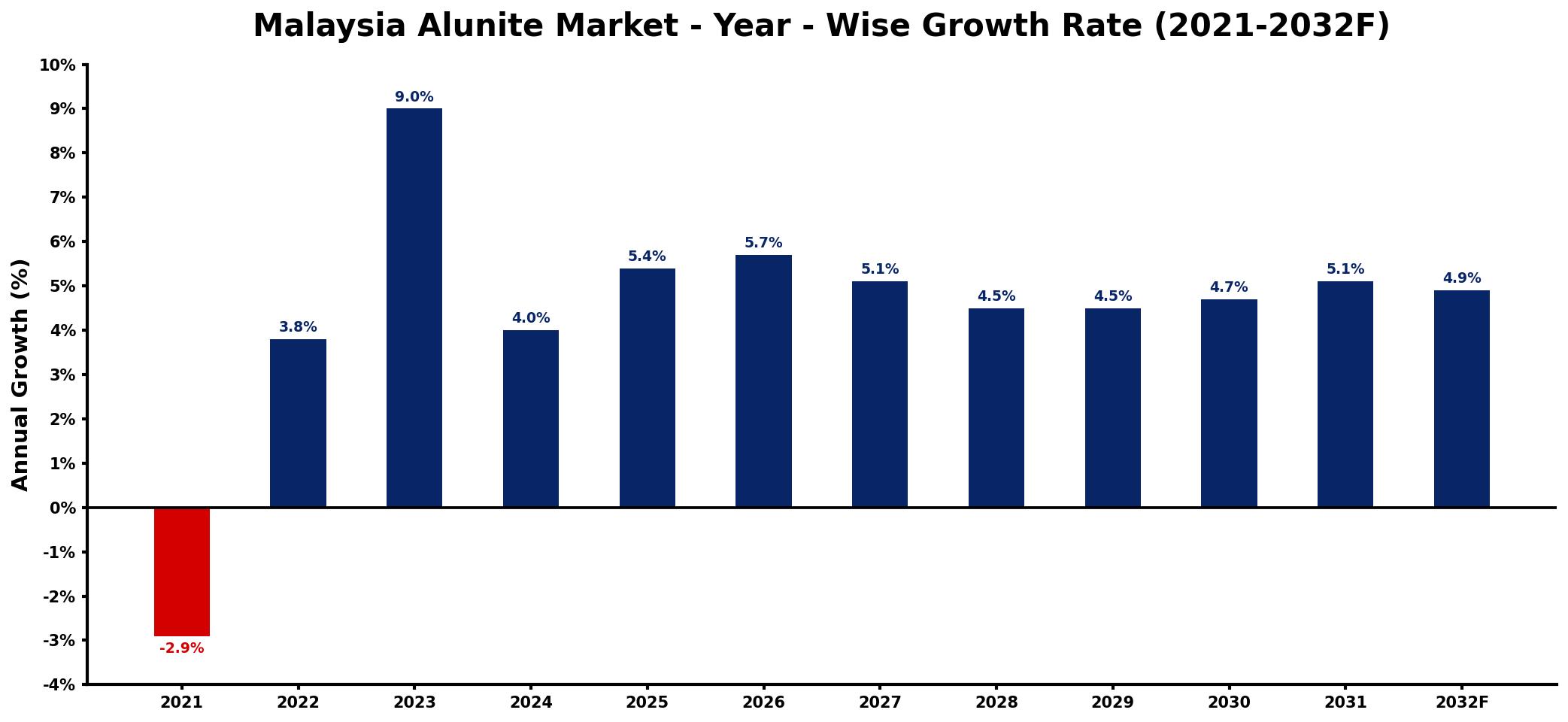
The table below presents the year‑wise growth rates along with the key drivers influencing the market
| Year | Growth Rate | Major Drivers |
| 2021 | -2.9% | decrease in industrial applications |
| 2022 | 3.8% | rise in construction sector investments |
| 2023 | 9.0% | growth in renewable energy projects |
| 2024 | 4.0% | increased demand for eco-friendly materials |
| 2025 | 5.4% | expansion of mining operations |
| 2026 | 5.7% | surge in infrastructure development |
| 2027 | 5.1% | strengthening international trade flows |
| 2028 | 4.5% | increase in export opportunities |
| 2029 | 4.5% | development of new technological applications |
| 2030 | 4.7% | expanding industrial usage applications |
| 2031 | 5.1% | improved raw material availability |
| 2032 | 4.9% | rising export shipment volumes |
Note: Market size estimations and growth projections presented in this report are based on 6Wresearch's proprietary forecasting methodology, utilizing the latest available industry data, government publications, and primary research inputs.
Malaysia Alunite Market Synopsis
The Malaysian alunite market has gained momentum in recent years, propelled by its essential role in both industrial applications and agricultural practices. As the demand for aluminum rises, so does the interest in alunite, primarily for alumina extraction and as a natural fertilizer alternative.
Looking ahead, the market is poised for steady expansion. The intertwining needs of the industrial and agricultural sectors create a robust framework for alunite consumption, particularly as stakeholders increasingly focus on sustainable sourcing. This dual appeal positions the Malaysia alunite market favorably in the broader context of economic development.
Malaysia Alunite Market Key Takeaways
- The market is projected to grow steadily, reaching USD 296 Million by 2032.
- Alunite serves as a critical raw material for alumina extraction, essential for aluminum manufacturing.
- Increased agricultural output drives demand for alunite-based fertilizers, enhancing crop yields.
- Domestic sourcing of alunite aligns with sustainability efforts, mitigating reliance on imports.
- Key players in the market are focusing on extraction efficiency and product quality to remain competitive.
Evaluation of Restraints in Malaysia Alunite Market
Despite its promising outlook, the Malaysia alunite market faces several restraints that could impede growth. One of the most significant challenges is the limited availability of high-quality alunite deposits, which can result in supply shortages and subsequent price volatility. Additionally, competition from alternative raw materials, especially in fertilizer applications, necessitates that market participants prioritize cost efficiency and product quality to maintain their market share. A focus on improving extraction techniques and sustainable practices is crucial for overcoming these hurdles.
Malaysia Alunite Market Trends
Current trends in the Malaysia alunite market reflect a growing emphasis on sustainability and environmentally friendly agricultural practices. There is an increasing shift towards the use of alunite in organic fertilizer formulations, driven by consumer preferences for sustainable farming. Moreover, technological advancements in mining and processing are enhancing efficiency and output. This trend is likely to continue as the market evolves to meet both local and international standards of sustainability and quality.
Malaysia Alunite Market Opportunities
The Malaysia alunite market presents genuine growth opportunities, particularly in the sectors of agriculture and aluminum production. Investment in local alunite mining and processing facilities could reduce dependency on imported raw materials, strengthening domestic supply chains. Furthermore, the increasing global demand for aluminum due to infrastructural development and green technologies offers potential avenues for market expansion. The integration of innovative agricultural practices utilizing alunite-based fertilizers can also unlock new customer segments.
Government Initiatives in the Malaysia Alunite Market
The Malaysian government has been proactive in promoting domestic mineral sourcing and industrial development, particularly in the mining sector. Initiatives aimed at enhancing local production capabilities and reducing reliance on imports are key components of government policy. Additionally, various public spending programs focus on sustainable agriculture, which could further stimulate demand for alunite-based fertilizers. These policies and incentives create a favorable environment for market players and attract potential investors.
Future Insights of the Malaysia Alunite Market
Looking towards 2026-2032, the Malaysia alunite market is expected to evolve significantly. As local industries recover from the impacts of COVID-19, there will likely be an increased emphasis on domestic sourcing of materials. This shift aligns with global trends favoring sustainability, which could enhance the competitiveness of Malaysian alunite in both local and international markets. Furthermore, as agriculture becomes more technology-driven, the demand for high-quality alunite-based fertilizers is expected to rise, solidifying the mineral's place in the future economy.
Malaysia Alunite Market Latest Developments (2025 - 2026)
In recent months, the Malaysia alunite market has seen several developments aimed at enhancing production capabilities and product offerings. Industry stakeholders are increasingly investing in research and development to improve extraction methods and processing efficiencies. There is also a notable uptick in partnerships between agricultural companies and alunite producers, reflecting a collaborative approach to meet the rising demand for sustainable fertilizers. This trend suggests a positive trajectory for market growth.
Malaysia Alunite Market - Key Attractiveness of the Report
- 10 Years of Market Numbers
- Historical Data Starting from 2022 to 2025
- Base Year: 2025
- Forecast Data until 2032
- Key Performance Indicators Impacting the Market
- Major Upcoming Developments and Projects
Key Highlights of the Report:
- Malaysia Alunite Market Outlook
- Market Size of Malaysia Alunite Market, 2025
- Forecast of Malaysia Alunite Market, 2032
- Historical Data and Forecast of Malaysia Alunite Revenues & Volume for the Period 2022-2032F
- Malaysia Alunite Market Trend Evolution
- Malaysia Alunite Market Drivers and Challenges
- Malaysia Alunite Price Trends
- Malaysia Alunite Porter's Five Forces
- Malaysia Alunite Industry Life Cycle
- Historical Data and Forecast of Malaysia Alunite Market Revenues & Volume By Product for the Period 2022-2032F
- Historical Data and Forecast of Malaysia Alunite Market Revenues & Volume By Natroalunite for the Period 2022-2032F
- Historical Data and Forecast of Malaysia Alunite Market Revenues & Volume By Potassium alunite for the Period 2022-2032F
- Historical Data and Forecast of Malaysia Alunite Market Revenues & Volume By End User for the Period 2022-2032F
- Historical Data and Forecast of Malaysia Alunite Market Revenues & Volume By Pharmaceuticals for the Period 2022-2032F
- Historical Data and Forecast of Malaysia Alunite Market Revenues & Volume By Cosmetics for the Period 2022-2032F
- Historical Data and Forecast of Malaysia Alunite Market Revenues & Volume By FMCG for the Period 2022-2032F
- Historical Data and Forecast of Malaysia Alunite Market Revenues & Volume By Others for the Period 2022-2032F
- Malaysia Alunite Import Export Trade Statistics
- Market Opportunity Assessment By Product
- Market Opportunity Assessment By End User
- Malaysia Alunite Top Companies Market Share
- Malaysia Alunite Competitive Benchmarking By Technical and Operational Parameters
- Malaysia Alunite Company Profiles
- Malaysia Alunite Key Strategic Recommendations






































