Malaysia Ammonium Hydroxide Market Size, Share & Growth Rate
The Malaysia Ammonium Hydroxide Market was estimated at USD 219 Million in 2025 and is projected to reach USD 284 Million by 2032, growing at a CAGR of 3.8% from 2026 to 2032. This robust growth trajectory can be attributed to the rising industrial applications of ammonium hydroxide, particularly in the textiles, chemicals, and pharmaceuticals sectors. Moreover, favorable government policies aimed at enhancing foreign investments are likely to bolster production capacity, expanding the market's presence across the Asia Pacific region.
Malaysia Ammonium Hydroxide Market Year-wise Growth Rate and Key Drivers
This graph highlights how the Malaysia Ammonium Hydroxide Market has steadily grown over the years, supported by major growth factors.
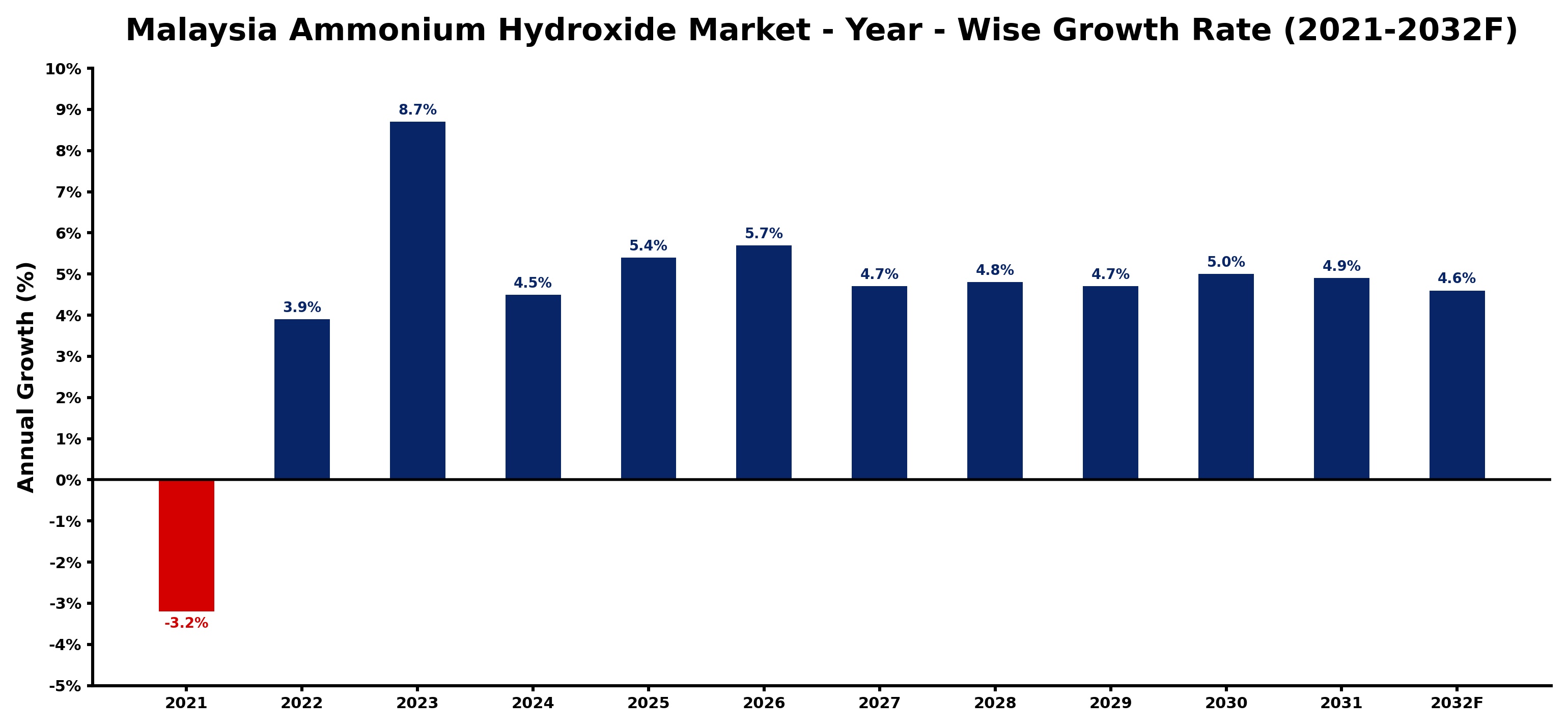
The table below presents the year‑wise growth rates along with the key drivers influencing the market
| Year | Growth Rate | Major Drivers |
| 2021 | -3.2% | Increasing industrial automation investments |
| 2022 | 3.9% | Expansion of manufacturing activities |
| 2023 | 8.7% | Government infrastructure modernization initiatives |
| 2024 | 4.5% | Increasing smart city development projects |
| 2025 | 5.4% | Growing renewable energy integration projects |
| 2026 | 5.7% | Expansion of manufacturing activities |
| 2027 | 4.7% | Rapid growth in telecom and data center sectors |
| 2028 | 4.8% | Expansion of transportation and logistics networks |
| 2029 | 4.7% | Increasing smart city development projects |
| 2030 | 5.0% | Increasing smart city development projects |
| 2031 | 4.9% | Growing renewable energy integration projects |
| 2032 | 4.6% | Increasing smart city development projects |
Note - Market size estimations and growth projections presented in this report are based on 6Wresearch's advanced forecasting approach, validated with industry datasets as of June 2026.
Malaysia Ammonium Hydroxide Market Synopsis
The Malaysian ammonium hydroxide market is currently experiencing a significant uptick in demand, driven by its diverse applications across various industries. As industries expand, the necessity for effective cleaning agents and chemical intermediates becomes paramount, thereby supporting market growth. Additionally, the food industry's increasing reliance on ammonium hydroxide as an ingredient further cements its relevance in the Malaysian market.
Furthermore, the government's proactive stance in promoting chemical manufacturing has led to enhanced production capabilities and opportunities for foreign investment. As companies seek to expand their operations, the market for ammonium hydroxide stands to gain substantial momentum, aligning with both regional industrial growth and increasing consumer demand.
Malaysia Ammonium Hydroxide Market Key Takeaways
- Malaysia's ammonium hydroxide market is witnessing a notable growth trajectory, driven by industrial applications.
- Key end-use sectors include textiles, chemicals, pharmaceuticals, and food processing.
- Government initiatives to attract foreign investments are poised to enhance production capabilities.
- Heightened demand for effective cleaning agents significantly supports market expansion.
- Ongoing developments in the manufacturing sector reflect optimism for future market stability.
Evaluation of Restraints in Malaysia Ammonium Hydroxide Market
Despite its robust growth potential, the Malaysian ammonium hydroxide market faces several noteworthy restraints. Chief among these are the fluctuations in raw material prices, which can directly influence production costs and profitability. Furthermore, compliance with stringent environmental regulations imposes additional burdens on manufacturers, necessitating investments in advanced technology and sustainable practices. These challenges could hinder growth if not effectively managed, as companies are urged to innovate and demonstrate the superior advantages of ammonium hydroxide over alternative solutions.
Malaysia Ammonium Hydroxide Market Trends
Emerging trends within the Malaysian ammonium hydroxide market indicate a shift towards more sustainable manufacturing processes. Companies are increasingly adopting eco-friendly alternatives and improving production methods to minimize environmental impact. Additionally, the surge in the food industry's growth and the ongoing advancements in cleaning technologies are reshaping demand dynamics. These trends point towards a future where the market must adapt to changing consumer preferences and regulatory requirements, thereby creating opportunities for innovation.
Malaysia Ammonium Hydroxide Market Opportunities
The ammonium hydroxide market in Malaysia presents substantial growth and investment opportunities, particularly within the realms of pharmaceuticals and food processing. As the healthcare sector continues to prioritize hygiene and disinfection, the demand for cleaning products containing ammonium hydroxide is poised to rise. Furthermore, the expanding textile and chemical industries indicate a need for robust supply chains, positioning manufacturers to capitalize on increased production capabilities and innovative applications.
Government Initiatives in the Malaysia Ammonium Hydroxide Market
The Malaysian government is actively promoting initiatives aimed at fostering industrial growth, particularly in the chemical sector. Policies designed to attract foreign investment are helping to enhance production capacities and modernize facilities. Moreover, incentives for adopting sustainable practices and compliance with environmental regulations are becoming increasingly relevant. These government efforts are establishing a conducive environment for growth, facilitating innovation and competitiveness within the ammonium hydroxide market.
Future Insights of the Malaysia Ammonium Hydroxide Market
Looking ahead to the period from 2026 to 2032, the Malaysian ammonium hydroxide market is expected to stabilize and thrive, driven by consistent demand from various industries. With the anticipated increase in production capacity and improvements in technology, manufacturers will likely position themselves to meet growing consumer needs efficiently. As the market evolves, stakeholders must stay attuned to emerging trends and regulatory shifts to leverage new opportunities and maintain competitive advantages.
Malaysia Ammonium Hydroxide Market Latest Developments (May 2025 - June 2026)
Recent developments in the Malaysian ammonium hydroxide market indicate a strategic focus on enhancing production efficiency and sustainability. Companies are investing in advanced technologies to reduce environmental impact while improving product quality. Additionally, collaborations and partnerships among industry players are being forged to ensure robust supply chains and meet increasing demand. As market dynamics shift, these initiatives are expected to bolster the competitive landscape and drive further growth in the coming years.
Malaysia Ammonium Hydroxide Market - Key Attractiveness of the Report
- 10 Years of Market Numbers
- Historical Data Starting from 2022 to 2025
- Base Year: 2025
- Forecast Data until 2032
- Key Performance Indicators Impacting the Market
- Major Upcoming Developments and Projects
Key Highlights of the Report:
- Malaysia Ammonium Hydroxide Market Outlook
- Market Size of Malaysia Ammonium Hydroxide Market, 2025
- Forecast of Malaysia Ammonium Hydroxide Market, 2032
- Historical Data and Forecast of Malaysia Ammonium Hydroxide Revenues & Volume for the Period 2022-2032F
- Malaysia Ammonium Hydroxide Market Trend Evolution
- Malaysia Ammonium Hydroxide Market Drivers and Challenges
- Malaysia Ammonium Hydroxide Price Trends
- Malaysia Ammonium Hydroxide Porter's Five Forces
- Malaysia Ammonium Hydroxide Industry Life Cycle
- Historical Data and Forecast of Malaysia Ammonium Hydroxide Market Revenues & Volume By End-Use Industry for the Period 2022-2032F
- Historical Data and Forecast of Malaysia Ammonium Hydroxide Market Revenues & Volume By Pharmaceutical for the Period 2022-2032F
- Historical Data and Forecast of Malaysia Ammonium Hydroxide Market Revenues & Volume By Food & Beverage for the Period 2022-2032F
- Historical Data and Forecast of Malaysia Ammonium Hydroxide Market Revenues & Volume By Personal Care for the Period 2022-2032F
- Historical Data and Forecast of Malaysia Ammonium Hydroxide Market Revenues & Volume By Chemical for the Period 2022-2032F
- Historical Data and Forecast of Malaysia Ammonium Hydroxide Market Revenues & Volume By Agriculture for the Period 2022-2032F
- Historical Data and Forecast of Malaysia Ammonium Hydroxide Market Revenues & Volume By Others for the Period 2022-2032F
- Historical Data and Forecast of Malaysia Ammonium Hydroxide Market Revenues & Volume By Application for the Period 2022-2032F
- Historical Data and Forecast of Malaysia Ammonium Hydroxide Market Revenues & Volume By Leaving agent for the Period 2022-2032F
- Historical Data and Forecast of Malaysia Ammonium Hydroxide Market Revenues & Volume By Acid Neutraliser for the Period 2022-2032F
- Historical Data and Forecast of Malaysia Ammonium Hydroxide Market Revenues & Volume By Flavour enhancer for the Period 2022-2032F
- Historical Data and Forecast of Malaysia Ammonium Hydroxide Market Revenues & Volume By Others for the Period 2022-2032F
- Historical Data and Forecast of Malaysia Ammonium Hydroxide Market Revenues & Volume By Source for the Period 2022-2032F
- Historical Data and Forecast of Malaysia Ammonium Hydroxide Market Revenues & Volume By Natural for the Period 2022-2032F
- Historical Data and Forecast of Malaysia Ammonium Hydroxide Market Revenues & Volume By Chemical for the Period 2022-2032F
- Malaysia Ammonium Hydroxide Import Export Trade Statistics
- Market Opportunity Assessment By End-Use Industry
- Market Opportunity Assessment By Application
- Market Opportunity Assessment By Source
- Malaysia Ammonium Hydroxide Top Companies Market Share
- Malaysia Ammonium Hydroxide Competitive Benchmarking By Technical and Operational Parameters
- Malaysia Ammonium Hydroxide Company Profiles
- Malaysia Ammonium Hydroxide Key Strategic Recommendations






































