Malaysia Animal Feed Enzymes Market Size, Share & Growth Rate
The Malaysia Animal Feed Enzymes Market was estimated at USD 462 Million in 2025 and is projected to reach USD 601 Million by 2032, growing at a CAGR of 3.8% from 2026 to 2032. This growth trajectory is fueled by the increasing demand for meat and dairy products, as farmers seek innovative solutions to enhance feed efficiency and animal health. As the livestock industry evolves, the need for tailored enzyme solutions is becoming critical, pushing the boundaries of sustainable animal agriculture in Malaysia.
Malaysia Animal Feed Enzymes Market Year-wise Growth Rate and Key Drivers
This graph highlights how the Malaysia Animal Feed Enzymes Market has steadily grown over the years, supported by major growth factors.
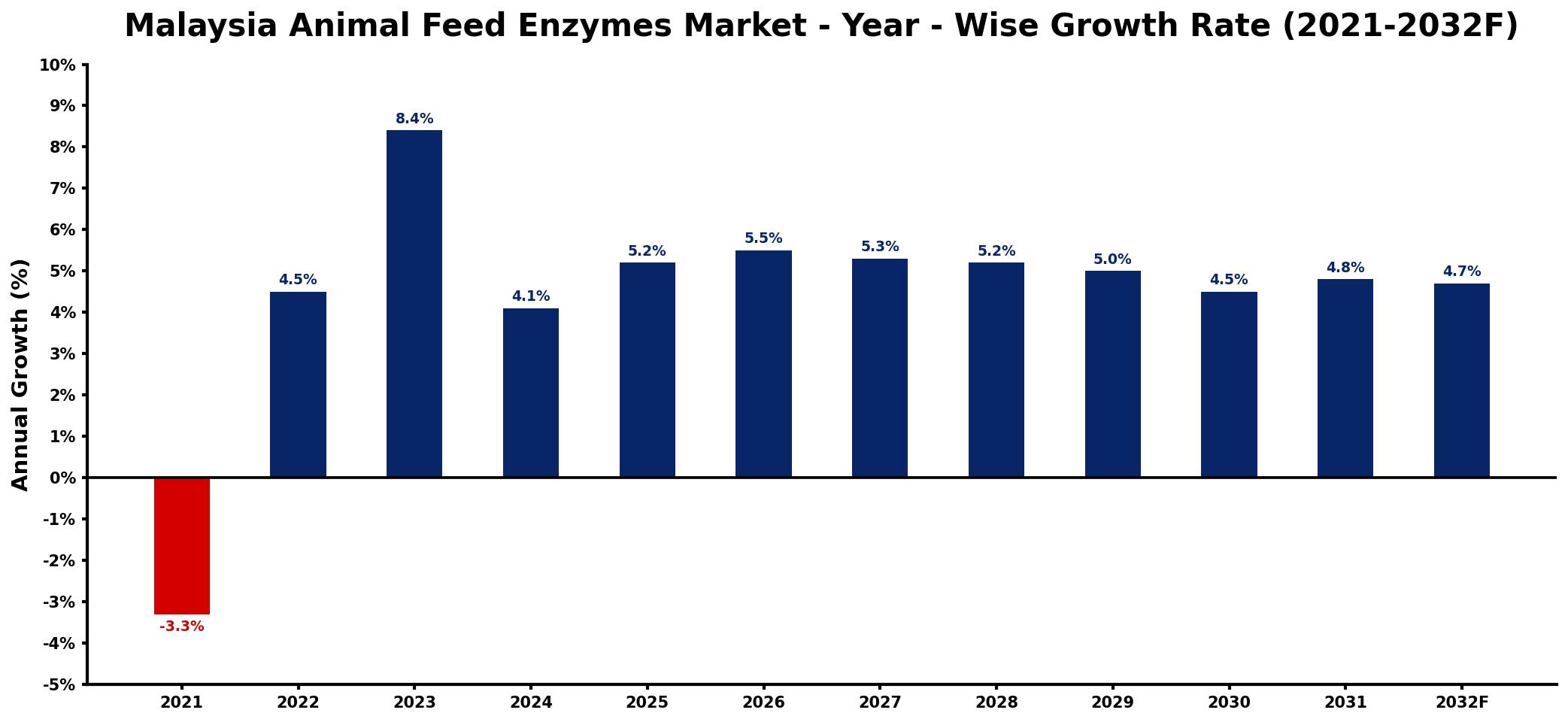
The table below presents the year‑wise growth rates along with the key drivers influencing the market
| Year | Growth Rate | Major Drivers |
| 2021 | -3.3% | lower demand for livestock products |
| 2022 | 4.5% | increased investment in agriculture |
| 2023 | 8.4% | growing awareness of nutrition |
| 2024 | 4.1% | rising livestock production rates |
| 2025 | 5.2% | expansion of poultry industry |
| 2026 | 5.5% | enhanced livestock health initiatives |
| 2027 | 5.3% | higher consumer protein consumption |
| 2028 | 5.2% | technological advancements in farming |
| 2029 | 5.0% | strengthening export market opportunities |
| 2030 | 4.5% | sustainable farming practices adoption |
| 2031 | 4.8% | increased domestic production output |
| 2032 | 4.7% | strengthening international trade flows |
Note: Market size estimations and growth projections presented in this report are based on 6Wresearch's proprietary forecasting methodology, utilizing the latest available industry data, government publications, and primary research inputs.
Malaysia Animal Feed Enzymes Market Synopsis
In recent years, the Malaysian animal feed enzymes market has garnered significant attention due to its pivotal role in optimizing animal nutrition. The enzymes facilitate better digestion, enabling livestock to extract maximum nutrients from feeds, which is essential for enhancing productivity in an increasingly competitive agricultural landscape.
As consumer preferences shift toward higher quality animal products, there is an observable trend among farmers to incorporate animal feed enzymes into their nutrition programs. This shift not only aligns with rising health consciousness among consumers but also supports the overall sustainability goals in animal husbandry.
Malaysia Animal Feed Enzymes Market Key Takeaways
- The market is growing due to rising demand for quality meat, dairy, and poultry products.
- Enhanced feed digestibility leads to improved livestock health and production efficiency.
- Growing consumer awareness regarding food safety is accelerating enzyme adoption.
- Manufacturers are innovating enzyme formulations tailored to specific livestock requirements.
- Strict regulatory landscapes pose challenges that require constant adaptation from industry players.
Evaluation of Restraints in Malaysia Animal Feed Enzymes Market
Despite the promising growth outlook, the Malaysia animal feed enzymes market faces several restraints that may impede progress. Chief among these is the stringent regulatory environment that demands high safety and quality standards for feed additives. Compliance with these regulations necessitates ongoing investment and resources, which can strain smaller companies in the industry. Additionally, the evolving landscape of consumer expectations regarding ethical and sustainable farming practices further complicates market dynamics, urging producers to innovate while maintaining affordability and accessibility in feed solutions.
Malaysia Animal Feed Enzymes Market Trends
Several emerging trends are shaping the Malaysia animal feed enzymes market. First, there is a noticeable shift toward the development of specialized enzyme formulations that cater to specific nutritional needs of livestock species. This trend is driven by the desire for optimized feed efficiency and improved animal welfare. Secondly, advancements in biotechnology are paving the way for more effective enzyme production methods, enhancing both yield and functionality. Lastly, the increased focus on sustainability in agriculture is pushing manufacturers to create enzyme solutions that minimize environmental impact while promoting ethical farming practices.
Malaysia Animal Feed Enzymes Market Opportunities
The Malaysia animal feed enzymes market is ripe with opportunities for growth and investment. Innovations in enzyme technology, particularly those that enhance the digestibility of alternative feed ingredients, offer substantial potential. Additionally, the rise of the organic and natural farming movement presents a unique chance for enzyme producers to cater to a niche market that prioritizes health and sustainability. Collaborations between researchers and manufacturers could further advance the development of enzyme solutions tailored to evolving agricultural practices, expanding market reach and enhancing competitive advantage.
Government Initiatives in the Malaysia Animal Feed Enzymes Market
The Malaysian government has recognized the importance of the livestock sector and is committed to enhancing agricultural productivity through various initiatives. Policies aimed at improving feed safety standards and supporting sustainable practices are shaping the framework within which the animal feed enzymes market operates. Public investments in agricultural research and development also serve to foster innovation, providing incentives for manufacturers to create more effective and safe feed enzyme solutions for the livestock sector.
Future Insights of the Malaysia Animal Feed Enzymes Market
Looking ahead to 2026-2032, the Malaysia animal feed enzymes market is set to witness substantial evolution driven by advancements in agricultural technology and changing consumer preferences. The continuous demand for efficient and sustainable animal nutrition solutions will likely foster increased research into enzyme formulations. Additionally, as the market becomes more competitive, companies that prioritize innovation and adaptability will be best positioned to meet the demands of both farmers and consumers, ultimately driving market growth and enhancing overall productivity in the livestock sector.
Malaysia Animal Feed Enzymes Market Latest Developments (2025 - 2026)
In the recent months, the animal feed enzymes market in Malaysia has experienced several noteworthy developments. Companies are increasingly focusing on research collaborations aimed at discovering new enzyme applications that promise to enhance feed efficiency further. There have also been discussions surrounding regulatory updates, encouraging players to align their products with evolving safety standards. This reflects the industry's commitment to adapting to both consumer demands and regulatory requirements, ensuring a forward-looking approach to animal nutrition solutions.
Malaysia Animal Feed Enzymes Market - Key Attractiveness of the Report
- 10 Years of Market Numbers
- Historical Data Starting from 2022 to 2025
- Base Year: 2025
- Forecast Data until 2032
- Key Performance Indicators Impacting the Market
- Major Upcoming Developments and Projects
Key Highlights of the Report:
- Malaysia Animal Feed Enzymes Market Outlook
- Market Size of Malaysia Animal Feed Enzymes Market, 2025
- Forecast of Malaysia Animal Feed Enzymes Market, 2032
- Historical Data and Forecast of Malaysia Animal Feed Enzymes Revenues & Volume for the Period 2022-2032F
- Malaysia Animal Feed Enzymes Market Trend Evolution
- Malaysia Animal Feed Enzymes Market Drivers and Challenges
- Malaysia Animal Feed Enzymes Price Trends
- Malaysia Animal Feed Enzymes Porter's Five Forces
- Malaysia Animal Feed Enzymes Industry Life Cycle
- Historical Data and Forecast of Malaysia Animal Feed Enzymes Market Revenues & Volume By Formulation for the Period 2022-2032F
- Historical Data and Forecast of Malaysia Animal Feed Enzymes Market Revenues & Volume By Dry for the Period 2022-2032F
- Historical Data and Forecast of Malaysia Animal Feed Enzymes Market Revenues & Volume By Liquid for the Period 2022-2032F
- Historical Data and Forecast of Malaysia Animal Feed Enzymes Market Revenues & Volume By Product for the Period 2022-2032F
- Historical Data and Forecast of Malaysia Animal Feed Enzymes Market Revenues & Volume By Phytase for the Period 2022-2032F
- Historical Data and Forecast of Malaysia Animal Feed Enzymes Market Revenues & Volume By Carbohydrase for the Period 2022-2032F
- Historical Data and Forecast of Malaysia Animal Feed Enzymes Market Revenues & Volume By Protease for the Period 2022-2032F
- Historical Data and Forecast of Malaysia Animal Feed Enzymes Market Revenues & Volume By Non starch polysaccharides for the Period 2022-2032F
- Historical Data and Forecast of Malaysia Animal Feed Enzymes Market Revenues & Volume By Livestock for the Period 2022-2032F
- Historical Data and Forecast of Malaysia Animal Feed Enzymes Market Revenues & Volume By Poultry for the Period 2022-2032F
- Historical Data and Forecast of Malaysia Animal Feed Enzymes Market Revenues & Volume By Swine for the Period 2022-2032F
- Historical Data and Forecast of Malaysia Animal Feed Enzymes Market Revenues & Volume By Ruminant for the Period 2022-2032F
- Historical Data and Forecast of Malaysia Animal Feed Enzymes Market Revenues & Volume By Aquaculture for the Period 2022-2032F
- Historical Data and Forecast of Malaysia Animal Feed Enzymes Market Revenues & Volume By Others for the Period 2022-2032F
- Malaysia Animal Feed Enzymes Import Export Trade Statistics
- Market Opportunity Assessment By Formulation
- Market Opportunity Assessment By Product
- Market Opportunity Assessment By Livestock
- Malaysia Animal Feed Enzymes Top Companies Market Share
- Malaysia Animal Feed Enzymes Competitive Benchmarking By Technical and Operational Parameters
- Malaysia Animal Feed Enzymes Company Profiles
- Malaysia Animal Feed Enzymes Key Strategic Recommendations






































