Malaysia Animal Horn Market Size, Share & Growth Rate
The Malaysia Animal Horn Market was estimated at USD 187 Million in 2025 and is projected to reach USD 243 Million by 2032, growing at a CAGR of 3.8% from 2026 to 2032. This growth trajectory is primarily driven by the resurgence of traditional practices and cultural significance associated with animal horns, particularly among local communities. Furthermore, there is a burgeoning demand for artisanal crafts that utilize animal horns, appealing to both domestic consumers and international markets.
Malaysia Animal Horn Market Year-wise Growth Rate and Key Drivers
This graph highlights how the Malaysia Animal Horn Market has steadily grown over the years, supported by major growth factors.
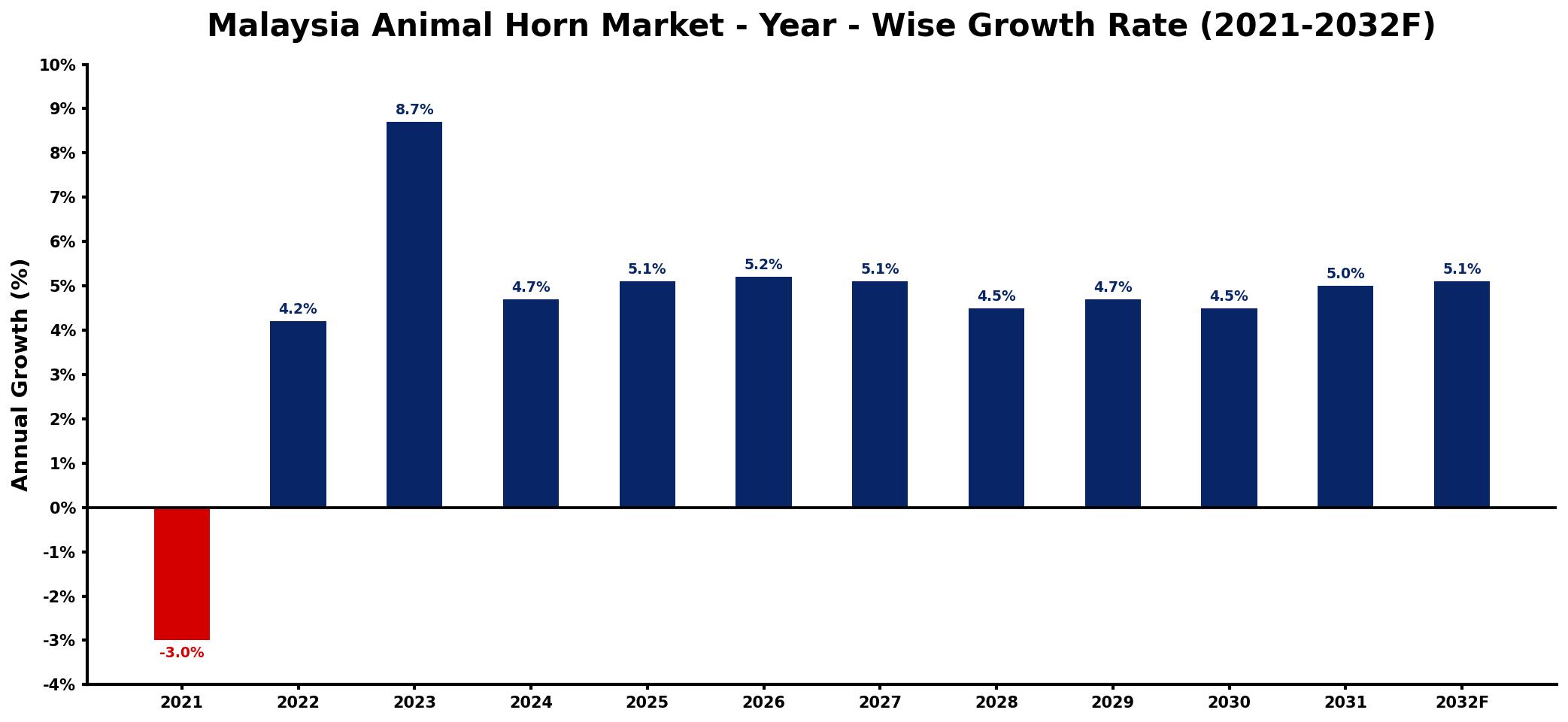
The table below presents the year‑wise growth rates along with the key drivers influencing the market
| Year | Growth Rate | Major Drivers |
| 2021 | -3.0% | decrease in export activities |
| 2022 | 4.2% | rising demand from artisans |
| 2023 | 8.7% | expansion of luxury markets |
| 2024 | 4.7% | growth in decorative applications |
| 2025 | 5.1% | increased interest from collectors |
| 2026 | 5.2% | enhanced distribution networks established |
| 2027 | 5.1% | growing popularity in fashion |
| 2028 | 4.5% | emerging trends in sustainability |
| 2029 | 4.7% | boost in cultural significance |
| 2030 | 4.5% | investment in local craftsmanship |
| 2031 | 5.0% | development of niche markets |
| 2032 | 5.1% | rising consumer awareness campaigns |
Note: Market size estimations and growth projections presented in this report are based on 6Wresearch's proprietary forecasting methodology, utilizing the latest available industry data, government publications, and primary research inputs.
Malaysia Animal Horn Market Synopsis
The current landscape of the Malaysia Animal Horn Market is marked by a complex interplay of tradition and regulation. International conservation efforts have imposed stringent laws that govern the trade of animal horns, particularly those derived from endangered species. As a result, stakeholders within the market are grappling with challenges that could reshape how these resources are sourced and sold.
Nevertheless, there remains a persistent cultural reliance on animal horns for ceremonial and ornamental purposes in various Malaysian communities. This cultural attachment, coupled with an increasing interest in sustainable sourcing practices, creates a unique environment where the market can potentially thrive, provided it adapts to modern ethical standards.
Malaysia Animal Horn Market Key Takeaways
- Growing cultural significance continues to fuel demand for animal horns in traditional ceremonies.
- Artisanal crafts using animal horns are increasingly popular among local and international consumers.
- Regulatory changes are necessitating a shift towards ethical and sustainable sourcing methods.
- Concerns regarding wildlife conservation are influencing consumer preferences and market dynamics.
- Collaborations among stakeholders are essential for developing innovative alternatives and maintaining market viability.
Evaluation of Restraints in Malaysia Animal Horn Market
The Malaysia Animal Horn Market faces significant restraints due to international wildlife protection regulations aimed at curtailing poaching and trade in endangered species. These stringent regulations complicate access to certain types of animal horns, limiting supply and market options for both artisans and consumers. Furthermore, the growing public awareness around conservation ethics pressures the market to adapt to non-endangered sources and alternative materials. This shift, while necessary, poses a challenge for traditional practices reliant on specific animal horns, which may not be readily available under the new guidelines.
Malaysia Animal Horn Market Trends
Several trends are emerging that are reshaping the Malaysia Animal Horn Market. Firstly, a notable shift towards sustainability is prompting artisans to explore alternative materials that mimic the appearance and functionality of animal horns. Additionally, an increasing number of consumers are seeking ethically sourced products, further encouraging businesses to adhere to sustainable practices. Furthermore, a growing appreciation for cultural heritage and artisanal craftsmanship is driving market participants to innovate while remaining rooted in tradition.
Malaysia Animal Horn Market Opportunities
Opportunities abound for growth within the Malaysia Animal Horn Market, particularly for businesses that can pivot towards sustainability. The rise of e-commerce and online platforms allows artisans to reach a global audience, expanding their market potential. Additionally, partnerships between conservation organizations and local artisans may foster the development of new product lines that highlight ethical sourcing practices. Companies that effectively educate consumers about the cultural significance of their products are likely to find a receptive market willing to support their initiatives.
Government Initiatives in the Malaysia Animal Horn Market
The Malaysian government has implemented several policies aimed at protecting wildlife and promoting sustainable practices within the animal horn market. Initiatives include stricter enforcement of existing laws against poaching and illegal trade, as well as support for organizations that promote conservation and ethical sourcing. Public awareness campaigns are also being launched to educate consumers about the importance of wildlife protection, encouraging them to choose sustainable and ethical products.
Future Insights of the Malaysia Animal Horn Market
Looking ahead to 2026-2032, the Malaysia Animal Horn Market is poised for transformation. With consumer preferences shifting towards ethical products, businesses that prioritize sustainability and transparency will likely lead the market. Furthermore, continued collaboration among artisans, conservationists, and policymakers will be critical in navigating regulatory landscapes. As the market matures, innovation in product offerings and the adoption of alternative materials may offer new avenues for growth, ensuring that the rich cultural heritage associated with animal horns is preserved while aligning with modern ethical standards.
Malaysia Animal Horn Market Latest Developments (2025 - 2026)
Recent developments in the Malaysia Animal Horn Market indicate a growing trend towards ethical sourcing and sustainability. Many artisans are now participating in training programs focused on alternative materials and eco-friendly practices. Concurrently, collaborations between local craftspeople and international NGOs are fostering innovative products that respect wildlife protection regulations. Public sentiment is increasingly favoring brands that demonstrate a commitment to both cultural authenticity and environmental responsibility, which could define the next phase of market evolution.
Malaysia Animal Horn Market - Key Attractiveness of the Report
- 10 Years of Market Numbers
- Historical Data Starting from 2022 to 2025
- Base Year: 2025
- Forecast Data until 2032
- Key Performance Indicators Impacting the Market
- Major Upcoming Developments and Projects
Key Highlights of the Report:
- Malaysia Animal Horn Market Outlook
- Market Size of Malaysia Animal Horn Market, 2025
- Forecast of Malaysia Animal Horn Market, 2032
- Historical Data and Forecast of Malaysia Animal Horn Revenues & Volume for the Period 2022-2032F
- Malaysia Animal Horn Market Trend Evolution
- Malaysia Animal Horn Market Drivers and Challenges
- Malaysia Animal Horn Price Trends
- Malaysia Animal Horn Porter's Five Forces
- Malaysia Animal Horn Industry Life Cycle
- Historical Data and Forecast of Malaysia Animal Horn Market Revenues & Volume By Distribution Channel for the Period 2022-2032F
- Historical Data and Forecast of Malaysia Animal Horn Market Revenues & Volume By Online for the Period 2022-2032F
- Historical Data and Forecast of Malaysia Animal Horn Market Revenues & Volume By Offline for the Period 2022-2032F
- Historical Data and Forecast of Malaysia Animal Horn Market Revenues & Volume By Application for the Period 2022-2032F
- Historical Data and Forecast of Malaysia Animal Horn Market Revenues & Volume By Commercial for the Period 2022-2032F
- Historical Data and Forecast of Malaysia Animal Horn Market Revenues & Volume By Cosmetics & Personal Care for the Period 2022-2032F
- Historical Data and Forecast of Malaysia Animal Horn Market Revenues & Volume By Others for the Period 2022-2032F
- Malaysia Animal Horn Import Export Trade Statistics
- Market Opportunity Assessment By Distribution Channel
- Market Opportunity Assessment By Application
- Malaysia Animal Horn Top Companies Market Share
- Malaysia Animal Horn Competitive Benchmarking By Technical and Operational Parameters
- Malaysia Animal Horn Company Profiles
- Malaysia Animal Horn Key Strategic Recommendations






































