Malaysia Anthracite Market Size Growth Rate
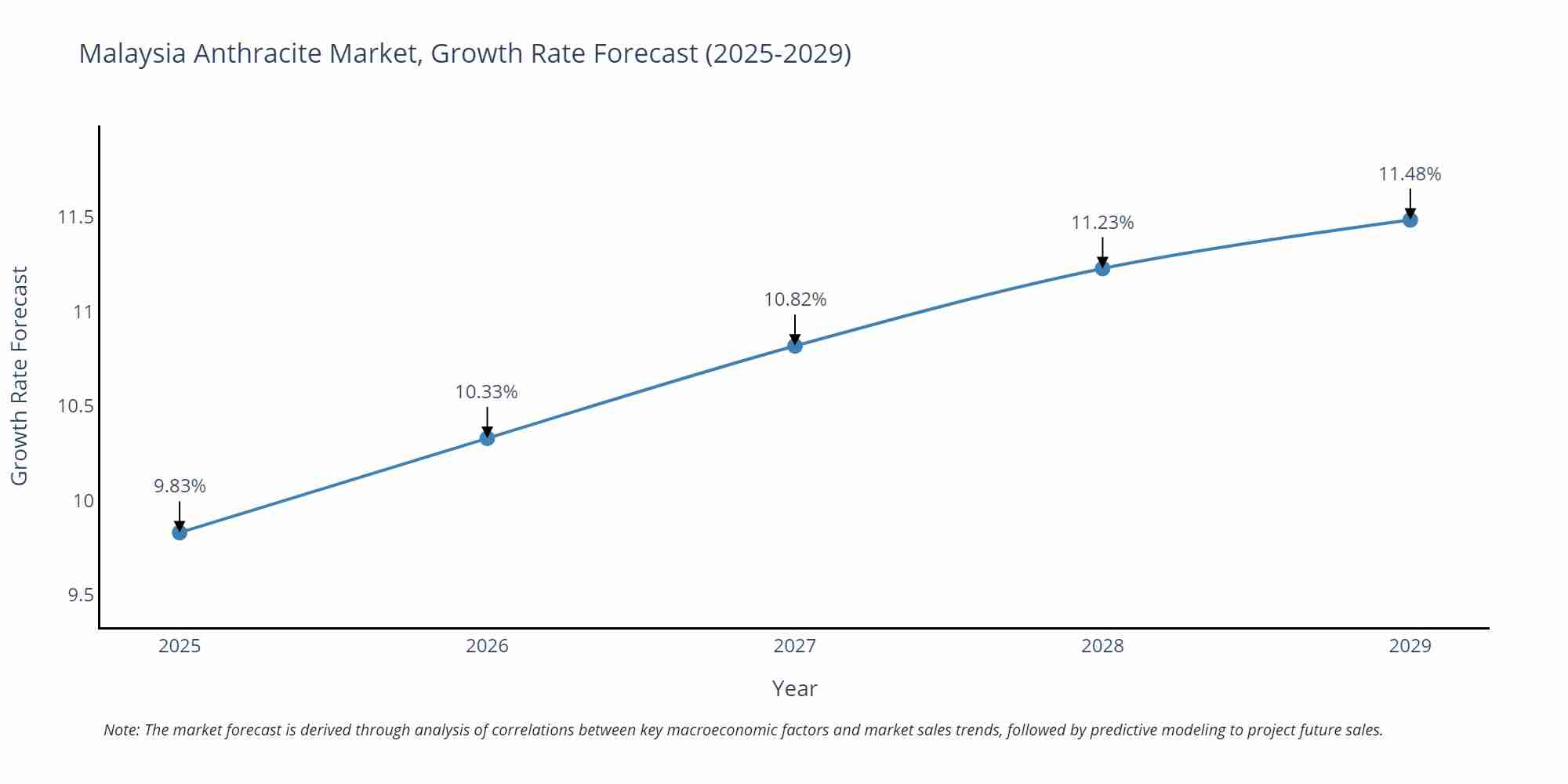
The Malaysia Anthracite Market is likely to experience consistent growth rate gains over the period 2025 to 2029. Commencing at 9.83% in 2025, growth builds up to 11.48% by 2029.
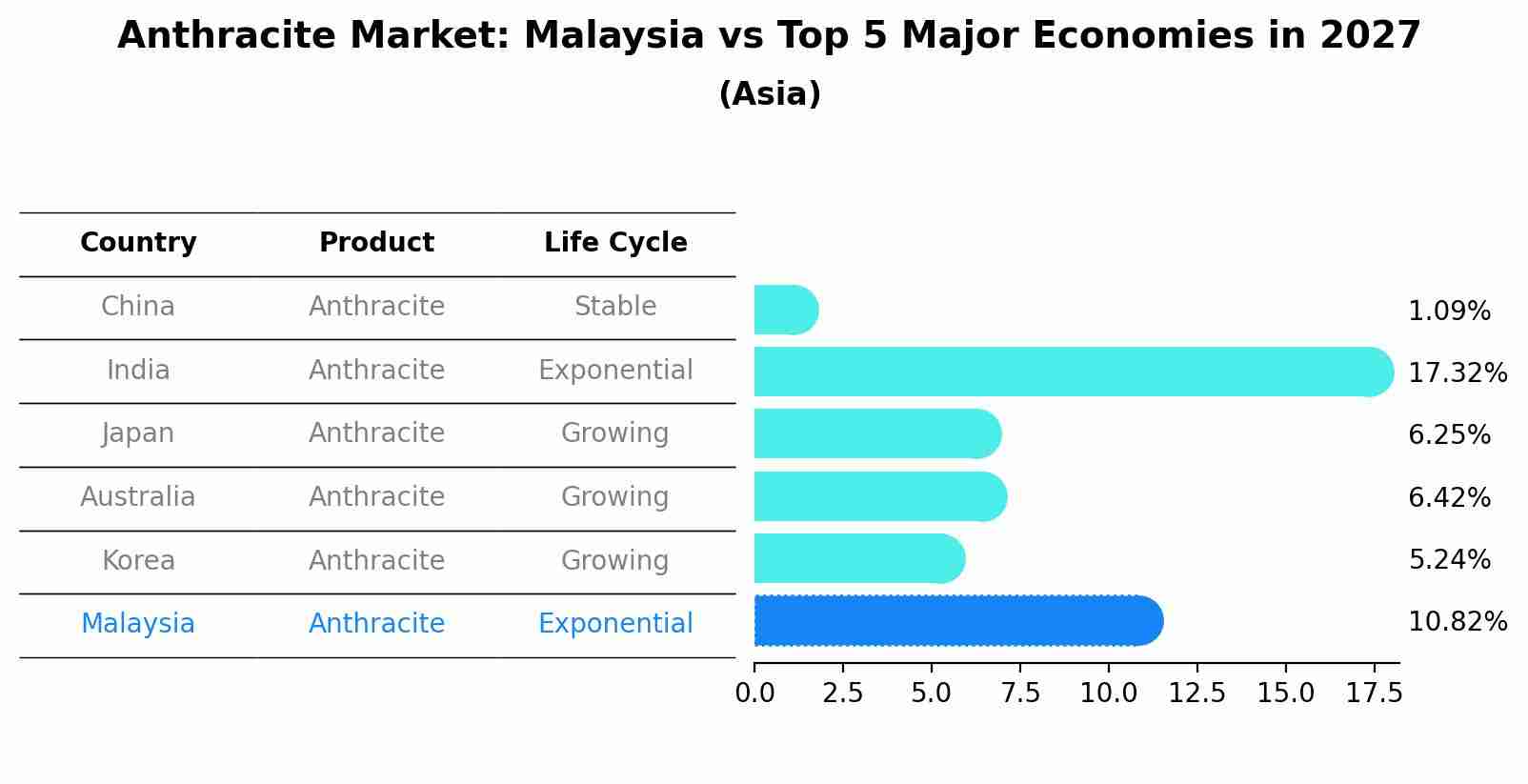
Anthracite Market: Malaysia vs Top 5 Major Economies in 2027 (Asia)
By 2027, the Anthracite market in Malaysia is anticipated to reach a growth rate of 10.82%, as part of an increasingly competitive Asia region, where China remains at the forefront, supported by India, Japan, Australia and South Korea, driving innovations and market adoption across sectors.
Malaysia Anthracite Market Synopsis
Anthracite is a high-quality form of coal used primarily for industrial processes such as steel production and water filtration. The market for anthracite in Malaysia is subject to global coal demand dynamics, which can be influenced by factors such as energy policies, environmental regulations, and international trade agreements. The outlook for anthracite in Malaysia is dependent on its role in these industrial processes and the broader global coal market trends.
Drivers of the Market
The anthracite market in Malaysia is characterized by stable demand, primarily from the industrial and energy sectors. Anthracite, known for its high carbon content and low impurities, is used as a key ingredient in the production of steel, in water filtration systems, and as a source of heat in some industrial processes. The demand for steel and the need for clean and efficient water treatment solutions continue to drive the anthracite market. While there may be fluctuations in demand due to economic conditions and industrial activities, anthracite remains a critical raw material for several key industries in Malaysia.
Challenges of the Market
The anthracite market in Malaysia is impacted by fluctuations in global coal prices and the shift towards cleaner energy sources. As anthracite is a type of coal, it is subject to environmental scrutiny and regulations aimed at reducing carbon emissions. Companies in this sector must navigate the transition to cleaner energy alternatives and potentially invest in carbon capture and storage technologies to mitigate environmental concerns.
COVID 19 Impact on the Market
The pandemic had implications for the anthracite coal markets in Malaysia. This coal types are used in energy generation and industrial processes. During the height of the pandemic, energy consumption decreased as businesses closed and people stayed home, leading to a decline in coal demand. Additionally, supply chain disruptions affected coal imports. While the coal markets faced challenges, the situation also prompted a shift towards cleaner energy sources and sustainability, which may have a lasting impact on coal consumption in the country. The long-term outlook for the coal markets may involve diversification into cleaner energy alternatives and a gradual transition away from traditional coal usage.
Key Players in the Market
Leading players in the Malaysia anthracite market consist of prominent coal mining companies such as China Shenhua Energy Company, Yanzhou Coal Mining Company, and BHP Group. These companies supply high-quality anthracite coal, primarily used in the steel and metallurgy industries, contributing significantly to Malaysia industrial growth.
Key Highlights of the Report:
- Malaysia Anthracite Market Outlook
- Market Size of Malaysia Anthracite Market, 2024
- Forecast of Malaysia Anthracite Market, 2031
- Historical Data and Forecast of Malaysia Anthracite Revenues & Volume for the Period 2021-2031
- Malaysia Anthracite Market Trend Evolution
- Malaysia Anthracite Market Drivers and Challenges
- Malaysia Anthracite Price Trends
- Malaysia Anthracite Porter's Five Forces
- Malaysia Anthracite Industry Life Cycle
- Historical Data and Forecast of Malaysia Anthracite Market Revenues & Volume By Application for the Period 2021-2031
- Historical Data and Forecast of Malaysia Anthracite Market Revenues & Volume By Fuel for the Period 2021-2031
- Historical Data and Forecast of Malaysia Anthracite Market Revenues & Volume By Steel Making for the Period 2021-2031
- Historical Data and Forecast of Malaysia Anthracite Market Revenues & Volume By Sinter Plants for the Period 2021-2031
- Historical Data and Forecast of Malaysia Anthracite Market Revenues & Volume By Indurating Furnaces for the Period 2021-2031
- Historical Data and Forecast of Malaysia Anthracite Market Revenues & Volume By Furnace Coal Replacement for the Period 2021-2031
- Historical Data and Forecast of Malaysia Anthracite Market Revenues & Volume By Others for the Period 2021-2031
- Historical Data and Forecast of Malaysia Anthracite Market Revenues & Volume By End-user for the Period 2021-2031
- Historical Data and Forecast of Malaysia Anthracite Market Revenues & Volume By Steel for the Period 2021-2031
- Historical Data and Forecast of Malaysia Anthracite Market Revenues & Volume By Energy & Power for the Period 2021-2031
- Historical Data and Forecast of Malaysia Anthracite Market Revenues & Volume By Bricks for the Period 2021-2031
- Historical Data and Forecast of Malaysia Anthracite Market Revenues & Volume By Silicon & Glass for the Period 2021-2031
- Historical Data and Forecast of Malaysia Anthracite Market Revenues & Volume By Synthetic Fuels for the Period 2021-2031
- Historical Data and Forecast of Malaysia Anthracite Market Revenues & Volume By Others for the Period 2021-2031
- Malaysia Anthracite Import Export Trade Statistics
- Market Opportunity Assessment By Application
- Market Opportunity Assessment By End-user
- Malaysia Anthracite Top Companies Market Share
- Malaysia Anthracite Competitive Benchmarking By Technical and Operational Parameters
- Malaysia Anthracite Company Profiles
- Malaysia Anthracite Key Strategic Recommendations






































