Malaysia Antifreeze & Coolants Market Size, Share & Growth Rate
The Malaysia Antifreeze & Coolants Market was estimated at USD 406 Million in 2025 and is projected to reach USD 529 Million by 2032, growing at a CAGR of 3.9% from 2026 to 2032. This growth trajectory is primarily driven by increasing vehicle ownership, coupled with the ongoing expansion of the automotive sector. The rising demand for improved engine efficiency and the growing trend toward eco-friendly coolant solutions further bolster market prospects in this tropical climate.
Malaysia Antifreeze & Coolants Market Year-wise Growth Rate and Key Drivers
This graph highlights how the Malaysia Antifreeze & Coolants Market has steadily grown over the years, supported by major growth factors.
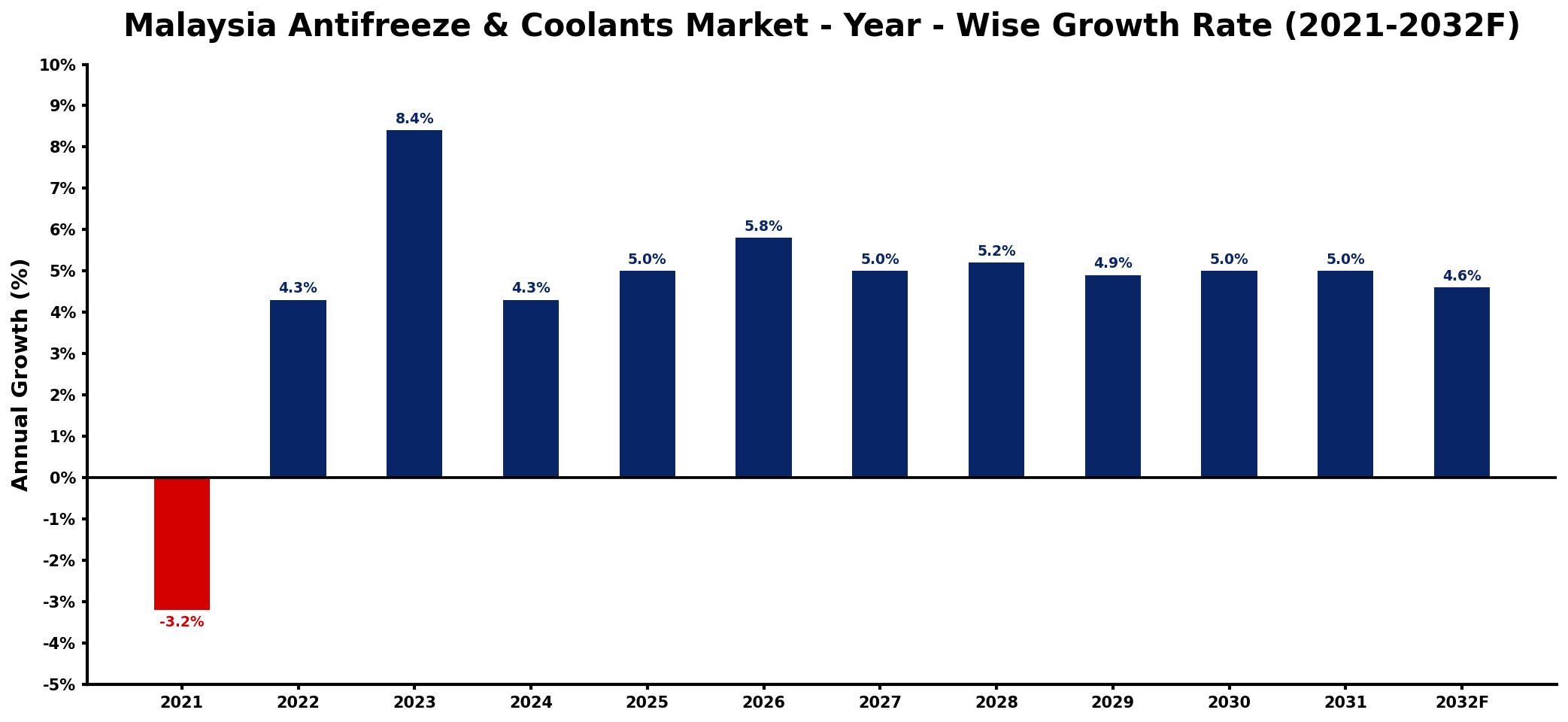
The table below presents the year‑wise growth rates along with the key drivers influencing the market
| Year | Growth Rate | Major Drivers |
| 2021 | -3.2% | Automobile production levels decreased significantly |
| 2022 | 4.3% | Rising automotive maintenance awareness increases |
| 2023 | 8.4% | Expansion of electric vehicle market |
| 2024 | 4.3% | Increasing automotive manufacturing investments |
| 2025 | 5.0% | Growth in transportation sector demand |
| 2026 | 5.8% | Technological advancements drive adoption |
| 2027 | 5.0% | Stricter regulations enhance product usage |
| 2028 | 5.2% | Rising consumer confidence in spending |
| 2029 | 4.9% | Emergence of new market players |
| 2030 | 5.0% | Increased focus on sustainability practices |
| 2031 | 5.0% | Growing automotive aftermarket services |
| 2032 | 4.6% | Enhanced distribution networks support growth |
Note: Market size estimations and growth projections presented in this report are based on 6Wresearch's proprietary forecasting methodology, utilizing the latest available industry data, government publications, and primary research inputs.
Malaysia Antifreeze & Coolants Market Synopsis
The automotive industry's ongoing modernization stands as the strongest force shaping the Malaysia Antifreeze & Coolants Market. As vehicle production and sales continue to rise, the essential need for high-quality antifreeze and coolants becomes increasingly critical to ensure optimal engine performance.
In addition to automotive applications, the expanding industrial and manufacturing sectors are driving demand for antifreeze solutions. These sectors require effective temperature regulation for machinery, further elevating the necessity for reliable coolant products that can operate efficiently in Malaysia's unique climatic conditions.
- The automotive industry remains the primary consumer of antifreeze & coolants in Malaysia, bolstering market growth.
- Demand for eco-friendly and innovative coolant solutions is on the rise, in line with global sustainability trends.
- Industrial expansion presents a new avenue for growth within the antifreeze & coolants market.
- Technological advancements in automotive cooling systems pose both opportunities and challenges for traditional coolant products.
- Key manufacturers are increasingly focused on meeting regulatory standards and consumer demands for environmentally safe solutions.
Despite the market's promising outlook, several restraints hinder its growth. Stricter environmental regulations are pushing manufacturers to pivot towards developing eco-friendly products, which may require significant investment in research and development. Additionally, rapid technological advancements in automotive cooling systems may shift demand away from traditional antifreeze formulations, requiring market players to adapt swiftly to changing consumer preferences and regulatory landscapes.
Current trends reveal a marked shift towards the formulation of biodegradable and environmentally friendly antifreeze coolants. This is being driven by both consumer awareness and regulatory requirements aimed at reducing environmental impact. Additionally, advancements in synthetic coolant technology are enhancing the efficiency and longevity of these products, making them more appealing to both automotive and industrial sectors.
The growing adoption of electric vehicles (EVs) presents a significant opportunity for innovation within the antifreeze coolants market. As EVs often require specialized cooling solutions, companies can leverage this trend by investing in research to develop tailored coolants. Furthermore, expanding the product range to include eco-friendly options will likely attract environmentally conscious consumers and businesses alike.
The Malaysian government has been proactive in promoting environmentally sustainable practices across various industries, including automotive and manufacturing. Initiatives aimed at reducing greenhouse gas emissions have led to increased support for the development and adoption of eco-friendly products, including advanced antifreeze coolants. Public funding and programs focused on sustainability are fostering an environment conducive to innovation and growth in this sector.
Looking ahead to 2026-2032, the Malaysia Antifreeze & Coolants Market is poised for steady growth driven by increasing vehicle ownership, industrial expansion, and heightened consumer demand for sustainable products. As manufacturers innovate to meet environmental standards and enhance product performance, the market is expected to witness a proliferation of advanced coolant solutions tailored to both traditional and electric vehicles.
In recent months, the Malaysian antifreeze coolants market has experienced a wave of innovation, with several manufacturers launching new product lines aimed at improving environmental sustainability. Additionally, collaborations between automotive companies and coolant manufacturers are being forged to develop next-generation cooling solutions suitable for advanced vehicles. This focus on innovation is expected to further energize market dynamics and consumer interest.
- 10 Years of Market Numbers
- Historical Data Starting from 2022 to 2025
- Base Year: 2025
- Forecast Data until 2032
- Key Performance Indicators Impacting the Market
- Major Upcoming Developments and Projects
Key Highlights of the Report:
- Malaysia Antifreeze & Coolants Market Outlook
- Market Size of Malaysia Antifreeze & Coolants Market, 2025
- Forecast of Malaysia Antifreeze & Coolants Market, 2032
- Historical Data and Forecast of Malaysia Antifreeze & Coolants Revenues & Volume for the Period 2022-2032F
- Malaysia Antifreeze & Coolants Market Trend Evolution
- Malaysia Antifreeze & Coolants Market Drivers and Challenges
- Malaysia Antifreeze & Coolants Price Trends
- Malaysia Antifreeze & Coolants Porter's Five Forces
- Malaysia Antifreeze & Coolants Industry Life Cycle
- Historical Data and Forecast of Malaysia Antifreeze & Coolants Market Revenues & Volume By Product Type for the Period 2022-2032F
- Historical Data and Forecast of Malaysia Antifreeze & Coolants Market Revenues & Volume By Ethylene Glycol for the Period 2022-2032F
- Historical Data and Forecast of Malaysia Antifreeze & Coolants Market Revenues & Volume By Propylene Glycol for the Period 2022-2032F
- Historical Data and Forecast of Malaysia Antifreeze & Coolants Market Revenues & Volume By Others for the Period 2022-2032F
- Historical Data and Forecast of Malaysia Antifreeze & Coolants Market Revenues & Volume By Technology for the Period 2022-2032F
- Historical Data and Forecast of Malaysia Antifreeze & Coolants Market Revenues & Volume By Inorganic Additive Technology (IAT) for the Period 2022-2032F
- Historical Data and Forecast of Malaysia Antifreeze & Coolants Market Revenues & Volume By Organic Acid Technology (OAT) for the Period 2022-2032F
- Historical Data and Forecast of Malaysia Antifreeze & Coolants Market Revenues & Volume By Nitrated Organic Acid Technology (NOAT) for the Period 2022-2032F
- Historical Data and Forecast of Malaysia Antifreeze & Coolants Market Revenues & Volume By Hybrid Organic Acid Technology (HOAT) for the Period 2022-2032F
- Historical Data and Forecast of Malaysia Antifreeze & Coolants Market Revenues & Volume By Others for the Period 2022-2032F
- Historical Data and Forecast of Malaysia Antifreeze & Coolants Market Revenues & Volume By Application for the Period 2022-2032F
- Historical Data and Forecast of Malaysia Antifreeze & Coolants Market Revenues & Volume By Automobiles for the Period 2022-2032F
- Historical Data and Forecast of Malaysia Antifreeze & Coolants Market Revenues & Volume By Industrial for the Period 2022-2032F
- Historical Data and Forecast of Malaysia Antifreeze & Coolants Market Revenues & Volume By Others for the Period 2022-2032F
- Malaysia Antifreeze & Coolants Import Export Trade Statistics
- Market Opportunity Assessment By Product Type
- Market Opportunity Assessment By Technology
- Market Opportunity Assessment By Application
- Malaysia Antifreeze & Coolants Top Companies Market Share
- Malaysia Antifreeze & Coolants Competitive Benchmarking By Technical and Operational Parameters
- Malaysia Antifreeze & Coolants Company Profiles
- Malaysia Antifreeze & Coolants Key Strategic Recommendations






































