Malaysia Antimony Ore Market Size, Share & Growth Rate
The Malaysia Antimony Ore Market was estimated at USD 423 Million in 2025 and is projected to reach USD 551 Million by 2032, growing at a CAGR of 3.8% from 2026 to 2032. This growth trajectory is fueled by a rising demand for antimony in applications such as flame retardants and battery production. As technology advances and more industries adopt antimony-based materials, the Malaysian market is poised for steady expansion amidst evolving global dynamics.
Malaysia Antimony Ore Market Year-wise Growth Rate and Key Drivers
This graph highlights how the Malaysia Antimony Ore Market has steadily grown over the years, supported by major growth factors.
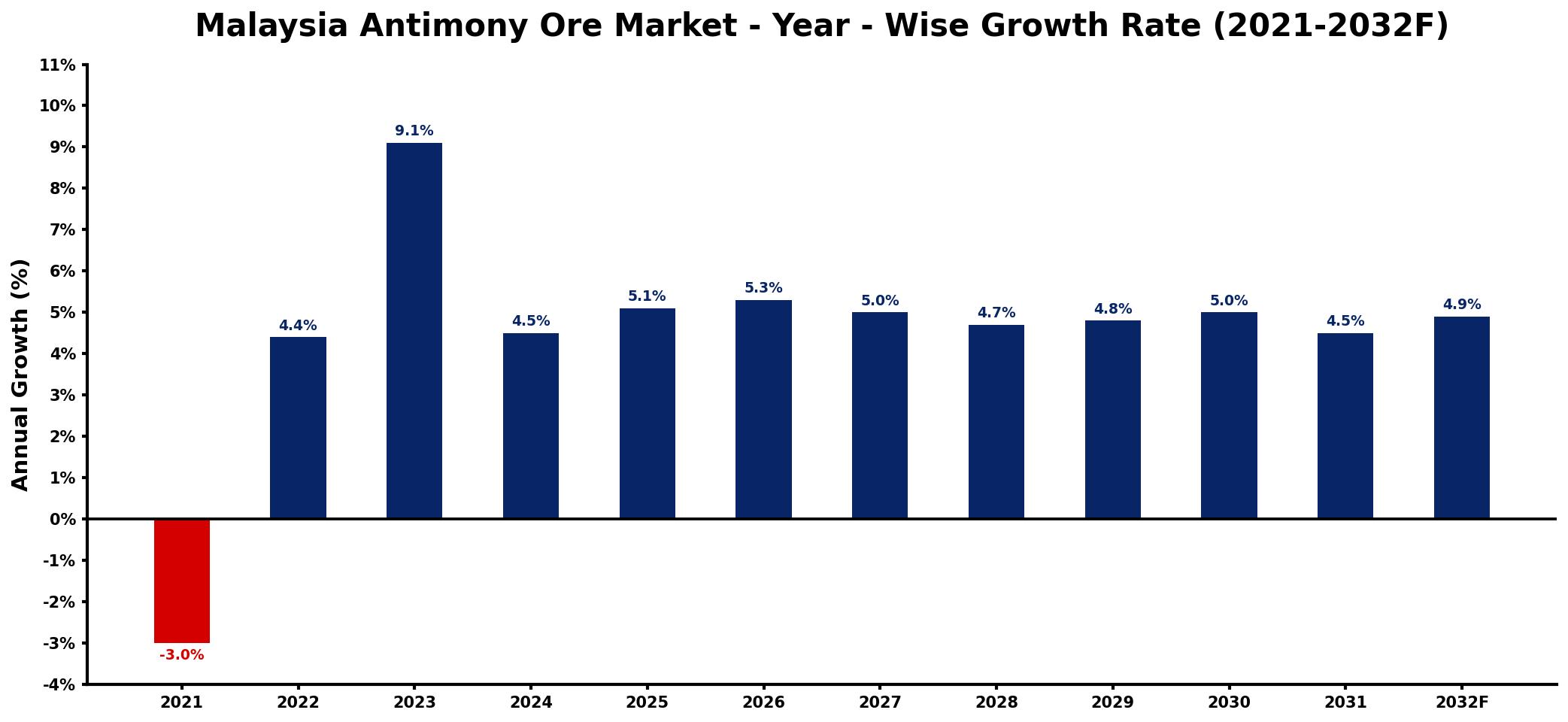
The table below presents the year‑wise growth rates along with the key drivers influencing the market
| Year | Growth Rate | Major Drivers |
| 2021 | -3.0% | Decreased industrial investment activities |
| 2022 | 4.4% | Rising demand from electronics sector |
| 2023 | 9.1% | Growth in renewable energy applications |
| 2024 | 4.5% | Increased government infrastructure projects |
| 2025 | 5.1% | Expansion of automotive manufacturing sector |
| 2026 | 5.3% | Higher demand from aerospace industry |
| 2027 | 5.0% | improved processing technologies adoption |
| 2028 | 4.7% | Increased usage in construction materials |
| 2029 | 4.8% | Rising interest in high-tech industries |
| 2030 | 5.0% | expanding manufacturing base activity |
| 2031 | 4.5% | strengthening international trade flows |
| 2032 | 4.9% | Increased demand from solar energy |
Note: Market size estimations and growth projections presented in this report are based on 6Wresearch's proprietary forecasting methodology, utilizing the latest available industry data, government publications, and primary research inputs.
Malaysia Antimony Ore Market Synopsis
The Malaysian antimony ore market has become an integral player in the global supply chain, primarily driven by its strategic importance in manufacturing flame retardants and alloys. Recent global trends indicate a shifting focus towards sustainable mining practices, which have sparked interest in Malaysia's operational compliance and environmental regulations.
As industries navigate a post-COVID world, demand for antimony has seen fluctuations, impacting production and operational strategies. This evolving landscape emphasizes the importance of innovative extraction methods and adherence to international standards in ensuring competitive advantage within the market.
Malaysia Antimony Ore Market Key Takeaways
- The market is expected to grow significantly, reflecting increased global demand for antimony applications.
- Regulatory pressures and environmental standards are shaping operational practices in Malaysia.
- Technological advancements play a crucial role in optimizing extraction and processing methods.
- Fluctuations in supply chain dynamics have affected availability and pricing within the sector.
- The long-term outlook remains positive, with potential shifts in applications further driving market expansion.
Evaluation of Restraints in Malaysia Antimony Ore Market
One significant restraint affecting the Malaysia antimony ore market is the volatility of global demand, which can lead to unpredictable pricing and investment hesitancy. As industries adapt to evolving environmental regulations, mining operations face pressures to enhance sustainability without compromising efficiency. Balancing compliance with productivity remains a challenge, as companies must also keep abreast of international market trends that dictate operational strategies.
Malaysia Antimony Ore Market Trends
Current trends highlight a growing emphasis on environmentally sustainable mining practices, as stakeholders increasingly prioritize compliance with global standards. Technological innovation is emerging as a critical driver, facilitating more efficient extraction techniques and reducing environmental footprints. Additionally, the demand for antimony in green technology applications, particularly in battery production for electric vehicles, is set to bolster market growth further.
Malaysia Antimony Ore Market Opportunities
There is significant potential for growth in sectors utilizing antimony, particularly in electronics, renewable energy, and automotive applications. As industries transition towards more environmentally friendly solutions, opportunities arise for Malaysian companies to innovate in extraction and processing methodologies. Moreover, strategic partnerships and investments in research and development could enhance the countrys competitive positioning in the global antimony market.
Government Initiatives in the Malaysia Antimony Ore Market
The Malaysian government has introduced several policies aimed at promoting sustainable mining practices within the antimony ore sector. Public investments in infrastructure and technology enhancements reflect a commitment to aligning with global standards. Initiatives to support research into advanced mining techniques and processing efficiencies are paving the way for a more robust and environmentally conscious industry.
Future Insights of the Malaysia Antimony Ore Market
Looking ahead to 2026-2032, the Malaysian antimony ore market is expected to evolve significantly, driven by increasing demand for antimony across various applications. Enhanced mining technologies and sustainable practices will likely become benchmarks for industry players. Moreover, as the global emphasis on green technologies intensifies, Malaysia stands to benefit from its resources and strategic initiatives aimed at expanding antimony's role in emerging markets.
Malaysia Antimony Ore Market Latest Developments (2025 - 2026)
In recent months, the Malaysia antimony ore market has seen a flurry of activity focused on technological advancements and environmental compliance. Industry players are increasingly investing in R&D to develop new extraction methods that align with sustainability goals. Additionally, collaborations between government and private sectors have emerged, aimed at enhancing the regulatory framework to support market growth and operational efficiencies.
Malaysia Antimony Ore Market - Key Attractiveness of the Report
- 10 Years of Market Numbers
- Historical Data Starting from 2022 to 2025
- Base Year: 2025
- Forecast Data until 2032
- Key Performance Indicators Impacting the Market
- Major Upcoming Developments and Projects
Key Highlights of the Report:
- Malaysia Antimony Ore Market Outlook
- Market Size of Malaysia Antimony Ore Market, 2025
- Forecast of Malaysia Antimony Ore Market, 2032
- Historical Data and Forecast of Malaysia Antimony Ore Revenues & Volume for the Period 2022-2032F
- Malaysia Antimony Ore Market Trend Evolution
- Malaysia Antimony Ore Market Drivers and Challenges
- Malaysia Antimony Ore Price Trends
- Malaysia Antimony Ore Porter's Five Forces
- Malaysia Antimony Ore Industry Life Cycle
- Historical Data and Forecast of Malaysia Antimony Ore Market Revenues & Volume By Type for the Period 2022-2032F
- Historical Data and Forecast of Malaysia Antimony Ore Market Revenues & Volume By Stibnite for the Period 2022-2032F
- Historical Data and Forecast of Malaysia Antimony Ore Market Revenues & Volume By Senarmontite for the Period 2022-2032F
- Historical Data and Forecast of Malaysia Antimony Ore Market Revenues & Volume By Other for the Period 2022-2032F
- Historical Data and Forecast of Malaysia Antimony Ore Market Revenues & Volume By Application for the Period 2022-2032F
- Historical Data and Forecast of Malaysia Antimony Ore Market Revenues & Volume By Battery Material for the Period 2022-2032F
- Historical Data and Forecast of Malaysia Antimony Ore Market Revenues & Volume By Fire Retardant for the Period 2022-2032F
- Historical Data and Forecast of Malaysia Antimony Ore Market Revenues & Volume By Chemicals for the Period 2022-2032F
- Historical Data and Forecast of Malaysia Antimony Ore Market Revenues & Volume By Ceramics and Glass for the Period 2022-2032F
- Historical Data and Forecast of Malaysia Antimony Ore Market Revenues & Volume By Other for the Period 2022-2032F
- Malaysia Antimony Ore Import Export Trade Statistics
- Market Opportunity Assessment By Type
- Market Opportunity Assessment By Application
- Malaysia Antimony Ore Top Companies Market Share
- Malaysia Antimony Ore Competitive Benchmarking By Technical and Operational Parameters
- Malaysia Antimony Ore Company Profiles
- Malaysia Antimony Ore Key Strategic Recommendations






































