Malaysia Antiparasitics Drugs Market Size, Share & Growth Rate
The Malaysia Antiparasitics Drugs Market was estimated at USD 198 Million in 2025 and is projected to reach USD 259 Million by 2032, growing at a CAGR of 3.9% from 2026 to 2032. This growth trajectory is driven by several factors, including increasing awareness of zoonotic diseases among pet owners and veterinarians, coupled with supportive government initiatives focusing on animal health regulations. Additionally, advancements in smart drug delivery systems are expected to enhance treatment efficacy, further propelling market growth.
Malaysia Antiparasitics Drugs Market Year-wise Growth Rate and Key Drivers
This graph highlights how the Malaysia Antiparasitics Drugs Market has steadily grown over the years, supported by major growth factors.
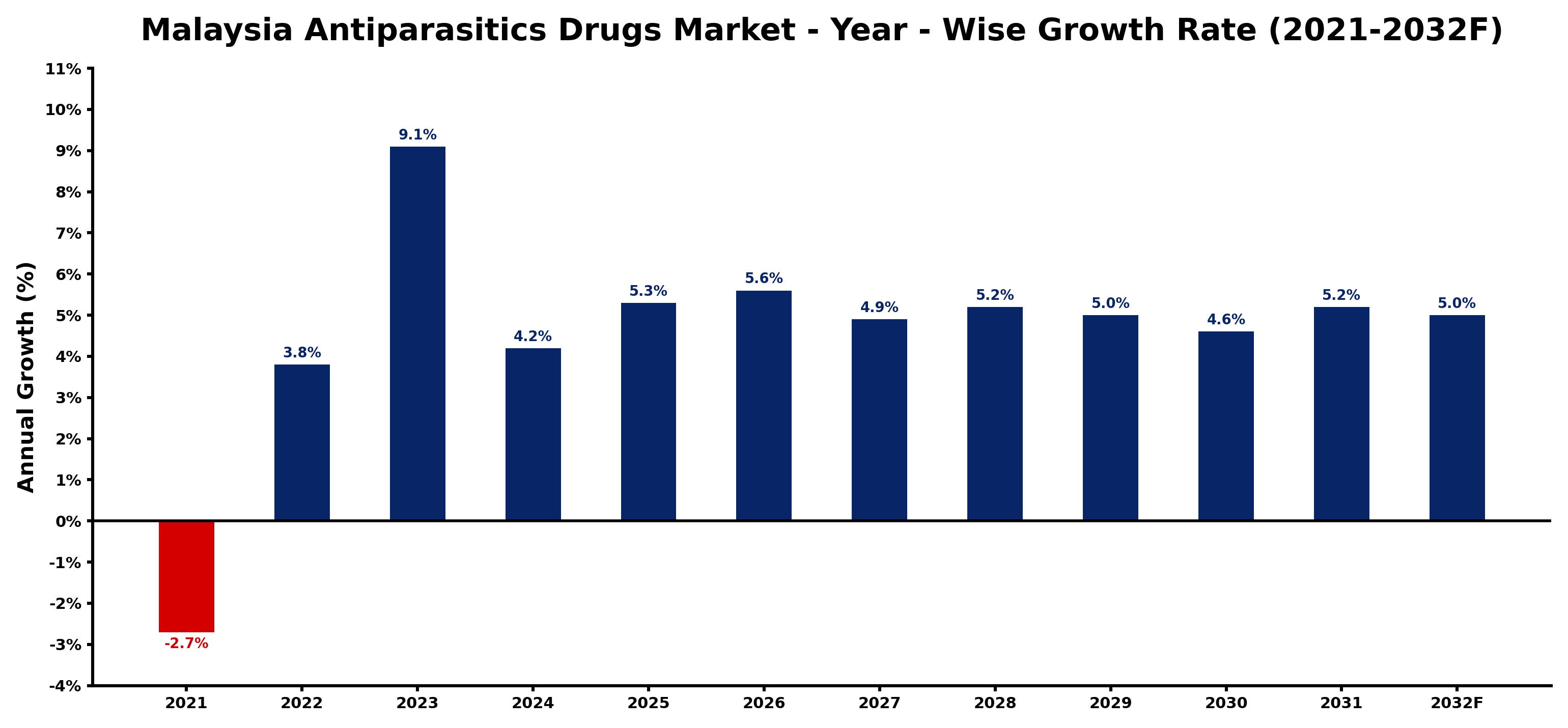
The table below presents the year‑wise growth rates along with the key drivers influencing the market
| Year | Growth Rate | Major Drivers |
| 2021 | -2.7% | Export driven demand downturn lowered antiparasitics manufacturing output significantly |
| 2022 | 3.8% | Precision engineering investments bolster production capabilities for antiparasitics |
| 2023 | 9.1% | Advanced manufacturing techniques boost production efficiency for antiparasitic drugs |
| 2024 | 4.2% | Domestic pharmaceutical manufacturers optimized production to meet export demands |
| 2025 | 5.3% | Precision engineering advancements optimized antiparasitic drug production efficiency |
| 2026 | 5.6% | Accelerated production of antiparasitics drives pharmaceutical manufacturing investment growth |
| 2027 | 4.9% | Precision engineering upgrades drive higher demand for antiparasitic drug formulations |
| 2028 | 5.2% | Export driven demand boosts manufacturing investment in antiparasitic drugs |
| 2029 | 5.0% | Advanced manufacturing technologies streamline antiparasitic drug production processes |
| 2030 | 4.6% | Increased production capacity for export driven antiparasitic formulations |
| 2031 | 5.2% | Precision engineering investments boosted antiparasitic production capacity in Malaysia |
| 2032 | 5.0% | Precision engineering investments boosted capacity in antiparasitics production |
Note - Market size estimations and growth projections presented in this report are based on 6Wresearch’s advanced forecasting approach, validated with industry datasets as of June 2026.
Malaysia Antiparasitics Drugs Market Synopsis
The Malaysian antiparasitics drugs market has experienced a period of significant momentum, but it now finds itself at a crucial juncture. As the demand for effective antiparasitic treatments continues to rise, the market is transitioning towards innovative solutions to address both human and animal health needs.
Looking ahead, the market is poised for continued expansion. Enhanced awareness initiatives and the increased prevalence of parasitic infections are expected to drive sustained growth. However, challenges such as counterfeit drugs and environmental factors also loom, necessitating a strategic response from market players.
Malaysia Antiparasitics Drugs Market Key Takeaways
- The market is projected to reach USD 259 Million by 2032, indicating robust growth potential.
- Increased awareness of zoonotic diseases is a primary driver of market expansion.
- Technological advancements, especially in drug delivery systems, are enhancing treatment effectiveness.
- Environmental changes may impact the prevalence of parasitic diseases, influencing market dynamics.
- Challenges such as counterfeit medications highlight the need for improved regulatory measures.
Evaluation of Restraints in Malaysia Antiparasitics Drugs Market
Despite its growth potential, the Malaysia Antiparasitics Drugs Market faces notable challenges that could inhibit progress. The prevalence of counterfeit drugs poses a significant threat, eroding consumer trust and compromising patient safety. Additionally, accurately diagnosing parasitic infections remains a hurdle, often resulting in mismanagement of treatment. Accessibility of effective antiparasitic drugs in remote areas further complicates the situation, potentially leaving vulnerable populations without necessary care. Moreover, the emergence of drug resistance highlights the urgency for innovative treatment options to ensure ongoing efficacy against evolving parasitic strains.
Malaysia Antiparasitics Drugs Market Trends
Current trends in the Malaysia Antiparasitics Drugs Market indicate a rising emphasis on personalized medicine and targeted therapies. The integration of digital health technologies is facilitating remote diagnosis and treatment, ensuring broader access to antiparasitic drugs. Additionally, there is an increasing focus on research and development to combat drug resistance, with collaborations between public health entities and pharmaceutical firms becoming more commonplace. Furthermore, as environmental sustainability gains prominence, eco-friendly formulations and practices are emerging as key considerations for both consumers and manufacturers.
Malaysia Antiparasitics Drugs Market Opportunities
The market landscape presents several promising growth opportunities. With the rising awareness of parasitic infections, there is a growing demand for effective treatments, particularly in rural and underserved areas. Investing in education and outreach programs can facilitate better understanding and usage of antiparasitic drugs. Moreover, innovations in drug delivery technologies offer avenues for enhanced product performance, creating a potential competitive edge for companies willing to embrace these advancements. Additionally, public-private partnerships aimed at addressing healthcare accessibility challenges can significantly expand market reach and improve treatment outcomes.
Government Initiatives in the Malaysia Antiparasitics Drugs Market
The Malaysian government has been proactive in implementing policies aimed at improving animal health and safety standards. Initiatives include the establishment of regulatory frameworks that ensure the quality and efficacy of antiparasitic drugs. Public health campaigns focused on educating both pet owners and veterinarians about parasitic diseases are gaining traction. Furthermore, collaborative efforts with international organizations to strengthen healthcare systems and enhance disease surveillance mechanisms are crucial for addressing the rising threat of parasitic infections.
Future Insights of the Malaysia Antiparasitics Drugs Market
From 2026 to 2032, the Malaysia Antiparasitics Drugs Market is expected to evolve considerably. The growing incidence of parasitic diseases, driven by climate change and urbanization, will necessitate the development of novel antiparasitic therapies. Additionally, increasing investments in healthcare infrastructure and ongoing government support are likely to create a conducive environment for market expansion. As consumer preferences shift towards more sustainable and effective treatment options, companies that can innovate and adapt are well-positioned to capitalize on the emerging opportunities within this dynamic market.
Malaysia Antiparasitics Drugs Market Latest Developments (May 2025 - June 2026)
In recent months, the Malaysian antiparasitics drugs market has witnessed significant industry developments. Companies are increasingly focusing on the research and development of new formulations that address the challenges of drug resistance. There is also a notable rise in partnerships between pharmaceutical companies and healthcare providers aimed at improving treatment accessibility. Additionally, advancements in telehealth services are enabling more efficient diagnosis and treatment of parasitic infections, marking a shift in how healthcare is delivered in this space.
Malaysia Antiparasitics Drugs Market - Key Attractiveness of the Report
- 10 Years of Market Numbers
- Historical Data Starting from 2022 to 2025
- Base Year: 2025
- Forecast Data until 2032
- Key Performance Indicators Impacting the Market
- Major Upcoming Developments and Projects
Key Highlights of the Report:
- Malaysia Antiparasitics Drugs Market Outlook
- Market Size of Malaysia Antiparasitics Drugs Market, 2025
- Forecast of Malaysia Antiparasitics Drugs Market, 2032
- Historical Data and Forecast of Malaysia Antiparasitics Drugs Revenues & Volume for the Period 2022-2032F
- Malaysia Antiparasitics Drugs Market Trend Evolution
- Malaysia Antiparasitics Drugs Market Drivers and Challenges
- Malaysia Antiparasitics Drugs Price Trends
- Malaysia Antiparasitics Drugs Porter's Five Forces
- Malaysia Antiparasitics Drugs Industry Life Cycle
- Historical Data and Forecast of Malaysia Antiparasitics Drugs Market Revenues & Volume By Route of Administration for the Period 2022-2032F
- Historical Data and Forecast of Malaysia Antiparasitics Drugs Market Revenues & Volume By Oral for the Period 2022-2032F
- Historical Data and Forecast of Malaysia Antiparasitics Drugs Market Revenues & Volume By Injectable for the Period 2022-2032F
- Historical Data and Forecast of Malaysia Antiparasitics Drugs Market Revenues & Volume By Topical for the Period 2022-2032F
- Historical Data and Forecast of Malaysia Antiparasitics Drugs Market Revenues & Volume By Drug class for the Period 2022-2032F
- Historical Data and Forecast of Malaysia Antiparasitics Drugs Market Revenues & Volume By Anthelmintics for the Period 2022-2032F
- Historical Data and Forecast of Malaysia Antiparasitics Drugs Market Revenues & Volume By Antiprotozoals for the Period 2022-2032F
- Historical Data and Forecast of Malaysia Antiparasitics Drugs Market Revenues & Volume By Others for the Period 2022-2032F
- Historical Data and Forecast of Malaysia Antiparasitics Drugs Market Revenues & Volume By Distribution Channel for the Period 2022-2032F
- Historical Data and Forecast of Malaysia Antiparasitics Drugs Market Revenues & Volume By Hospital Pharmacies for the Period 2022-2032F
- Historical Data and Forecast of Malaysia Antiparasitics Drugs Market Revenues & Volume By Retail Pharmacies for the Period 2022-2032F
- Historical Data and Forecast of Malaysia Antiparasitics Drugs Market Revenues & Volume By Online Pharmacies for the Period 2022-2032F
- Malaysia Antiparasitics Drugs Import Export Trade Statistics
- Market Opportunity Assessment By Route of Administration
- Market Opportunity Assessment By Drug class
- Market Opportunity Assessment By Distribution Channel
- Malaysia Antiparasitics Drugs Top Companies Market Share
- Malaysia Antiparasitics Drugs Competitive Benchmarking By Technical and Operational Parameters
- Malaysia Antiparasitics Drugs Company Profiles
- Malaysia Antiparasitics Drugs Key Strategic Recommendations






































