Malaysia Apparel Accessories Market Size, Share & Growth Rate
The Malaysia Apparel Accessories Market was estimated at USD 370 Million in 2025 and is projected to reach USD 481 Million by 2032, growing at a CAGR of 3.8% from 2026 to 2032. This promising trajectory is driven by the rising fashion consciousness among consumers, increasing disposable incomes, and a preference for unique, personalized accessories. As e-commerce continues to expand, brands are increasingly leveraging online platforms to reach a broader audience, fueling market growth.
Malaysia Apparel Accessories Market Year-wise Growth Rate and Key Drivers
This graph highlights how the Malaysia Apparel Accessories Market has steadily grown over the years, supported by major growth factors.
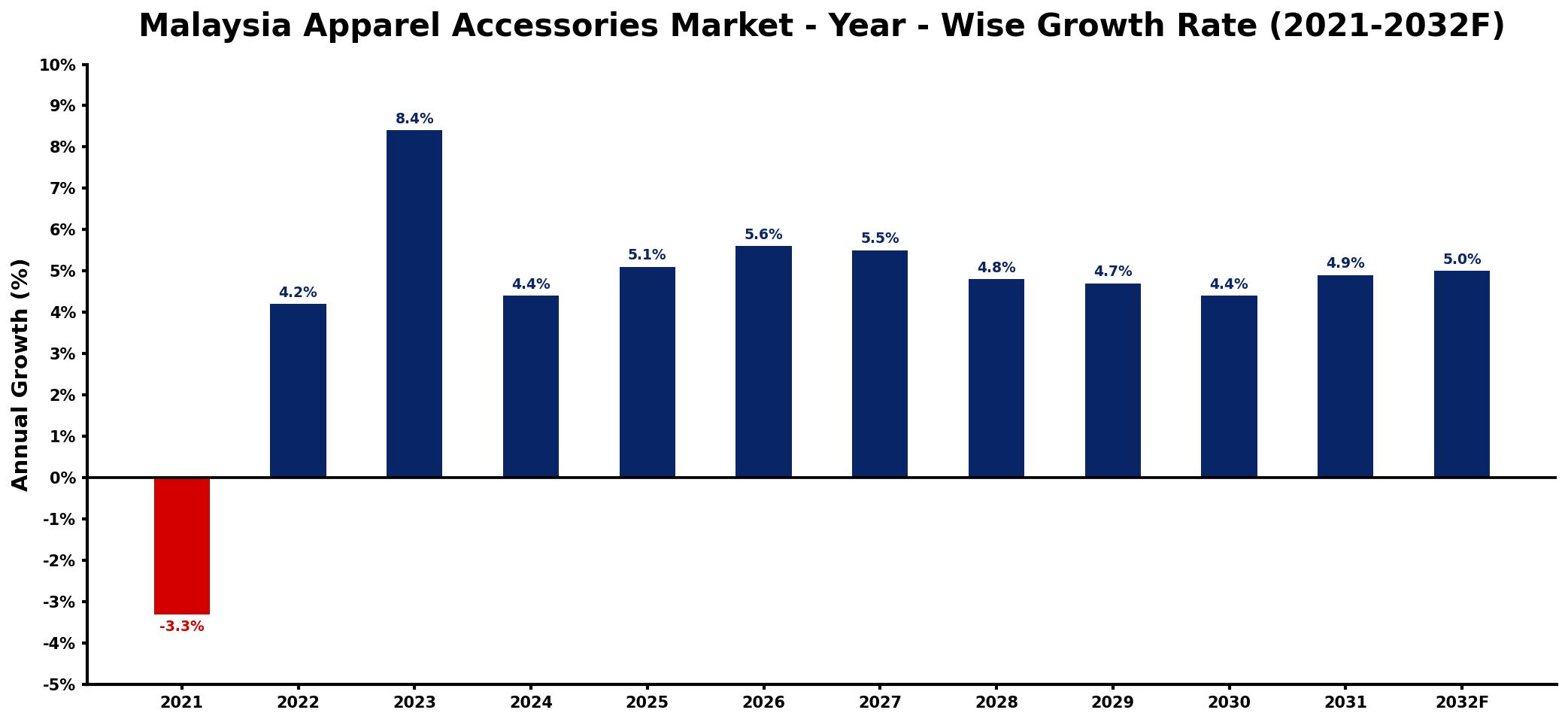
The table below presents the year‑wise growth rates along with the key drivers influencing the market
| Year | Growth Rate | Major Drivers |
| 2021 | -3.3% | decreased consumer spending habits |
| 2022 | 4.2% | rising online shopping trends |
| 2023 | 8.4% | expansion of local brands |
| 2024 | 4.4% | increased disposable income levels |
| 2025 | 5.1% | growing interest in sustainability |
| 2026 | 5.6% | enhanced marketing strategies deployed |
| 2027 | 5.5% | emergence of fashion collaborations |
| 2028 | 4.8% | growing demand for customization |
| 2029 | 4.7% | increased participation in events |
| 2030 | 4.4% | enhanced product quality standards |
| 2031 | 4.9% | higher investment in technology |
| 2032 | 5.0% | growing influence of social media |
Note: Market size estimations and growth projections presented in this report are based on 6Wresearch's proprietary forecasting methodology, utilizing the latest available industry data, government publications, and primary research inputs.
Malaysia Apparel Accessories Market Synopsis
The primary force shaping the Malaysia apparel accessories market is the evolving fashion landscape, which emphasizes personal expression through accessories. Items such as belts, scarves, hats, and jewelry have become essential components of personal style, significantly influencing consumer purchasing behaviors.
Furthermore, the impact of digital commerce cannot be overstated. Social media trends and influencer marketing have sparked a greater interest in diverse accessory options, leading to the rise of niche brands catering to specific consumer desires.
Malaysia Apparel Accessories Market Key Takeaways
- The market is driven by a shift towards individualized fashion statements.
- E-commerce platforms are increasingly pivotal for sales and brand visibility.
- Social media significantly influences consumer trends and preferences.
- Growing disposable incomes are allowing more consumers to invest in accessories.
- Local brands are emerging alongside global retailers, catering to distinct tastes.
Evaluation of Restraints in Malaysia Apparel Accessories Market
Despite the positive growth trajectory, the Malaysia apparel accessories market faces considerable restraints. The rapid pace of changing fashion trends requires brands to constantly innovate and adapt their offerings. Failure to stay current can result in inventory stagnation and decreased sales. Additionally, the proliferation of e-commerce has intensified competition, posing challenges for traditional retail outlets that may struggle to maintain a significant market presence without robust online strategies.
Malaysia Apparel Accessories Market Trends
Several current and emerging trends are shaping the Malaysia apparel accessories market. Sustainability has become increasingly important, with consumers gravitating towards eco-friendly and ethically-produced accessories. Additionally, customization and personalization are gaining traction, as buyers seek unique items that reflect their individual identities. The integration of technology in fashion accessories, such as wearable tech, is also beginning to influence consumer choices, catering to the modern lifestyle.
Malaysia Apparel Accessories Market Opportunities
The market presents numerous opportunities for growth and investment, especially in the e-commerce sector. Brands that can harness digital marketing strategies and utilize social media platforms to engage consumers are likely to thrive. Furthermore, there is potential for local artisans and niche brands to capture market share by offering unique and handcrafted accessories. Targeting specific demographics, such as younger consumers or those interested in sustainable fashion, can also yield significant rewards.
Government Initiatives in the Malaysia Apparel Accessories Market
The Malaysian government has been proactive in promoting local fashion brands through various initiatives and public spending programs. Policies aimed at boosting the textile and apparel sectors encourage innovation and sustainability, fostering an environment conducive to growth. Furthermore, participation in international trade fairs and exhibitions is supported, helping local brands gain exposure to a global audience.
Future Insights of the Malaysia Apparel Accessories Market
Looking ahead, the Malaysia apparel accessories market is set to experience notable changes between 2026 and 2032. As consumer preferences continue to shift towards online shopping, brands will need to enhance their digital presence and user experience. Additionally, trends in personalization and sustainability will likely shape product development strategies. With the ongoing evolution of fashion, agility and adaptability will be paramount for success in this vibrant market.
Malaysia Apparel Accessories Market Latest Developments (2025 - 2026)
In recent months, the Malaysia apparel accessories market has seen a surge in brands embracing digital transformation. Many retailers are refining their online platforms to provide enhanced shopping experiences. Additionally, a growing emphasis on sustainable practices has prompted companies to explore eco-friendly materials and production methods. Collaborations with local designers and artisans are also becoming more common, catering to the demand for unique and culturally resonant products.
Malaysia Apparel Accessories Market - Key Attractiveness of the Report
- 10 Years of Market Numbers
- Historical Data Starting from 2022 to 2025
- Base Year: 2025
- Forecast Data until 2032
- Key Performance Indicators Impacting the Market
- Major Upcoming Developments and Projects
Key Highlights of the Report:
- Malaysia Apparel Accessories Market Outlook
- Market Size of Malaysia Apparel Accessories Market, 2025
- Forecast of Malaysia Apparel Accessories Market, 2032
- Historical Data and Forecast of Malaysia Apparel Accessories Revenues & Volume for the Period 2022-2032F
- Malaysia Apparel Accessories Market Trend Evolution
- Malaysia Apparel Accessories Market Drivers and Challenges
- Malaysia Apparel Accessories Price Trends
- Malaysia Apparel Accessories Porter's Five Forces
- Malaysia Apparel Accessories Industry Life Cycle
- Historical Data and Forecast of Malaysia Apparel Accessories Market Revenues & Volume By Product for the Period 2022-2032F
- Historical Data and Forecast of Malaysia Apparel Accessories Market Revenues & Volume By Belts for the Period 2022-2032F
- Historical Data and Forecast of Malaysia Apparel Accessories Market Revenues & Volume By Handbags for the Period 2022-2032F
- Historical Data and Forecast of Malaysia Apparel Accessories Market Revenues & Volume By Scarves for the Period 2022-2032F
- Historical Data and Forecast of Malaysia Apparel Accessories Market Revenues & Volume By Eye wear for the Period 2022-2032F
- Historical Data and Forecast of Malaysia Apparel Accessories Market Revenues & Volume By Jewelry for the Period 2022-2032F
- Historical Data and Forecast of Malaysia Apparel Accessories Market Revenues & Volume By Neckties for the Period 2022-2032F
- Historical Data and Forecast of Malaysia Apparel Accessories Market Revenues & Volume By Gloves for the Period 2022-2032F
- Historical Data and Forecast of Malaysia Belts Apparel Accessories Market Revenues & Volume By Others for the Period 2022-2032F
- Historical Data and Forecast of Malaysia Apparel Accessories Market Revenues & Volume By Demographic for the Period 2022-2032F
- Historical Data and Forecast of Malaysia Apparel Accessories Market Revenues & Volume By Men for the Period 2022-2032F
- Historical Data and Forecast of Malaysia Apparel Accessories Market Revenues & Volume By Women for the Period 2022-2032F
- Historical Data and Forecast of Malaysia Apparel Accessories Market Revenues & Volume By Children for the Period 2022-2032F
- Historical Data and Forecast of Malaysia Apparel Accessories Market Revenues & Volume By Price for the Period 2022-2032F
- Historical Data and Forecast of Malaysia Apparel Accessories Market Revenues & Volume By Economical Apparel Accessories for the Period 2022-2032F
- Historical Data and Forecast of Malaysia Apparel Accessories Market Revenues & Volume By Mid-range Apparel Accessories for the Period 2022-2032F
- Historical Data and Forecast of Malaysia Apparel Accessories Market Revenues & Volume By Premium Apparel Accessories for the Period 2022-2032F
- Historical Data and Forecast of Malaysia Apparel Accessories Market Revenues & Volume By Super-premium Apparel Accessories for the Period 2022-2032F
- Historical Data and Forecast of Malaysia Apparel Accessories Market Revenues & Volume By Sales Channel for the Period 2022-2032F
- Historical Data and Forecast of Malaysia Apparel Accessories Market Revenues & Volume By Apparel Accessories Sold through Modern Trade for the Period 2022-2032F
- Historical Data and Forecast of Malaysia Apparel Accessories Market Revenues & Volume By Apparel Accessories Sold at Franchise Outlets for the Period 2022-2032F
- Historical Data and Forecast of Malaysia Apparel Accessories Market Revenues & Volume By Apparel Accessories Sold at Specialty Stores for the Period 2022-2032F
- Historical Data and Forecast of Malaysia Apparel Accessories Market Revenues & Volume By Others for the Period 2022-2032F
- Malaysia Apparel Accessories Import Export Trade Statistics
- Market Opportunity Assessment By Product
- Market Opportunity Assessment By Demographic
- Market Opportunity Assessment By Price
- Market Opportunity Assessment By Sales Channel
- Malaysia Apparel Accessories Top Companies Market Share
- Malaysia Apparel Accessories Competitive Benchmarking By Technical and Operational Parameters
- Malaysia Apparel Accessories Company Profiles
- Malaysia Apparel Accessories Key Strategic Recommendations






































