Malaysia Application Modernization Services Market Size & Growth Rate (2026-2032)
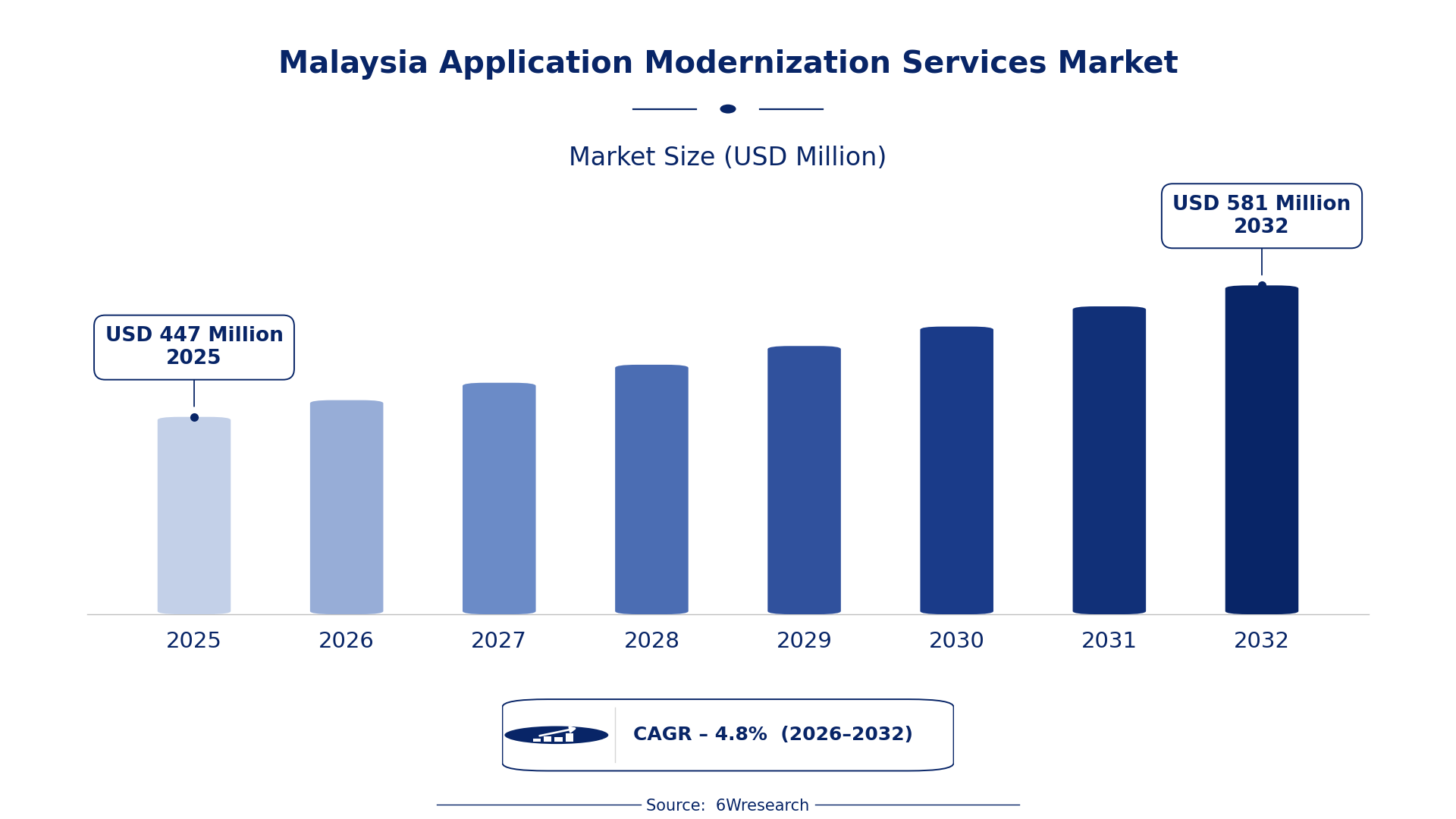
The Malaysia Application Modernization Services Market was estimated at USD 447 Million in 2025 and is projected to reach USD 581 Million by 2032, growing at a CAGR of 4.8% from 2026 to 2032.
Malaysia Application Modernization Services Market Synopsis
The urgent need for businesses to modernize legacy systems is the most powerful force driving the Malaysia Application Modernization Services Market today. Organizations are increasingly recognizing that outdated applications restrict operational efficiency and competitive edge.
As companies embrace digital transformation, the shift toward cloud-native solutions and containerization is becoming commonplace. This trend not only enhances agility but also fortifies security, making modernization services essential for businesses aiming to thrive in a dynamic technological environment.
Malaysia Application Modernization Services Market Year-wise Growth Rate and Key Drivers
This graph illustrates the annual growth rates of the Malaysia Application Modernization Services Market from 2021 to 2032, highlighting a steady upward trajectory and projected expansion over the forecast period.
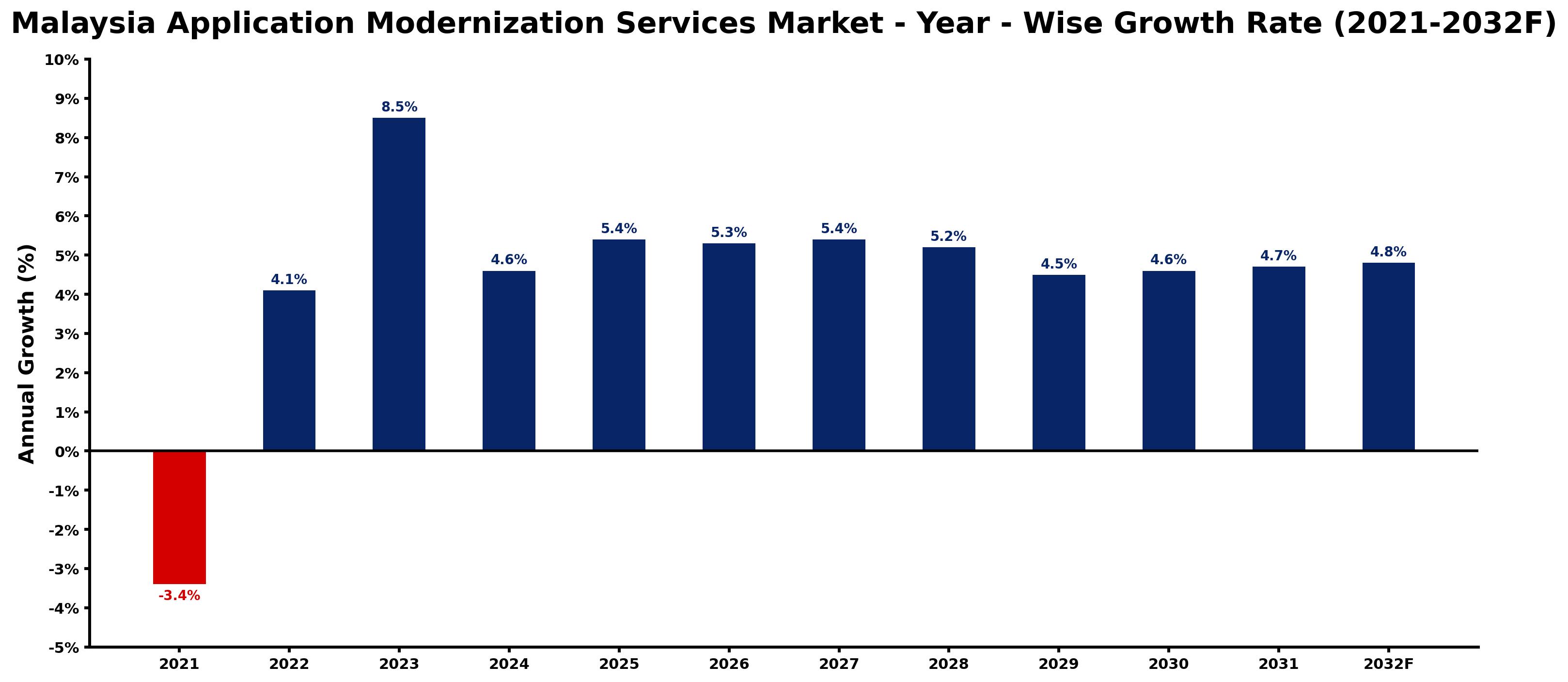
The table below presents the year‑wise growth rates along with the key drivers influencing the market
| Year | Growth Rate | Major Drivers |
| 2021 | -3.4% | MDEC's restrictive policies hindered software development adoption. |
| 2022 | 4.1% | MyDigital Nasional initiative promoting digital economy transformations. |
| 2023 | 8.5% | Increased focus on cybersecurity regulations boosting modernization requirements. |
| 2024 | 4.6% | Rising adoption of cloud services in Malaysian SMEs. |
| 2025 | 5.4% | Government push for digital payment solutions driving app upgrades. |
| 2026 | 5.3% | Emerging tech start-ups driving innovation in application services. |
| 2027 | 5.4% | Growing need for data analytics solutions in local enterprises. |
| 2028 | 5.2% | Higher adoption of AI tools influencing application enhancements. |
| 2029 | 4.5% | Local manufacturers pursuing automation enhancing application needs. |
| 2030 | 4.6% | Government initiatives supporting fintech application development. |
| 2031 | 4.7% | Increasing interest in microservices architecture among Malaysian firms. |
| 2032 | 4.8% | Demand for integrated health tech applications rising significantly. |
Note: Market size estimations and growth projections presented in this report are based on 6Wresearch's proprietary forecasting methodology, utilizing the latest available industry data, government publications, and primary research inputs.
Malaysia Application Modernization Services Market Key Takeaways
Below are some of the specific key takeaways from the market, including:
- The market is driven by the necessity to update outdated applications to improve efficiency.
- Cloud computing and microservices are becoming integral to modernization strategies.
- COVID-19 has accelerated the demand for modernization services across various sectors.
- Leading organizations are investing in modernization to enhance scalability and security.
- Resistance to change remains a notable barrier in the adoption of modernization services.
Evaluation of Restraints in Malaysia Application Modernization Services Market
One of the primary constraints hindering growth in the Malaysia Application Modernization Services Market is the reluctance of businesses to invest in modernization initiatives. Many organizations remain attached to their legacy systems, fearing the potential disruption and costs associated with the transition. This hesitance is compounded by concerns regarding the integration of new technologies with existing operations. Without effective change management strategies, the path to modernization can be fraught with challenges that deter investment.
Malaysia Application Modernization Services Market Trends
Several trends are shaping the demand for application modernization services in Malaysia. Firstly, the rising adoption of cloud-native architectures is enabling businesses to build applications that are more flexible and scalable. Secondly, containerization has emerged as a popular approach, allowing organizations to streamline deployment processes. As companies increasingly focus on enhancing customer experiences, the integration of advanced analytics into modernization efforts is also gaining traction, providing deeper insights into user behavior.
Malaysia Application Modernization Services Market Opportunities
The Malaysia Application Modernization Services Market presents numerous growth opportunities. Organizations looking to enhance operational efficiency can invest in modernization as a means to reduce costs and improve service delivery. on top of that, with the government promoting digitalization initiatives, there is a potential for public-private partnerships that can spur innovation and create a conducive environment for modernization projects. As businesses continue to prioritize agility and security, those offering specialized modernization solutions will find a receptive market.
Government Initiatives in the Malaysia Application Modernization Services Market
Government policy is significantly influencing the Malaysia Application Modernization Services Market. With a focus on digital transformation, the government is actively promoting initiatives that enhance the technological capabilities of businesses. This regulatory support is vital, as it encourages investment in modernization efforts, making it easier for companies to adopt new technologies.
- A national digital infrastructure upgrade programme now in its rollout phase aims to enhance connectivity and facilitate modernization efforts across industries.
- A regulatory framework introduced in 2025 mandating digital transparency is currently being implemented, encouraging businesses to modernize their operations.
- A public-private initiative expected to expand access to cloud services is planned for launch in 2027, which will support modernization efforts.
- Recently completed initiatives focus on providing funding for SMEs to upgrade their legacy systems, promoting broader adoption of modernization services.
Future Insights of the Malaysia Application Modernization Services Market
Looking ahead to 2026-2032, the Malaysia Application Modernization Services Market is set for continued growth. As businesses increasingly prioritize agility and security, the demand for modernization services will rise. The trend towards cloud-native solutions will likely solidify, supported by ongoing governmental initiatives and rising consumer expectations for digital experiences. Companies that proactively modernize their applications will position themselves competitively in an increasingly digital economy.
Malaysia Application Modernization Services Market Latest Developments
In the past year, activity in the Malaysia Application Modernization Services Market has surged. Organizations have ramped up their investments in modernization projects, driven by the need to stay competitive in a rapidly changing environment. The focus has shifted towards integrating advanced technologies that facilitate smoother transitions and improved user experiences.
- A major technology vendor launched a new suite of modernization tools in early 2025, aimed at streamlining application upgrades for businesses.
- An initiative that began in mid-2025 and remains underway focuses on collaborating with SMEs to enhance their digital capabilities through modernization.
- A rollout expected to begin in the second half of 2026 aims to expand cloud services in rural areas, supporting wider adoption of modernization.
- Recently, a prominent consultancy announced a partnership with local businesses to offer tailored modernization solutions, enhancing the service offerings available in the market.
Malaysia Application Modernization Services Market - Key Attractiveness of the Report
- 10 Years of Market Numbers
- Historical Data Starting from 2022 to 2025
- Base Year: 2025
- Forecast Data until 2032
- Key Performance Indicators Impacting the Market
- Major Upcoming Developments and Projects
Key Highlights of the Report:
- Malaysia Application Modernization Services Market Outlook
- Market Size of Malaysia Application Modernization Services Market, 2025
- Forecast of Malaysia Application Modernization Services Market, 2032
- Historical Data and Forecast of Malaysia Application Modernization Services Revenues & Volume for the Period 2022-2032F
- Malaysia Application Modernization Services Market Trend Evolution
- Malaysia Application Modernization Services Market Drivers and Challenges
- Malaysia Application Modernization Services Price Trends
- Malaysia Application Modernization Services Porter's Five Forces
- Malaysia Application Modernization Services Industry Life Cycle
- Historical Data and Forecast of Malaysia Application Modernization Services Market Revenues & Volume By Service Type for the Period 2022-2032F
- Historical Data and Forecast of Malaysia Application Modernization Services Market Revenues & Volume By Application Portfolio Assessment for the Period 2022-2032F
- Historical Data and Forecast of Malaysia Application Modernization Services Market Revenues & Volume By Cloud Application Migration for the Period 2022-2032F
- Historical Data and Forecast of Malaysia Application Modernization Services Market Revenues & Volume By Application Re-Platforming for the Period 2022-2032F
- Historical Data and Forecast of Malaysia Application Modernization Services Market Revenues & Volume By Application Integration for the Period 2022-2032F
- Historical Data and Forecast of Malaysia Application Modernization Services Market Revenues & Volume By UI Modernization for the Period 2022-2032F
- Historical Data and Forecast of Malaysia Application Modernization Services Market Revenues & Volume By Post-Modernization for the Period 2022-2032F
- Historical Data and Forecast of Malaysia Application Modernization Services Market Revenues & Volume By Deployment Mode for the Period 2022-2032F
- Historical Data and Forecast of Malaysia Application Modernization Services Market Revenues & Volume By Public Cloud for the Period 2022-2032F
- Historical Data and Forecast of Malaysia Application Modernization Services Market Revenues & Volume By Private Cloud for the Period 2022-2032F
- Historical Data and Forecast of Malaysia Application Modernization Services Market Revenues & Volume By Organization Size for the Period 2022-2032F
- Historical Data and Forecast of Malaysia Application Modernization Services Market Revenues & Volume By Large enterprises for the Period 2022-2032F
- Historical Data and Forecast of Malaysia Application Modernization Services Market Revenues & Volume By Small and Medium Enterprises (SMEs) for the Period 2022-2032F
- Historical Data and Forecast of Malaysia Application Modernization Services Market Revenues & Volume By Verticals for the Period 2022-2032F
- Historical Data and Forecast of Malaysia Application Modernization Services Market Revenues & Volume By BFSI for the Period 2022-2032F
- Historical Data and Forecast of Malaysia Application Modernization Services Market Revenues & Volume By Healthcare and Life Sciences for the Period 2022-2032F
- Historical Data and Forecast of Malaysia Application Modernization Services Market Revenues & Volume By Telecommunication for the Period 2022-2032F
- Historical Data and Forecast of Malaysia Application Modernization Services Market Revenues & Volume By IT and ITeS for the Period 2022-2032F
- Historical Data and Forecast of Malaysia Application Modernization Services Market Revenues & Volume By Retail and Consumer Goods for the Period 2022-2032F
- Historical Data and Forecast of Malaysia Application Modernization Services Market Revenues & Volume By Government and Public Sector for the Period 2022-2032F
- Historical Data and Forecast of Malaysia Application Modernization Services Market Revenues & Volume By Energy and Utilities for the Period 2022-2032F
- Historical Data and Forecast of Malaysia Application Modernization Services Market Revenues & Volume By Manufacturing for the Period 2022-2032F
- Malaysia Application Modernization Services Import Export Trade Statistics
- Market Opportunity Assessment By Service Type
- Market Opportunity Assessment By Deployment Mode
- Market Opportunity Assessment By Organization Size
- Market Opportunity Assessment By Verticals
- Malaysia Application Modernization Services Top Companies Market Share
- Malaysia Application Modernization Services Competitive Benchmarking By Technical and Operational Parameters
- Malaysia Application Modernization Services Company Profiles
- Malaysia Application Modernization Services Key Strategic Recommendations






































