Malaysia Architectural Hardware Market Summary
The malaysia architectural hardware market was estimated at USD 334 Million in 2025 and is projected to reach USD 435 Million by 2032, growing at a CAGR of 5.4% from 2026 to 2032.
Malaysia Architectural Hardware Market Year-wise Growth Rate and Key Drivers
This graph highlights how the Malaysia Architectural Hardware Market has steadily grown over the past five years, supported by major growth factors.
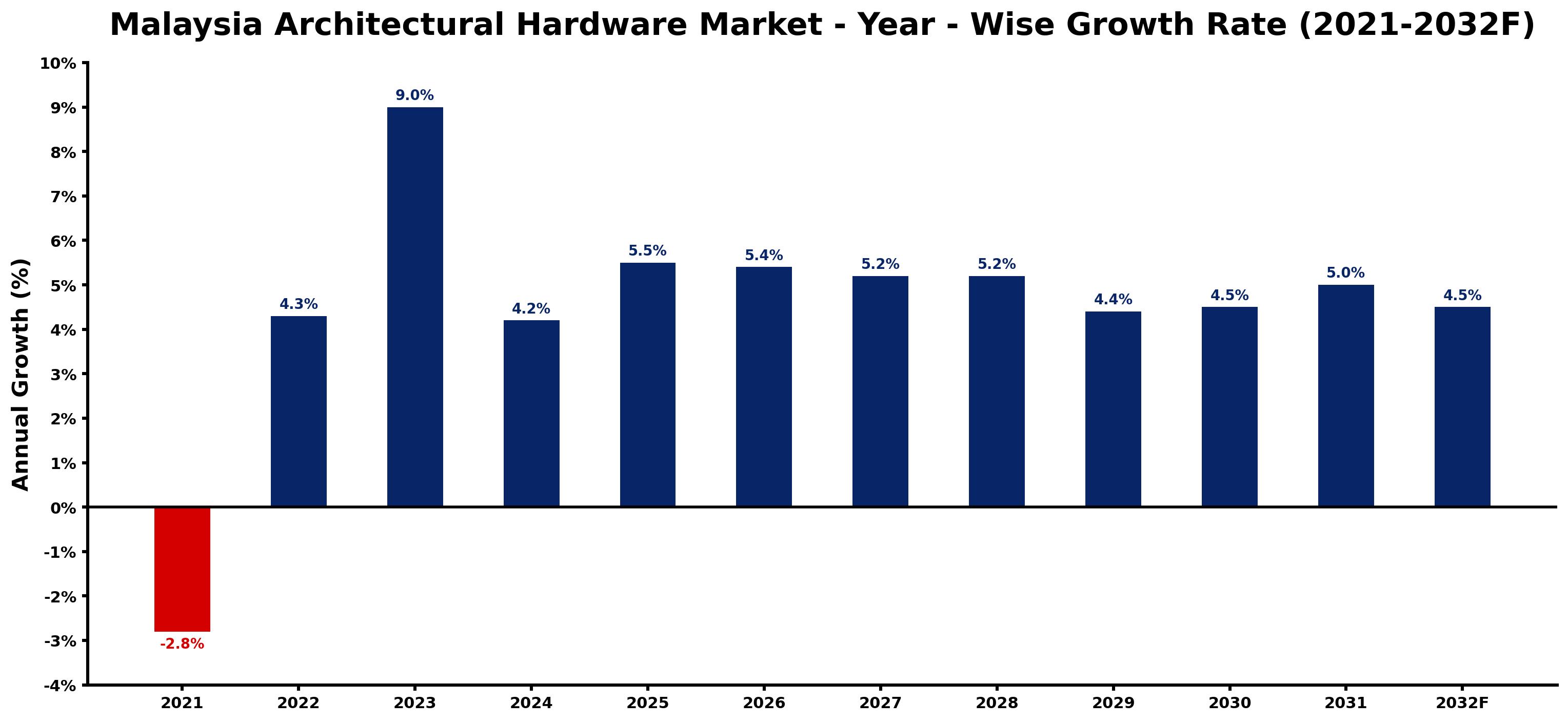
The table below presents the year wise growth rates along with the key drivers influencing the market
| Year | Growth Rate | Major Drivers |
| 2021 | -2.8% | Supply chain disruptions hindered construction projects, leading to decreased demand for architectural hardware in 2021. |
| 2022 | 4.3% | Emerging construction trends favored sustainable materials, enhancing market appeal and innovation. |
| 2023 | 9.0% | The residential construction sector saw significant investment in modernization and design upgrades. |
| 2024 | 4.2% | Technological integration in smart buildings increased the need for advanced architectural components. |
| 2025 | 5.5% | Renewed focus on safety and security sparked interest in high-performance hardware solutions. |
| 2026 | 5.4% | Evolving consumer preferences demanded aesthetic designs, impacting product offerings from suppliers. |
| 2027 | 5.2% | Urbanization trends pushed for more infrastructure projects, expanding hardware market opportunities. |
| 2028 | 5.2% | Collaboration among architects and manufacturers fostered innovation in custom hardware solutions. |
| 2029 | 4.4% | Increased foreign direct investment led to a thriving construction and architectural hardware sector. |
| 2030 | 4.5% | Growing awareness of energy efficiency prompted shifts towards eco-friendly hardware materials. |
| 2031 | 5.0% | Technological advancements in manufacturing improved production efficiency and reduced costs significantly. |
| 2032 | 4.5% | The integration of AI in design processes transformed how architectural solutions are developed. |
Note - Market size estimations and growth projections presented in this report are based on 6Wresearch's advanced forecasting approach, validated with industry datasets as of June 2026.
Malaysia Architectural Hardware Market Synopsis
The Malaysia Architectural Hardware Market is projected to reach 5.4% and witness significant growth during the forecast period (2026-2032). This anticipated growth can be primarily attributed to the robust construction activities in both residential and commercial sectors throughout the country. As Malaysia experiences a growing demand for luxury homes, architectural hardware products are becoming increasingly essential. Furthermore, government initiatives such as the "Malaysia My Second Home" program are poised to stimulate economic development and attract investments in housing infrastructure projects, thereby enhancing market potential.
Malaysia Architectural Hardware Market Growth Drivers
Several key factors are driving the growth of the Malaysia Architectural Hardware Market. One of the primary drivers is the escalating construction activities in urban areas, leading to heightened demand for high-quality architectural elements. The increasing trend toward luxury and sustainable homes is also contributing to this market shift, as consumers seek premium hardware solutions that align with their aesthetic and functional requirements.
- The rise in disposable incomes among the Malaysian population is leading to greater spending power, particularly in the real estate market.
- Urbanization continues to surge, accelerating the demand for new residential and commercial properties, thereby boosting architectural hardware usage.
- The government's focus on improving infrastructure and living standards under various national development plans is fostering a conducive environment for architectural hardware investments.
- The influx of foreign investments in the real estate sector is facilitating the introduction of innovative hardware solutions catering to diverse consumer preferences.
- Increasing awareness of building safety standards and sustainable practices is prompting builders and architects to invest in high-quality architectural hardware products.
Malaysia Architectural Hardware Market Trends and Opportunities
The Malaysia Architectural Hardware Market is witnessing several trends that indicate a shift toward modernization and sophistication in design. There is a growing inclination toward smart home technologies, leading to increased demand for technologically advanced hardware solutions. Additionally, the trend of eco-friendly and sustainable construction practices is creating opportunities for manufacturers to innovate and cater to environmentally conscious consumers.
- The integration of IoT technology in architectural hardware products is gaining momentum, providing enhanced convenience and security features for residential and commercial applications.
- Sustainable and recyclable materials are becoming a focal point for architects, prompting hardware manufacturers to adopt greener production processes.
- Customized solutions are increasingly sought after, reflecting a trend where architects and builders partner with manufacturers to develop tailored hardware designs.
- Luxury home design trends are leading to an increased demand for high-end finishes and decorative hardware, which are becoming essential elements in modern architecture.
- Collaborations between architectural firms and hardware suppliers are fostering innovation, resulting in unique designs that enhance both functionality and aesthetics.
Malaysia Architectural Hardware Market Challenges and Restraints
Despite the positive growth trajectory of the Malaysia Architectural Hardware Market, various challenges could impede progress. Economic fluctuations and uncertainties can lead to reduced investment in construction projects, affecting hardware demand directly. Additionally, the market faces competitive pressure from importers of architectural hardware, which can lead to price wars and squeeze profit margins for domestic manufacturers.
- Fluctuating raw material prices can impact production costs for manufacturers, leading to potential price increases for end consumers.
- Regulatory challenges, including compliance with stringent building codes and safety standards, can complicate market entry for new hardware products.
- The market is confronted with the challenge of adapting to rapid technological advancements, requiring continuous investment in research and development.
- Consumer preferences are evolving quickly, and manufacturers must remain agile to keep pace with trends and preferences.
- The prevalence of counterfeit products in the market can undermine brand reputation and consumer trust in genuine architectural hardware solutions.
Malaysia Architectural Hardware Market Government Investment and Initiatives
The Malaysian government plays a crucial role in fostering the growth of the architectural hardware market through various initiatives and spending programs. Infrastructure development is a central pillar of national strategies, with substantial public investments allocated to enhance housing and urban environments. The "Malaysia My Second Home" program stands out as a pivotal initiative aimed at attracting foreign investments, stimulating demand for quality housing solutions, which subsequently drives the need for superior architectural hardware.
- The government is focusing on infrastructure improvements as part of its national development policy, enhancing housing availability and quality.
- Public spending on urban development projects is expected to increase, creating a favorable landscape for market growth.
- Incentives for sustainable construction practices are being introduced, urging manufacturers to align products with green building standards.
- Collaboration with private sectors in large-scale development projects is facilitating the integration of advanced architectural hardware solutions.
- Ongoing initiatives to boost tourism are positively influencing the hospitality sector, leading to increased demand for high-quality architectural hardware in hotels and resorts.
Malaysia Architectural Hardware Market Latest Developments (May 2025 - June 2026)
In the period from May 2025 to June 2026, the Malaysia Architectural Hardware Market has seen a series of developments that reflect its dynamic nature. Efforts towards innovation in product designs have ramped up, with manufacturers exploring new materials and technologies that promote sustainability. Additionally, government-led initiatives aimed at bolstering the housing sector have continued to gain momentum, creating significant opportunities for architectural hardware applications in new buildings.
- Increased collaboration between public and private sectors is leading to innovative housing projects that necessitate advanced architectural hardware solutions.
- The market has observed a rise in interest from foreign investors looking to capitalize on Malaysia's growing real estate sector.
- Technological advancements in manufacturing processes are being embraced, allowing for the production of more efficient and eco-friendly hardware products.
- Market players are focusing on digital transformation strategies to enhance customer engagement and streamline operations.
- Consumer education initiatives are being rolled out to promote awareness regarding the benefits of high-quality architectural hardware, fostering greater demand.
Malaysia Architectural Hardware Market - Key Attractiveness of the Report
- 10 Years of Market Numbers
- Historical Data Starting from 2022 to 2025
- Base Year: 2025
- Forecast Data until 2032
- Key Performance Indicators Impacting the Market
- Major Upcoming Developments and Projects
Key Highlights of the Report:
- Malaysia Architectural Hardware Market Outlook
- Market Size of Malaysia Architectural Hardware Market, 2025
- Forecast of Malaysia Architectural Hardware Market, 2032F
- Historical Data and Forecast of Malaysia Architectural Hardware Revenues & Volume for the Period 2022-2032F
- Malaysia Architectural Hardware Market Trend Evolution
- Malaysia Architectural Hardware Market Drivers and Challenges
- Malaysia Architectural Hardware Price Trends
- Malaysia Architectural Hardware Porter's Five Forces
- Malaysia Architectural Hardware Industry Life Cycle
- Historical Data and Forecast of Malaysia Architectural Hardware Market Revenues & Volume By Application for the Period 2022-2032F
- Historical Data and Forecast of Malaysia Architectural Hardware Market Revenues & Volume By Doors for the Period 2022-2032F
- Historical Data and Forecast of Malaysia Architectural Hardware Market Revenues & Volume By Windows for the Period 2022-2032F
- Historical Data and Forecast of Malaysia Architectural Hardware Market Revenues & Volume By Furniture for the Period 2022-2032F
- Historical Data and Forecast of Malaysia Architectural Hardware Market Revenues & Volume By Shower for the Period 2022-2032F
- Historical Data and Forecast of Malaysia Architectural Hardware Market Revenues & Volume By End-user for the Period 2022-2032F
- Historical Data and Forecast of Malaysia Architectural Hardware Market Revenues & Volume By Commercial for the Period 2022-2032F
- Historical Data and Forecast of Malaysia Architectural Hardware Market Revenues & Volume By Industrial for the Period 2022-2032F
- Historical Data and Forecast of Malaysia Architectural Hardware Market Revenues & Volume By Residential for the Period 2022-2032F
- Malaysia Architectural Hardware Import Export Trade Statistics
- Market Opportunity Assessment By Application
- Market Opportunity Assessment By End-user
- Malaysia Architectural Hardware Top Companies Market Share
- Malaysia Architectural Hardware Competitive Benchmarking By Technical and Operational Parameters
- Malaysia Architectural Hardware Company Profiles
- Malaysia Architectural Hardware Key Strategic Recommendations






































