Malaysia Armored Vehicle Market Size, Share & Growth Rate
The Malaysia Armored Vehicle Market was estimated at USD 260 Million in 2025 and is projected to reach USD 342 Million by 2032, growing at a CAGR of 4.0% from 2026 to 2032. This growth is primarily fueled by the increasing focus on national security and regional stability, which compels the Malaysian government to invest in defense modernization. As security threats evolve, the demand for versatile and technologically advanced armored vehicles is expected to rise significantly across military and law enforcement sectors.
Malaysia Armored Vehicle Market Year-wise Growth Rate and Key Drivers
This graph highlights how the Malaysia Armored Vehicle Market has steadily grown over the years, supported by major growth factors.
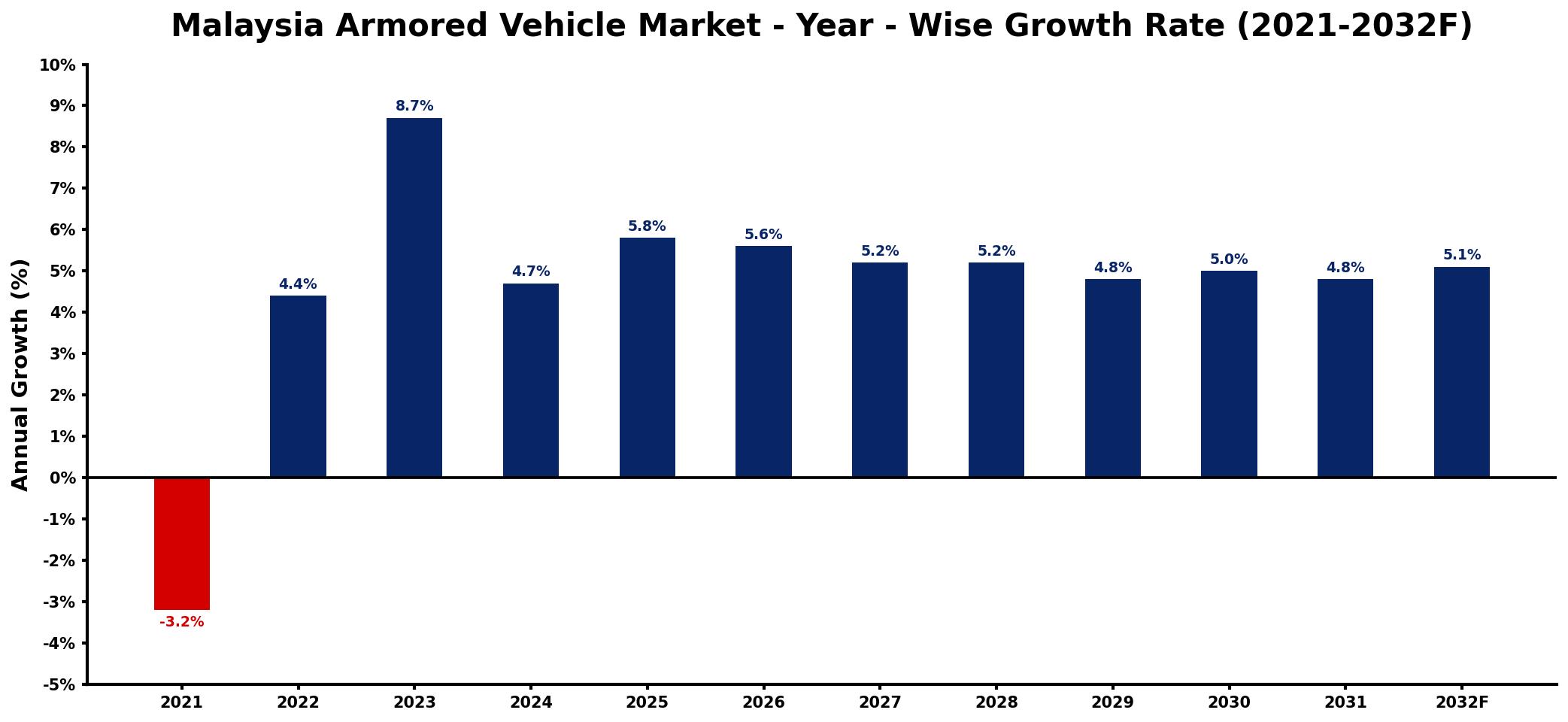
The table below presents the year‑wise growth rates along with the key drivers influencing the market
| Year | Growth Rate | Major Drivers |
| 2021 | -3.2% | decreased defense spending and investments |
| 2022 | 4.4% | increased government security initiatives |
| 2023 | 8.7% | growing regional defense collaborations |
| 2024 | 4.7% | rising demand for border security |
| 2025 | 5.8% | expansion of private sector contracts |
| 2026 | 5.6% | enhanced technological advancements integration |
| 2027 | 5.2% | increased participation in defense expos |
| 2028 | 5.2% | growing interest in military modernization |
| 2029 | 4.8% | rising focus on urban security |
| 2030 | 5.0% | increased funding for defense projects |
| 2031 | 4.8% | growing international partnerships for defense |
| 2032 | 5.1% | expanding research and development efforts |
Note: Market size estimations and growth projections presented in this report are based on 6Wresearch's proprietary forecasting methodology, utilizing the latest available industry data, government publications, and primary research inputs.
Malaysia Armored Vehicle Market Synopsis
In recent years, the Malaysian government has prioritized enhancing its defense capabilities, leading to a robust demand for armored vehicles. This trend is evident in both military and law enforcement sectors as Malaysia aims to safeguard its sovereignty while addressing internal security challenges.
The market's growth is bolstered by a burgeoning local manufacturing base, which aligns with government initiatives to develop indigenous capabilities in defense technology. This strategy not only ensures self-reliance but also enhances the operational efficiency of security forces by providing them with tailored solutions.
Malaysia Armored Vehicle Market Key Takeaways
- Strong government investment is driving the growth of the armored vehicle market, focused on modernizing defense capabilities.
- Indigenous manufacturing is becoming increasingly crucial for sustaining long-term market stability and technological advancement.
- The market is adapting to evolving security threats and regional tensions, which necessitate innovative armored solutions.
- Operational partnerships between local manufacturers and the government are essential for fostering trust and credibility.
- Public health challenges, like the COVID-19 pandemic, have prompted reconsideration of procurement strategies and funding allocations in the defense sector.
Evaluation of Restraints in Malaysia Armored Vehicle Market
Despite its growth potential, the Malaysia Armored Vehicle Market faces notable restraints. Stringent government regulations pose hurdles for international manufacturers seeking to enter the market, limiting competition and innovation. Additionally, navigating the balance between effective security measures and civilian safety remains a complex challenge for market players. The rapidly changing technological landscape requires continuous investment in R&D, which can elevate production costs, putting pressure on profit margins. Lastly, building and maintaining trust with governmental defense agencies requires a strong performance history, making market entry difficult for new players.
Malaysia Armored Vehicle Market Trends
The current landscape of the Malaysia Armored Vehicle Market is shaped by several key trends. Firstly, there's a marked shift towards advanced technology integration, including robotics and artificial intelligence, in armored vehicles for enhanced operational capabilities. Furthermore, the focus on modular and versatile vehicle designs allows for quick adaptations to various mission profiles. Sustainability is also becoming a priority, with manufacturers exploring eco-friendly materials and energy-efficient technologies. Additionally, the market sees a rise in collaboration between private firms and government entities, fostering innovation and shared expertise.
Malaysia Armored Vehicle Market Opportunities
With the increasing emphasis on national security, there are substantial growth opportunities in the Malaysia Armored Vehicle Market. Investment in advanced manufacturing capabilities can enhance local production while reducing dependence on foreign imports. Additionally, the expansion into new applications, such as humanitarian assistance and disaster relief, can broaden market prospects beyond traditional defense roles. The demand for specialized vehicles for law enforcement and internal security operations is also on the rise, presenting avenues for targeted product development.
Government Initiatives in the Malaysia Armored Vehicle Market
The Malaysian government is committed to fortifying its defense capabilities through various initiatives, including increased defense budgets and the promotion of local manufacturing. Key policies focus on creating a self-sufficient defense industry, encouraging innovation, and fostering public-private partnerships to develop advanced armored vehicles. Additionally, the government has initiated programs to ensure that armed forces have access to cutting-edge technologies, which is vital for maintaining operational readiness in a complex security environment.
Future Insights of the Malaysia Armored Vehicle Market
Looking ahead, the Malaysia Armored Vehicle Market is expected to continue its growth trajectory through 2032. As regional tensions persist and defense strategies evolve, demand for versatile and technologically advanced armored vehicles will become paramount. Ongoing investments in local manufacturing capabilities are likely to enhance the market's resilience and adaptability. Furthermore, the integration of advanced technologies and sustainable practices will play a critical role in shaping the future of the industry, ensuring that Malaysia remains at the forefront of modern defense solutions.
Malaysia Armored Vehicle Market Latest Developments (2025 - 2026)
Recent developments in the Malaysia Armored Vehicle Market indicate a strategic shift towards advanced defense technology. Manufacturers are increasingly focusing on modular designs to meet diverse operational demands. Additionally, government-led initiatives aimed at enhancing local production capabilities have gained momentum, reflecting a commitment to self-reliance in defense. Innovations in vehicle technology, including upgrades in armor and communication systems, are also taking center stage as agencies seek to enhance operational efficiency in complex environments.
Malaysia Armored Vehicle Market - Key Attractiveness of the Report
- 10 Years of Market Numbers
- Historical Data Starting from 2022 to 2025
- Base Year: 2025
- Forecast Data until 2032
- Key Performance Indicators Impacting the Market
- Major Upcoming Developments and Projects
Key Highlights of the Report:
- Malaysia Armored Vehicle Market Outlook
- Market Size of Malaysia Armored Vehicle Market, 2025
- Forecast of Malaysia Armored Vehicle Market, 2032
- Historical Data and Forecast of Malaysia Armored Vehicle Revenues & Volume for the Period 2022-2032F
- Malaysia Armored Vehicle Market Trend Evolution
- Malaysia Armored Vehicle Market Drivers and Challenges
- Malaysia Armored Vehicle Price Trends
- Malaysia Armored Vehicle Porter's Five Forces
- Malaysia Armored Vehicle Industry Life Cycle
- Historical Data and Forecast of Malaysia Armored Vehicle Market Revenues & Volume By Platform for the Period 2022-2032F
- Historical Data and Forecast of Malaysia Armored Vehicle Market Revenues & Volume By Combat Vehicles for the Period 2022-2032F
- Historical Data and Forecast of Malaysia Armored Vehicle Market Revenues & Volume By Combat Support Vehicles for the Period 2022-2032F
- Historical Data and Forecast of Malaysia Armored Vehicle Market Revenues & Volume By Unmanned Armored Ground Vehicles for the Period 2022-2032F
- Historical Data and Forecast of Malaysia Armored Vehicle Market Revenues & Volume By Mobility for the Period 2022-2032F
- Historical Data and Forecast of Malaysia Armored Vehicle Market Revenues & Volume By Wheeled for the Period 2022-2032F
- Historical Data and Forecast of Malaysia Armored Vehicle Market Revenues & Volume By Tracked for the Period 2022-2032F
- Historical Data and Forecast of Malaysia Armored Vehicle Market Revenues & Volume By System for the Period 2022-2032F
- Historical Data and Forecast of Malaysia Armored Vehicle Market Revenues & Volume By Engine for the Period 2022-2032F
- Historical Data and Forecast of Malaysia Armored Vehicle Market Revenues & Volume By Drive System for the Period 2022-2032F
- Historical Data and Forecast of Malaysia Armored Vehicle Market Revenues & Volume By Ballistic Armor for the Period 2022-2032F
- Historical Data and Forecast of Malaysia Armored Vehicle Market Revenues & Volume By Turret Drives for the Period 2022-2032F
- Historical Data and Forecast of Malaysia Armored Vehicle Market Revenues & Volume By Ammunition Handling System for the Period 2022-2032F
- Historical Data and Forecast of Malaysia Armored Vehicle Market Revenues & Volume By Fire Control Systems (FCS) for the Period 2022-2032F
- Historical Data and Forecast of Malaysia Armored Vehicle Market Revenues & Volume By Armaments for the Period 2022-2032F
- Historical Data and Forecast of Malaysia Armored Vehicle Market Revenues & Volume By Countermeasure System for the Period 2022-2032F
- Malaysia Armored Vehicle Import Export Trade Statistics
- Market Opportunity Assessment By Platform
- Market Opportunity Assessment By Mobility
- Market Opportunity Assessment By System
- Malaysia Armored Vehicle Top Companies Market Share
- Malaysia Armored Vehicle Competitive Benchmarking By Technical and Operational Parameters
- Malaysia Armored Vehicle Company Profiles
- Malaysia Armored Vehicle Key Strategic Recommendations






































