Malaysia Artificial Intelligence in Accounting Market Size & Growth Rate (2026-2032)
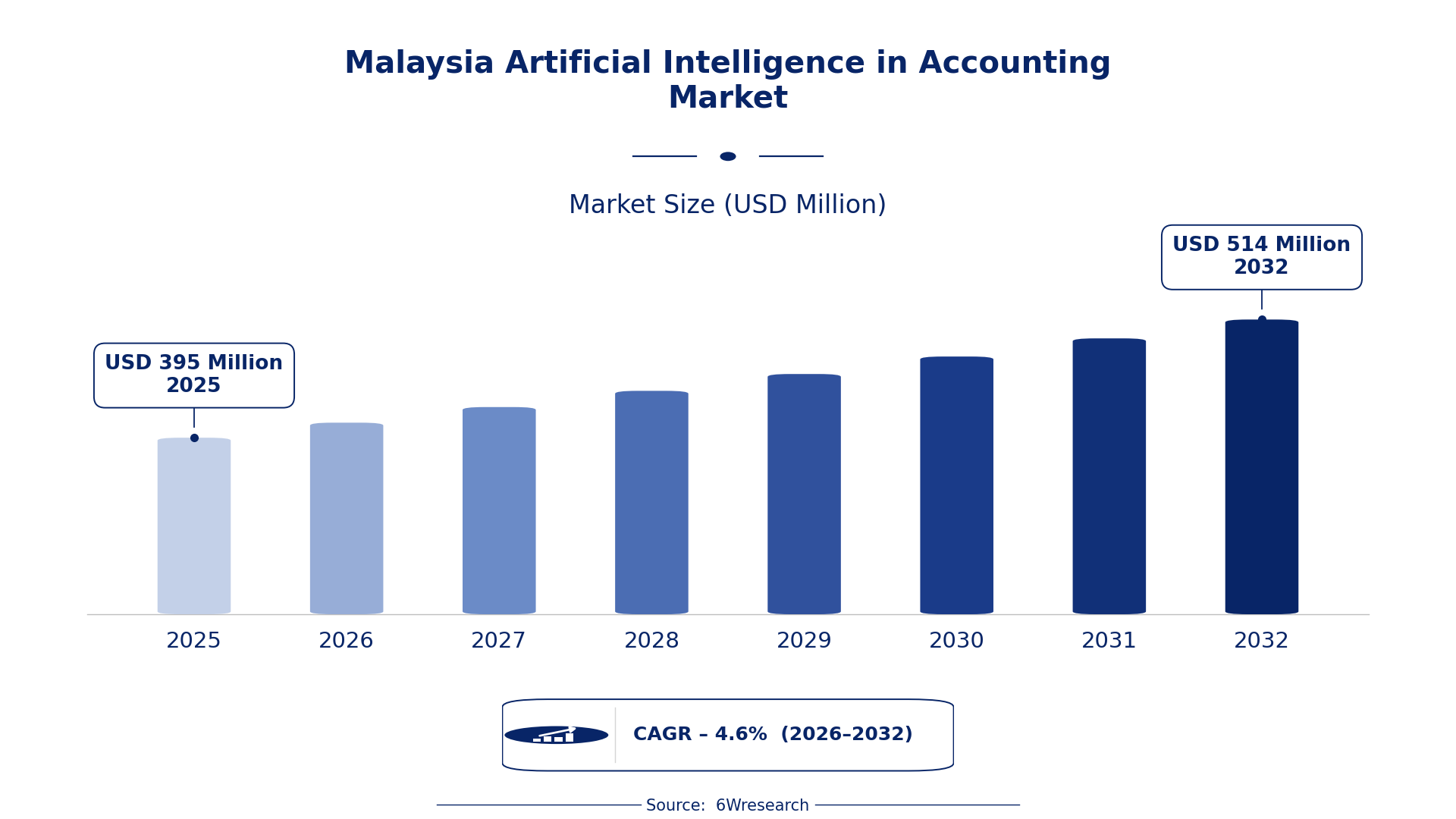
The Malaysia Artificial Intelligence in Accounting Market was estimated at USD 395 Million in 2025 and is projected to reach USD 514 Million by 2032, growing at a CAGR of 4.6% from 2026 to 2032.
Malaysia Artificial Intelligence in Accounting Market Synopsis
The growing demand for automation in accounting practices is reshaping financial operations across Malaysia. Businesses are increasingly turning to AI-driven solutions to enhance efficiency in areas like invoice processing, compliance, and financial reporting.
As regulatory pressures mount and data complexities increase, AI is emerging as a critical enabler in the accounting sector. The drive for accuracy and speed in financial processes makes AI not just an option, but a necessity for many organizations in Malaysia.
Malaysia Artificial Intelligence in Accounting Market Year-wise Growth Rate and Key Drivers
This graph illustrates the annual growth rates of the Malaysia Artificial Intelligence in Accounting Market from 2021 to 2032, highlighting a steady upward trajectory and projected expansion over the forecast period.
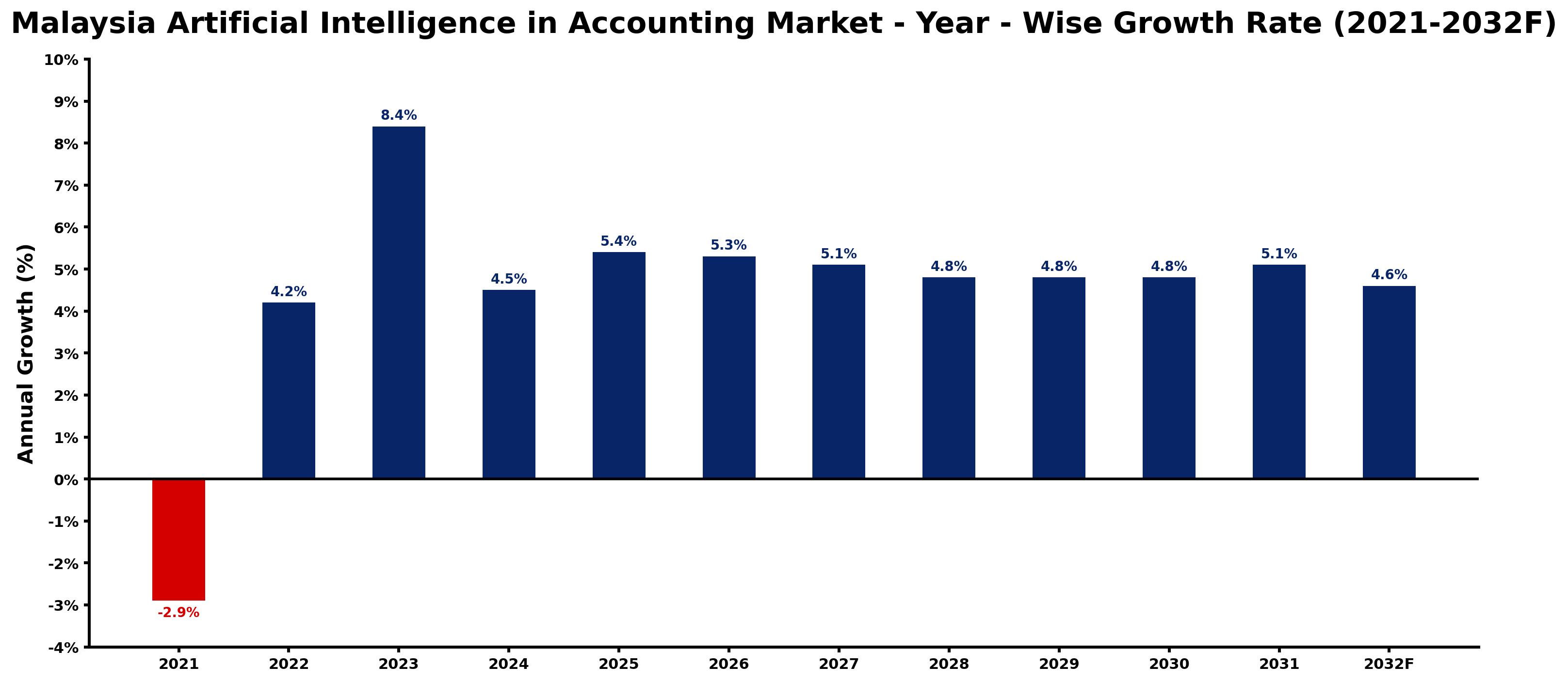
The table below presents the year‑wise growth rates along with the key drivers influencing the market
| Year | Growth Rate | Major Drivers |
| 2021 | -2.9% | Delayed adoption of AI technologies in Malaysian SMEs. |
| 2022 | 4.2% | Implementation of MDEC's AI Strategic Framework |
| 2023 | 8.4% | Increased demand for automated tax compliance solutions |
| 2024 | 4.5% | Rise in SME adoption of digital accounting tools |
| 2025 | 5.4% | Enhanced cybersecurity regulations boosting AI investments |
| 2026 | 5.3% | Growing focus on data analytics in financial reporting |
| 2027 | 5.1% | Support from Bank Negara Malaysia for AI integration |
| 2028 | 4.8% | Rising talent pool from local universities in AI |
| 2029 | 4.8% | Government incentives for AI-driven accounting solutions |
| 2030 | 4.8% | Increased awareness of AI benefits among accountants |
| 2031 | 5.1% | Major firms transitioning to AI-enabled auditing processes |
| 2032 | 4.6% | Strengthened policies promoting digital transformation in finance |
Note: Market size estimations and growth projections presented in this report are based on 6Wresearch's proprietary forecasting methodology, utilizing the latest available industry data, government publications, and primary research inputs.
Malaysia Artificial Intelligence in Accounting Market Key Takeaways
Below are some of the specific key takeaways from the market, including:
- The shift towards AI in accounting is fueled by the need for automation and enhanced accuracy.
- Organizations are increasingly investing in AI solutions for cost-effective financial management.
- The fear of job displacement remains a challenge, necessitating clear communication on AI's role.
- Regulatory compliance is driving the adoption of AI tools to ensure accurate reporting.
- The COVID-19 pandemic accelerated interest in technology investments for operational efficiency.
Evaluation of Restraints in Malaysia Artificial Intelligence in Accounting Market
Several factors are holding back the broader adoption of AI in Malaysia's accounting sector. A primary concern is the anxiety surrounding job security among accounting professionals, with many perceiving AI as a threat rather than a support tool. on top of that, the integration of AI solutions must navigate complex regulatory frameworks, which can complicate the implementation process. Organizations must find a balance between embracing innovation and adhering to established compliance standards, which can be a considerable barrier.
Malaysia Artificial Intelligence in Accounting Market Trends
The landscape of AI in accounting is being influenced by several key trends. One notable trend is the move toward cloud-based accounting solutions, which facilitate remote access and collaboration. Businesses are also increasingly utilizing machine learning algorithms to enhance predictive analytics in financial forecasting. Additionally, there is a growing emphasis on integrating AI with existing ERP systems, allowing for more streamlined financial operations.
Malaysia Artificial Intelligence in Accounting Market Opportunities
Opportunities abound for businesses willing to invest in AI technology within accounting. The demand for customized AI solutions tailored to specific industries is on the rise, presenting a lucrative avenue for developers. on top of that, as more organizations recognize the long-term cost benefits of AI-driven accounting, investment in training programs for finance professionals will become increasingly necessary. This opens the door for educational institutions to collaborate with businesses to develop relevant training initiatives.
Government Initiatives in the Malaysia Artificial Intelligence in Accounting Market
Government policy is actively shaping the direction of the Artificial Intelligence in Accounting market in Malaysia. Authorities are focusing on creating a regulatory environment that encourages innovation while ensuring compliance. This proactive stance is essential for fostering trust among businesses looking to implement AI solutions in their accounting practices.
- A national digital infrastructure upgrade programme recently launched aims to enhance technological capabilities across sectors, including accounting.
- A regulatory framework introduced in 2025 mandates improved billing transparency, compelling businesses to adopt AI-driven compliance tools.
- Currently ongoing initiatives include a public-private partnership aimed at developing AI literacy programs for finance professionals.
- A planned initiative expected to expand access to AI solutions in rural areas is slated for rollout by 2028.
Future Insights of the Malaysia Artificial Intelligence in Accounting Market
Looking ahead to 2026-2032, the Malaysia Artificial Intelligence in Accounting Market is set for substantial growth. As the demand for accuracy and efficiency in financial operations continues to rise, organizations will increasingly adopt AI technologies. The focus will likely shift toward developing more sophisticated AI solutions that can integrate seamlessly with existing financial systems. This will not only streamline operations but also drive further innovation in the sector.
Malaysia Artificial Intelligence in Accounting Market Latest Developments
Recent activity in Malaysia’s Artificial Intelligence in Accounting market indicates a strong push towards modernization and technological integration. Companies are focusing on enhancing their offerings to meet the evolving needs of businesses amid a competitive landscape.
- A major technology vendor announced an AI-powered accounting solution rollout that began in early 2025, aimed at automating financial reporting processes.
- A partnership between two leading firms, established in late 2024, focuses on developing AI tools tailored for compliance management.
- An initiative that began in mid-2025 is currently underway to integrate AI capabilities into existing ERP platforms for seamless financial management.
- A product upgrade, expected to be completed by Q3 2026, will enhance AI functionalities for real-time data analysis in accounting.
Malaysia Artificial Intelligence in Accounting Market - Key Attractiveness of the Report
- 10 Years of Market Numbers
- Historical Data Starting from 2022 to 2025
- Base Year: 2025
- Forecast Data until 2032
- Key Performance Indicators Impacting the Market
- Major Upcoming Developments and Projects
Key Highlights of the Report:
- Malaysia Artificial Intelligence in Accounting Market Outlook
- Market Size of Malaysia Artificial Intelligence in Accounting Market, 2025
- Forecast of Malaysia Artificial Intelligence in Accounting Market, 2032
- Historical Data and Forecast of Malaysia Artificial Intelligence in Accounting Revenues & Volume for the Period 2022-2032F
- Malaysia Artificial Intelligence in Accounting Market Trend Evolution
- Malaysia Artificial Intelligence in Accounting Market Drivers and Challenges
- Malaysia Artificial Intelligence in Accounting Price Trends
- Malaysia Artificial Intelligence in Accounting Porter's Five Forces
- Malaysia Artificial Intelligence in Accounting Industry Life Cycle
- Historical Data and Forecast of Malaysia Artificial Intelligence in Accounting Market Revenues & Volume By Application for the Period 2022-2032F
- Historical Data and Forecast of Malaysia Artificial Intelligence in Accounting Market Revenues & Volume By Automated Bookkeeping for the Period 2022-2032F
- Historical Data and Forecast of Malaysia Artificial Intelligence in Accounting Market Revenues & Volume By Invoice Classification and Approvals for the Period 2022-2032F
- Historical Data and Forecast of Malaysia Artificial Intelligence in Accounting Market Revenues & Volume By Fraud and Risk Management for the Period 2022-2032F
- Historical Data and Forecast of Malaysia Artificial Intelligence in Accounting Market Revenues & Volume By Reporting for the Period 2022-2032F
- Historical Data and Forecast of Malaysia Artificial Intelligence in Accounting Market Revenues & Volume By Others for the Period 2022-2032F
- Historical Data and Forecast of Malaysia Artificial Intelligence in Accounting Market Revenues & Volume By Component for the Period 2022-2032F
- Historical Data and Forecast of Malaysia Artificial Intelligence in Accounting Market Revenues & Volume By Solutions for the Period 2022-2032F
- Historical Data and Forecast of Malaysia Artificial Intelligence in Accounting Market Revenues & Volume By Services for the Period 2022-2032F
- Historical Data and Forecast of Malaysia Artificial Intelligence in Accounting Market Revenues & Volume By Technology for the Period 2022-2032F
- Historical Data and Forecast of Malaysia Artificial Intelligence in Accounting Market Revenues & Volume By Machine Learning (ML) and Deep Learning for the Period 2022-2032F
- Historical Data and Forecast of Malaysia Artificial Intelligence in Accounting Market Revenues & Volume By NLP for the Period 2022-2032F
- Historical Data and Forecast of Malaysia Artificial Intelligence in Accounting Market Revenues & Volume By Deployment Mode for the Period 2022-2032F
- Historical Data and Forecast of Malaysia Artificial Intelligence in Accounting Market Revenues & Volume By On-premises for the Period 2022-2032F
- Historical Data and Forecast of Malaysia Artificial Intelligence in Accounting Market Revenues & Volume By Cloud for the Period 2022-2032F
- Historical Data and Forecast of Malaysia Artificial Intelligence in Accounting Market Revenues & Volume By Enterprise Size for the Period 2022-2032F
- Historical Data and Forecast of Malaysia Artificial Intelligence in Accounting Market Revenues & Volume By Large Enterprises for the Period 2022-2032F
- Historical Data and Forecast of Malaysia Artificial Intelligence in Accounting Market Revenues & Volume By Small and Medium-Sized Enterprises (SMEs) for the Period 2022-2032F
- Malaysia Artificial Intelligence in Accounting Import Export Trade Statistics
- Market Opportunity Assessment By Application
- Market Opportunity Assessment By Component
- Market Opportunity Assessment By Technology
- Market Opportunity Assessment By Deployment Mode
- Market Opportunity Assessment By Enterprise Size
- Malaysia Artificial Intelligence in Accounting Top Companies Market Share
- Malaysia Artificial Intelligence in Accounting Competitive Benchmarking By Technical and Operational Parameters
- Malaysia Artificial Intelligence in Accounting Company Profiles
- Malaysia Artificial Intelligence in Accounting Key Strategic Recommendations






































