Malaysia Artificial Intelligence Platform Market Size & Growth Rate (2026-2032)
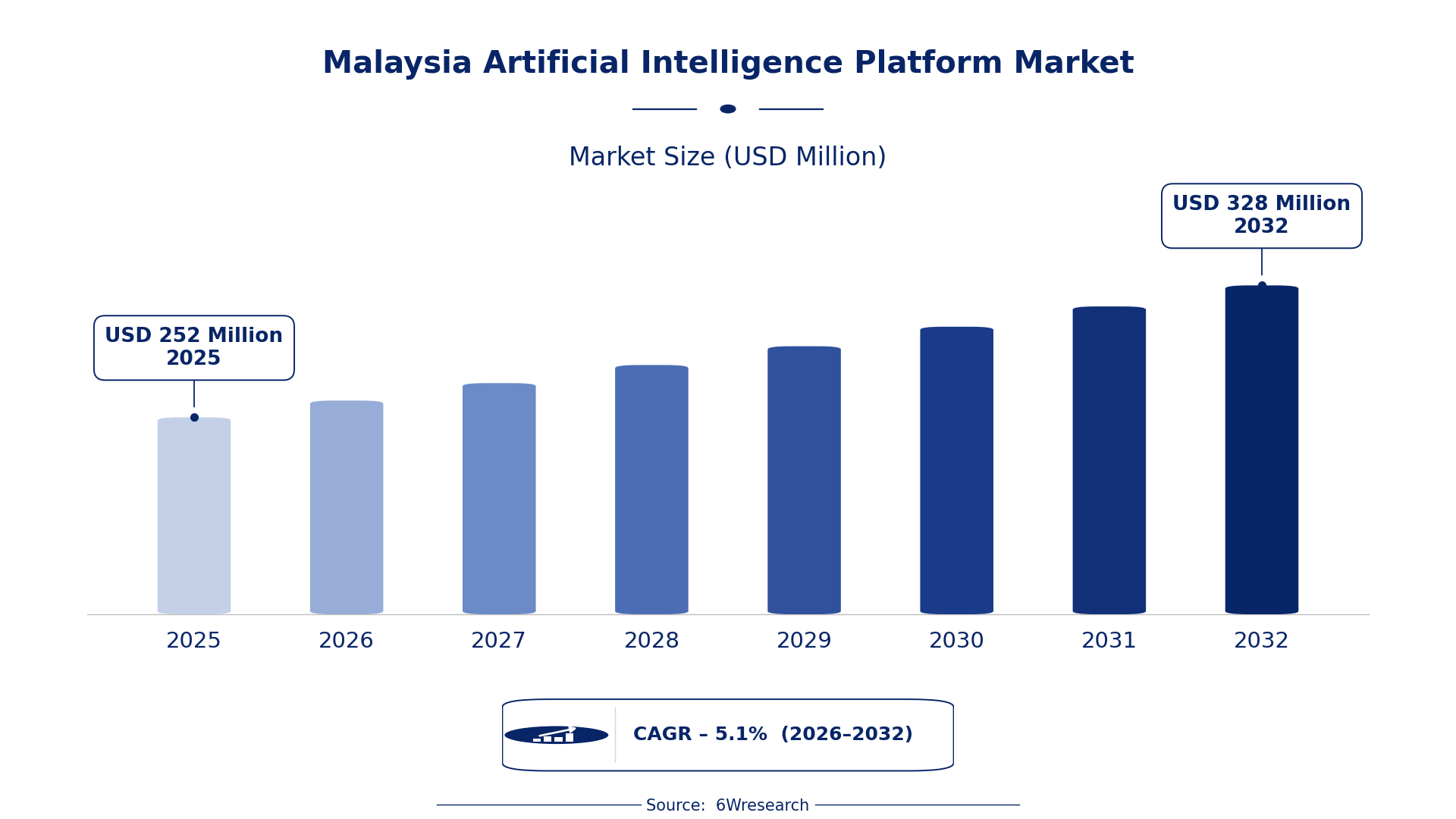
The Malaysia Artificial Intelligence Platform Market was estimated at USD 252 Million in 2025 and is projected to reach USD 328 Million by 2032, growing at a CAGR of 5.1% from 2026 to 2032.
Malaysia Artificial Intelligence Platform Market Synopsis
The momentum in Malaysia's artificial intelligence platform market reflects a shift towards greater technological adoption, driven by businesses eager to harness AI's potential. As organizations increasingly recognize AI's capability to streamline operations and elevate customer experiences, the market is set for significant growth in the coming years.
Looking ahead, the market is transitioning from early adoption phases to widespread integration across diverse sectors. This transformation is supported by government initiatives and rising data volumes, which bolster the demand for intelligent solutions that offer actionable insights and predictive analytics.
Malaysia Artificial Intelligence Platform Market Year-wise Growth Rate and Key Drivers
This graph illustrates the annual growth rates of the Malaysia Artificial Intelligence Platform Market from 2021 to 2032, highlighting a steady upward trajectory and projected expansion over the forecast period.
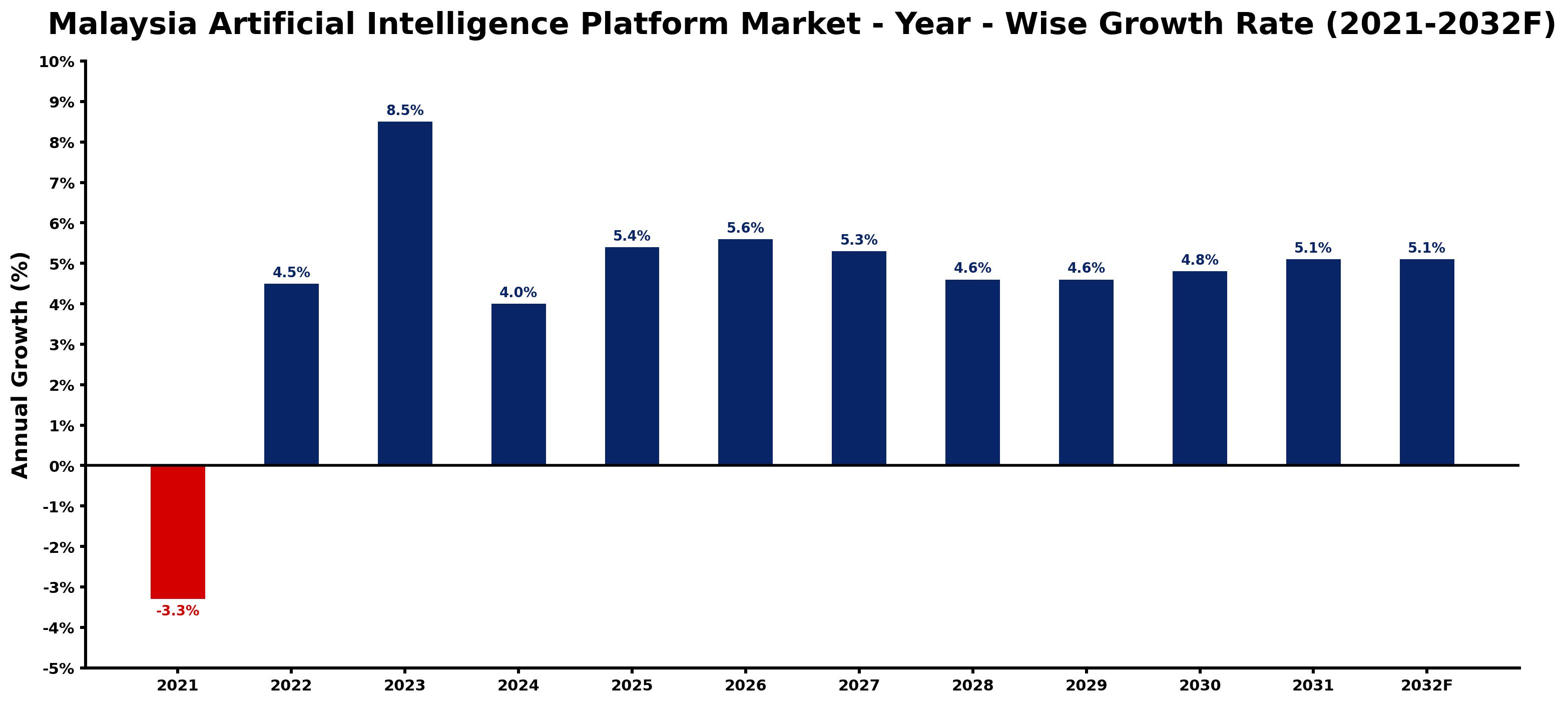
The table below presents the year‑wise growth rates along with the key drivers influencing the market
| Year | Growth Rate | Major Drivers |
| 2021 | -3.3% | MDA's strict licensing regulations hinder new AI projects. |
| 2022 | 4.5% | Government's MyDigital initiative enhancing digital economy capabilities |
| 2023 | 8.5% | Rise in AI-driven e-commerce platforms boosting market engagement |
| 2024 | 4.0% | Implementation of AI ethics guidelines by Malaysian regulators |
| 2025 | 5.4% | Growing local startups leveraging AI for agriculture innovations |
| 2026 | 5.6% | Increased investment in AI research by national universities |
| 2027 | 5.3% | Emergence of smart manufacturing initiatives across Malaysian factories |
| 2028 | 4.6% | Regulatory support for AI in educational technology advancements |
| 2029 | 4.6% | Local demand for AI in tourism experience enhancement |
| 2030 | 4.8% | Partnerships between telcos and AI firms for optimized services |
| 2031 | 5.1% | Government focus on AI talent development and training programs |
| 2032 | 5.1% | Rising interest in AI for smart city urban planning solutions |
Note: Market size estimations and growth projections presented in this report are based on 6Wresearch's proprietary forecasting methodology, utilizing the latest available industry data, government publications, and primary research inputs.
Malaysia Artificial Intelligence Platform Market Key Takeaways
Below are some of the specific key takeaways from the market, including:
- Growing interest in AI-driven data analytics and automation among various industries.
- Increased government support for AI research and development initiatives.
- Challenges related to skilled workforce shortages and data privacy concerns persist.
- AI platforms are becoming central to digital transformation strategies for businesses.
- Emerging technologies are set to redefine operational processes in the coming years.
Evaluation of Restraints in Malaysia Artificial Intelligence Platform Market
One major constraint hindering the Malaysia artificial intelligence platform market is the acute shortage of skilled professionals. As businesses ramp up their AI initiatives, the demand for talent with expertise in AI technologies far outstrips supply, creating bottlenecks in implementation. on top of that, the increasing focus on data privacy and security adds complexity, requiring businesses to navigate stringent regulations while integrating AI systems. These challenges need to be addressed to ensure the market can fully realize its growth potential.
Malaysia Artificial Intelligence Platform Market Trends
Several trends are currently shaping the Malaysia artificial intelligence platform market. The push for automation across industries is driving companies to adopt AI technologies to enhance efficiency and reduce operational costs. Additionally, there is a notable shift towards utilizing AI for predictive analytics, allowing businesses to anticipate customer needs and market trends more effectively. The integration of AI with IoT devices is also gaining traction, opening new avenues for real-time data processing and decision-making.
Malaysia Artificial Intelligence Platform Market Opportunities
Opportunities in the Malaysian AI platform market are abundant, particularly in sectors such as healthcare, finance, and logistics. The increasing demand for personalized customer experiences presents a ripe opportunity for AI solutions that can analyze consumer behavior and preferences. on top of that, public-private partnerships can accelerate the development of AI technologies and infrastructure, creating a more favorable environment for innovation and investment in this space.
Government Initiatives in the Malaysia Artificial Intelligence Platform Market
The Malaysian government plays a crucial role in shaping the artificial intelligence platform market through various initiatives aimed at fostering innovation and creating a supportive ecosystem. With a focus on developing AI capabilities, public policy is increasingly aligned with the needs of the industry, emphasizing the importance of regulatory frameworks and funding for research.
- A national AI strategy launched in 2025 aims to enhance the country's technological landscape by prioritizing AI adoption across sectors.
- Currently ongoing initiatives include partnerships with educational institutions to develop AI training programs and address the skills gap.
- Recent funding programs established to support startups focusing on AI technologies have been pivotal in nurturing local innovation.
- A regulatory framework under development is set to address data privacy concerns, ensuring compliance while promoting AI growth.
- Future initiatives are expected to introduce tax incentives for companies investing in AI research and development by 2028.
Future Insights of the Malaysia Artificial Intelligence Platform Market
From 2026 to 2032, the Malaysia artificial intelligence platform market is anticipated to evolve significantly as organizations increasingly recognize AI's strategic value. Enhanced data analytics capabilities and automation will become fundamental components in business strategies, leading to improved operational efficiencies. As the government continues to support AI initiatives, the ecosystem will mature, paving the way for innovative applications and collaborations that can redefine industry standards.
Malaysia Artificial Intelligence Platform Market Latest Developments
Over the past year, the Malaysia artificial intelligence platform market has seen a flurry of activity as businesses seek to capitalize on AI's potential. Increased investment in AI technologies has led to notable advancements and collaborations, positioning the market for future growth.
- A major technology vendor launched an AI-driven analytics platform in Q1 2025, aimed at improving decision-making for businesses across sectors.
- In mid-2025, a collaboration between a local university and a tech firm was announced to develop AI training modules for students, addressing the skills gap.
- By early 2026, an initiative is expected to roll out, focusing on integrating AI solutions in public services to enhance citizen engagement.
- A pilot project, currently underway, aims to utilize AI for predictive maintenance in manufacturing, set to conclude by late 2025.
- Upcoming in 2026, a public-private partnership initiative is planned to create a digital innovation hub dedicated to AI research and development.
Malaysia Artificial Intelligence Platform Market - Key Attractiveness of the Report
- 10 Years of Market Numbers
- Historical Data Starting from 2022 to 2025
- Base Year: 2025
- Forecast Data until 2032
- Key Performance Indicators Impacting the Market
- Major Upcoming Developments and Projects
Key Highlights of the Report:
- Malaysia Artificial Intelligence Platform Market Outlook
- Market Size of Malaysia Artificial Intelligence Platform Market, 2025
- Forecast of Malaysia Artificial Intelligence Platform Market, 2032
- Historical Data and Forecast of Malaysia Artificial Intelligence Platform Revenues & Volume for the Period 2022-2032F
- Malaysia Artificial Intelligence Platform Market Trend Evolution
- Malaysia Artificial Intelligence Platform Market Drivers and Challenges
- Malaysia Artificial Intelligence Platform Price Trends
- Malaysia Artificial Intelligence Platform Porter's Five Forces
- Malaysia Artificial Intelligence Platform Industry Life Cycle
- Historical Data and Forecast of Malaysia Artificial Intelligence Platform Market Revenues & Volume By Component for the Period 2022-2032F
- Historical Data and Forecast of Malaysia Artificial Intelligence Platform Market Revenues & Volume By Tools for the Period 2022-2032F
- Historical Data and Forecast of Malaysia Artificial Intelligence Platform Market Revenues & Volume By Services for the Period 2022-2032F
- Historical Data and Forecast of Malaysia Artificial Intelligence Platform Market Revenues & Volume By Application for the Period 2022-2032F
- Historical Data and Forecast of Malaysia Artificial Intelligence Platform Market Revenues & Volume By Forecasts and prescriptive models for the Period 2022-2032F
- Historical Data and Forecast of Malaysia Artificial Intelligence Platform Market Revenues & Volume By Chatbots for the Period 2022-2032F
- Historical Data and Forecast of Malaysia Artificial Intelligence Platform Market Revenues & Volume By Speech recognition for the Period 2022-2032F
- Historical Data and Forecast of Malaysia Artificial Intelligence Platform Market Revenues & Volume By Text recognition for the Period 2022-2032F
- Historical Data and Forecast of Malaysia Artificial Intelligence Platform Market Revenues & Volume By Others for the Period 2022-2032F
- Historical Data and Forecast of Malaysia Artificial Intelligence Platform Market Revenues & Volume By Deployment Mode for the Period 2022-2032F
- Historical Data and Forecast of Malaysia Artificial Intelligence Platform Market Revenues & Volume By Cloud for the Period 2022-2032F
- Historical Data and Forecast of Malaysia Artificial Intelligence Platform Market Revenues & Volume By On-Premises for the Period 2022-2032F
- Historical Data and Forecast of Malaysia Artificial Intelligence Platform Market Revenues & Volume By Tools for the Period 2022-2032F
- Historical Data and Forecast of Malaysia Artificial Intelligence Platform Market Revenues & Volume By NLP for the Period 2022-2032F
- Historical Data and Forecast of Malaysia Artificial Intelligence Platform Market Revenues & Volume By ML for the Period 2022-2032F
- Malaysia Artificial Intelligence Platform Import Export Trade Statistics
- Market Opportunity Assessment By Component
- Market Opportunity Assessment By Application
- Market Opportunity Assessment By Deployment Mode
- Market Opportunity Assessment By Tools
- Malaysia Artificial Intelligence Platform Top Companies Market Share
- Malaysia Artificial Intelligence Platform Competitive Benchmarking By Technical and Operational Parameters
- Malaysia Artificial Intelligence Platform Company Profiles
- Malaysia Artificial Intelligence Platform Key Strategic Recommendations






































