Malaysia Artificial Organs Market Size, Share & Growth Rate
The Malaysia Artificial Organs Market was estimated at USD 393 Million in 2025 and is projected to reach USD 509 Million by 2032, growing at a CAGR of 3.8% from 2026 to 2032. This growth trajectory is fueled by the dual forces of an aging population and the rising incidence of chronic diseases, which have collectively heightened the demand for various artificial organs, including pacemakers and artificial kidneys. As advancements in medical technology continue to evolve, the improved functionality and accessibility of these devices are expected to further bolster market expansion.
Malaysia Artificial Organs Market Year-wise Growth Rate and Key Drivers
This graph highlights how the Malaysia Artificial Organs Market has steadily grown over the years, supported by major growth factors.
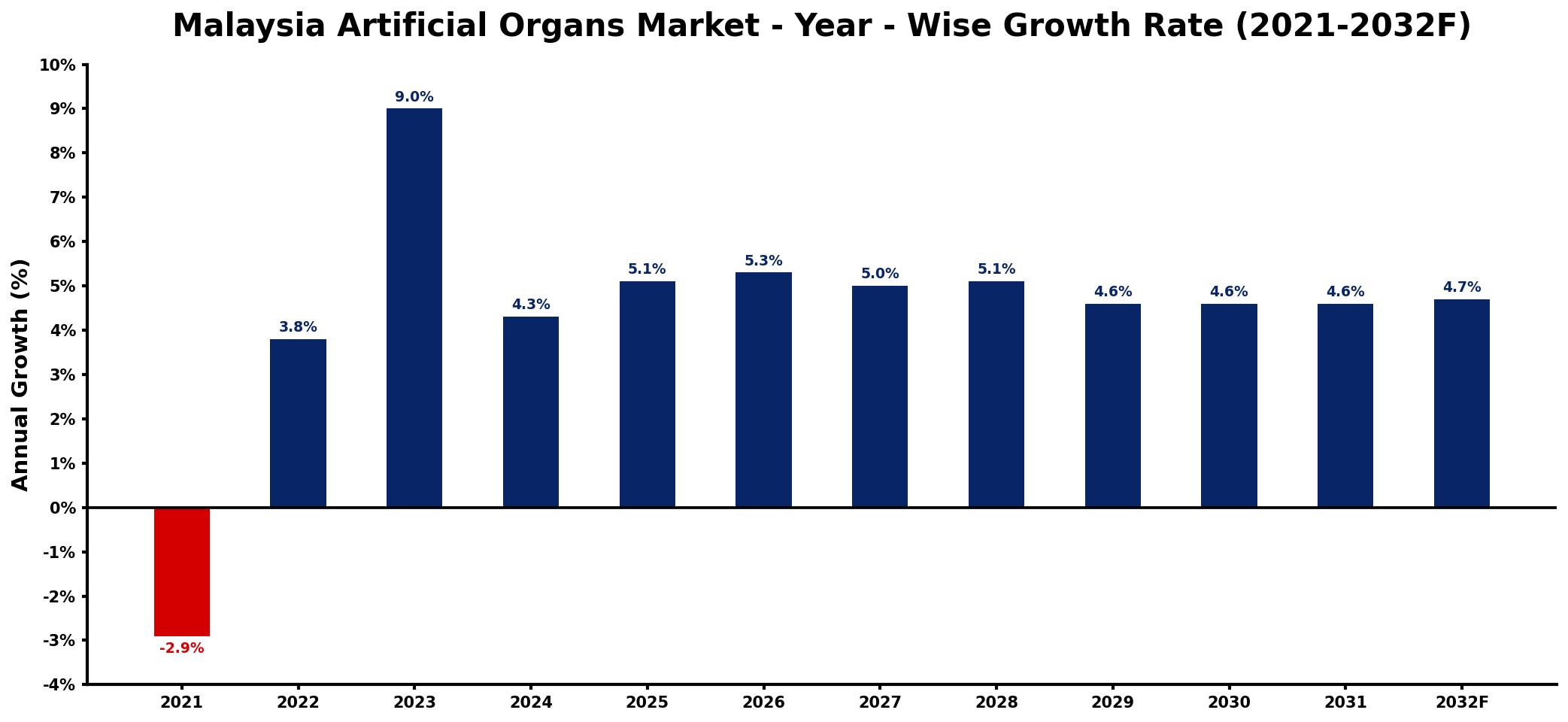
The table below presents the year‑wise growth rates along with the key drivers influencing the market
| Year | Growth Rate | Major Drivers |
| 2021 | -2.9% | decreased healthcare expenditure on innovations |
| 2022 | 3.8% | rising demand for advanced alternatives |
| 2023 | 9.0% | increased investment in biotechnology sector |
| 2024 | 4.3% | growing aging population requiring solutions |
| 2025 | 5.1% | expansion of healthcare infrastructure facilities |
| 2026 | 5.3% | rising export shipment volumes |
| 2027 | 5.0% | enhanced collaboration with tech startups |
| 2028 | 5.1% | improvement in regulatory approval processes |
| 2029 | 4.6% | increased awareness of medical technologies |
| 2030 | 4.6% | development of personalized treatment options |
| 2031 | 4.6% | growth in global market partnerships |
| 2032 | 4.7% | advancements in manufacturing techniques |
Note: Market size estimations and growth projections presented in this report are based on 6Wresearch's proprietary forecasting methodology, utilizing the latest available industry data, government publications, and primary research inputs.
Malaysia Artificial Organs Market Synopsis
The artificial organs market in Malaysia has recently seen an uptick in activity, driven largely by increasing healthcare awareness and advancements in technology. However, the path ahead presents both opportunities and challenges, with the market positioned for steady growth in the coming years.
In the short term, Malaysia's market is characterized by a growing demand for innovative artificial organs resulting from lifestyle changes and chronic health conditions. As public and private healthcare sectors evolve, they are expected to play a pivotal role in supporting the accessibility of these life-saving devices, helping to bridge gaps in healthcare delivery.
Malaysia Artificial Organs Market Key Takeaways
- The aging population is a primary driver for the increased demand for artificial organs in Malaysia.
- Technological advancements enhance the quality and durability of artificial organs, leading to higher acceptance rates.
- Accessibility to healthcare services and skilled professionals is improving, facilitating more surgeries and treatments.
- COVID-19 has impacted elective surgeries, yet the market is anticipated to rebound with normalized healthcare services.
- Key players in the market are continually innovating to improve patient outcomes and quality of life.
Evaluation of Restraints in Malaysia Artificial Organs Market
While the Malaysia Artificial Organs Market is on a growth trajectory, it does face several constraints that could impede rapid expansion. One significant issue is the regulatory environment, which can prolong the approval process for new technologies and devices. Additionally, the high costs associated with artificial organs create barriers for many patients, limiting their accessibility. Furthermore, the need for skilled medical professionals to implant and maintain these devices presents an ongoing challenge for healthcare systems. Addressing these constraints will be essential to unlocking the market's full potential.
Malaysia Artificial Organs Market Trends
Current trends in the Malaysia Artificial Organs Market reflect a shift toward more patient-centric designs and the integration of digital health technologies. The adoption of telemedicine and remote monitoring tools is revolutionizing patient care, allowing for better management of chronic conditions. Additionally, the increased focus on biocompatible materials is shaping the future of artificial organ development, with manufacturers striving for longer-lasting and more effective solutions. Such trends not only enhance patient outcomes but also contribute to a more efficient healthcare delivery system.
Malaysia Artificial Organs Market Opportunities
The future holds significant investment opportunities within the Malaysia Artificial Organs Market. Key areas for growth include research and development of next-generation artificial organs that utilize advanced materials and technology. There is also a burgeoning need for public-private partnerships to enhance healthcare infrastructure, which could facilitate greater access to artificial organ transplants. As awareness of organ donation and transplantation rises, expanding educational campaigns can further drive demand. Targeting these opportunities could yield substantial returns for investors and stakeholders alike.
Government Initiatives in the Malaysia Artificial Organs Market
The Malaysian government has implemented various initiatives aimed at improving healthcare access and quality, particularly in the field of organ transplantation. Policies promoting research into medical technology and public health awareness are crucial for advancing artificial organ solutions. Public funding directed towards healthcare infrastructure is also enhancing facilities for surgical procedures and patient care. Overall, government support plays a critical role in creating a conducive environment for growth within the artificial organs market.
Future Insights of the Malaysia Artificial Organs Market
Looking ahead to 2026-2032, the Malaysia Artificial Organs Market is expected to experience transformative changes propelled by ongoing technological innovations and enhanced healthcare policies. As the demand for artificial organs continues to rise, stakeholders will need to adapt to evolving patient needs and expectations. The integration of artificial intelligence and machine learning into medical devices may further streamline processes, resulting in improved patient outcomes. A concerted effort to address affordability and accessibility will be paramount to harnessing the market's full potential.
Malaysia Artificial Organs Market Latest Developments (2025 - 2026)
Recent developments within the Malaysia Artificial Organs Market indicate a strong push toward innovation and improved healthcare delivery. Collaborative efforts among medical institutions and private companies are focused on pioneering new artificial organ technologies. Additionally, patient-centric initiatives are gaining traction, ensuring that healthcare solutions are both effective and accessible. As the market adapts to changing dynamics, a focus on education regarding organ health is becoming increasingly critical.
Malaysia Artificial Organs Market - Key Attractiveness of the Report
- 10 Years of Market Numbers
- Historical Data Starting from 2022 to 2025
- Base Year: 2025
- Forecast Data until 2032
- Key Performance Indicators Impacting the Market
- Major Upcoming Developments and Projects
Key Highlights of the Report:
- Malaysia Artificial Organs Market Outlook
- Market Size of Malaysia Artificial Organs Market, 2025
- Forecast of Malaysia Artificial Organs Market, 2032
- Historical Data and Forecast of Malaysia Artificial Organs Revenues & Volume for the Period 2022-2032F
- Malaysia Artificial Organs Market Trend Evolution
- Malaysia Artificial Organs Market Drivers and Challenges
- Malaysia Artificial Organs Price Trends
- Malaysia Artificial Organs Porter's Five Forces
- Malaysia Artificial Organs Industry Life Cycle
- Historical Data and Forecast of Malaysia Artificial Organs Market Revenues & Volume By Product Type for the Period 2022-2032F
- Historical Data and Forecast of Malaysia Artificial Organs Market Revenues & Volume By Artificial Kidney for the Period 2022-2032F
- Historical Data and Forecast of Malaysia Artificial Organs Market Revenues & Volume By Artificial Heart for the Period 2022-2032F
- Historical Data and Forecast of Malaysia Artificial Organs Market Revenues & Volume By Artificial Pancreas for the Period 2022-2032F
- Historical Data and Forecast of Malaysia Artificial Organs Market Revenues & Volume By Cochlear Implants for the Period 2022-2032F
- Historical Data and Forecast of Malaysia Artificial Organs Market Revenues & Volume By Others for the Period 2022-2032F
- Malaysia Artificial Organs Import Export Trade Statistics
- Market Opportunity Assessment By Product Type
- Malaysia Artificial Organs Top Companies Market Share
- Malaysia Artificial Organs Competitive Benchmarking By Technical and Operational Parameters
- Malaysia Artificial Organs Company Profiles
- Malaysia Artificial Organs Key Strategic Recommendations






































