Malaysia Artificial Wood Beams Market Size, Share & Growth Rate
The Malaysia Artificial Wood Beams Market was estimated at USD 249 Million in 2025 and is projected to reach USD 324 Million by 2032, growing at a CAGR of 3.8% from 2026 to 2032. This growth trajectory is driven primarily by the ongoing expansion of the construction industry, which is fueled by urbanization and a rising demand for sustainable building materials. Additionally, the aesthetic and cost-effective qualities of artificial wood beams are resonating well with both commercial and residential developers.
Malaysia Artificial Wood Beams Market Year-wise Growth Rate and Key Drivers
This graph highlights how the Malaysia Artificial Wood Beams Market has steadily grown over the years, supported by major growth factors.
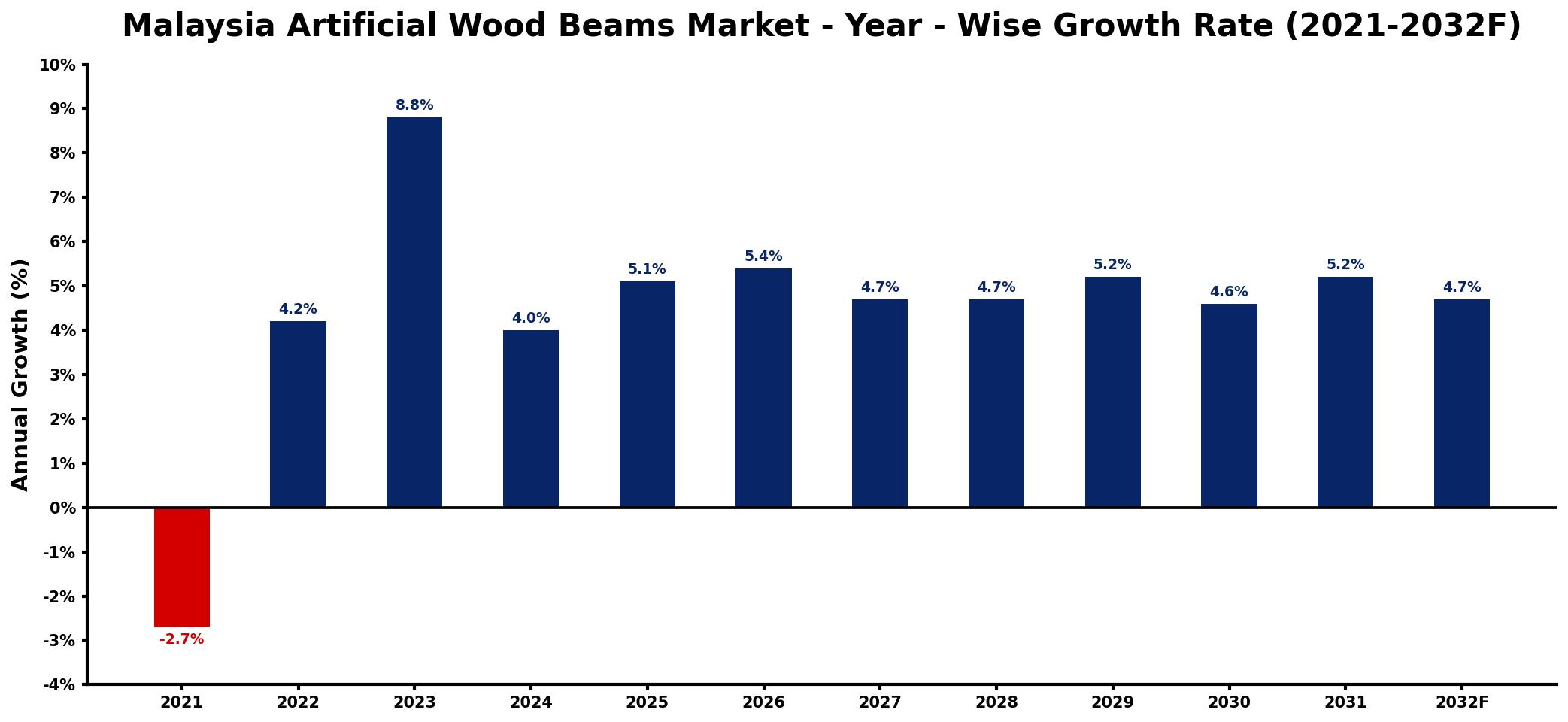
The table below presents the year‑wise growth rates along with the key drivers influencing the market
| Year | Growth Rate | Major Drivers |
| 2021 | -2.7% | construction projects experiencing slowdown |
| 2022 | 4.2% | increased demand from construction sector |
| 2023 | 8.8% | rise in residential building projects |
| 2024 | 4.0% | growing interest in sustainable materials |
| 2025 | 5.1% | expansion of renovation activities |
| 2026 | 5.4% | increased investments in infrastructure |
| 2027 | 4.7% | growth in commercial property development |
| 2028 | 4.7% | higher consumer preference for alternatives |
| 2029 | 5.2% | surge in eco-friendly construction trends |
| 2030 | 4.6% | enhanced focus on energy efficiency |
| 2031 | 5.2% | growing urbanization and population density |
| 2032 | 4.7% | development of new housing initiatives |
Note: Market size estimations and growth projections presented in this report are based on 6Wresearch's proprietary forecasting methodology, utilizing the latest available industry data, government publications, and primary research inputs.
Malaysia Artificial Wood Beams Market Synopsis
The strongest force shaping the Malaysia Artificial Wood Beams Market right now is the robust growth in the construction and real estate sectors. As infrastructure projects gain momentum and housing demands soar, artificial wood beams are increasingly favored for their combination of aesthetic appeal and durability.
The rising awareness of sustainable construction practices is also influencing market dynamics. Manufacturers are under growing pressure to innovate and offer eco-friendly products that align with global sustainability trends, thereby positioning artificial wood beams as a viable alternative to traditional materials.
Malaysia Artificial Wood Beams Market Key Takeaways
- Artificial wood beams are gaining popularity due to their cost-effectiveness and ease of installation.
- Urbanization and infrastructure development are significant drivers of market growth.
- The market is increasingly focusing on sustainable and eco-friendly options.
- Post-pandemic recovery has revived demand in the construction sector.
- Local manufacturers are responding to competition from traditional wood products with innovative solutions.
Evaluation of Restraints in Malaysia Artificial Wood Beams Market
Despite the promising growth prospects, the Malaysia Artificial Wood Beams Market faces several restraints that could limit its potential. One major concern is the increasing consumer awareness of environmental sustainability, which has spurred demand for truly eco-friendly materials. This shift requires manufacturers to adapt quickly and implement sustainable practices or risk losing market share. Additionally, competition from traditional wood beams and other alternative materials may hinder penetration, particularly in regions where such options are more entrenched in consumer preferences.
Malaysia Artificial Wood Beams Market Trends
Current trends in the Malaysia Artificial Wood Beams Market include a heightened focus on innovative design and customization to meet specific architectural demands. Advances in manufacturing technologies are also enabling the production of highly durable and aesthetically pleasing artificial wood products, further driving demand. Moreover, there is a noticeable trend toward integrating artificial wood beams into both traditional and modern designs, catering to a diverse range of consumer tastes.
Malaysia Artificial Wood Beams Market Opportunities
The potential for growth in the Malaysia Artificial Wood Beams Market lies in several areas. With ongoing urbanization, significant investment in infrastructure projects presents a ripe opportunity for manufacturers to showcase their products. Furthermore, as public and private sectors increasingly prioritize sustainable practices, there is a growing market for eco-friendly artificial wood solutions. These trends create avenues for innovation and expansion, inviting investment from both local and international stakeholders.
Government Initiatives in the Malaysia Artificial Wood Beams Market
The Malaysian government has been actively promoting sustainable construction through various policies and initiatives, emphasizing the importance of eco-friendly materials in building practices. Public spending on infrastructure projects is on the rise, with clear incentives for developers to integrate sustainable solutions into their designs. Such initiatives signal a favorable environment for the growth of the artificial wood beams market as companies align their offerings with government priorities.
Future Insights of the Malaysia Artificial Wood Beams Market
Looking ahead to 2026-2032, the Malaysia Artificial Wood Beams Market is poised for substantial growth. As urbanization continues and the demand for sustainable building materials intensifies, artificial wood beams will likely find broader applications across various construction projects. The industry's shift toward eco-friendly practices and innovative product offerings will serve as a catalyst for market expansion, ensuring a competitive landscape that accommodates emerging consumer preferences.
Malaysia Artificial Wood Beams Market Latest Developments (2025 - 2026)
Recent developments in the Malaysia Artificial Wood Beams Market have highlighted a concerted effort among manufacturers to enhance product offerings through innovative materials and designs. Companies are focusing on sustainable practices, responding to increasing demand for eco-friendly solutions. Additionally, collaborations between construction firms and product manufacturers are becoming more prevalent, facilitating a seamless integration of artificial wood beams into various projects.
Malaysia Artificial Wood Beams Market - Key Attractiveness of the Report
- 10 Years of Market Numbers
- Historical Data Starting from 2022 to 2025
- Base Year: 2025
- Forecast Data until 2032
- Key Performance Indicators Impacting the Market
- Major Upcoming Developments and Projects
Key Highlights of the Report:
- Malaysia Artificial Wood Beams Market Outlook
- Market Size of Malaysia Artificial Wood Beams Market, 2025
- Forecast of Malaysia Artificial Wood Beams Market, 2032
- Historical Data and Forecast of Malaysia Artificial Wood Beams Revenues & Volume for the Period 2022-2032F
- Malaysia Artificial Wood Beams Market Trend Evolution
- Malaysia Artificial Wood Beams Market Drivers and Challenges
- Malaysia Artificial Wood Beams Price Trends
- Malaysia Artificial Wood Beams Porter's Five Forces
- Malaysia Artificial Wood Beams Industry Life Cycle
- Historical Data and Forecast of Malaysia Artificial Wood Beams Market Revenues & Volume By Product Type for the Period 2022-2032F
- Historical Data and Forecast of Malaysia Artificial Wood Beams Market Revenues & Volume By U-shaped Beams for the Period 2022-2032F
- Historical Data and Forecast of Malaysia Artificial Wood Beams Market Revenues & Volume By Box Beams for the Period 2022-2032F
- Historical Data and Forecast of Malaysia Artificial Wood Beams Market Revenues & Volume By Arched Beams for the Period 2022-2032F
- Historical Data and Forecast of Malaysia Artificial Wood Beams Market Revenues & Volume By Decorative Beams for the Period 2022-2032F
- Historical Data and Forecast of Malaysia Artificial Wood Beams Market Revenues & Volume By Others for the Period 2022-2032F
- Historical Data and Forecast of Malaysia Artificial Wood Beams Market Revenues & Volume By Material Type for the Period 2022-2032F
- Historical Data and Forecast of Malaysia Artificial Wood Beams Market Revenues & Volume By Thermoplastic for the Period 2022-2032F
- Historical Data and Forecast of Malaysia Artificial Wood Beams Market Revenues & Volume By Thermosetting for the Period 2022-2032F
- Historical Data and Forecast of Malaysia Artificial Wood Beams Market Revenues & Volume By Others for the Period 2022-2032F
- Historical Data and Forecast of Malaysia Artificial Wood Beams Market Revenues & Volume By End Users for the Period 2022-2032F
- Historical Data and Forecast of Malaysia Artificial Wood Beams Market Revenues & Volume By Residential for the Period 2022-2032F
- Historical Data and Forecast of Malaysia Artificial Wood Beams Market Revenues & Volume By Commercial for the Period 2022-2032F
- Malaysia Artificial Wood Beams Import Export Trade Statistics
- Market Opportunity Assessment By Product Type
- Market Opportunity Assessment By Material Type
- Market Opportunity Assessment By End Users
- Malaysia Artificial Wood Beams Top Companies Market Share
- Malaysia Artificial Wood Beams Competitive Benchmarking By Technical and Operational Parameters
- Malaysia Artificial Wood Beams Company Profiles
- Malaysia Artificial Wood Beams Key Strategic Recommendations






































