Malaysia Auto Parts And Accessories Market Size, Share & Growth Rate
The Malaysia Auto Parts And Accessories Market was estimated at USD 493 Million in 2025 and is projected to reach USD 643 Million by 2032, growing at a CAGR of 3.9% from 2026 to 2032. This anticipated growth is primarily fueled by the increasing number of vehicles on Malaysian roads, coupled with a vibrant automotive aftermarket eager for both replacement parts and innovative accessories. The market is also benefiting from rising consumer interest in vehicle customization, which drives demand for specialized aftermarket products.
Malaysia Auto Parts And Accessories Market Year-wise Growth Rate and Key Drivers
This graph highlights how the Malaysia Auto Parts And Accessories Market has steadily grown over the years, supported by major growth factors.
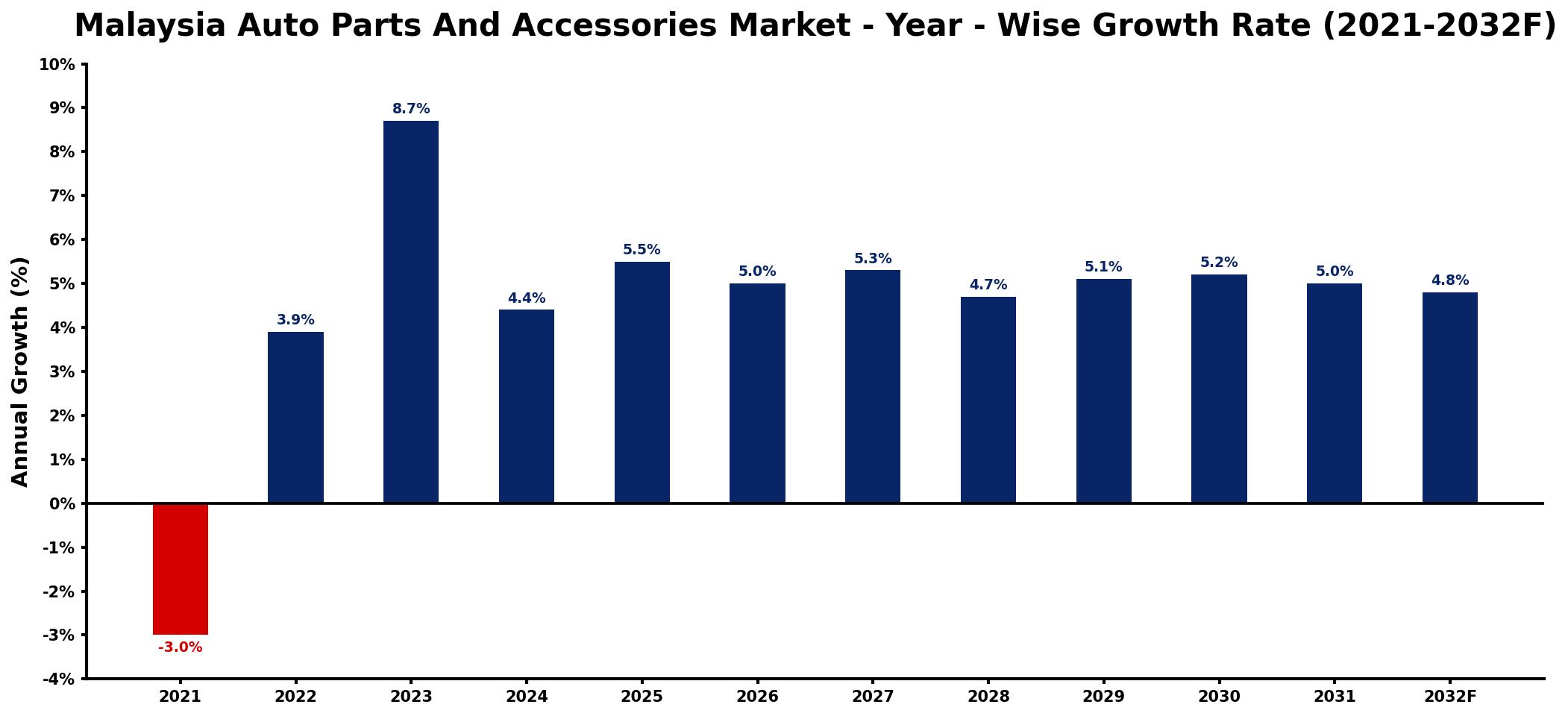
The table below presents the year‑wise growth rates along with the key drivers influencing the market
| Year | Growth Rate | Major Drivers |
| 2021 | -3.0% | decrease in consumer spending |
| 2022 | 3.9% | rising demand for vehicles |
| 2023 | 8.7% | increased investments in technology |
| 2024 | 4.4% | growth in e-commerce platforms |
| 2025 | 5.5% | expansion of manufacturing capabilities |
| 2026 | 5.0% | enhanced distribution network efficiency |
| 2027 | 5.3% | growing interest in sustainability |
| 2028 | 4.7% | demand for electric vehicle solutions |
| 2029 | 5.1% | growing downstream application demand |
| 2030 | 5.2% | adoption of smart technologies |
| 2031 | 5.0% | strengthening regional trade agreements |
| 2032 | 4.8% | focus on supply chain resilience |
Note: Market size estimations and growth projections presented in this report are based on 6Wresearch's proprietary forecasting methodology, utilizing the latest available industry data, government publications, and primary research inputs.
Malaysia Auto Parts And Accessories Market Synopsis
In Malaysia, the auto parts and accessories market thrives on a well-established network of suppliers and distributors, ensuring a seamless supply chain that caters to both traditional and modern automotive needs. The market's strength is further amplified by the growing trend of vehicle modification, as consumers increasingly seek to personalize their automobiles.
Additionally, technological advancements in automotive parts, especially those catering to electric and hybrid vehicles, are gaining ground. With a continuous focus on vehicle safety and performance enhancements, the demand for high-quality parts is becoming increasingly pronounced among Malaysian consumers.
Malaysia Auto Parts And Accessories Market Key Takeaways
- The market is bolstered by a strong automotive industry and a rising vehicle count.
- Technological advancements in electric and hybrid vehicle components are reshaping product offerings.
- Consumer interest in vehicle safety and customization drives demand for quality parts.
- Government support for local manufacturing presents further growth opportunities.
- Emerging trends in e-commerce are transforming distribution strategies in the aftermarket sector.
Evaluation of Restraints in Malaysia Auto Parts And Accessories Market
Despite the positive outlook, certain constraints limit the growth of the auto parts and accessories market in Malaysia. The increasing prevalence of counterfeit products poses a significant challenge, impacting both brand integrity and consumer trust. Furthermore, global supply chain disruptions have created volatility in the availability of key components, making it difficult for manufacturers to maintain consistent production levels. Lastly, rapidly evolving consumer preferences demand constant innovation, placing pressure on market players to adapt quickly to maintain competitiveness.
Malaysia Auto Parts And Accessories Market Trends
Several trends are currently shaping the Malaysian auto parts and accessories market. The shift toward electric vehicles is notably significant, with a burgeoning demand for EV-specific parts and accessories. Additionally, the rise of e-commerce platforms is enabling consumers to access a broader range of products conveniently, transforming traditional purchasing behaviors. Customization remains a strong trend, with consumers eager to enhance aesthetics and performance, thereby pushing suppliers to innovate continually.
Malaysia Auto Parts And Accessories Market Opportunities
The auto parts and accessories market in Malaysia presents numerous growth opportunities. The increasing inclination towards electric and hybrid vehicles is one area ripe for investment, as companies develop and supply parts specifically designed for these models. Additionally, the automotive aftermarket is seeing a surge in demand for technologically advanced products, including safety features and performance enhancements. Companies that can harness these emerging trends stand to gain significant market share.
Government Initiatives in the Malaysia Auto Parts And Accessories Market
The Malaysian government is actively promoting its automotive industry through various policies and initiatives aimed at fostering local manufacturing and innovation. Incentives for research and development in automotive technology, including electric vehicles, are gaining traction. Public spending on infrastructure improvements is also expected to enhance the automotive ecosystem, facilitating better distribution channels and accessibility for auto parts and accessories.
Future Insights of the Malaysia Auto Parts And Accessories Market
Looking ahead to 2026-2032, the Malaysian auto parts and accessories market is likely to continue its upward trajectory, driven by the dual forces of vehicle proliferation and technological advancement. As consumer preferences evolve, the market will need to pivot towards more sustainable and innovative products, particularly in the electric vehicle segment. The ongoing government support and a robust distribution network will play crucial roles in shaping the future landscape of this dynamic market.
Malaysia Auto Parts And Accessories Market Latest Developments (2025 - 2026)
Recent developments in the Malaysia auto parts and accessories market indicate a shift towards digitalization. Industry players are increasingly adopting e-commerce strategies to cater to a tech-savvy consumer base. Moreover, there is a growing focus on enhancing supply chain resilience to mitigate impacts from global disruptions. Innovations in product design and functionality are expected to take center stage as companies respond to emerging consumer trends.
Malaysia Auto Parts And Accessories Market - Key Attractiveness of the Report
- 10 Years of Market Numbers
- Historical Data Starting from 2022 to 2025
- Base Year: 2025
- Forecast Data until 2032
- Key Performance Indicators Impacting the Market
- Major Upcoming Developments and Projects
Key Highlights of the Report:
- Malaysia Auto Parts And Accessories Market Outlook
- Market Size of Malaysia Auto Parts And Accessories Market, 2025
- Forecast of Malaysia Auto Parts And Accessories Market, 2032
- Historical Data and Forecast of Malaysia Auto Parts And Accessories Revenues & Volume for the Period 2022-2032F
- Malaysia Auto Parts And Accessories Market Trend Evolution
- Malaysia Auto Parts And Accessories Market Drivers and Challenges
- Malaysia Auto Parts And Accessories Price Trends
- Malaysia Auto Parts And Accessories Porter's Five Forces
- Malaysia Auto Parts And Accessories Industry Life Cycle
- Historical Data and Forecast of Malaysia Auto Parts And Accessories Market Revenues & Volume By Product for the Period 2022-2032F
- Historical Data and Forecast of Malaysia Auto Parts And Accessories Market Revenues & Volume By Driveline & Powertrain for the Period 2022-2032F
- Historical Data and Forecast of Malaysia Auto Parts And Accessories Market Revenues & Volume By Interiors & Exteriors for the Period 2022-2032F
- Historical Data and Forecast of Malaysia Auto Parts And Accessories Market Revenues & Volume By Electronics for the Period 2022-2032F
- Historical Data and Forecast of Malaysia Auto Parts And Accessories Market Revenues & Volume By Bodies & Chassis for the Period 2022-2032F
- Historical Data and Forecast of Malaysia Auto Parts And Accessories Market Revenues & Volume By Wheel & Tires for the Period 2022-2032F
- Historical Data and Forecast of Malaysia Auto Parts And Accessories Market Revenues & Volume By Others for the Period 2022-2032F
- Historical Data and Forecast of Malaysia Auto Parts And Accessories Market Revenues & Volume By Application for the Period 2022-2032F
- Historical Data and Forecast of Malaysia Auto Parts And Accessories Market Revenues & Volume By OEMs for the Period 2022-2032F
- Historical Data and Forecast of Malaysia Auto Parts And Accessories Market Revenues & Volume By Aftermarket for the Period 2022-2032F
- Malaysia Auto Parts And Accessories Import Export Trade Statistics
- Market Opportunity Assessment By Product
- Market Opportunity Assessment By Application
- Malaysia Auto Parts And Accessories Top Companies Market Share
- Malaysia Auto Parts And Accessories Competitive Benchmarking By Technical and Operational Parameters
- Malaysia Auto Parts And Accessories Company Profiles
- Malaysia Auto Parts And Accessories Key Strategic Recommendations






































