Malaysia Automotive Reversing Radar Market Size, Share & Growth Rate
The Malaysia Automotive Reversing Radar Market was estimated at USD 1405 Million in 2025 and is projected to reach USD 2081 Million by 2032, growing at a CAGR of 5.8% from 2026 to 2032. This growth trajectory is fueled by increasing vehicle sales, heightened consumer awareness regarding road safety, and stringent regulatory frameworks that emphasize the incorporation of advanced safety technologies in automobiles. As more urban areas expand and vehicle populations rise, the demand for reversing radar systems is expected to escalate significantly.
Malaysia Automotive Reversing Radar Market Year-wise Growth Rate and Key Drivers
This graph highlights how the Malaysia Automotive Reversing Radar Market has steadily grown over the years, supported by major growth factors.
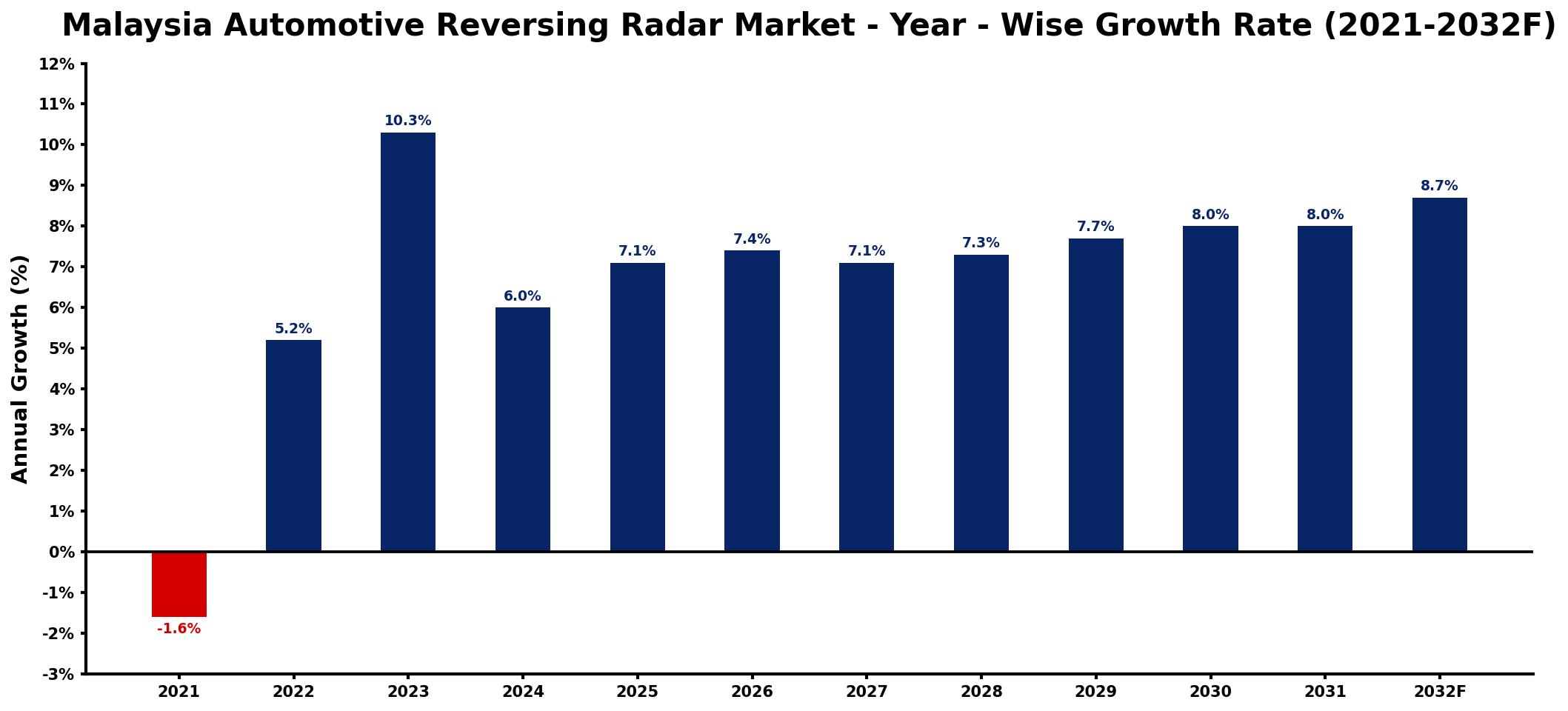
The table below presents the year‑wise growth rates along with the key drivers influencing the market
| Year | Growth Rate | Major Drivers |
| 2021 | -1.6% | decreased consumer spending on technology |
| 2022 | 5.2% | rising demand for safety features |
| 2023 | 10.3% | growing interest in smart vehicles |
| 2024 | 6.0% | increased investment in vehicle technology |
| 2025 | 7.1% | expanding urban infrastructure projects |
| 2026 | 7.4% | enhanced regulations for vehicle safety |
| 2027 | 7.1% | surge in electric vehicle adoption |
| 2028 | 7.3% | growing awareness of road safety |
| 2029 | 7.7% | improvements in manufacturing capabilities |
| 2030 | 8.0% | expansion of consumer electronics market |
| 2031 | 8.0% | rising popularity of advanced features |
| 2032 | 8.7% | increased collaboration in technology sectors |
Note: Market size estimations and growth projections presented in this report are based on 6Wresearch's proprietary forecasting methodology, utilizing the latest available industry data, government publications, and primary research inputs.
Malaysia Automotive Reversing Radar Market Synopsis
The Malaysian automotive landscape is witnessing a transformation driven by an unwavering focus on vehicle safety. Reversing radar systems, also known as backup sensors, are becoming integral components of modern vehicles, essential for mitigating collision risks during reverse maneuvers. This shift is not just a trend but a response to the increasing number of vehicles on the roads and the evolving expectations of safety-conscious consumers.
In response to rising safety demands, manufacturers are innovating rapidly to enhance radar technologies and integrate them with existing vehicle safety systems. The overall impact is a growing acceptance of reversing radars as standard equipment in new cars, further augmenting their market presence as a vital feature for urban driving environments.
Malaysia Automotive Reversing Radar Market Key Takeaways
- The market is projected to grow significantly, driven by increased vehicle sales and urbanization.
- Rising consumer expectations for advanced safety features are influencing market dynamics.
- Technological advancements are pivotal in developing innovative reversing radar solutions.
- Regulatory frameworks are becoming more stringent, supporting the adoption of safety features in vehicles.
- Cost-effectiveness remains a crucial factor for manufacturers amidst rising consumer demand.
Evaluation of Restraints in Malaysia Automotive Reversing Radar Market
The Malaysian automotive reversing radar market faces several restraints that can hinder its growth. The rapid pace of technological advancements means that manufacturers must continuously innovate to meet consumer expectations for cutting-edge features. Theres a growing demand for integrated systems, such as 360-degree sensors and automated parking assistance, which can create significant pressure on production and development costs. Additionally, navigating complex regulatory requirements related to frequency allocations and safety standards poses a challenge for market participants, potentially delaying product launches and increasing operational complexities.
Malaysia Automotive Reversing Radar Market Trends
Emerging trends in the Malaysian automotive reversing radar market highlight a shift toward enhanced integration of technology and user-centric design. The move towards smart vehicles is prompting manufacturers to combine reversing radars with other safety systems, creating comprehensive driver-assistance packages. Furthermore, the integration of Artificial Intelligence (AI) in sensor technology is enhancing the accuracy and responsiveness of reversing radars, making them indispensable for modern driving scenarios. The focus is also shifting toward more affordable solutions without compromising safety, appealing to a broader consumer base.
Malaysia Automotive Reversing Radar Market Opportunities
The landscape of the Malaysian automotive reversing radar market is ripe with opportunities for growth and innovation. With the increasing number of vehicles and a rising trend in urbanization, manufacturers have a chance to develop cost-effective and advanced reversing radar systems. There is significant potential for partnerships with automotive manufacturers to embed these systems as standard features. Additionally, the aftermarket segment presents substantial opportunities for firms providing retrofitted solutions for older vehicle models, catering to the safety-conscious consumer.
Government Initiatives in the Malaysia Automotive Reversing Radar Market
The Malaysian government is actively promoting road safety through various initiatives and regulations aimed at enhancing vehicle safety standards. Policies encouraging the adoption of advanced safety features, such as reversing radar systems, reflect a commitment to reducing traffic accidents and fatalities. Public spending on infrastructure improvements and the promotion of smart city initiatives further bolster the integration of advanced automotive technologies, creating a conducive environment for the growth of the reversing radar market.
Future Insights of the Malaysia Automotive Reversing Radar Market
Looking ahead to 2026-2032, the Malaysian automotive reversing radar market is positioned for transformative growth. Innovations in sensor technology and a shift toward fully integrated safety systems will likely drive consumer adoption. Additionally, as urban areas expand and the number of vehicles continues to rise, safety features such as reversing radars will become essential components in all vehicle segments. Continued advancements and the push towards smarter and more connected vehicles will play a critical role in shaping the market's future, ultimately leading to improved road safety across Malaysia.
Malaysia Automotive Reversing Radar Market Latest Developments (2025 - 2026)
Recent trends indicate a consolidation of efforts among manufacturers to innovate and upgrade reversing radar technologies. There has been a notable emphasis on developing systems that not only alert drivers to obstacles but also integrate with other smart vehicle technologies. Collaborations between automakers and technology firms are becoming more prevalent, aiming to deliver comprehensive safety solutions that meet consumer demands for enhanced vehicle safety and convenience.
Malaysia Automotive Reversing Radar Market - Key Attractiveness of the Report
- 10 Years of Market Numbers
- Historical Data Starting from 2022 to 2025
- Base Year: 2025
- Forecast Data until 2032
- Key Performance Indicators Impacting the Market
- Major Upcoming Developments and Projects
Key Highlights of the Report:
- Malaysia Automotive Reversing Radar Market Outlook
- Market Size of Malaysia Automotive Reversing Radar Market, 2025
- Forecast of Malaysia Automotive Reversing Radar Market, 2032
- Historical Data and Forecast of Malaysia Automotive Reversing Radar Revenues & Volume for the Period 2022-2032F
- Malaysia Automotive Reversing Radar Market Trend Evolution
- Malaysia Automotive Reversing Radar Market Drivers and Challenges
- Malaysia Automotive Reversing Radar Price Trends
- Malaysia Automotive Reversing Radar Porter's Five Forces
- Malaysia Automotive Reversing Radar Industry Life Cycle
- Historical Data and Forecast of Malaysia Automotive Reversing Radar Market Revenues & Volume By Type for the Period 2022-2032F
- Historical Data and Forecast of Malaysia Automotive Reversing Radar Market Revenues & Volume By Ultrasonic for the Period 2022-2032F
- Historical Data and Forecast of Malaysia Automotive Reversing Radar Market Revenues & Volume By Electromagnetic for the Period 2022-2032F
- Historical Data and Forecast of Malaysia Automotive Reversing Radar Market Revenues & Volume By Application for the Period 2022-2032F
- Historical Data and Forecast of Malaysia Automotive Reversing Radar Market Revenues & Volume By Passenger Vehicle for the Period 2022-2032F
- Historical Data and Forecast of Malaysia Automotive Reversing Radar Market Revenues & Volume By Commercial Vehicle for the Period 2022-2032F
- Malaysia Automotive Reversing Radar Import Export Trade Statistics
- Market Opportunity Assessment By Type
- Market Opportunity Assessment By Application
- Malaysia Automotive Reversing Radar Top Companies Market Share
- Malaysia Automotive Reversing Radar Competitive Benchmarking By Technical and Operational Parameters
- Malaysia Automotive Reversing Radar Company Profiles
- Malaysia Automotive Reversing Radar Key Strategic Recommendations






































