Malaysia Ballast Water Treatment Market Size, Share & Growth Rate
The Malaysia Ballast Water Treatment Market was estimated at USD 253 Million in 2025 and is projected to reach USD 330 Million by 2032, growing at a CAGR of 3.9% from 2026 to 2032. This growth trajectory is primarily fueled by tightening environmental regulations demanding compliance from shipowners and operators. As international standards become increasingly stringent, the imperative for effective ballast water management systems intensifies, aligning with Malaysias strategic position as a significant player in the maritime industry.
Malaysia Ballast Water Treatment Market Year-wise Growth Rate and Key Drivers
This graph highlights how the Malaysia Ballast Water Treatment Market has steadily grown over the years, supported by major growth factors.
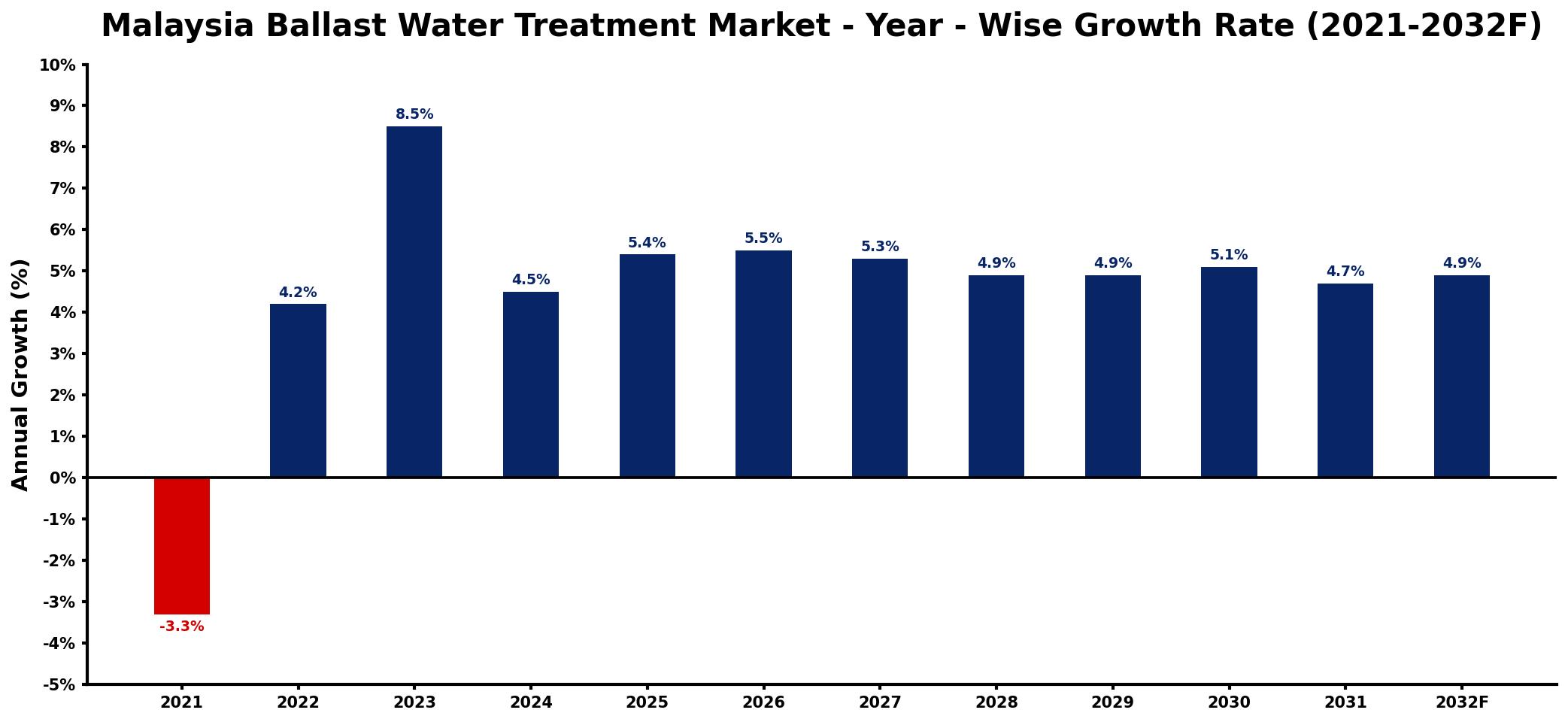
The table below presents the year‑wise growth rates along with the key drivers influencing the market
| Year | Growth Rate | Major Drivers |
| 2021 | -3.3% | decreased maritime environmental regulations |
| 2022 | 4.2% | rising marine ecosystem protection initiatives |
| 2023 | 8.5% | increased shipping industry investments |
| 2024 | 4.5% | growing awareness of biodiversity preservation |
| 2025 | 5.4% | expanding port infrastructure development projects |
| 2026 | 5.5% | heightened global sustainability commitments |
| 2027 | 5.3% | increased demand for eco-friendly solutions |
| 2028 | 4.9% | growing maritime compliance requirements |
| 2029 | 4.9% | enhanced international regulatory frameworks |
| 2030 | 5.1% | rising technological innovations adoption |
| 2031 | 4.7% | growing partnerships in marine conservation |
| 2032 | 4.9% | increased focus on environmental stewardship |
Note: Market size estimations and growth projections presented in this report are based on 6Wresearch's proprietary forecasting methodology, utilizing the latest available industry data, government publications, and primary research inputs.
Malaysia Ballast Water Treatment Market Synopsis
The Malaysian ballast water treatment market is seeing a surge in demand, driven by the nation's robust maritime activities and a growing awareness of the ecological impact of untreated ballast water. With over 100 ports and extensive shipping routes, Malaysia recognizes the crucial role of ballast water management in protecting its unique marine biodiversity.
As regulations evolve, shipowners are increasingly investing in advanced treatment systems to ensure compliance with international conventions aimed at preventing the spread of invasive aquatic species. This shift is not only about adherence to laws but also about embracing a sustainable approach to shipping practices.
Malaysia Ballast Water Treatment Market Key Takeaways
- Increased regulatory scrutiny is driving demand for advanced ballast water treatment systems in Malaysia.
- Investments in this sector reflect a broader commitment to environmental sustainability and compliance with international standards.
- The market is strategically positioned for growth due to Malaysias active shipping routes and vibrant maritime industry.
- Technological advancements are leading to more efficient and cost-effective ballast water management solutions.
- COVID-19 disruptions have delayed some investments, but recovery signals a rebound in maritime activities.
Evaluation of Restraints in Malaysia Ballast Water Treatment Market
Despite the promising growth outlook, the Malaysia ballast water treatment market faces notable challenges. Chief among these are the financial burdens associated with implementing compliance measures for smaller shipping companies. The costs of acquiring, installing, and maintaining state-of-the-art ballast water treatment systems can be prohibitive, potentially stifling broader adoption. Furthermore, the technical expertise required to operate these systems effectively remains a barrier, necessitating training and development that could strain resources.
Malaysia Ballast Water Treatment Market Trends
The market is witnessing several notable trends shaping both demand and technology. A significant movement towards the adoption of eco-friendly technologies is emerging, as stakeholders increasingly recognize the environmental impacts associated with ballast water discharge. Additionally, collaborative partnerships between technology providers and shipping companies are on the rise, aimed at developing integrated solutions that streamline compliance and operational efficiency.
Malaysia Ballast Water Treatment Market Opportunities
Investors and stakeholders in the Malaysia ballast water treatment market have numerous opportunities to explore. The push for sustainable maritime practices opens avenues for innovation in treatment technologies, particularly in areas such as chemical treatment solutions and filtration systems. Furthermore, the potential for government support and incentives for adopting green technologies adds an additional layer of opportunity for growth and development in this sector.
Government Initiatives in the Malaysia Ballast Water Treatment Market
The Malaysian government has enacted a series of policies aimed at enhancing maritime sustainability and ensuring compliance with international environmental standards. These initiatives include funding for research into advanced ballast water treatment technologies and the establishment of public-private partnerships to facilitate infrastructure development. Such proactive measures reflect a commitment to safeguarding Malaysias marine environments while supporting the growth of the maritime sector.
Future Insights of the Malaysia Ballast Water Treatment Market
Looking ahead to 2026-2032, the Malaysia ballast water treatment market is set to undergo significant transformation. The ongoing evolution of environmental regulations will compel shipowners to invest more heavily in compliance solutions. As the market matures, innovation will be key, with technologies becoming increasingly automated and efficient. This period will also likely see the emergence of more comprehensive regulations addressing not just treatment but also the overall management of ballast water throughout a vessel's lifecycle.
Malaysia Ballast Water Treatment Market Latest Developments (2025 - 2026)
Recent developments in the Malaysia ballast water treatment market indicate a pivot toward enhanced technological solutions. Companies are focusing on research and development efforts to bring forth systems that are not only effective but also cost-efficient. Moreover, collaborations between local maritime businesses and technology developers are increasingly common, suggesting a concerted effort to navigate regulatory landscapes and market demands successfully.
Malaysia Ballast Water Treatment Market - Key Attractiveness of the Report
- 10 Years of Market Numbers
- Historical Data Starting from 2022 to 2025
- Base Year: 2025
- Forecast Data until 2032
- Key Performance Indicators Impacting the Market
- Major Upcoming Developments and Projects
Key Highlights of the Report:
- Malaysia Ballast Water Treatment Market Outlook
- Market Size of Malaysia Ballast Water Treatment Market, 2025
- Forecast of Malaysia Ballast Water Treatment Market, 2032
- Historical Data and Forecast of Malaysia Ballast Water Treatment Revenues & Volume for the Period 2022-2032F
- Malaysia Ballast Water Treatment Market Trend Evolution
- Malaysia Ballast Water Treatment Market Drivers and Challenges
- Malaysia Ballast Water Treatment Price Trends
- Malaysia Ballast Water Treatment Porter's Five Forces
- Malaysia Ballast Water Treatment Industry Life Cycle
- Historical Data and Forecast of Malaysia Ballast Water Treatment Market Revenues & Volume By Technology for the Period 2022-2032F
- Historical Data and Forecast of Malaysia Ballast Water Treatment Market Revenues & Volume By Physical Disinfection for the Period 2022-2032F
- Historical Data and Forecast of Malaysia Ballast Water Treatment Market Revenues & Volume By Mechanical Method for the Period 2022-2032F
- Historical Data and Forecast of Malaysia Ballast Water Treatment Market Revenues & Volume By Chemical Method for the Period 2022-2032F
- Historical Data and Forecast of Malaysia Ballast Water Treatment Market Revenues & Volume By Service for the Period 2022-2032F
- Historical Data and Forecast of Malaysia Ballast Water Treatment Market Revenues & Volume By Installation & Calibration for the Period 2022-2032F
- Historical Data and Forecast of Malaysia Ballast Water Treatment Market Revenues & Volume By Performance Measurement for the Period 2022-2032F
- Historical Data and Forecast of Malaysia Ballast Water Treatment Market Revenues & Volume By Recommissioning for the Period 2022-2032F
- Malaysia Ballast Water Treatment Import Export Trade Statistics
- Market Opportunity Assessment By Technology
- Market Opportunity Assessment By Service
- Malaysia Ballast Water Treatment Top Companies Market Share
- Malaysia Ballast Water Treatment Competitive Benchmarking By Technical and Operational Parameters
- Malaysia Ballast Water Treatment Company Profiles
- Malaysia Ballast Water Treatment Key Strategic Recommendations






































