Malaysia Benzoic Acid Market Size Growth Rate
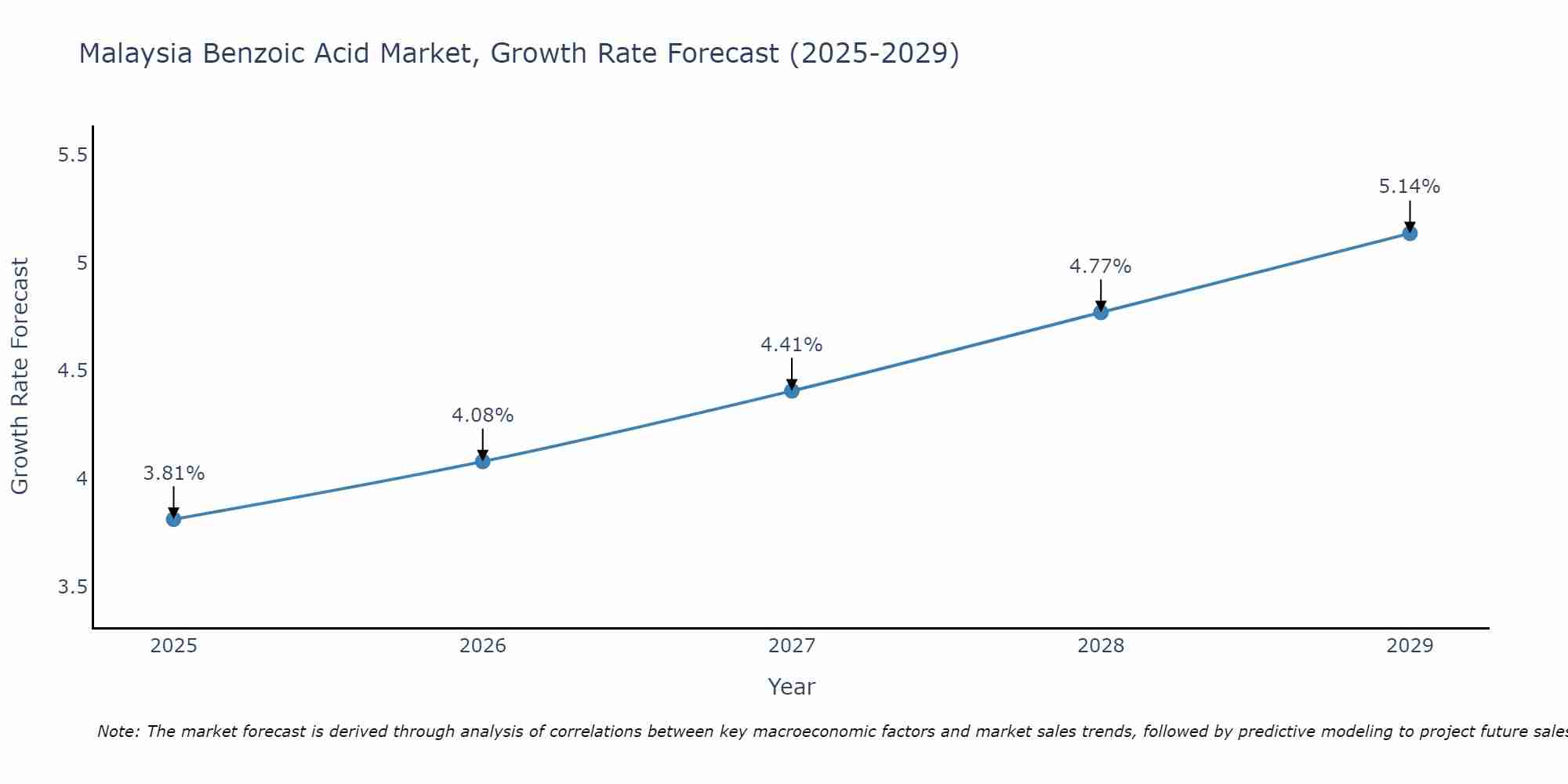
The Malaysia Benzoic Acid Market is poised for steady growth rate improvements from 2025 to 2029. The growth rate starts at 3.81% in 2025 and reaches 5.14% by 2029.
Benzoic Acid Market: Malaysia vs Top 5 Major Economies in 2027 (Asia)
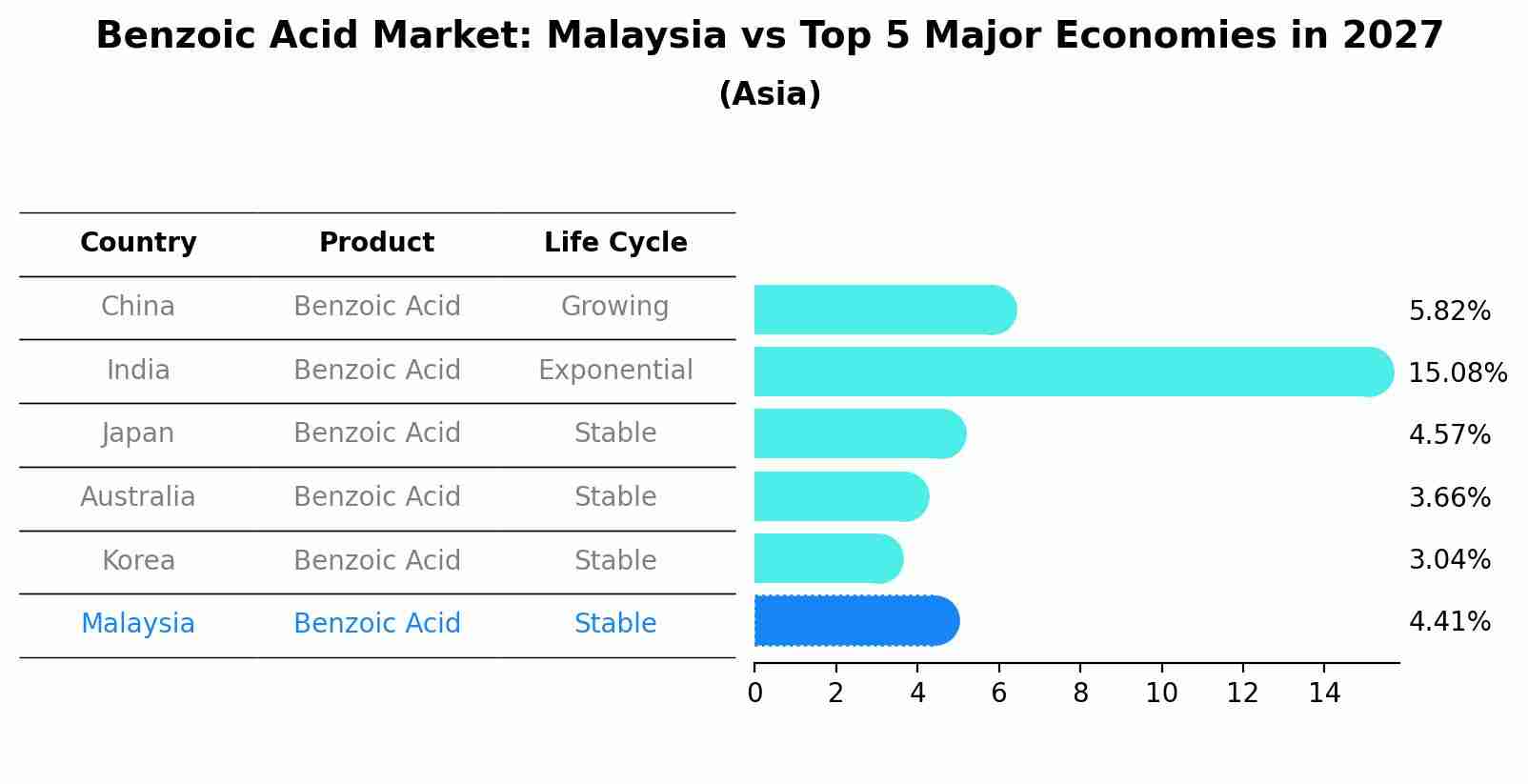
The Benzoic Acid market in Malaysia is projected to grow at a stable growth rate of 4.41% by 2027, highlighting the country's increasing focus on advanced technologies within the Asia region, where China holds the dominant position, followed closely by India, Japan, Australia and South Korea, shaping overall regional demand.
Malaysia Benzoic Acid Market Synopsis
The market for benzoic acid in Malaysia is estimated to be worth USD 9.1 million in 2025 and is expected to grow at a CAGR of 4.4% over the froecast period. The increasing demand from the food & beverage industry, personal care products, paints & coatings, and pharmaceuticals industries are driving the growth of this market. In 2025, Asia Pacific held the largest share in terms of value among all regions globally with China leading as top consumer with nearly 61%.
Market Drivers of the market
The benzoic acid market in Malaysia is expected to witness steady growth due to the increasing demand from the food and beverage, pharmaceutical, and personal care industries. Benzoic acid is widely used as a preservative in food and beverages, as well as an intermediate in pharmaceutical and cosmetic formulations. The growing population, changing consumer lifestyles, and the need for longer shelf life of products will drive the demand for benzoic acid. Moreover, the expansion of the pharmaceutical and personal care sectors will further contribute to market growth. However, market growth may be hindered by the presence of stringent regulations on preservatives in food and the availability of alternative preservative options.
Challenges of the market
The benzoic acid market in Malaysia faces certain challenges that may impact its growth and market dynamics. One of the significant challenges is the competition from other preservatives and food additives that offer similar functionalities. Benzoic acid is widely used as a preservative in food and beverages, but there may be alternative preservatives with comparable efficacy. Additionally, the need for natural and clean-label ingredients in food products can impact the demand for synthetic preservatives like benzoic acid. Moreover, regulations on the maximum allowable limits of preservatives in food products can affect the market demand. To address these challenges, the industry needs to focus on product innovation, explore new applications, and promote the benefits of benzoic acid in preserving food quality and safety.
Covid-19 Impact on the market
The benzoic acid market could have been impacted by disruptions in the food and beverage and pharmaceutical industries. As consumer preferences shifted during the pandemic, the demand for certain products containing benzoic acid might have been affected.
Key Players of the market
The Malaysia benzoic acid market is largely dominated by some of the key players such as BASF, P&G Chemicals, Solvay SA, Emerald Performance Materials (formerly known as PolyOne Corporation), and AkzoNobel. BASF is the largest producer in the region with a significant share in terms of volume and value. Other companies operating in this space include Eastman Chemical Company, Stepan Company, Clariant AG, Niacet Corporation, Kao Corporation and others. All these leading players are continuously focusing on innovation and product development to gain an edge over their competitors.
Key Highlights of the Report:
- Malaysia Benzoic Acid Market Outlook
- Market Size of Malaysia Benzoic Acid Market, 2024
- Forecast of Malaysia Benzoic Acid Market, 2031
- Historical Data and Forecast of Malaysia Benzoic Acid Revenues & Volume for the Period 2021-2031
- Malaysia Benzoic Acid Market Trend Evolution
- Malaysia Benzoic Acid Market Drivers and Challenges
- Malaysia Benzoic Acid Price Trends
- Malaysia Benzoic Acid Porter's Five Forces
- Malaysia Benzoic Acid Industry Life Cycle
- Historical Data and Forecast of Malaysia Benzoic Acid Market Revenues & Volume By End-use Industry for the Period 2021-2031
- Historical Data and Forecast of Malaysia Benzoic Acid Market Revenues & Volume By Food & Beverages for the Period 2021-2031
- Historical Data and Forecast of Malaysia Benzoic Acid Market Revenues & Volume By Chemical for the Period 2021-2031
- Historical Data and Forecast of Malaysia Benzoic Acid Market Revenues & Volume By Pharmaceutical for the Period 2021-2031
- Historical Data and Forecast of Malaysia Benzoic Acid Market Revenues & Volume By Application for the Period 2021-2031
- Historical Data and Forecast of Malaysia Benzoic Acid Market Revenues & Volume By Benzoates for the Period 2021-2031
- Historical Data and Forecast of Malaysia Benzoic Acid Market Revenues & Volume By Benzoate plasticizers for the Period 2021-2031
- Historical Data and Forecast of Malaysia Benzoic Acid Market Revenues & Volume By Benzoyl Chloride for the Period 2021-2031
- Historical Data and Forecast of Malaysia Benzoic Acid Market Revenues & Volume By Alkyd Resins for the Period 2021-2031
- Historical Data and Forecast of Malaysia Benzoic Acid Market Revenues & Volume By Animal Feed Additive for the Period 2021-2031
- Malaysia Benzoic Acid Import Export Trade Statistics
- Market Opportunity Assessment By End-use Industry
- Market Opportunity Assessment By Application
- Malaysia Benzoic Acid Top Companies Market Share
- Malaysia Benzoic Acid Competitive Benchmarking By Technical and Operational Parameters
- Malaysia Benzoic Acid Company Profiles
- Malaysia Benzoic Acid Key Strategic Recommendations






































