Malaysia Big Data Market Size & Growth Rate (2026-2032)
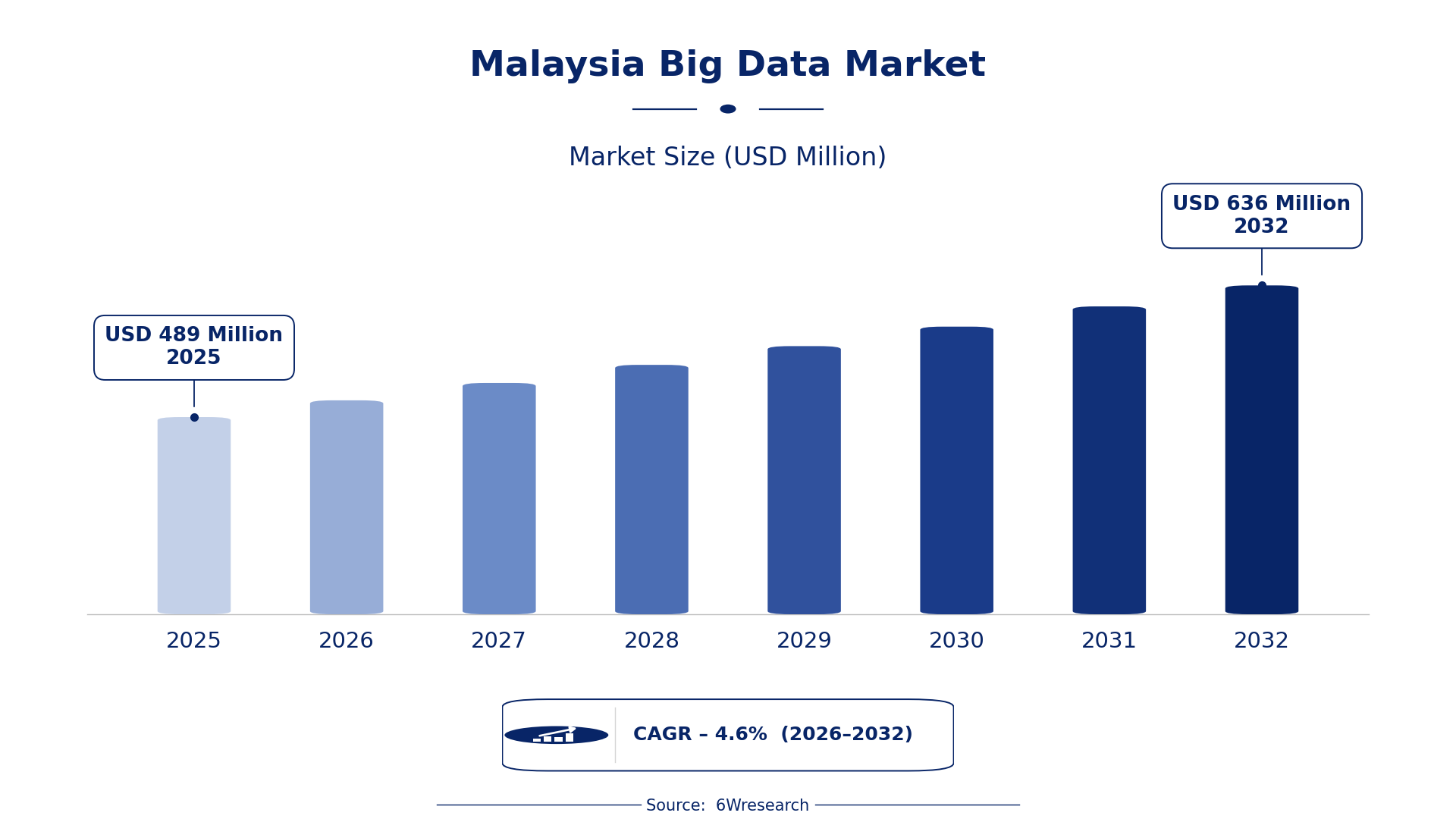
The Malaysia Big Data Market was estimated at USD 489 Million in 2025 and is projected to reach USD 636 Million by 2032, growing at a CAGR of 4.6% from 2026 to 2032.
Malaysia Big Data Market Synopsis
The surge in data generation across various sectors is propelling the demand for big data solutions in Malaysia. Organizations are increasingly recognizing the importance of transforming vast data sets into actionable insights, particularly in industries like e-commerce and telecommunications, where data-driven decisions can significantly influence competitive positioning.
With a growing emphasis on digital transformation, Malaysian businesses are investing heavily in big data analytics and infrastructure. This trend is not merely a reaction to market pressures; it reflects a strategic shift toward innovation and enhanced operational efficiency. As these organizations accumulate more data, the appetite for advanced analytics tools will only intensify.
Malaysia Big Data Market Year-wise Growth Rate and Key Drivers
This graph illustrates the annual growth rates of the Malaysia Big Data Market from 2021 to 2032, highlighting a steady upward trajectory and projected expansion over the forecast period.
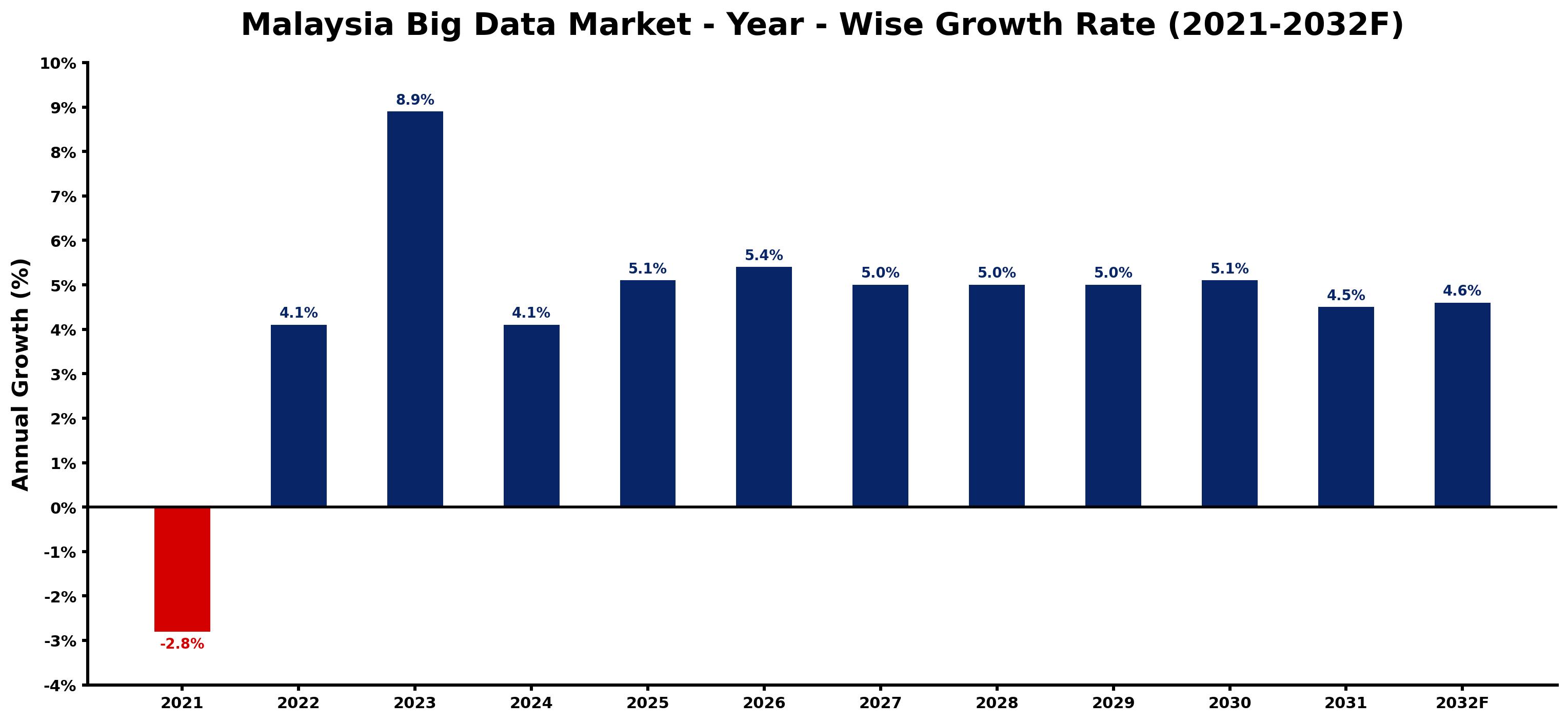
The table below presents the year‑wise growth rates along with the key drivers influencing the market
| Year | Growth Rate | Major Drivers |
| 2021 | -2.8% | Government funding cuts for digital transformation initiatives |
| 2022 | 4.1% | Malaysian government promoting data-driven economic initiatives. |
| 2023 | 8.9% | Increased adoption of AI and machine learning technologies. |
| 2024 | 4.1% | Rise in demand for data analytics in healthcare sector. |
| 2025 | 5.1% | Local SMEs investing in big data solutions for growth. |
| 2026 | 5.4% | Implementation of Malaysia's National Data Strategy driving demand. |
| 2027 | 5.0% | Telecommunications sector utilizing big data for customer insights. |
| 2028 | 5.0% | Financial services enhancing risk management using big data. |
| 2029 | 5.0% | Government fostering smart city projects leveraging big data. |
| 2030 | 5.1% | E-commerce companies utilizing data insights for marketing strategies. |
| 2031 | 4.5% | Increased cybersecurity regulations prompting demand for data solutions. |
| 2032 | 4.6% | Local tech startups innovating solutions for data management. |
Note: Market size estimations and growth projections presented in this report are based on 6Wresearch's proprietary forecasting methodology, utilizing the latest available industry data, government publications, and primary research inputs.
Malaysia Big Data Market Key Takeaways
Below are some of the specific key takeaways from the market, including:
- Malaysia's big data market is evolving rapidly, driven by the proliferation of data sources.
- Investment in big data infrastructure is crucial for organizations aiming to harness data for competitive advantage.
- Data privacy and security challenges remain significant, requiring robust compliance measures.
- The impact of the COVID-19 pandemic accelerated the adoption of big data solutions across various industries.
- Government initiatives are pivotal in shaping the regulatory environment and fostering market growth.
Evaluation of Restraints in Malaysia Big Data Market
Despite the rapid growth, the Malaysia Big Data Market faces notable restraints. Data privacy issues are paramount, as increasing volumes of data heighten the risk of breaches. Companies are under constant pressure to implement stringent security measures, which can divert resources and complicate operations. on top of that, a shortage of skilled professionals in big data analytics presents a significant barrier to fully leveraging data-driven opportunities. These challenges necessitate a balanced approach to innovation and security.
Malaysia Big Data Market Trends
Key trends are shaping the Malaysia Big Data Market, particularly the rise of cloud-based analytics solutions. As organizations migrate to cloud environments, they gain flexibility and scalability in handling vast data sets. The integration of artificial intelligence and machine learning tools into big data analytics is also gaining traction, enabling more sophisticated data processing and predictive insights.
on top of that, an increasing focus on real-time data processing is emerging. Businesses are demanding solutions that can provide immediate insights, allowing for agile decision-making. This trend is particularly pronounced in sectors where customer engagement and operational efficiency are critical.
Malaysia Big Data Market Opportunities
Opportunities in the Malaysia Big Data Market are abundant. With the government's push to establish Malaysia as a regional data hub, businesses can expect support in terms of infrastructure and workforce development. The expansion of e-commerce is another area ripe for growth; companies can harness data analytics to enhance customer experiences and optimize supply chains.
Additionally, sectors like finance and healthcare are on the verge of transformative changes through big data. The demand for personalized services and predictive analytics will drive investment in advanced analytics platforms and technologies.
Government Initiatives in the Malaysia Big Data Market
The Malaysian government plays a crucial role in fostering the growth of the big data market through various initiatives and policies. By establishing a supportive regulatory framework, the government aims to stimulate innovation and ensure data privacy. These efforts are essential as Malaysia seeks to position itself as a leading data-centric economy in the region.
- A national digital infrastructure upgrade programme was launched recently to enhance data processing capabilities across sectors.
- Ongoing initiatives focus on developing a skilled workforce in data analytics through educational programs and partnerships with universities.
- A regulatory framework introduced in 2025 mandates enhanced data privacy and security measures for organizations handling sensitive information.
- Upcoming public-private initiatives aim to expand broadband access, facilitating better data collection and analysis capabilities.
- Current policy discussions are underway to support the establishment of data centers in strategic locations across Malaysia.
Future Insights of the Malaysia Big Data Market
Looking ahead to 2026-2032, the Malaysia Big Data Market is set for continued expansion. As businesses increasingly recognize the value of data-driven strategies, investments in advanced analytics will intensify. The integration of emerging technologies like AI will further enhance the capabilities of big data solutions, driving demand across various sectors. on top of that, government support and infrastructure investments will create an environment conducive to innovation and growth.
Malaysia Big Data Market Latest Developments
Recent developments in the Malaysia Big Data Market reflect a dynamic environment where organizations are rapidly adapting to technological advancements. Over the past year, businesses have begun to prioritize data analytics as a core component of their operational strategies. This shift is evident in numerous initiatives aimed at enhancing data capabilities.
- A major technology vendor launched a new analytics platform in early 2025, enabling businesses to process and analyze data more efficiently.
- An initiative that began in mid-2025 is currently underway, focusing on integrating AI tools into existing big data frameworks.
- In Q4 2025, a partnership was formed between local universities and industries to develop a curriculum aimed at equipping graduates with essential data analytics skills.
- Plans for a new data center are expected to begin construction in early 2026, aimed at enhancing data storage and processing capabilities.
- A pilot program launched in late 2025 is testing real-time analytics solutions in the retail sector to improve customer engagement strategies.
Malaysia Big Data Market - Key Attractiveness of the Report
- 10 Years of Market Numbers
- Historical Data Starting from 2022 to 2025
- Base Year: 2025
- Forecast Data until 2032
- Key Performance Indicators Impacting the Market
- Major Upcoming Developments and Projects
Key Highlights of the Report:
- Malaysia Big Data Market Outlook
- Market Size of Malaysia Big Data Market, 2025
- Forecast of Malaysia Big Data Market, 2032
- Historical Data and Forecast of Malaysia Big Data Revenues & Volume for the Period 2022-2032F
- Malaysia Big Data Market Trend Evolution
- Malaysia Big Data Market Drivers and Challenges
- Malaysia Big Data Price Trends
- Malaysia Big Data Porter's Five Forces
- Malaysia Big Data Industry Life Cycle
- Historical Data and Forecast of Malaysia Big Data Market Revenues & Volume By Business Function for the Period 2022-2032F
- Historical Data and Forecast of Malaysia Big Data Market Revenues & Volume By Finance for the Period 2022-2032F
- Historical Data and Forecast of Malaysia Big Data Market Revenues & Volume By Marketing and Sales for the Period 2022-2032F
- Historical Data and Forecast of Malaysia Big Data Market Revenues & Volume By Human Resources for the Period 2022-2032F
- Historical Data and Forecast of Malaysia Big Data Market Revenues & Volume By Operations for the Period 2022-2032F
- Historical Data and Forecast of Malaysia Big Data Market Revenues & Volume By Industry Vertical for the Period 2022-2032F
- Historical Data and Forecast of Malaysia Big Data Market Revenues & Volume By BFSI for the Period 2022-2032F
- Historical Data and Forecast of Malaysia Big Data Market Revenues & Volume By Government and Defense for the Period 2022-2032F
- Historical Data and Forecast of Malaysia Big Data Market Revenues & Volume By Healthcare and Life Sciences for the Period 2022-2032F
- Historical Data and Forecast of Malaysia Big Data Market Revenues & Volume By Manufacturing for the Period 2022-2032F
- Historical Data and Forecast of Malaysia Big Data Market Revenues & Volume By Retail and Consumer Goods for the Period 2022-2032F
- Historical Data and Forecast of Malaysia Big Data Market Revenues & Volume By Media and Entertainment for the Period 2022-2032F
- Historical Data and Forecast of Malaysia Big Data Market Revenues & Volume By Telecommunications and IT for the Period 2022-2032F
- Historical Data and Forecast of Malaysia Big Data Market Revenues & Volume By Transportation and Logistics for the Period 2022-2032F
- Historical Data and Forecast of Malaysia Big Data Market Revenues & Volume By Component for the Period 2022-2032F
- Historical Data and Forecast of Malaysia Big Data Market Revenues & Volume By Solutions for the Period 2022-2032F
- Historical Data and Forecast of Malaysia Big Data Market Revenues & Volume By Big Data Analytics for the Period 2022-2032F
- Historical Data and Forecast of Malaysia Big Data Market Revenues & Volume By Data Discovery for the Period 2022-2032F
- Historical Data and Forecast of Malaysia Big Data Market Revenues & Volume By Data Visualization for the Period 2022-2032F
- Historical Data and Forecast of Malaysia Big Data Market Revenues & Volume By Data Management for the Period 2022-2032F
- Historical Data and Forecast of Malaysia Big Data Market Revenues & Volume By Services for the Period 2022-2032F
- Historical Data and Forecast of Malaysia Big Data Market Revenues & Volume By Deployment Mode for the Period 2022-2032F
- Historical Data and Forecast of Malaysia Big Data Market Revenues & Volume By Cloud for the Period 2022-2032F
- Historical Data and Forecast of Malaysia Big Data Market Revenues & Volume By Public Cloud for the Period 2022-2032F
- Historical Data and Forecast of Malaysia Big Data Market Revenues & Volume By Private Cloud for the Period 2022-2032F
- Historical Data and Forecast of Malaysia Big Data Market Revenues & Volume By Hybrid Cloud for the Period 2022-2032F
- Historical Data and Forecast of Malaysia Big Data Market Revenues & Volume By On-premises for the Period 2022-2032F
- Historical Data and Forecast of Malaysia Big Data Market Revenues & Volume By Organization Size for the Period 2022-2032F
- Historical Data and Forecast of Malaysia Big Data Market Revenues & Volume By Small and Medium-Sized Enterprises for the Period 2022-2032F
- Historical Data and Forecast of Malaysia Big Data Market Revenues & Volume By Large Enterprises for the Period 2022-2032F
- Malaysia Big Data Import Export Trade Statistics
- Market Opportunity Assessment By Business Function
- Market Opportunity Assessment By Industry Vertical
- Market Opportunity Assessment By Component
- Market Opportunity Assessment By Deployment Mode
- Market Opportunity Assessment By Organization Size
- Malaysia Big Data Top Companies Market Share
- Malaysia Big Data Competitive Benchmarking By Technical and Operational Parameters
- Malaysia Big Data Company Profiles
- Malaysia Big Data Key Strategic Recommendations






































