Malaysia Blue-veined Cheese Market Size, Share & Growth Rate
The Malaysia Blue-veined Cheese Market was estimated at USD 239 Million in 2025 and is projected to reach USD 312 Million by 2032, growing at a CAGR of 3.9% from 2026 to 2032. This positive trajectory is bolstered by increasing consumer interest in gourmet cheeses, as well as the proliferation of specialty food retail outlets. As Malaysians become more adventurous in their culinary choices, blue cheeses are gaining traction due to their unique flavor profiles and versatility in various dishes.
Malaysia Blue-veined Cheese Market Growth Rate Analysis (2021-2032)
The Malaysian blue-veined cheese market has shown a notable recovery and expansion following a slight contraction of -3.3% in 2021. This shift is largely attributed to rising consumer interest in gourmet and artisanal products, alongside increased investments in local dairy production capabilities. The market rebounded by 4.3% in 2022 and surged to 8.9% in 2023, bolstered by a growing middle class and evolving tastes. Projections indicate continued growth, with rates around 4.5% to 5.7% expected through 2025 to 2032. Key to this development is the integration of modern supply chain technologies and increased online availability, enhancing consumer access and driving demand for premium cheese offerings.
Malaysia Blue-veined Cheese Market Year-wise Growth Rate and Key Drivers
This graph highlights how the Malaysia Blue-veined Cheese Market has steadily grown over the past five years, supported by major growth factors.
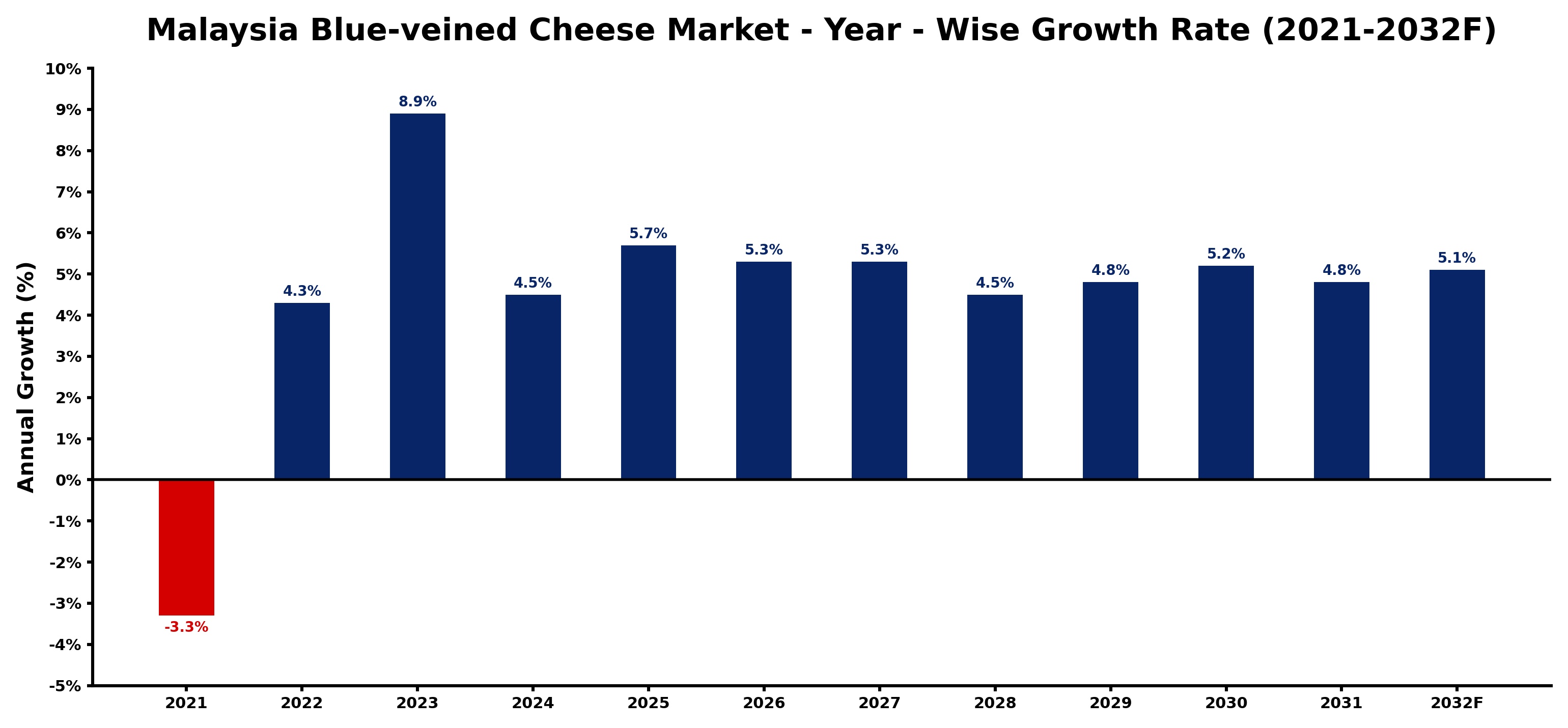
The table below presents the year‑wise growth rates along with the key drivers influencing the market
| Year | Growth Rate | Major Drivers |
| 2021 | -3.3% | Consumer preferences shifted downward |
| 2022 | 4.3% | Artisanal cheese popularity increased |
| 2023 | 8.9% | Gourmet food trends expanded market |
| 2024 | 4.5% | Local production capabilities improved |
| 2025 | 5.7% | Culinary tourism enhanced demand |
| 2026 | 5.3% | Health consciousness drove consumption |
| 2027 | 5.3% | Social media influence grew rapidly |
| 2028 | 4.5% | Food pairing education expanded reach |
| 2029 | 4.8% | Export opportunities opened markets |
| 2030 | 5.2% | Sustainable sourcing practices gained traction |
| 2031 | 4.8% | Innovative recipes attracted new consumers |
| 2032 | 5.1% | Culinary collaborations enhanced visibility |
Note - Market size estimations and growth projections presented in this report are based on 6Wresearch’s advanced forecasting approach, validated with industry datasets as of June 2026.
Malaysia Blue-veined Cheese Market Synopsis
The Malaysia blue veined cheese market is experiencing a noteworthy evolution. Recent trends indicate a growing acceptance among consumers who are now more willing to embrace gourmet options. As a result, this segment is moving towards a more mainstream market presence, driven by enhanced distribution through supermarkets and eateries.
However, the potential for growth remains significant as awareness increases. With changing consumer preferences leaning towards artisanal and craft cheeses, the market is poised for further expansion, demonstrating a blend of tradition and innovation that appeals to the modern palate.
Malaysia Blue-veined Cheese Market Key Takeaways
- Increased availability through various retail and dining channels is catalyzing market growth.
- Consumer preferences are shifting towards unique and craft cheese varieties, enhancing demand.
- Artisanal production methods emphasize quality, appealing to discerning consumers.
- Culinary exploration is fostering a broader acceptance of gourmet cheeses in Malaysia.
- Challenges in consumer education about blue cheeses remain, yet opportunities abound in niche marketing.
Evaluation of Restraints in Malaysia Blue-veined Cheese Market
Despite the promising outlook, several restraints could hold back the Malaysia blue veined cheese market. One primary challenge lies in the general unfamiliarity of consumers with the distinct taste and texture of blue cheeses, which are often different from local culinary norms. This cultural barrier can slow down acceptance rates among traditional consumers. Additionally, maintaining quality during distribution requires careful handling and storage, given the cheese's sensitive nature. Effective marketing and educational initiatives will be crucial to overcoming these obstacles and fostering growth.
Malaysia Blue-veined Cheese Market Trends
Emerging trends in the Malaysia blue veined cheese market reflect a growing culinary sophistication. The rise of food bloggers and social media influencers plays a pivotal role in shaping consumer perceptions. Educational initiatives about cheese pairings and cooking demonstrations are becoming popular, helping to demystify gourmet cheeses. Furthermore, the trend towards health-conscious eating and natural ingredients supports the demand for artisanal cheeses, as consumers become more discerning about their food choices.
Malaysia Blue-veined Cheese Market Opportunities
Opportunities in the Malaysia blue veined cheese market are abundant, particularly in the context of an evolving food landscape. The expansion of gourmet retail spaces presents a fertile ground for blue cheese offerings. Collaborations with local chefs and restaurants can also create unique tasting experiences that elevate the product's profile. Moreover, creating educational campaigns focused on the versatility of blue cheese can stimulate interest and broaden its consumer base, leading to increased sales and market penetration.
Government Initiatives in the Malaysia Blue-veined Cheese Market
Government initiatives aimed at boosting the agriculture and food production sectors in Malaysia have significant implications for the blue veined cheese market. Policies encouraging local dairy farming can improve the supply chain for cheese production, while funding for food innovation projects may support the development of new cheese varieties. Public awareness campaigns promoting local artisanal products also enhance market visibility, benefiting niche segments such as blue veined cheese.
Future Insights of the Malaysia Blue-veined Cheese Market
Looking ahead to 2026-2032, the Malaysia blue veined cheese market is expected to evolve into a more mainstream option for consumers. As gourmet food culture continues to gain traction, consumers will increasingly seek out unique flavors and experiences. The growth of the online grocery sector and the popularity of food delivery services will further facilitate access to specialty cheeses. Overall, the market is poised for dynamic growth, underpinned by the dual forces of consumer curiosity and culinary experimentation.
Malaysia Blue-veined Cheese Market Latest Developments (May 2025 - June 2026)
Recent developments in the Malaysia blue veined cheese market indicate a significant push towards artisanal production techniques. New boutique cheese makers are entering the scene, bringing innovative flavor profiles to consumers. Additionally, there has been a notable increase in the collaboration between local chefs and cheese producers, resulting in exclusive cheese-based dishes that are drawing attention. Educational workshops and tasting events are becoming commonplace, enhancing consumer engagement and appreciation for blue cheeses.
Malaysia Blue-veined Cheese Market - Key Attractiveness of the Report
- 10 Years of Market Numbers
- Historical Data Starting from 2022 to 2025
- Base Year: 2025
- Forecast Data until 2032
- Key Performance Indicators Impacting the Market
- Major Upcoming Developments and Projects
Key Highlights of the Report:
- Malaysia Blue-veined Cheese Market Outlook
- Market Size of Malaysia Blue-veined Cheese Market, 2025
- Forecast of Malaysia Blue-veined Cheese Market, 2032F
- Historical Data and Forecast of Malaysia Blue-veined Cheese Revenues & Volume for the Period 2022-2032F
- Malaysia Blue-veined Cheese Market Trend Evolution
- Malaysia Blue-veined Cheese Market Drivers and Challenges
- Malaysia Blue-veined Cheese Price Trends
- Malaysia Blue-veined Cheese Porter's Five Forces
- Malaysia Blue-veined Cheese Industry Life Cycle
- Historical Data and Forecast of Malaysia Blue-veined Cheese Market Revenues & Volume By Product Type for the Period 2022-2032F
- Historical Data and Forecast of Malaysia Blue-veined Cheese Market Revenues & Volume By Gorgonzola Cheese for the Period 2022-2032F
- Historical Data and Forecast of Malaysia Blue-veined Cheese Market Revenues & Volume By Roquefort Cheese for the Period 2022-2032F
- Historical Data and Forecast of Malaysia Blue-veined Cheese Market Revenues & Volume By Stilton Cheese for the Period 2022-2032F
- Historical Data and Forecast of Malaysia Blue-veined Cheese Market Revenues & Volume By Cashel Blue for the Period 2022-2032F
- Historical Data and Forecast of Malaysia Blue-veined Cheese Market Revenues & Volume By Danablu for the Period 2022-2032F
- Historical Data and Forecast of Malaysia Blue-veined Cheese Market Revenues & Volume By Danish Blue cheese for the Period 2022-2032F
- Historical Data and Forecast of Malaysia Blue-veined Cheese Market Revenues & Volume By Other for the Period 2022-2032F
- Historical Data and Forecast of Malaysia Blue-veined Cheese Market Revenues & Volume By Production Types for the Period 2022-2032F
- Historical Data and Forecast of Malaysia Blue-veined Cheese Market Revenues & Volume By Processed Cheese for the Period 2022-2032F
- Historical Data and Forecast of Malaysia Blue-veined Cheese Market Revenues & Volume By Natural Cheese for the Period 2022-2032F
- Historical Data and Forecast of Malaysia Blue-veined Cheese Market Revenues & Volume By Sources for the Period 2022-2032F
- Historical Data and Forecast of Malaysia Blue-veined Cheese Market Revenues & Volume By Cow for the Period 2022-2032F
- Historical Data and Forecast of Malaysia Blue-veined Cheese Market Revenues & Volume By Goat for the Period 2022-2032F
- Historical Data and Forecast of Malaysia Blue-veined Cheese Market Revenues & Volume By Sheep for the Period 2022-2032F
- Historical Data and Forecast of Malaysia Blue-veined Cheese Market Revenues & Volume By Reindeer for the Period 2022-2032F
- Historical Data and Forecast of Malaysia Blue-veined Cheese Market Revenues & Volume By Yak for the Period 2022-2032F
- Historical Data and Forecast of Malaysia Blue-veined Cheese Market Revenues & Volume By Textures for the Period 2022-2032F
- Historical Data and Forecast of Malaysia Blue-veined Cheese Market Revenues & Volume By Hard Cheese for the Period 2022-2032F
- Historical Data and Forecast of Malaysia Blue-veined Cheese Market Revenues & Volume By Semi Hard Cheese for the Period 2022-2032F
- Historical Data and Forecast of Malaysia Blue-veined Cheese Market Revenues & Volume By Semi-Soft Cheese for the Period 2022-2032F
- Historical Data and Forecast of Malaysia Blue-veined Cheese Market Revenues & Volume By Soft Cheese for the Period 2022-2032F
- Historical Data and Forecast of Malaysia Blue-veined Cheese Market Revenues & Volume By Distribution Channels for the Period 2022-2032F
- Historical Data and Forecast of Malaysia Blue-veined Cheese Market Revenues & Volume By Manufacturer for the Period 2022-2032F
- Historical Data and Forecast of Malaysia Blue-veined Cheese Market Revenues & Volume By Retail Shops for the Period 2022-2032F
- Historical Data and Forecast of Malaysia Blue-veined Cheese Market Revenues & Volume By Specialty Shops for the Period 2022-2032F
- Historical Data and Forecast of Malaysia Blue-veined Cheese Market Revenues & Volume By Wholesalers for the Period 2022-2032F
- Historical Data and Forecast of Malaysia Blue-veined Cheese Market Revenues & Volume By Online shops for the Period 2022-2032F
- Historical Data and Forecast of Malaysia Blue-veined Cheese Market Revenues & Volume By Portals for the Period 2022-2032F
- Malaysia Blue-veined Cheese Import Export Trade Statistics
- Market Opportunity Assessment By Product Type
- Market Opportunity Assessment By Production Types
- Market Opportunity Assessment By Sources
- Market Opportunity Assessment By Textures
- Market Opportunity Assessment By Distribution Channels
- Malaysia Blue-veined Cheese Top Companies Market Share
- Malaysia Blue-veined Cheese Competitive Benchmarking By Technical and Operational Parameters
- Malaysia Blue-veined Cheese Company Profiles
- Malaysia Blue-veined Cheese Key Strategic Recommendations






































