Malaysia Boron Compounds Market Size, Share & Growth Rate
The Malaysia Boron Compounds Market was estimated at USD 156 Million in 2025 and is projected to reach USD 203 Million by 2032, growing at a CAGR of 3.8% from 2026 to 2032. This growth trajectory is primarily fueled by increasing demand in key sectors such as electronics and construction, where boron compounds play a crucial role in enhancing product durability and performance. Additionally, government-backed infrastructure initiatives are fostering a conducive environment for market expansion.
Malaysia Boron Compounds Market Year-wise Growth Rate and Key Drivers
This graph highlights how the Malaysia Boron Compounds Market has steadily grown over the years, supported by major growth factors.
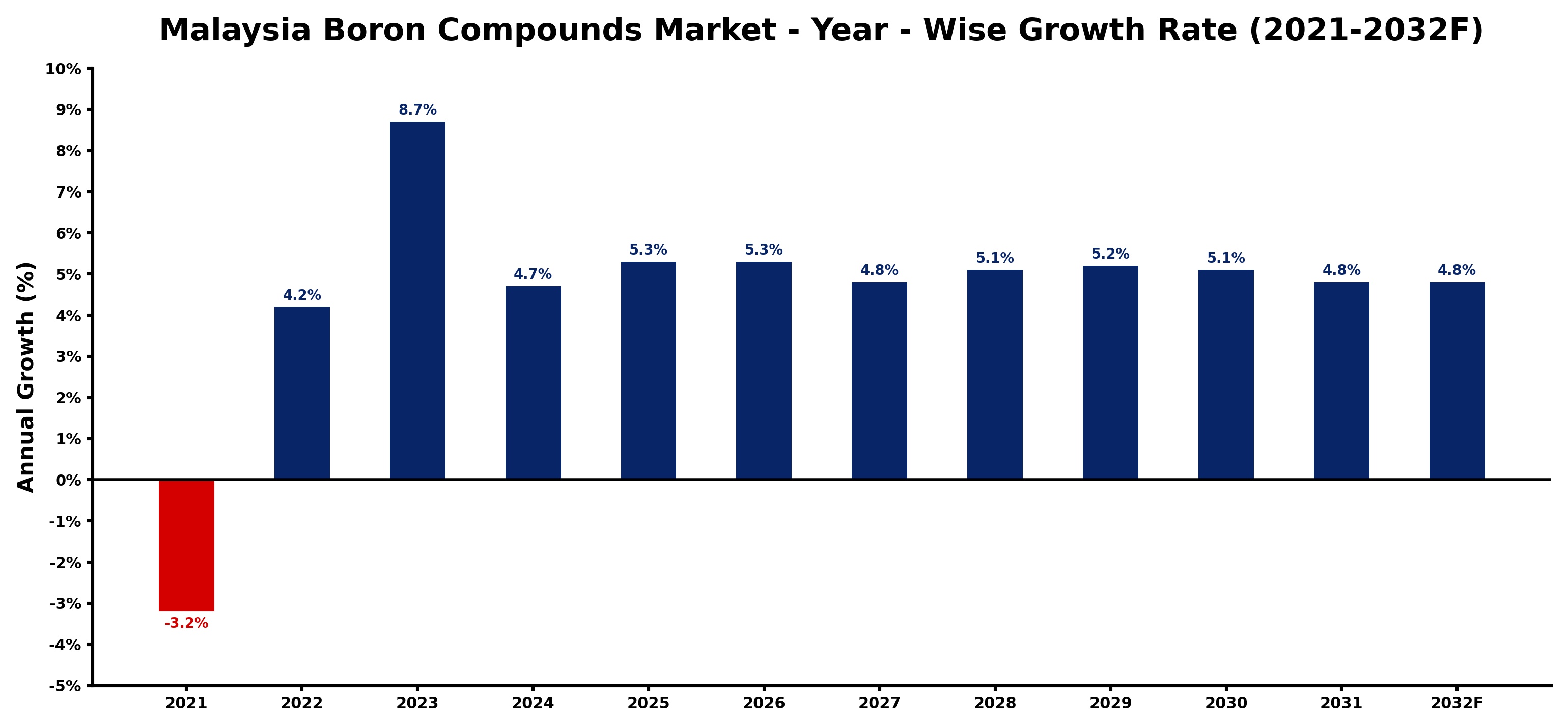
The table below presents the year‑wise growth rates along with the key drivers influencing the market
| Year | Growth Rate | Major Drivers |
| 2021 | -3.2% | Supply chain disruptions affected availability |
| 2022 | 4.2% | Industrial applications drove demand growth |
| 2023 | 8.7% | Technological advancements enhanced production |
| 2024 | 4.7% | Construction sector expansion increased usage |
| 2025 | 5.3% | Agricultural innovations boosted consumption |
| 2026 | 5.3% | Renewable energy projects increased demand |
| 2027 | 4.8% | Consumer awareness of benefits rose |
| 2028 | 5.1% | Export opportunities expanded market reach |
| 2029 | 5.2% | Research initiatives promoted new applications |
| 2030 | 5.1% | Sustainability trends influenced purchasing decisions |
| 2031 | 4.8% | Government policies supported industry growth |
| 2032 | 4.8% | Collaboration with research institutions increased |
Note - Market size estimations and growth projections presented in this report are based on 6Wresearch’s advanced forecasting approach, validated with industry datasets as of June 2026.
Malaysia Boron Compounds Market Synopsis
In recent years, the Malaysia boron compounds market has witnessed a surge in demand, particularly from the automotive, electronics, and ceramics sectors. As industries adapt to technological advancements and focus on sustainable materials, the need for high-performance boron compounds is expected to intensify. Looking ahead, the market is poised for steady growth, driven by continuous innovations and an increasing number of applications across various industries.
The expansion of the electronics and ceramics industries serves as a strong foundation for the boron compounds market in Malaysia. However, the need for stable supply chains and regulatory compliance poses ongoing challenges. Companies are actively pursuing sustainable practices while exploring new product developments, which will be pivotal for capturing the evolving market landscape.
Malaysia Boron Compounds Market Key Takeaways
- The market is expected to grow at a CAGR of 3.8% from 2026 to 2032, indicating a stable upward trajectory.
- Key drivers of demand include the electronics and ceramics sectors, which rely heavily on advanced boron compounds.
- Government initiatives to boost infrastructure development are significantly influencing market dynamics.
- Supply chain stability and sustainable practices are critical concerns that need addressing for continued growth.
- Ongoing research and innovation are likely to broaden the scope of applications for boron compounds in Malaysia.
Evaluation of Restraints in Malaysia Boron Compounds Market
Despite the promising growth trajectory, the Malaysia boron compounds market faces several restraints. Supply chain disruptions have emerged as a significant concern, particularly with respect to the availability of boron minerals. Furthermore, the diverse applications of boron compounds necessitate stable sourcing to meet industry demands. Environmental issues related to production processes and waste management are also critical, pushing companies to adopt more sustainable practices while ensuring compliance with regulatory frameworks. Balancing these aspects remains vital for the future health of the market.
Malaysia Boron Compounds Market Trends
Current trends in the Malaysia boron compounds market are heavily influenced by technological innovations and the rising need for advanced materials. The push towards sustainability is driving interest in eco-friendly boron compounds, particularly in the photovoltaic sector. Additionally, the growing emphasis on research and development is fostering new applications and formulations, enhancing the versatility of boron compounds. As companies strive for competitive advantage, the market will likely see a significant shift towards high-performance and specialized products.
Malaysia Boron Compounds Market Opportunities
The opportunities for growth in the Malaysia boron compounds market are vast, particularly in emerging sectors such as renewable energy and electronics. Investments in infrastructure development create a robust demand for boron-based materials in construction applications. Furthermore, increasing global awareness about sustainable practices provides a platform for companies to develop innovative and environmentally friendly boron products. Firms that can leverage these opportunities through strategic partnerships and R&D investments are well-positioned to capitalize on this expanding market.
Government Initiatives in the Malaysia Boron Compounds Market
The Malaysian government has been actively involved in promoting infrastructure development projects, which directly contribute to the growing demand for boron compounds. Initiatives aimed at boosting research and development in advanced materials and sustainable practices are also in place. Public spending on construction and technological advancements aligns with the market's needs, creating a favorable environment for manufacturers and suppliers of boron compounds. Such supportive measures will likely enhance the overall growth prospects of the market in the coming years.
Future Insights of the Malaysia Boron Compounds Market
Looking towards 2026-2032, the Malaysia boron compounds market is anticipated to undergo significant transformation driven by technological advancements and increasing industrial applications. The emphasis on high-performance materials will likely spur innovation and create opportunities in sectors such as electronics and sustainable energy. As demand rises, players in the market must adapt to changing regulations and invest in sustainable practices. Overall, the market is expected to flourish, supported by continuous improvements in product quality and innovation.
Malaysia Boron Compounds Market Latest Developments (May 2025 - June 2026)
Recent developments in the Malaysia boron compounds market indicate a proactive approach by companies to enhance product offerings and tackle supply chain challenges. Numerous firms are investing in R&D for innovative applications and environmentally friendly products. Additionally, collaborations between industry stakeholders are emerging to address sustainability concerns and ensure compliance with regulatory standards. These efforts reflect a collective commitment to advancing the boron compounds market amid evolving consumer preferences and technological advancements.
Malaysia Boron Compounds Market - Key Attractiveness of the Report
- 10 Years of Market Numbers
- Historical Data Starting from 2022 to 2025
- Base Year: 2025
- Forecast Data until 2032
- Key Performance Indicators Impacting the Market
- Major Upcoming Developments and Projects
Key Highlights of the Report:
- Malaysia Boron Compounds Market Outlook
- Market Size of Malaysia Boron Compounds Market, 2025
- Forecast of Malaysia Boron Compounds Market, 2032
- Historical Data and Forecast of Malaysia Boron Compounds Revenues & Volume for the Period 2022-2032F
- Malaysia Boron Compounds Market Trend Evolution
- Malaysia Boron Compounds Market Drivers and Challenges
- Malaysia Boron Compounds Price Trends
- Malaysia Boron Compounds Porter's Five Forces
- Malaysia Boron Compounds Industry Life Cycle
- Historical Data and Forecast of Malaysia Boron Compounds Market Revenues & Volume By Type for the Period 2022-2032F
- Historical Data and Forecast of Malaysia Boron Compounds Market Revenues & Volume By Borax for the Period 2022-2032F
- Historical Data and Forecast of Malaysia Boron Compounds Market Revenues & Volume By Boric acid for the Period 2022-2032F
- Historical Data and Forecast of Malaysia Boron Compounds Market Revenues & Volume By Boric oxide for the Period 2022-2032F
- Historical Data and Forecast of Malaysia Boron Compounds Market Revenues & Volume By Sodium perborate for the Period 2022-2032F
- Historical Data and Forecast of Malaysia Boron Compounds Market Revenues & Volume By Application for the Period 2022-2032F
- Historical Data and Forecast of Malaysia Boron Compounds Market Revenues & Volume By Borosilicate glass for the Period 2022-2032F
- Historical Data and Forecast of Malaysia Boron Compounds Market Revenues & Volume By Fiberglass for the Period 2022-2032F
- Historical Data and Forecast of Malaysia Boron Compounds Market Revenues & Volume By Agriculture for the Period 2022-2032F
- Historical Data and Forecast of Malaysia Boron Compounds Market Revenues & Volume By Ceramics for the Period 2022-2032F
- Historical Data and Forecast of Malaysia Boron Compounds Market Revenues & Volume By Detergents & Soaps for the Period 2022-2032F
- Historical Data and Forecast of Malaysia Boron Compounds Market Revenues & Volume By Photography for the Period 2022-2032F
- Historical Data and Forecast of Malaysia Boron Compounds Market Revenues & Volume By Tanning for the Period 2022-2032F
- Historical Data and Forecast of Malaysia Boron Compounds Market Revenues & Volume By Cellulose insulation for the Period 2022-2032F
- Malaysia Boron Compounds Import Export Trade Statistics
- Market Opportunity Assessment By Type
- Market Opportunity Assessment By Application
- Malaysia Boron Compounds Top Companies Market Share
- Malaysia Boron Compounds Competitive Benchmarking By Technical and Operational Parameters
- Malaysia Boron Compounds Company Profiles
- Malaysia Boron Compounds Key Strategic Recommendations






































