Malaysia Building Construction Market Size, Share & Growth Rate
The Malaysia Building Construction Market was estimated at USD 219 Million in 2025 and is projected to reach USD 289 Million by 2032, growing at a CAGR of 4.0% from 2026 to 2032. This upward trajectory is primarily driven by rapid urbanization, a burgeoning population, and significant government investment in infrastructure projects. The increasing demand for sustainable and affordable housing solutions further enhances the markets prospects, positioning Malaysia as a promising landscape for building construction.
Malaysia Building Construction Market Year-wise Growth Rate and Key Drivers
This graph highlights how the Malaysia Building Construction Market has steadily grown over the years, supported by major growth factors.
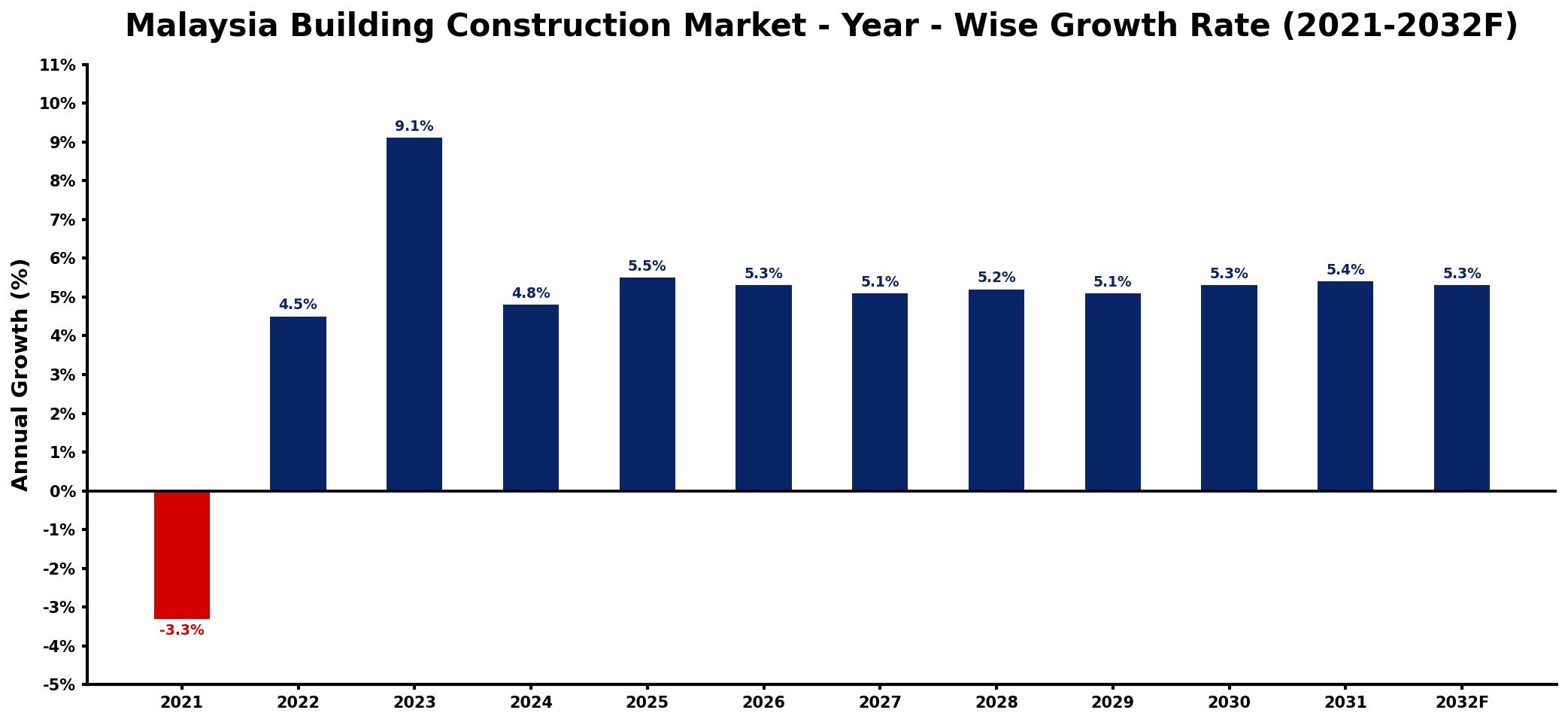
The table below presents the year‑wise growth rates along with the key drivers influencing the market
| Year | Growth Rate | Major Drivers |
| 2021 | -3.3% | decreased infrastructure project funding |
| 2022 | 4.5% | increased residential property demand |
| 2023 | 9.1% | growing government infrastructure investments |
| 2024 | 4.8% | expansion of urban development projects |
| 2025 | 5.5% | rising foreign direct investments |
| 2026 | 5.3% | increased demand for commercial spaces |
| 2027 | 5.1% | growing emphasis on sustainable practices |
| 2028 | 5.2% | increased public-private partnerships opportunities |
| 2029 | 5.1% | rising demand for smart technologies |
| 2030 | 5.3% | growing emerging market penetration |
| 2031 | 5.4% | growing focus on eco-friendly materials |
| 2032 | 5.3% | increased urban population growth |
Note: Market size estimations and growth projections presented in this report are based on 6Wresearch's proprietary forecasting methodology, utilizing the latest available industry data, government publications, and primary research inputs.
Malaysia Building Construction Market Synopsis
Recent momentum in the Malaysia building construction market underscores a robust recovery following the challenges posed by the COVID-19 pandemic. As restrictions have eased, construction activities are gaining speed, with a marked increase in both residential and commercial projects. However, the future trajectory remains optimistic, fueled by government policies supporting sustainability and urban development.
The Malaysian market is adapting to evolving demands, such as the shift towards green building practices and the incorporation of digital technologies like Building Information Modeling (BIM). These advancements, coupled with a proactive approach to urban planning, signal a transformative phase for the industry. As local firms step up to meet these expectations, the groundwork for lasting growth and innovation is firmly established.
Malaysia Building Construction Market Key Takeaways
- Urbanization and population growth are pivotal drivers of construction demand.
- Government initiatives are fostering sustainable housing and infrastructure projects.
- Adoption of innovative technologies is reshaping construction practices and efficiencies.
- The market is witnessing a shift towards environmentally friendly construction materials and methods.
- Investment opportunities are ripe as the sector rebounds from pandemic-related challenges.
Evaluation of Restraints in Malaysia Building Construction Market
Despite promising growth, the Malaysia building construction market is hindered by several constraints. The intricate landscape of regulatory compliance and permitting can lead to project delays and inflated costs, stifling timely development. Labor shortages pose another significant issue, as finding skilled workers becomes increasingly challenging, particularly in a competitive market. Moreover, the pressing need to balance development with environmental stewardship places additional constraints on project execution, necessitating a shift towards sustainable practices that are not yet universally adopted.
Malaysia Building Construction Market Trends
Several key trends are shaping the Malaysia building construction market. The movement toward sustainability is evident in the rising demand for green buildings, which utilize eco-friendly materials and energy-efficient designs. Additionally, the integration of technology, such as BIM, is becoming mainstream, allowing for enhanced project management and cost efficiency. There is also an increasing focus on modular construction methods, which promise faster delivery times and reduced waste. Lastly, the market is seeing a shift in consumer preferences towards high-quality, affordable housing, driven by urban population growth.
Malaysia Building Construction Market Opportunities
The Malaysia building construction market presents numerous growth and investment opportunities. The ongoing demand for affordable housing, coupled with government incentives for sustainable development, opens doors for innovative builders. Infrastructure projects, including transportation and public facilities, continue to require significant investment, fostering a robust environment for construction. Furthermore, the push for smart city developments highlights the need for advanced construction practices, offering new avenues for companies willing to adapt to these emerging trends.
Government Initiatives in the Malaysia Building Construction Market
The Malaysian government has implemented various initiatives aimed at fostering growth within the building construction sector. Through public spending on infrastructure, the government seeks to enhance urban connectivity and economic development. Policies that promote sustainable construction practices are also in place, encouraging builders to adopt environmentally responsible methods. Additionally, various programs aim to increase access to affordable housing, further solidifying the government's commitment to enhancing living conditions across urban areas.
Future Insights of the Malaysia Building Construction Market
As we look toward 2026-2032, the Malaysia building construction market is poised for a transformative period. Continued urbanization and the implementation of smart technologies in construction will drive efficiency and sustainability. The increasing emphasis on environmental conservation will likely influence regulations, pushing firms to innovate in building practices. Moreover, as the government commits to extensive infrastructure projects, opportunities for investment and development will flourish, ensuring that the market remains resilient and adaptive in the face of changing economic conditions.
Malaysia Building Construction Market Latest Developments (2025 - 2026)
The Malaysia building construction market has witnessed significant shifts over the past year, particularly in response to evolving industry demands and economic recovery efforts. Many construction firms are increasingly adopting digital solutions to enhance operational efficiency and project management. Additionally, there has been a noticeable surge in the construction of green buildings, reflecting a broader commitment to sustainability. Government policies and incentives continue to play a vital role in guiding the direction of the market, as infrastructure initiatives unfold and residential projects gain momentum.
Malaysia Building Construction Market - Key Attractiveness of the Report
- 10 Years of Market Numbers
- Historical Data Starting from 2022 to 2025
- Base Year: 2025
- Forecast Data until 2032
- Key Performance Indicators Impacting the Market
- Major Upcoming Developments and Projects
Key Highlights of the Report:
- Malaysia Building Construction Market Outlook
- Market Size of Malaysia Building Construction Market, 2025
- Forecast of Malaysia Building Construction Market, 2032
- Historical Data and Forecast of Malaysia Building Construction Revenues & Volume for the Period 2022-2032F
- Malaysia Building Construction Market Trend Evolution
- Malaysia Building Construction Market Drivers and Challenges
- Malaysia Building Construction Price Trends
- Malaysia Building Construction Porter's Five Forces
- Malaysia Building Construction Industry Life Cycle
- Historical Data and Forecast of Malaysia Building Construction Market Revenues & Volume By Type for the Period 2022-2032F
- Historical Data and Forecast of Malaysia Building Construction Market Revenues & Volume By Residential for the Period 2022-2032F
- Historical Data and Forecast of Malaysia Building Construction Market Revenues & Volume By Non-residential for the Period 2022-2032F
- Historical Data and Forecast of Malaysia Building Construction Market Revenues & Volume By Construction Type for the Period 2022-2032F
- Historical Data and Forecast of Malaysia Building Construction Market Revenues & Volume By New Construction for the Period 2022-2032F
- Historical Data and Forecast of Malaysia Building Construction Market Revenues & Volume By Renovation for the Period 2022-2032F
- Historical Data and Forecast of Malaysia Building Construction Market Revenues & Volume By Application for the Period 2022-2032F
- Historical Data and Forecast of Malaysia Building Construction Market Revenues & Volume By Owned for the Period 2022-2032F
- Historical Data and Forecast of Malaysia Building Construction Market Revenues & Volume By Rental for the Period 2022-2032F
- Historical Data and Forecast of Malaysia Building Construction Market Revenues & Volume By End User for the Period 2022-2032F
- Historical Data and Forecast of Malaysia Building Construction Market Revenues & Volume By Private for the Period 2022-2032F
- Historical Data and Forecast of Malaysia Building Construction Market Revenues & Volume By Public for the Period 2022-2032F
- Malaysia Building Construction Import Export Trade Statistics
- Market Opportunity Assessment By Type
- Market Opportunity Assessment By Construction Type
- Market Opportunity Assessment By Application
- Market Opportunity Assessment By End User
- Malaysia Building Construction Top Companies Market Share
- Malaysia Building Construction Competitive Benchmarking By Technical and Operational Parameters
- Malaysia Building Construction Company Profiles
- Malaysia Building Construction Key Strategic Recommendations






































