Malaysia Bulk Continuous Filament Yarn Market Size, Share & Growth Rate
The Malaysia Bulk Continuous Filament Yarn Market was estimated at USD 227 Million in 2025 and is projected to reach USD 295 Million by 2032, growing at a CAGR of 3.8% from 2026 to 2032. This growth trajectory can be attributed to the robust demand for high-quality textiles driven by rising disposable incomes and evolving fashion trends among Malaysian consumers. Additionally, the increasing focus on sustainability is compelling manufacturers to innovate and incorporate eco-friendly production practices, further fueling market expansion.
Malaysia Bulk Continuous Filament Yarn Market Year-wise Growth Rate and Key Drivers
This graph highlights how the Malaysia Bulk Continuous Filament Yarn Market has steadily grown over the years, supported by major growth factors.
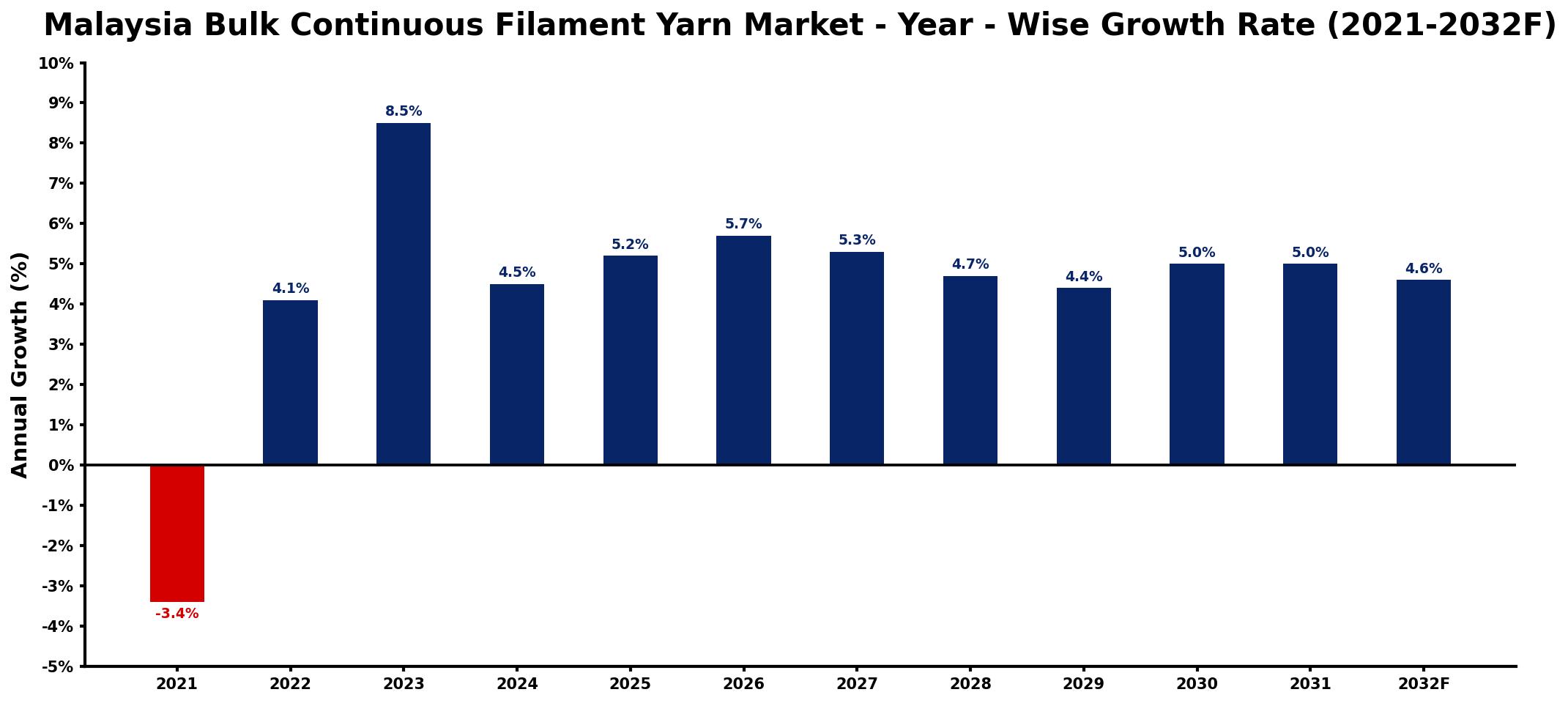
The table below presents the year‑wise growth rates along with the key drivers influencing the market
| Year | Growth Rate | Major Drivers |
| 2021 | -3.4% | decreased demand from textile industry |
| 2022 | 4.1% | growing popularity of sustainable fabrics |
| 2023 | 8.5% | increased investment in manufacturing technology |
| 2024 | 4.5% | expansion of export markets |
| 2025 | 5.2% | rising consumer interest in fashion |
| 2026 | 5.7% | development of innovative textile applications |
| 2027 | 5.3% | strengthened supply chain networks |
| 2028 | 4.7% | growing adoption of eco-friendly practices |
| 2029 | 4.4% | increased collaboration with fashion brands |
| 2030 | 5.0% | enhanced production capabilities emerging |
| 2031 | 5.0% | growing commercial sector adoption |
| 2032 | 4.6% | growing demand for customized solutions |
Note: Market size estimations and growth projections presented in this report are based on 6Wresearch's proprietary forecasting methodology, utilizing the latest available industry data, government publications, and primary research inputs.
Malaysia Bulk Continuous Filament Yarn Market Synopsis
The most significant force currently shaping the Malaysia Bulk Continuous Filament Yarn Market is the surge in demand for high-performance textiles. This demand is primarily driven by the textile and apparel sectors, which are actively seeking materials that offer enhanced durability and aesthetic appeal. As Malaysian consumers become more discerning and environmentally conscious, manufacturers are increasingly prioritizing sustainable yarn options, which is reshaping market dynamics.
Moreover, the advent of advanced manufacturing technologies is enabling producers to enhance the performance characteristics of bulk continuous filament yarns. This trend is vital as it positions the market to meet the diverse needs of applications ranging from apparel to industrial textiles, underscoring a significant opportunity for growth in both domestic and export markets.
Malaysia Bulk Continuous Filament Yarn Market Key Takeaways
- The market is expected to witness steady growth driven by the textile and industrial sectors.
- Technological innovations are enhancing the performance of bulk continuous filament yarns, catering to evolving consumer preferences.
- Sustainability initiatives are influencing manufacturers to adopt eco-friendly practices and materials.
- The increasing disposable income of consumers is fueling the demand for high-quality textiles.
- The market offers substantial growth opportunities for companies investing in R&D and sustainable product lines.
Evaluation of Restraints in Malaysia Bulk Continuous Filament Yarn Market
Despite the promising growth prospects, the Malaysia Bulk Continuous Filament Yarn Market faces notable restraints that could hinder its potential. The cost-efficiency of production remains a significant concern, particularly as energy-intensive manufacturing processes can lead to higher overall production costs. Additionally, competition from both natural and synthetic fibers poses challenges, compelling manufacturers to continuously innovate and find ways to distinguish their offerings. As sustainability increasingly takes center stage, the pressure to invest in eco-friendly practices may also strain resources for smaller manufacturers.
Malaysia Bulk Continuous Filament Yarn Market Trends
A prominent trend in the Malaysia Bulk Continuous Filament Yarn Market is the growing consumer demand for sustainable and eco-friendly textile options. This shift is pushing manufacturers to explore recycled and bio-based yarn alternatives, which not only appeal to environmentally conscious consumers but also comply with emerging regulations. Additionally, the integration of technology in manufacturing processes is improving yarn performance, making products more versatile for various applications such as apparel, home textiles, and industrial fabrics.
Malaysia Bulk Continuous Filament Yarn Market Opportunities
Investors and businesses in the Malaysia Bulk Continuous Filament Yarn Market have a range of promising opportunities ahead. The rising trend of sustainability offers a lucrative avenue for growth, as companies that prioritize eco-friendly practices can tap into a growing consumer base. Furthermore, there is substantial potential for innovation in product development, particularly through R&D aimed at enhancing yarn characteristics to meet specific industry needs, from fashion to industrial textiles.
Government Initiatives in the Malaysia Bulk Continuous Filament Yarn Market
The Malaysian government is actively promoting initiatives to enhance the textile sector's sustainability and competitiveness. Through various programs, there is an emphasis on encouraging eco-friendly production methods and supporting innovation in textiles. Additionally, government policies aim to bolster exports by fostering partnerships between manufacturers and international markets, further enhancing the potential of the bulk continuous filament yarn sector.
Future Insights of the Malaysia Bulk Continuous Filament Yarn Market
Looking ahead to the period from 2026 to 2032, the Malaysia Bulk Continuous Filament Yarn Market is anticipated to evolve significantly. The continued rise in consumer spending coupled with a robust shift towards sustainable textiles is expected to drive market growth. Moreover, ongoing technological advancements in production processes will likely improve yarn quality and lower production costs, enabling local manufacturers to remain competitive both domestically and internationally.
Malaysia Bulk Continuous Filament Yarn Market Latest Developments (2025 - 2026)
In the recent months, the Malaysia Bulk Continuous Filament Yarn Market has observed a shift towards more sustainable manufacturing practices, with several companies unveiling initiatives aimed at reducing their environmental footprint. There have been heightened collaborations between textile manufacturers and research institutions focusing on developing innovative yarns that enhance performance while adhering to eco-friendly standards. Additionally, the sector is witnessing a resurgence in demand as global fashion trends bounce back from the pandemic-related downturn.
Malaysia Bulk Continuous Filament Yarn Market - Key Attractiveness of the Report
- 10 Years of Market Numbers
- Historical Data Starting from 2022 to 2025
- Base Year: 2025
- Forecast Data until 2032
- Key Performance Indicators Impacting the Market
- Major Upcoming Developments and Projects
Key Highlights of the Report:
- Malaysia Bulk Continuous Filament Yarn Market Outlook
- Market Size of Malaysia Bulk Continuous Filament Yarn Market, 2025
- Forecast of Malaysia Bulk Continuous Filament Yarn Market, 2032
- Historical Data and Forecast of Malaysia Bulk Continuous Filament Yarn Revenues & Volume for the Period 2022-2032F
- Malaysia Bulk Continuous Filament Yarn Market Trend Evolution
- Malaysia Bulk Continuous Filament Yarn Market Drivers and Challenges
- Malaysia Bulk Continuous Filament Yarn Price Trends
- Malaysia Bulk Continuous Filament Yarn Porter's Five Forces
- Malaysia Bulk Continuous Filament Yarn Industry Life Cycle
- Historical Data and Forecast of Malaysia Bulk Continuous Filament Yarn Market Revenues & Volume By Material Type for the Period 2022-2032F
- Historical Data and Forecast of Malaysia Bulk Continuous Filament Yarn Market Revenues & Volume By Nylon for the Period 2022-2032F
- Historical Data and Forecast of Malaysia Bulk Continuous Filament Yarn Market Revenues & Volume By Polyester for the Period 2022-2032F
- Historical Data and Forecast of Malaysia Bulk Continuous Filament Yarn Market Revenues & Volume By Polypropylene for the Period 2022-2032F
- Historical Data and Forecast of Malaysia Bulk Continuous Filament Yarn Market Revenues & Volume By Others for the Period 2022-2032F
- Historical Data and Forecast of Malaysia Bulk Continuous Filament Yarn Market Revenues & Volume By Application for the Period 2022-2032F
- Historical Data and Forecast of Malaysia Bulk Continuous Filament Yarn Market Revenues & Volume By Carpets for the Period 2022-2032F
- Historical Data and Forecast of Malaysia Bulk Continuous Filament Yarn Market Revenues & Volume By Rugs for the Period 2022-2032F
- Historical Data and Forecast of Malaysia Bulk Continuous Filament Yarn Market Revenues & Volume By Others for the Period 2022-2032F
- Historical Data and Forecast of Malaysia Bulk Continuous Filament Yarn Market Revenues & Volume By End-use for the Period 2022-2032F
- Historical Data and Forecast of Malaysia Bulk Continuous Filament Yarn Market Revenues & Volume By Residential for the Period 2022-2032F
- Historical Data and Forecast of Malaysia Bulk Continuous Filament Yarn Market Revenues & Volume By Commercial for the Period 2022-2032F
- Malaysia Bulk Continuous Filament Yarn Import Export Trade Statistics
- Market Opportunity Assessment By Material Type
- Market Opportunity Assessment By Application
- Market Opportunity Assessment By End-use
- Malaysia Bulk Continuous Filament Yarn Top Companies Market Share
- Malaysia Bulk Continuous Filament Yarn Competitive Benchmarking By Technical and Operational Parameters
- Malaysia Bulk Continuous Filament Yarn Company Profiles
- Malaysia Bulk Continuous Filament Yarn Key Strategic Recommendations






































