Malaysia Business Intelligence Market Size & Growth Rate (2026-2032)
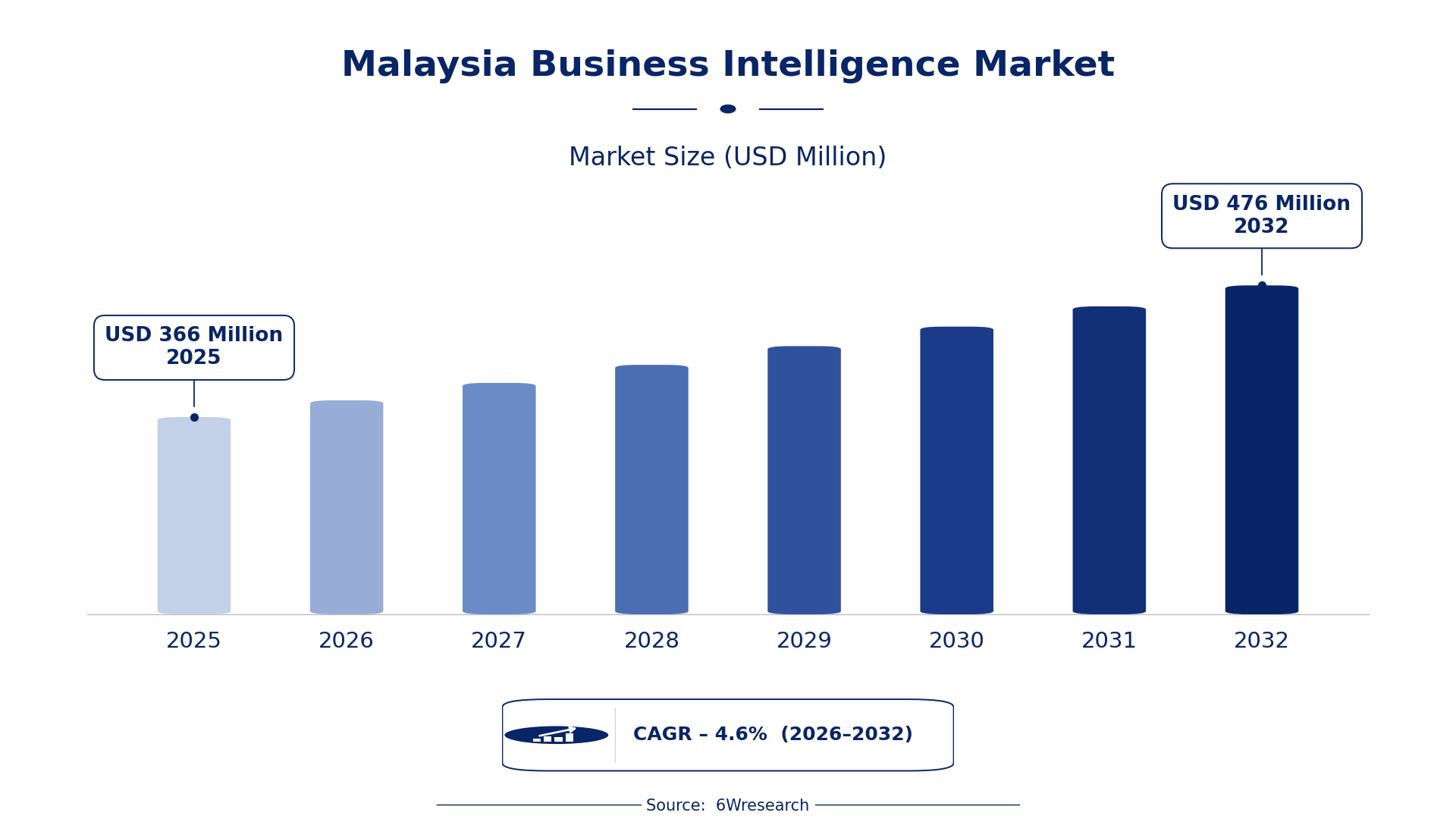
The Malaysia Business Intelligence Market was estimated at USD 366 Million in 2025 and is projected to reach USD 476 Million by 2032, growing at a CAGR of 4.6% from 2026 to 2032.
Malaysia Business Intelligence Market Synopsis
The Malaysian business landscape is shifting towards data-centric decision-making, significantly impacting the Business Intelligence (BI) market. This transition is evident as organizations across sectors recognize the necessity of harnessing data to drive operational efficiencies and strategic initiatives.
As sectors such as finance and healthcare increasingly adopt advanced analytics tools, the demand for tailored BI solutions has surged. The integration of AI and machine learning in analytics is not merely a trend but a fundamental shift in how data is utilized for predictive insights, enhancing competitive positioning.
Malaysia Business Intelligence Market Year-wise Growth Rate and Key Drivers
This graph illustrates the annual growth rates of the Malaysia Business Intelligence Market from 2021 to 2032, highlighting a steady upward trajectory and projected expansion over the forecast period.
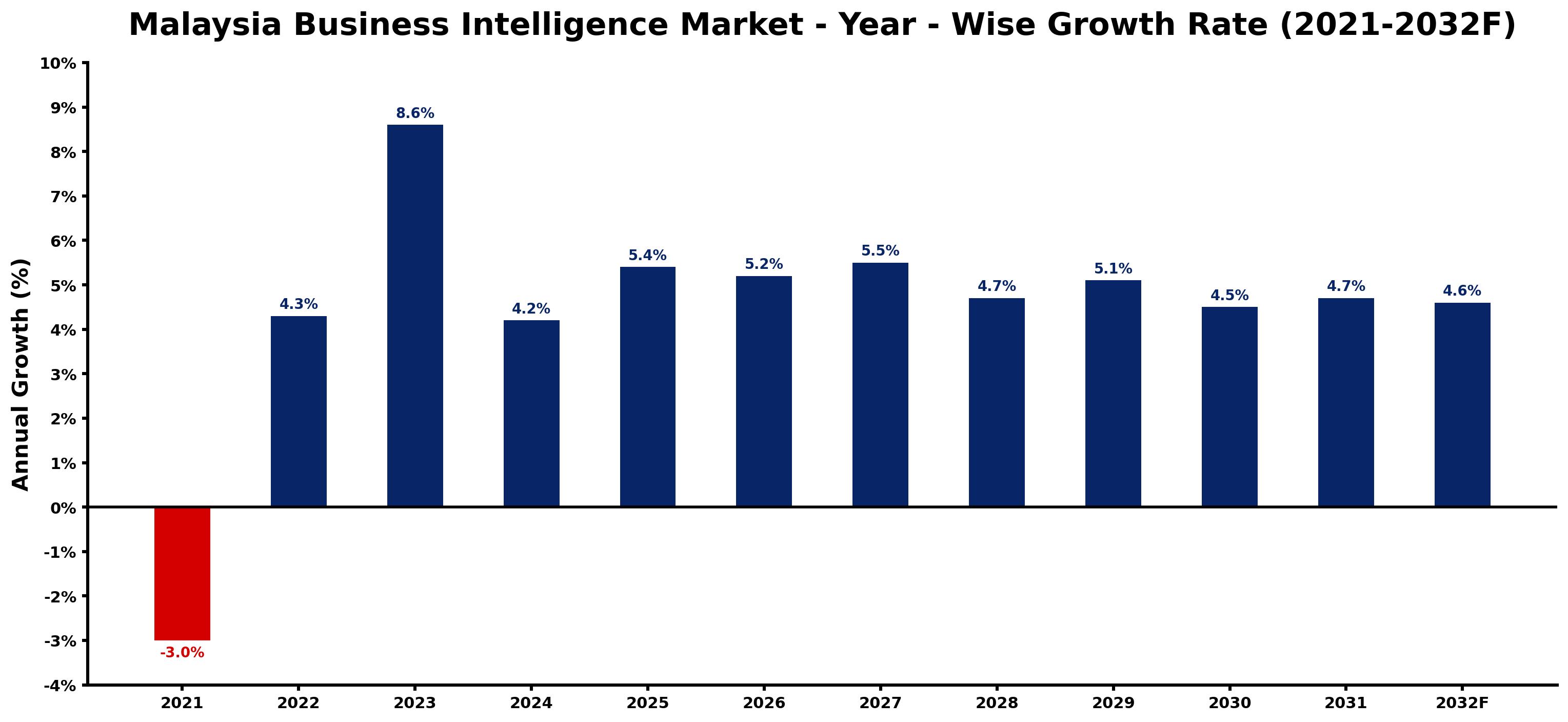
The table below presents the year‑wise growth rates along with the key drivers influencing the market
| Year | Growth Rate | Major Drivers |
| 2021 | -3.0% | MDEC's push for local data governance hindered adoption |
| 2022 | 4.3% | Adoption of SISW framework by Malaysian government agencies. |
| 2023 | 8.6% | Increased investment in data-driven decision-making initiatives. |
| 2024 | 4.2% | Growth of SMEs leveraging BI tools for competitiveness. |
| 2025 | 5.4% | Support from Malaysia Digital Economy Corporation initiatives. |
| 2026 | 5.2% | Enhanced cybersecurity regulations boosting demand for BI solutions. |
| 2027 | 5.5% | Government incentives for AI integration in business operations. |
| 2028 | 4.7% | Rising digital literacy driving demand for analytics tools. |
| 2029 | 5.1% | Improved collaboration with tech incubators for BI startups. |
| 2030 | 4.5% | E-commerce growth fueling demand for real-time analytics. |
| 2031 | 4.7% | Focus on sustainability metrics in corporate reporting. |
| 2032 | 4.6% | Emergence of local partnerships for tailored BI solutions. |
Note: Market size estimations and growth projections presented in this report are based on 6Wresearch's proprietary forecasting methodology, utilizing the latest available industry data, government publications, and primary research inputs.
Malaysia Business Intelligence Market Key Takeaways
Below are some of the specific key takeaways from the market, including:
- Strong growth trajectory propelled by the increasing need for data-driven insights across industries.
- Integration of AI and machine learning technologies is reshaping analytical capabilities.
- Challenges in data integration and quality persist, requiring focused investment from organizations.
- COVID-19 accelerated the adoption of self-service BI tools for agile decision-making.
- Government initiatives are fostering a conducive environment for BI market growth.
Evaluation of Restraints in Malaysia Business Intelligence Market
The Business Intelligence market in Malaysia is grappling with several constraints that hinder its full potential. Data integration remains a formidable challenge; organizations often struggle to consolidate disparate data sources into a unified system. This fragmentation can lead to inaccuracies, undermining the reliability of insights drawn from BI tools.
on top of that, the ongoing need for investment to keep BI tools updated and adaptable to changing business environments presents a continuous hurdle. As organizations expand their data infrastructure, ensuring compliance with evolving data security regulations adds another layer of complexity. These challenges necessitate strategic approaches to ensure effective BI implementation and utilization.
Malaysia Business Intelligence Market Trends
Current trends in the Malaysian Business Intelligence market highlight a growing preference for self-service BI tools. Organizations are empowering their employees with the ability to access and analyze data independently, fostering a culture of data literacy. This trend aligns with the increased demand for real-time insights that facilitate swift decision-making.
Additionally, the rise of cloud-based BI solutions is gaining traction, driven by the need for scalable, cost-effective options. This shift is complemented by the integration of advanced analytics capabilities, including predictive modeling and machine learning, which are becoming standard features in BI offerings.
Malaysia Business Intelligence Market Opportunities
The future of the Business Intelligence market in Malaysia is rife with opportunities for growth and innovation. Companies are increasingly seeking tailored solutions that address specific industry needs, creating a demand for niche providers who can deliver specialized analytics capabilities.
on top of that, as organizations prioritize digital transformation initiatives, there is substantial potential for investment in AI-driven analytics platforms. The continued focus on enhancing data security and compliance measures will also drive demand for advanced BI tools that integrate these functionalities seamlessly.
Government Initiatives in the Malaysia Business Intelligence Market
The Malaysian government is actively shaping the Business Intelligence market through strategic initiatives aimed at fostering a data-driven economy. Policymakers are prioritizing the enhancement of digital infrastructure and supporting technological adoption to ensure that businesses can harness data effectively. These initiatives are crucial for encouraging investment and innovation in the BI sector.
- A recently completed digital infrastructure upgrade program aimed to enhance connectivity and data accessibility across various sectors.
- A current initiative is focused on promoting data literacy and analytics capabilities within public institutions to improve decision-making processes.
- A planned regulatory framework expected to be introduced in 2026 will mandate transparency in data usage, benefiting BI tools.
- An ongoing public-private partnership initiative is working to improve the integration of AI technologies into existing BI frameworks.
- A government-sponsored program is set to launch in 2027 to support small and medium enterprises in adopting BI solutions.
Future Insights of the Malaysia Business Intelligence Market
Looking ahead to 2026-2032, the Malaysia Business Intelligence market is expected to continue its growth trajectory, driven by the relentless push for data-driven decision-making across industries. The integration of emerging technologies, particularly AI and machine learning, will enhance the capabilities of BI solutions, allowing organizations to derive deeper insights and make informed strategic decisions.
As data volumes grow and the complexity of data sources increases, businesses that invest in advanced analytics tools will hold a competitive edge. The government's commitment to fostering a robust data ecosystem will further catalyze the market, ensuring that businesses are well-equipped to leverage their data for future growth.
Malaysia Business Intelligence Market Latest Developments
In the past year, the Malaysia Business Intelligence market has witnessed notable developments reflecting a commitment to innovation and enhancement of analytics capabilities. Organizations are increasingly adopting cloud-based solutions, facilitating more agile operations and improved data accessibility. The focus on integrating advanced analytics into BI tools is becoming more pronounced, with organizations seeking ways to maximize their data utilization.
- A major technology vendor launched an upgraded BI platform in early 2025, enhancing user experience and data visualization capabilities.
- An ongoing project initiated in mid-2025 aims to develop a standardized framework for data quality assessment across industries.
- A regional operator is currently rolling out a new self-service BI tool designed to empower users across various departments.
- An upcoming partnership expected to be announced by late 2025 will focus on integrating machine learning capabilities into existing BI solutions.
- A government-backed initiative is planned for mid-2026 to support the development of data-driven strategies in public health sectors.
Malaysia Business Intelligence Market - Key Attractiveness of the Report
- 10 Years of Market Numbers
- Historical Data Starting from 2022 to 2025
- Base Year: 2025
- Forecast Data until 2032
- Key Performance Indicators Impacting the Market
- Major Upcoming Developments and Projects
Key Highlights of the Report:
- Malaysia Business Intelligence Market Outlook
- Market Size of Malaysia Business Intelligence Market, 2025
- Forecast of Malaysia Business Intelligence Market, 2032
- Historical Data and Forecast of Malaysia Business Intelligence Revenues & Volume for the Period 2022-2032F
- Malaysia Business Intelligence Market Trend Evolution
- Malaysia Business Intelligence Market Drivers and Challenges
- Malaysia Business Intelligence Price Trends
- Malaysia Business Intelligence Porter's Five Forces
- Malaysia Business Intelligence Industry Life Cycle
- Historical Data and Forecast of Malaysia Business Intelligence Market Revenues & Volume By Component for the Period 2022-2032F
- Historical Data and Forecast of Malaysia Business Intelligence Market Revenues & Volume By Solutions for the Period 2022-2032F
- Historical Data and Forecast of Malaysia Business Intelligence Market Revenues & Volume By Services for the Period 2022-2032F
- Historical Data and Forecast of Malaysia Business Intelligence Market Revenues & Volume By Business Function for the Period 2022-2032F
- Historical Data and Forecast of Malaysia Business Intelligence Market Revenues & Volume By Human Resource for the Period 2022-2032F
- Historical Data and Forecast of Malaysia Business Intelligence Market Revenues & Volume By Finance for the Period 2022-2032F
- Historical Data and Forecast of Malaysia Business Intelligence Market Revenues & Volume By Operations for the Period 2022-2032F
- Historical Data and Forecast of Malaysia Business Intelligence Market Revenues & Volume By Sales and Marketing for the Period 2022-2032F
- Historical Data and Forecast of Malaysia Business Intelligence Market Revenues & Volume By Deployment Mode for the Period 2022-2032F
- Historical Data and Forecast of Malaysia Business Intelligence Market Revenues & Volume By On-premises for the Period 2022-2032F
- Historical Data and Forecast of Malaysia Business Intelligence Market Revenues & Volume By Cloud for the Period 2022-2032F
- Historical Data and Forecast of Malaysia Business Intelligence Market Revenues & Volume By Organization Size for the Period 2022-2032F
- Historical Data and Forecast of Malaysia Business Intelligence Market Revenues & Volume By SMEs for the Period 2022-2032F
- Historical Data and Forecast of Malaysia Business Intelligence Market Revenues & Volume By Large Enterprises for the Period 2022-2032F
- Historical Data and Forecast of Malaysia Business Intelligence Market Revenues & Volume By Vertical for the Period 2022-2032F
- Historical Data and Forecast of Malaysia Business Intelligence Market Revenues & Volume By Retail for the Period 2022-2032F
- Historical Data and Forecast of Malaysia Business Intelligence Market Revenues & Volume By Manufacturing for the Period 2022-2032F
- Historical Data and Forecast of Malaysia Business Intelligence Market Revenues & Volume By Government and Public Services for the Period 2022-2032F
- Historical Data and Forecast of Malaysia Business Intelligence Market Revenues & Volume By Media and Entertainment for the Period 2022-2032F
- Historical Data and Forecast of Malaysia Business Intelligence Market Revenues & Volume By Transportation and Logistics for the Period 2022-2032F
- Historical Data and Forecast of Malaysia Business Intelligence Market Revenues & Volume By BFSI for the Period 2022-2032F
- Historical Data and Forecast of Malaysia Business Intelligence Market Revenues & Volume By Telecom and IT for the Period 2022-2032F
- Historical Data and Forecast of Malaysia Business Intelligence Market Revenues & Volume By Healthcare and Life Sciences for the Period 2022-2032F
- Malaysia Business Intelligence Import Export Trade Statistics
- Market Opportunity Assessment By Component
- Market Opportunity Assessment By Business Function
- Market Opportunity Assessment By Deployment Mode
- Market Opportunity Assessment By Organization Size
- Market Opportunity Assessment By Vertical
- Malaysia Business Intelligence Top Companies Market Share
- Malaysia Business Intelligence Competitive Benchmarking By Technical and Operational Parameters
- Malaysia Business Intelligence Company Profiles
- Malaysia Business Intelligence Key Strategic Recommendations






































