Malaysia Canvas Market Size, Share & Growth Rate
The Malaysia Canvas Market was estimated at USD 374 Million in 2025 and is projected to reach USD 486 Million by 2032, growing at a CAGR of 3.8% from 2026 to 2032. This growth trajectory is fueled by an increasing demand in the arts and crafts sector and the rising popularity of outdoor recreational activities, including camping and hiking. Additionally, the rising trend of DIY projects and the integration of canvas in digital printing are further propelling market expansion.
Malaysia Canvas Market Year-wise Growth Rate and Key Drivers
This graph highlights how the Malaysia Canvas Market has steadily grown over the years, supported by major growth factors.
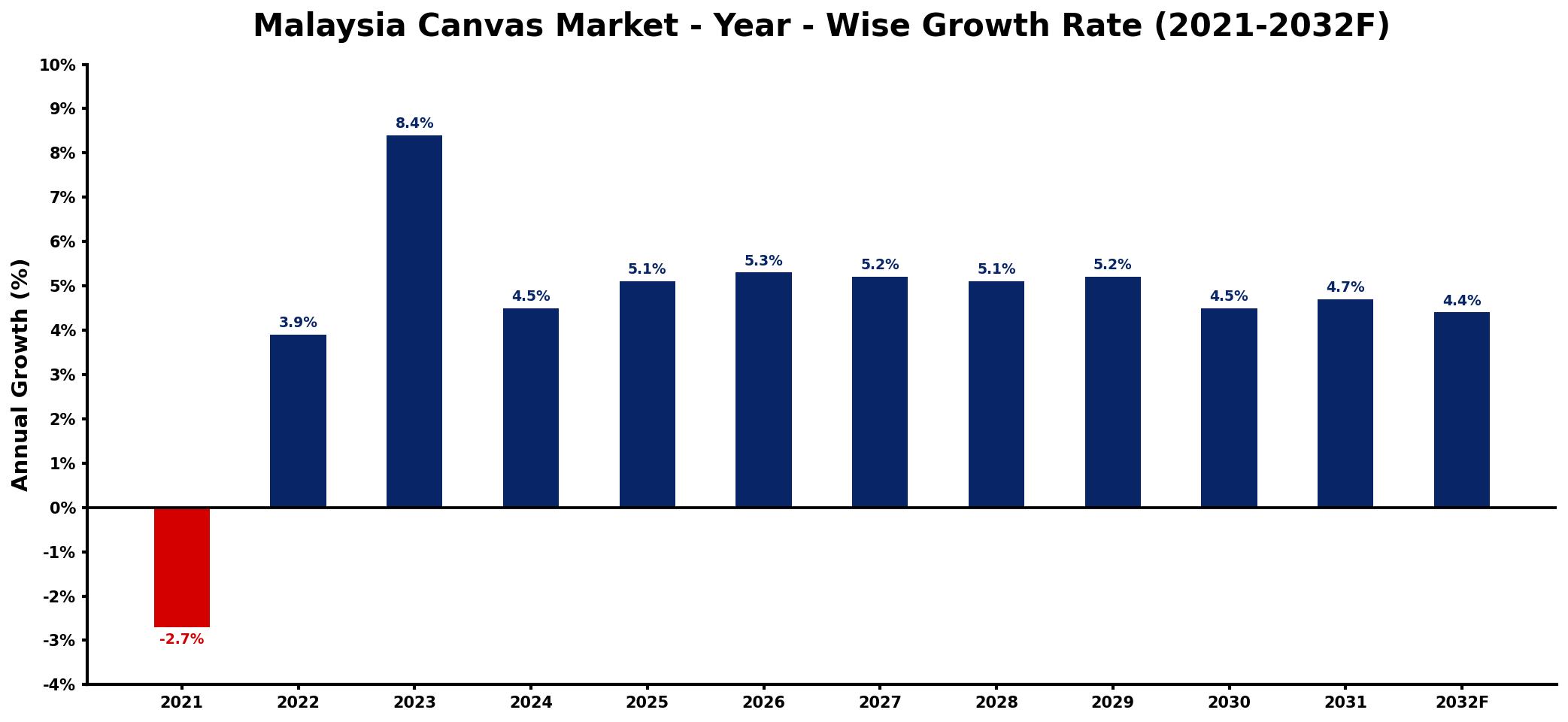
The table below presents the year‑wise growth rates along with the key drivers influencing the market
| Year | Growth Rate | Major Drivers |
| 2021 | -2.7% | decreased consumer spending on arts |
| 2022 | 3.9% | increased interest in home decoration |
| 2023 | 8.4% | growing demand for sustainable materials |
| 2024 | 4.5% | expansion of local art communities |
| 2025 | 5.1% | rising popularity of DIY projects |
| 2026 | 5.3% | increased investment in creative industries |
| 2027 | 5.2% | growing trend of personalized gifts |
| 2028 | 5.1% | surge in online art sales |
| 2029 | 5.2% | enhanced focus on educational programs |
| 2030 | 4.5% | growth in artistic workshops offerings |
| 2031 | 4.7% | increased collaboration with local artists |
| 2032 | 4.4% | rising end-use demand growth |
Note: Market size estimations and growth projections presented in this report are based on 6Wresearch's proprietary forecasting methodology, utilizing the latest available industry data, government publications, and primary research inputs.
Malaysia Canvas Market Synopsis
The canvas market in Malaysia is experiencing a rebound after facing challenges during the COVID-19 pandemic. As sectors like advertising and art recover, the canvas market is set to regain momentum, with a renewed interest in home crafts and outdoor pursuits influencing demand.
As consumer preferences evolve, the market is also witnessing diversification in product applications, from traditional uses in art to contemporary trends in fashion and interior design. This adaptation will be crucial for sustaining growth in the coming years.
Malaysia Canvas Market Key Takeaways
- The market is poised for steady growth driven by demand from arts, crafts, and outdoor sectors.
- Increased participation in DIY projects is creating new opportunities for canvas suppliers.
- Digital printing is becoming a prominent application of canvas materials.
- Challenges remain in diversifying product applications and adapting to digital influences.
- Key players are strategically positioned to benefit from the evolving market landscape.
Evaluation of Restraints in Malaysia Canvas Market
Despite the promising growth trajectory, the Malaysia Canvas Market faces significant restraints. One of the primary concerns is the need for product diversification to cater to evolving consumer preferences. As digital technologies continue to reshape the creative landscape, traditional canvas applications may see diminished relevance unless innovative adaptations are embraced. Moreover, market players must navigate competitive pricing pressures and seek sustainable sourcing to remain appealing to eco-conscious consumers.
Malaysia Canvas Market Trends
Current trends in the Malaysia Canvas Market reflect a growing inclination toward sustainable materials and practices. Consumers are increasingly seeking eco-friendly canvas options, pushing suppliers to adopt responsible sourcing and production methods. Additionally, the rise of social media platforms is facilitating the popularity of DIY projects, which is further driving canvas demand. On the technology front, advancements in digital printing are expanding creative possibilities, enabling artists and businesses to utilize canvas in innovative ways.
Malaysia Canvas Market Opportunities
Opportunities within the Malaysia Canvas Market are ripe for exploration. As the demand for personalized and customized products rises, canvas can be leveraged in fashion accessories, home décor, and promotional items. Furthermore, the expanding outdoor recreational landscape presents a fertile ground for canvas applications in camping gear and outdoor furniture. By tapping into these segments, businesses can unlock substantial growth potential and cater to a broader audience.
Government Initiatives in the Malaysia Canvas Market
Government initiatives aimed at supporting the arts and crafts sector can significantly impact the Malaysia Canvas Market. Policies promoting local artisans and encouraging tourism related to art exhibitions create a conducive environment for growth. Additionally, investments in infrastructure to facilitate outdoor activities contribute to the rising demand for canvas in recreational gear. Overall, government support fosters innovation and collaboration across the industry, enhancing market viability.
Future Insights of the Malaysia Canvas Market
Looking forward, the Malaysia Canvas Market is anticipated to thrive as it embraces digitalization and sustainability. The integration of technology in canvas manufacturing will likely improve efficiency and product offerings. By 2026-2032, the market is expected to see innovative designs and applications become mainstream, driven by consumer demand for unique and personalized items. Additionally, as outdoor activities gain traction post-pandemic, canvas products will increasingly cater to this growing market segment, solidifying their relevance.
Malaysia Canvas Market Latest Developments (2025 - 2026)
Recent developments in the Malaysia Canvas Market indicate a vibrant and dynamic landscape. Companies are ramping up production to meet the rising demand from both the arts and outdoor sectors. Collaborative efforts between artists and manufacturers are leading to innovative canvas applications, while online platforms are facilitating direct-to-consumer sales, enhancing accessibility for hobbyists and professionals alike. These directions mark a significant shift in how canvas is perceived and utilized across various industries.
Malaysia Canvas Market - Key Attractiveness of the Report
- 10 Years of Market Numbers
- Historical Data Starting from 2022 to 2025
- Base Year: 2025
- Forecast Data until 2032
- Key Performance Indicators Impacting the Market
- Major Upcoming Developments and Projects
Key Highlights of the Report:
- Malaysia Canvas Market Outlook
- Market Size of Malaysia Canvas Market, 2025
- Forecast of Malaysia Canvas Market, 2032
- Historical Data and Forecast of Malaysia Canvas Revenues & Volume for the Period 2022-2032F
- Malaysia Canvas Market Trend Evolution
- Malaysia Canvas Market Drivers and Challenges
- Malaysia Canvas Price Trends
- Malaysia Canvas Porter's Five Forces
- Malaysia Canvas Industry Life Cycle
- Historical Data and Forecast of Malaysia Canvas Market Revenues & Volume By Types for the Period 2022-2032F
- Historical Data and Forecast of Malaysia Canvas Market Revenues & Volume By Plane Canvas for the Period 2022-2032F
- Historical Data and Forecast of Malaysia Canvas Market Revenues & Volume By Duck Canvas for the Period 2022-2032F
- Historical Data and Forecast of Malaysia Canvas Market Revenues & Volume By Application for the Period 2022-2032F
- Historical Data and Forecast of Malaysia Canvas Market Revenues & Volume By Tent for the Period 2022-2032F
- Historical Data and Forecast of Malaysia Canvas Market Revenues & Volume By Luggage Fabric for the Period 2022-2032F
- Historical Data and Forecast of Malaysia Canvas Market Revenues & Volume By Automotive Fabric for the Period 2022-2032F
- Historical Data and Forecast of Malaysia Canvas Market Revenues & Volume By Apparel for the Period 2022-2032F
- Historical Data and Forecast of Malaysia Canvas Market Revenues & Volume By Others for the Period 2022-2032F
- Malaysia Canvas Import Export Trade Statistics
- Market Opportunity Assessment By Types
- Market Opportunity Assessment By Application
- Malaysia Canvas Top Companies Market Share
- Malaysia Canvas Competitive Benchmarking By Technical and Operational Parameters
- Malaysia Canvas Company Profiles
- Malaysia Canvas Key Strategic Recommendations






































