Malaysia Car Air Fresheners Market Size, Share & Growth Rate
The Malaysia Car Air Fresheners Market was estimated at USD 1196 Million in 2025 and is projected to reach USD 1786 Million by 2032, growing at a CAGR of 5.9% from 2026 to 2032. This upward trajectory is primarily driven by the increasing number of vehicles on Malaysian roads and a growing consumer demand for a more pleasant driving environment. Additionally, innovations in fragrance offerings and the incorporation of air purifying technologies are likely to further enhance market appeal and drive growth.
Malaysia Car Air Fresheners Market Year-wise Growth Rate and Key Drivers
This graph highlights how the Malaysia Car Air Fresheners Market has steadily grown over the years, supported by major growth factors.
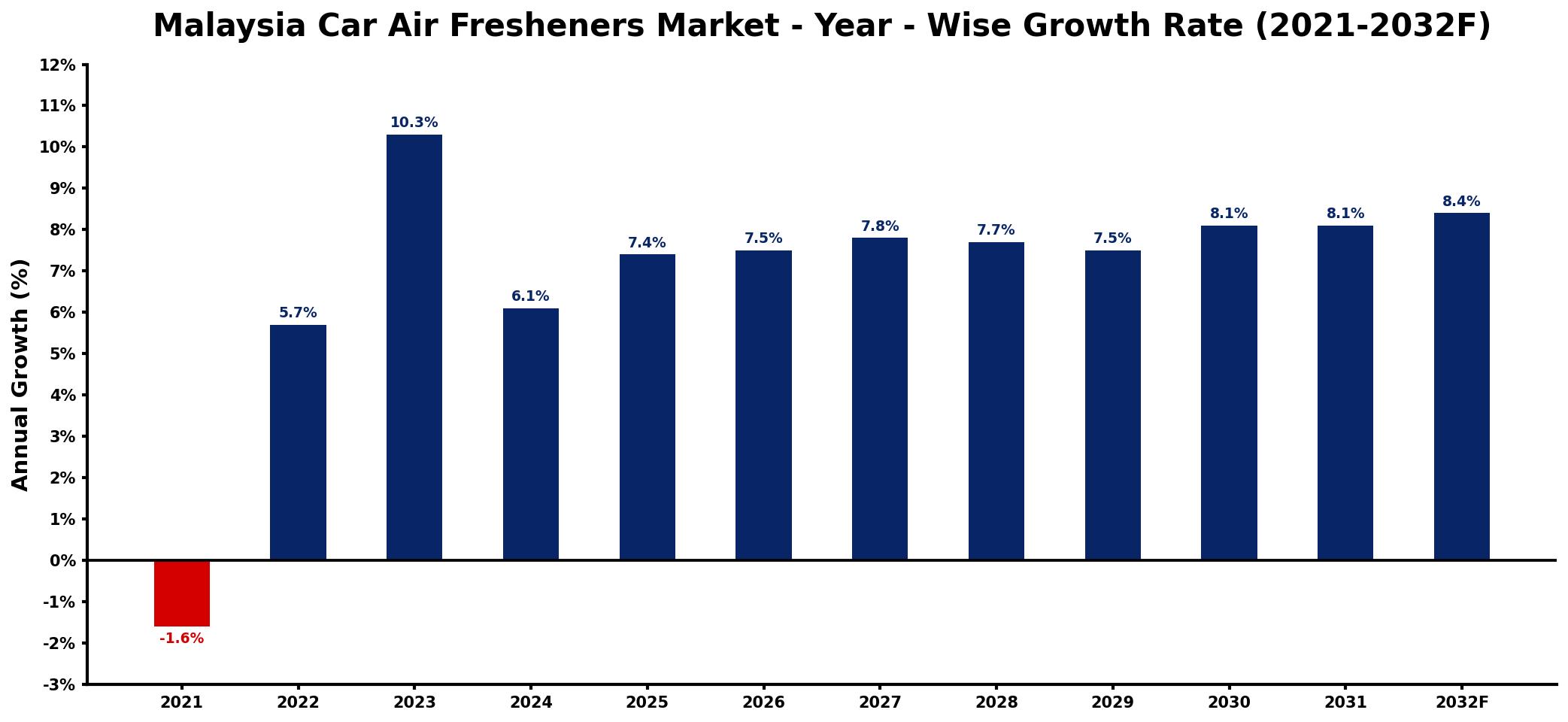
The table below presents the year‑wise growth rates along with the key drivers influencing the market
| Year | Growth Rate | Major Drivers |
| 2021 | -1.6% | decrease in consumer spending habits |
| 2022 | 5.7% | rising disposable income levels |
| 2023 | 10.3% | increased focus on hygiene |
| 2024 | 6.1% | growing popularity of online shopping |
| 2025 | 7.4% | expansion of retail distribution channels |
| 2026 | 7.5% | introduction of innovative fragrances |
| 2027 | 7.8% | increased consumer awareness campaigns |
| 2028 | 7.7% | growth in automotive sales market |
| 2029 | 7.5% | rising demand for eco-friendly products |
| 2030 | 8.1% | enhanced marketing strategies implemented |
| 2031 | 8.1% | development of subscription services |
| 2032 | 8.4% | emphasis on lifestyle branding initiatives |
Note: Market size estimations and growth projections presented in this report are based on 6Wresearch's proprietary forecasting methodology, utilizing the latest available industry data, government publications, and primary research inputs.
Malaysia Car Air Fresheners Market Synopsis
Following a challenging period during the COVID-19 pandemic, the Malaysia car air fresheners market is regaining momentum as consumer confidence returns and travel resumes. The desire for improved in-car experiences is steering preferences toward a diverse range of air freshening products, blending comfort with modern scent innovations.
As the market evolves, a significant shift toward eco-friendly products is evident. Consumers are increasingly aware of environmental issues, motivating manufacturers to introduce sustainable, long-lasting air fresheners. This growing emphasis on sustainability is likely to shape the future landscape of the market, creating new avenues for growth.
Malaysia Car Air Fresheners Market Key Takeaways
- Increasing vehicle ownership rates are driving the demand for car air fresheners in Malaysia.
- Consumer preferences are shifting towards eco-friendly and innovative products with longer-lasting effects.
- The market is recovering from pandemic-induced setbacks, with renewed interest in car accessories.
- Technological advancements in fragrance and air purification are shaping product offerings.
- Adherence to safety and environmental regulations remains crucial for manufacturers.
Evaluation of Restraints in Malaysia Car Air Fresheners Market
Despite the positive market trajectory, several restraints can impede growth. One significant factor is the fluctuating consumer preferences, especially concerning fragrance types. As consumers become more discerning, there is a risk that certain products may fall out of favor. Additionally, concerns over chemical ingredients in traditional air fresheners pose a challenge, leading to increased scrutiny from both consumers and regulatory bodies. Furthermore, maintaining product quality while adhering to strict safety regulations is vital, as failure to do so could hinder market acceptance and overall growth.
Malaysia Car Air Fresheners Market Trends
Emerging trends within the Malaysia car air fresheners market highlight a noticeable shift towards personalization and unique scent combinations. Consumers are increasingly drawn to customized fragrance solutions that reflect their personalities and preferences. Moreover, the integration of technology such as app-controlled air fresheners and smart features enhances user engagement. Eco-friendly and biodegradable products are not just trends but essential elements that reflect the growing environmental consciousness among Malaysian consumers. This trend is further supported by the increasing popularity of natural and organic fragrances.
Malaysia Car Air Fresheners Market Opportunities
Significant opportunities exist within the Malaysia car air fresheners market as businesses tap into the rising demand for innovative and sustainable products. Manufacturers can explore collaborations with local scent creators to offer uniquely Malaysian fragrances, enhancing emotional connections with consumers. Additionally, the potential for growth in online retail channels presents a lucrative avenue for reaching tech-savvy consumers. With the increasing interest in air purification, combining air freshening with odor-neutralizing technology presents a compelling market opportunity, addressing the dual consumer need for freshness and cleanliness in vehicles.
Government Initiatives in the Malaysia Car Air Fresheners Market
The Malaysian government is actively promoting environmental sustainability through various initiatives aimed at encouraging the use of eco-friendly products, including car air fresheners. Incentives for businesses developing sustainable products and adhering to safety regulations create a favorable environment for market growth. Policies focused on reducing plastic waste and promoting green technologies align closely with the preferences of modern consumers, thus supporting the growth of eco-conscious brands in this sector.
Future Insights of the Malaysia Car Air Fresheners Market
Looking ahead to 2026-2032, the Malaysia car air fresheners market is poised for significant expansion as consumer preferences continue to evolve. The integration of advanced technologies, combined with the rising demand for sustainable products, will shape the future of the market. As economic conditions stabilize and travel resumes, consumer spending on car accessories, including air fresheners, is expected to increase. With an increasing focus on health and wellness, product innovations that blend fragrance with air purification will likely gain traction, positioning manufacturers for sustained growth and success.
Malaysia Car Air Fresheners Market Latest Developments (2025 - 2026)
Recent developments in the Malaysia car air fresheners market reflect a dynamic shift towards sustainability and consumer engagement. Companies are launching new product lines that focus on natural ingredients and biodegradable materials. Additionally, there is a noticeable trend towards the inclusion of interactive features in air fresheners, allowing consumers to customize scents through mobile applications. As consumer interest in wellness grows, brands are increasingly emphasizing the mental health benefits associated with pleasant scents during driving.
Malaysia Car Air Fresheners Market - Key Attractiveness of the Report
- 10 Years of Market Numbers
- Historical Data Starting from 2022 to 2025
- Base Year: 2025
- Forecast Data until 2032
- Key Performance Indicators Impacting the Market
- Major Upcoming Developments and Projects
Key Highlights of the Report:
- Malaysia Car Air Fresheners Market Outlook
- Market Size of Malaysia Car Air Fresheners Market, 2025
- Forecast of Malaysia Car Air Fresheners Market, 2032
- Historical Data and Forecast of Malaysia Car Air Fresheners Revenues & Volume for the Period 2022-2032F
- Malaysia Car Air Fresheners Market Trend Evolution
- Malaysia Car Air Fresheners Market Drivers and Challenges
- Malaysia Car Air Fresheners Price Trends
- Malaysia Car Air Fresheners Porter's Five Forces
- Malaysia Car Air Fresheners Industry Life Cycle
- Historical Data and Forecast of Malaysia Car Air Fresheners Market Revenues & Volume By Product for the Period 2022-2032F
- Historical Data and Forecast of Malaysia Car Air Fresheners Market Revenues & Volume By Gel & Cans for the Period 2022-2032F
- Historical Data and Forecast of Malaysia Car Air Fresheners Market Revenues & Volume By Spray/Aerosol for the Period 2022-2032F
- Historical Data and Forecast of Malaysia Car Air Fresheners Market Revenues & Volume By Paper Car Air Fresheners for the Period 2022-2032F
- Historical Data and Forecast of Malaysia Car Air Fresheners Market Revenues & Volume By Vents & Clips for the Period 2022-2032F
- Historical Data and Forecast of Malaysia Car Air Fresheners Market Revenues & Volume By End-User for the Period 2022-2032F
- Historical Data and Forecast of Malaysia Car Air Fresheners Market Revenues & Volume By Sports Car for the Period 2022-2032F
- Historical Data and Forecast of Malaysia Car Air Fresheners Market Revenues & Volume By Mid-range Car for the Period 2022-2032F
- Historical Data and Forecast of Malaysia Car Air Fresheners Market Revenues & Volume By SUV for the Period 2022-2032F
- Historical Data and Forecast of Malaysia Car Air Fresheners Market Revenues & Volume By Others for the Period 2022-2032F
- Historical Data and Forecast of Malaysia Car Air Fresheners Market Revenues & Volume By Fragrance for the Period 2022-2032F
- Historical Data and Forecast of Malaysia Car Air Fresheners Market Revenues & Volume By Scented for the Period 2022-2032F
- Historical Data and Forecast of Malaysia Car Air Fresheners Market Revenues & Volume By UnScented for the Period 2022-2032F
- Malaysia Car Air Fresheners Import Export Trade Statistics
- Market Opportunity Assessment By Product
- Market Opportunity Assessment By End-User
- Market Opportunity Assessment By Fragrance
- Malaysia Car Air Fresheners Top Companies Market Share
- Malaysia Car Air Fresheners Competitive Benchmarking By Technical and Operational Parameters
- Malaysia Car Air Fresheners Company Profiles
- Malaysia Car Air Fresheners Key Strategic Recommendations






































