Malaysia Car Vacuum Cleaner Market Size, Share & Growth Rate
The Malaysia Car Vacuum Cleaner Market was estimated at USD 364 Million in 2025 and is projected to reach USD 476 Million by 2032, growing at a CAGR of 3.9% from 2026 to 2032. This growth trajectory is underscored by an increasing emphasis on cleanliness and hygiene, particularly in a post-pandemic world where vehicle interiors are prioritized for their health implications. As urbanization accelerates and car ownership continues to rise, consumers are seeking convenient and effective solutions for maintaining their vehicles.
Malaysia Car Vacuum Cleaner Market Year-wise Growth Rate and Key Drivers
This graph highlights how the Malaysia Car Vacuum Cleaner Market has steadily grown over the years, supported by major growth factors.
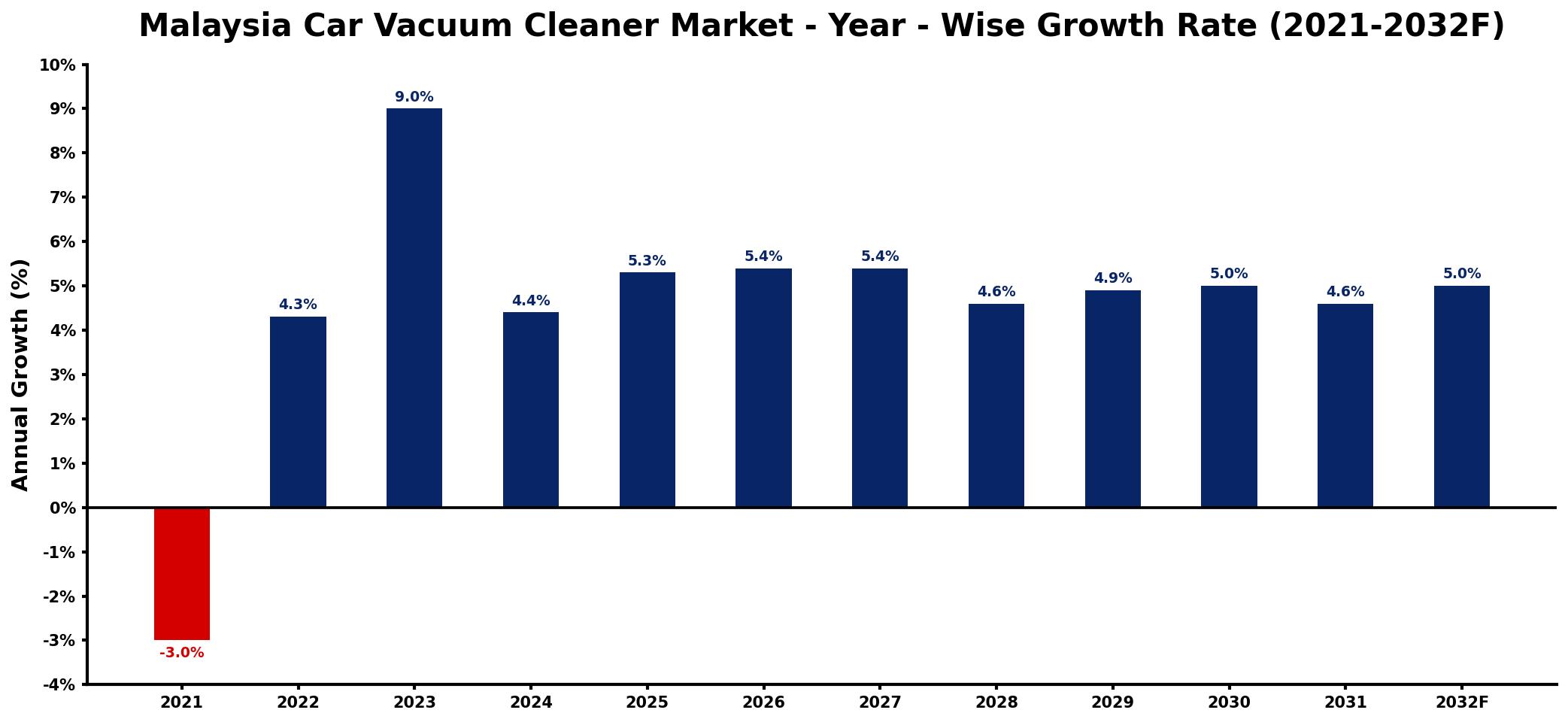
The table below presents the year‑wise growth rates along with the key drivers influencing the market
| Year | Growth Rate | Major Drivers |
| 2021 | -3.0% | decrease in consumer spending habits |
| 2022 | 4.3% | rise in disposable income levels |
| 2023 | 9.0% | increased awareness of hygiene |
| 2024 | 4.4% | growth in e-commerce platforms |
| 2025 | 5.3% | expansion of automotive accessories market |
| 2026 | 5.4% | higher investment in home improvement |
| 2027 | 5.4% | increased focus on sustainability practices |
| 2028 | 4.6% | growing automotive sector requirements |
| 2029 | 4.9% | rising demand for convenience solutions |
| 2030 | 5.0% | increased overall sector activity |
| 2031 | 4.6% | increased availability of innovative technologies |
| 2032 | 5.0% | growing popularity of home services |
Note: Market size estimations and growth projections presented in this report are based on 6Wresearch's proprietary forecasting methodology, utilizing the latest available industry data, government publications, and primary research inputs.
Malaysia Car Vacuum Cleaner Market Synopsis
Recent momentum in the Malaysia Car Vacuum Cleaner Market has been significant, reflecting a shift in consumer attitudes towards vehicle cleanliness. As lifestyles evolve, the demand for high-performance, user-friendly cleaning solutions has surged, laying a robust foundation for future growth.
Looking ahead, the market is anticipated to evolve further with innovations in product design and functionality. The introduction of advanced features such as cordless capabilities and enhanced filtration systems promises to meet the ever-changing preferences of Malaysian consumers, establishing a dynamic market environment.
Malaysia Car Vacuum Cleaner Market Key Takeaways
- Growing consumer awareness regarding hygiene is significantly boosting demand for car vacuum cleaners.
- Urbanization and increased vehicle ownership are crucial drivers of market expansion.
- Manufacturers are focusing on innovation, introducing features like portability and UV-C sanitization.
- The market is witnessing a rebound post-COVID-19, with renewed interest in car maintenance.
- Competitive pricing and product quality remain essential for capturing market share.
Evaluation of Restraints in Malaysia Car Vacuum Cleaner Market
Despite the upward momentum, the Malaysia Car Vacuum Cleaner Market faces several restraints. Market saturation poses a significant challenge, as numerous brands compete for consumer attention. Furthermore, economic downturns can affect discretionary spending, leading consumers to prioritize essential purchases over car accessories. The rapid advancement of technology necessitates continuous product innovation, compelling manufacturers to balance affordability with quality. As consumers grow more discerning, aligning products with their expectations becomes increasingly critical.
Malaysia Car Vacuum Cleaner Market Trends
Current trends indicate a marked shift towards cordless and portable vacuum cleaners, catering to the busy lifestyles of urban Malaysian consumers. There's also a growing interest in features that enhance user experience, such as lightweight designs and multi-functional capabilities. Health-conscious consumers are particularly drawn to vacuum cleaners equipped with advanced filtration systems that improve indoor air quality. Additionally, the integration of smart technology is beginning to make waves, offering users connectivity and control via mobile applications.
Malaysia Car Vacuum Cleaner Market Opportunities
The future looks promising for stakeholders in the Malaysia Car Vacuum Cleaner Market, with genuine growth opportunities on the horizon. There is potential for developing eco-friendly products that align with the increasing consumer preference for sustainable solutions. Furthermore, expanding into e-commerce platforms offers manufacturers a chance to reach a wider audience and enhance customer engagement. Tailoring marketing strategies to address local preferences can also drive brand loyalty and market penetration, positioning companies for long-term success.
Government Initiatives in the Malaysia Car Vacuum Cleaner Market
The Malaysian government is actively promoting cleanliness and hygiene standards across various sectors, including automotive care. Initiatives aimed at improving public health awareness may indirectly bolster the car vacuum cleaner market. Various programs focused on environmental sustainability could lead to increased consumer interest in eco-friendly products, encouraging manufacturers to innovate within this sphere. Government subsidies for green technologies could also play a role in enhancing the affordability and accessibility of high-quality car cleaning solutions.
Future Insights of the Malaysia Car Vacuum Cleaner Market
From 2026 to 2032, the Malaysia Car Vacuum Cleaner Market is set to experience transformative growth. Innovations in technology, particularly regarding battery efficiency and cleaning efficacy, will likely take center stage. As urbanization continues, consumers will increasingly seek compact solutions that can be utilized in tight spaces. The emphasis on health will persist, driving demand for products that not only clean effectively but also promote a healthier environment. Adapting to these trends will be crucial for manufacturers to capture market share and stay competitive.
Malaysia Car Vacuum Cleaner Market Latest Developments (2025 - 2026)
Recent developments in the Malaysia Car Vacuum Cleaner Market reflect a robust adaptation to consumer needs, with manufacturers emphasizing the introduction of innovative features aimed at improving usability and effectiveness. The trend toward e-commerce has accelerated, enabling brands to expand their reach and engage directly with consumers. Additionally, there have been noticeable shifts in marketing strategies to highlight the importance of hygiene and cleanliness, resulting in heightened consumer interest and purchases post-pandemic.
Malaysia Car Vacuum Cleaner Market - Key Attractiveness of the Report
- 10 Years of Market Numbers
- Historical Data Starting from 2022 to 2025
- Base Year: 2025
- Forecast Data until 2032
- Key Performance Indicators Impacting the Market
- Major Upcoming Developments and Projects
Key Highlights of the Report:
- Malaysia Car Vacuum Cleaner Market Outlook
- Market Size of Malaysia Car Vacuum Cleaner Market, 2025
- Forecast of Malaysia Car Vacuum Cleaner Market, 2032
- Historical Data and Forecast of Malaysia Car Vacuum Cleaner Revenues & Volume for the Period 2022-2032F
- Malaysia Car Vacuum Cleaner Market Trend Evolution
- Malaysia Car Vacuum Cleaner Market Drivers and Challenges
- Malaysia Car Vacuum Cleaner Price Trends
- Malaysia Car Vacuum Cleaner Porter's Five Forces
- Malaysia Car Vacuum Cleaner Industry Life Cycle
- Historical Data and Forecast of Malaysia Car Vacuum Cleaner Market Revenues & Volume By Type for the Period 2022-2032F
- Historical Data and Forecast of Malaysia Car Vacuum Cleaner Market Revenues & Volume By Below 100 Watts for the Period 2022-2032F
- Historical Data and Forecast of Malaysia Car Vacuum Cleaner Market Revenues & Volume By 100 - 300 Watts for the Period 2022-2032F
- Historical Data and Forecast of Malaysia Car Vacuum Cleaner Market Revenues & Volume By Above 300 Watts for the Period 2022-2032F
- Historical Data and Forecast of Malaysia Car Vacuum Cleaner Market Revenues & Volume By Vacuum Bag Type for the Period 2022-2032F
- Historical Data and Forecast of Malaysia Car Vacuum Cleaner Market Revenues & Volume By Bagged for the Period 2022-2032F
- Historical Data and Forecast of Malaysia Car Vacuum Cleaner Market Revenues & Volume By Bagless for the Period 2022-2032F
- Historical Data and Forecast of Malaysia Car Vacuum Cleaner Market Revenues & Volume By Cord Type for the Period 2022-2032F
- Historical Data and Forecast of Malaysia Car Vacuum Cleaner Market Revenues & Volume By Corded for the Period 2022-2032F
- Historical Data and Forecast of Malaysia Car Vacuum Cleaner Market Revenues & Volume By Cordless for the Period 2022-2032F
- Historical Data and Forecast of Malaysia Car Vacuum Cleaner Market Revenues & Volume By Distribution Channel for the Period 2022-2032F
- Historical Data and Forecast of Malaysia Car Vacuum Cleaner Market Revenues & Volume By Offline for the Period 2022-2032F
- Historical Data and Forecast of Malaysia Car Vacuum Cleaner Market Revenues & Volume By Online for the Period 2022-2032F
- Malaysia Car Vacuum Cleaner Import Export Trade Statistics
- Market Opportunity Assessment By Type
- Market Opportunity Assessment By Vacuum Bag Type
- Market Opportunity Assessment By Cord Type
- Market Opportunity Assessment By Distribution Channel
- Malaysia Car Vacuum Cleaner Top Companies Market Share
- Malaysia Car Vacuum Cleaner Competitive Benchmarking By Technical and Operational Parameters
- Malaysia Car Vacuum Cleaner Company Profiles
- Malaysia Car Vacuum Cleaner Key Strategic Recommendations






































