Malaysia Carbon Credit Market Size, Share & Growth Rate
The Malaysia Carbon Credit Market was estimated at USD 319 Million in 2025 and is projected to reach USD 415 Million by 2032, growing at a CAGR of 3.8% from 2026 to 2032. This growth trajectory is largely driven by the Malaysian government's commitment to reducing greenhouse gas emissions and a heightened awareness among businesses regarding their carbon footprints. Furthermore, international climate agreements and the push for sustainable practices across various sectors are expected to bolster carbon credit trading initiatives in the country.
Malaysia Carbon Credit Market Year-wise Growth Rate and Key Drivers
This graph highlights how the Malaysia Carbon Credit Market has steadily grown over the years, supported by major growth factors.
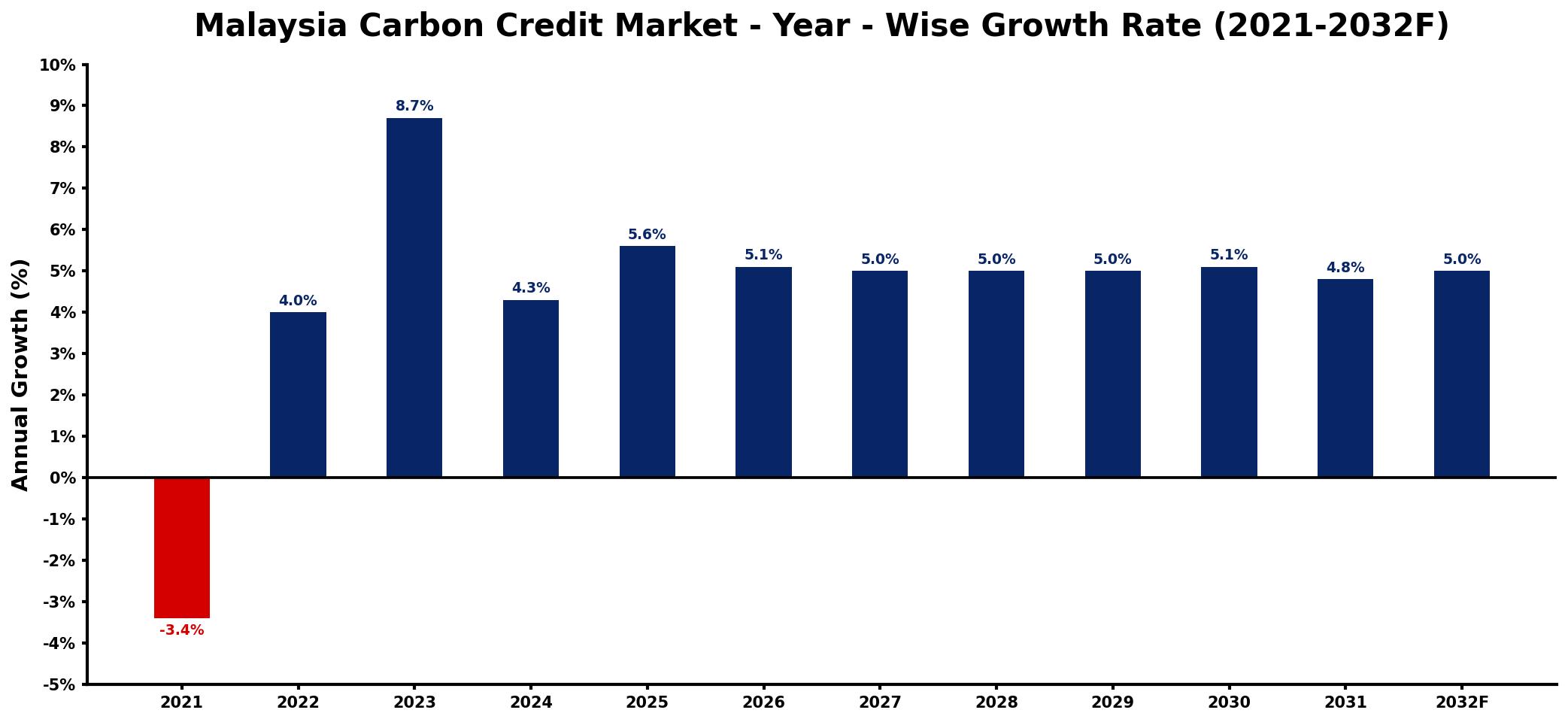
The table below presents the year‑wise growth rates along with the key drivers influencing the market
| Year | Growth Rate | Major Drivers |
| 2021 | -3.4% | decreased interest in sustainability initiatives |
| 2022 | 4.0% | growing investments in renewable energy |
| 2023 | 8.7% | increased corporate sustainability commitments |
| 2024 | 4.3% | expansion of regulatory frameworks worldwide |
| 2025 | 5.6% | rising demand for green technologies |
| 2026 | 5.1% | enhanced public awareness campaigns |
| 2027 | 5.0% | development of innovative financing solutions |
| 2028 | 5.0% | strengthened partnerships across sectors |
| 2029 | 5.0% | growing participation in environmental programs |
| 2030 | 5.1% | increased focus on climate resilience |
| 2031 | 4.8% | broadening scope of environmental policies |
| 2032 | 5.0% | strengthened global sustainability networks |
Note: Market size estimations and growth projections presented in this report are based on 6Wresearch's proprietary forecasting methodology, utilizing the latest available industry data, government publications, and primary research inputs.
Malaysia Carbon Credit Market Synopsis
In recent years, the carbon credit market in Malaysia has gained significant attention, spurred by a national agenda focused on sustainability and environmental responsibility. As organizations across the spectrum begin to adopt carbon neutrality goals, the demand for carbon credits is increasingly evident.
The market remains in a nascent stage, yet it is evolving rapidly. With a mix of public and private initiatives aimed at promoting sustainable practices, Malaysia is carving out a space for itself within the global carbon trading landscape.
Malaysia Carbon Credit Market Key Takeaways
- The market is projected to grow at a CAGR of 3.8% from 2026 to 2032.
- Government initiatives are pivotal in shaping carbon credit trading mechanisms.
- Public and private sector collaboration is essential for market development.
- The COVID-19 pandemic highlighted the importance of sustainability in business practices.
- Growing corporate interest in sustainability is driving demand for carbon offsets.
Evaluation of Restraints in Malaysia Carbon Credit Market
While the Malaysia Carbon Credit Market shows promising potential, several restraints hinder its full-scale growth. The nascent nature of carbon trading mechanisms creates uncertainties for businesses looking to invest. Additionally, discrepancies in emissions measurement and verification processes lead to concerns regarding the credibility of carbon credits. Without strong regulatory frameworks and public-private partnerships to strengthen market infrastructure, achieving the anticipated growth trajectory may be challenging.
Malaysia Carbon Credit Market Trends
Key trends shaping the Malaysia Carbon Credit Market include an increasing push towards regulatory reforms that facilitate easier access to carbon trading and greater transparency in emissions reporting. Moreover, the integration of technology, such as blockchain for tracking carbon credits, is gaining traction. The rise in corporate sustainability reporting is also prompting more companies to engage in carbon offset projects, further driving demand for credits.
Malaysia Carbon Credit Market Opportunities
The growing focus on achieving net-zero emissions presents lucrative investment opportunities within the Malaysia Carbon Credit Market. Companies looking to enhance their sustainability profiles are increasingly seeking innovative carbon offset solutions. This creates an avenue for investment in carbon capture technology, afforestation projects, and energy efficiency programs, all of which could significantly contribute to the market's growth. Additionally, engaging in partnerships that enhance the local understanding of carbon credit mechanisms can spur market activity.
Government Initiatives in the Malaysia Carbon Credit Market
The Malaysian government has introduced several initiatives aimed at fostering a robust carbon credit market. Policy frameworks promoting carbon neutrality are being developed, alongside incentives for businesses to reduce emissions. Efforts to align with international climate accords are strengthening the regulatory landscape, while public spending on environmental projects is on the rise. Programs aimed at enhancing awareness and capacity building in carbon trading are also being implemented to cultivate a more engaged market.
Future Insights of the Malaysia Carbon Credit Market
Looking ahead to the 2026-2032 period, the Malaysia Carbon Credit Market is poised for significant evolution. With continuing government support and increasing corporate engagement, the market is likely to transition into a more structured and reliable platform for carbon trading. As Malaysia enhances its commitment to sustainability, the anticipation is that innovative projects and stronger regulatory frameworks will facilitate smoother trading processes, drawing more participants into the market.
Malaysia Carbon Credit Market Latest Developments (2025 - 2026)
Recent developments in the Malaysia Carbon Credit Market highlight a growing engagement from both public and private sectors. Increased collaborations have emerged to streamline carbon credit verification processes. Several pilot projects focusing on innovative carbon capture technologies have also gained traction. Moreover, discussions regarding the establishment of a national carbon exchange are underway, aimed at enhancing liquidity in the market.
Malaysia Carbon Credit Market - Key Attractiveness of the Report
- 10 Years of Market Numbers
- Historical Data Starting from 2022 to 2025
- Base Year: 2025
- Forecast Data until 2032
- Key Performance Indicators Impacting the Market
- Major Upcoming Developments and Projects
Key Highlights of the Report:
- Malaysia Carbon Credit Market Outlook
- Market Size of Malaysia Carbon Credit Market, 2025
- Forecast of Malaysia Carbon Credit Market, 2032
- Historical Data and Forecast of Malaysia Carbon Credit Revenues & Volume for the Period 2022-2032F
- Malaysia Carbon Credit Market Trend Evolution
- Malaysia Carbon Credit Market Drivers and Challenges
- Malaysia Carbon Credit Price Trends
- Malaysia Carbon Credit Porter's Five Forces
- Malaysia Carbon Credit Industry Life Cycle
- Historical Data and Forecast of Malaysia Carbon Credit Market Revenues & Volume By Sector for the Period 2022-2032F
- Historical Data and Forecast of Malaysia Carbon Credit Market Revenues & Volume By Energy for the Period 2022-2032F
- Historical Data and Forecast of Malaysia Carbon Credit Market Revenues & Volume By Transportation for the Period 2022-2032F
- Historical Data and Forecast of Malaysia Carbon Credit Market Revenues & Volume By Residential And Commercial Buildings for the Period 2022-2032F
- Historical Data and Forecast of Malaysia Carbon Credit Market Revenues & Volume By Industry for the Period 2022-2032F
- Historical Data and Forecast of Malaysia Carbon Credit Market Revenues & Volume By Agriculture for the Period 2022-2032F
- Historical Data and Forecast of Malaysia Carbon Credit Market Revenues & Volume By Forestry for the Period 2022-2032F
- Historical Data and Forecast of Malaysia Carbon Credit Market Revenues & Volume By Water And Wastewater for the Period 2022-2032F
- Malaysia Carbon Credit Import Export Trade Statistics
- Market Opportunity Assessment By Sector
- Malaysia Carbon Credit Top Companies Market Share
- Malaysia Carbon Credit Competitive Benchmarking By Technical and Operational Parameters
- Malaysia Carbon Credit Company Profiles
- Malaysia Carbon Credit Key Strategic Recommendations






































