Malaysia Carbonated Beverages Market Size Growth Rate
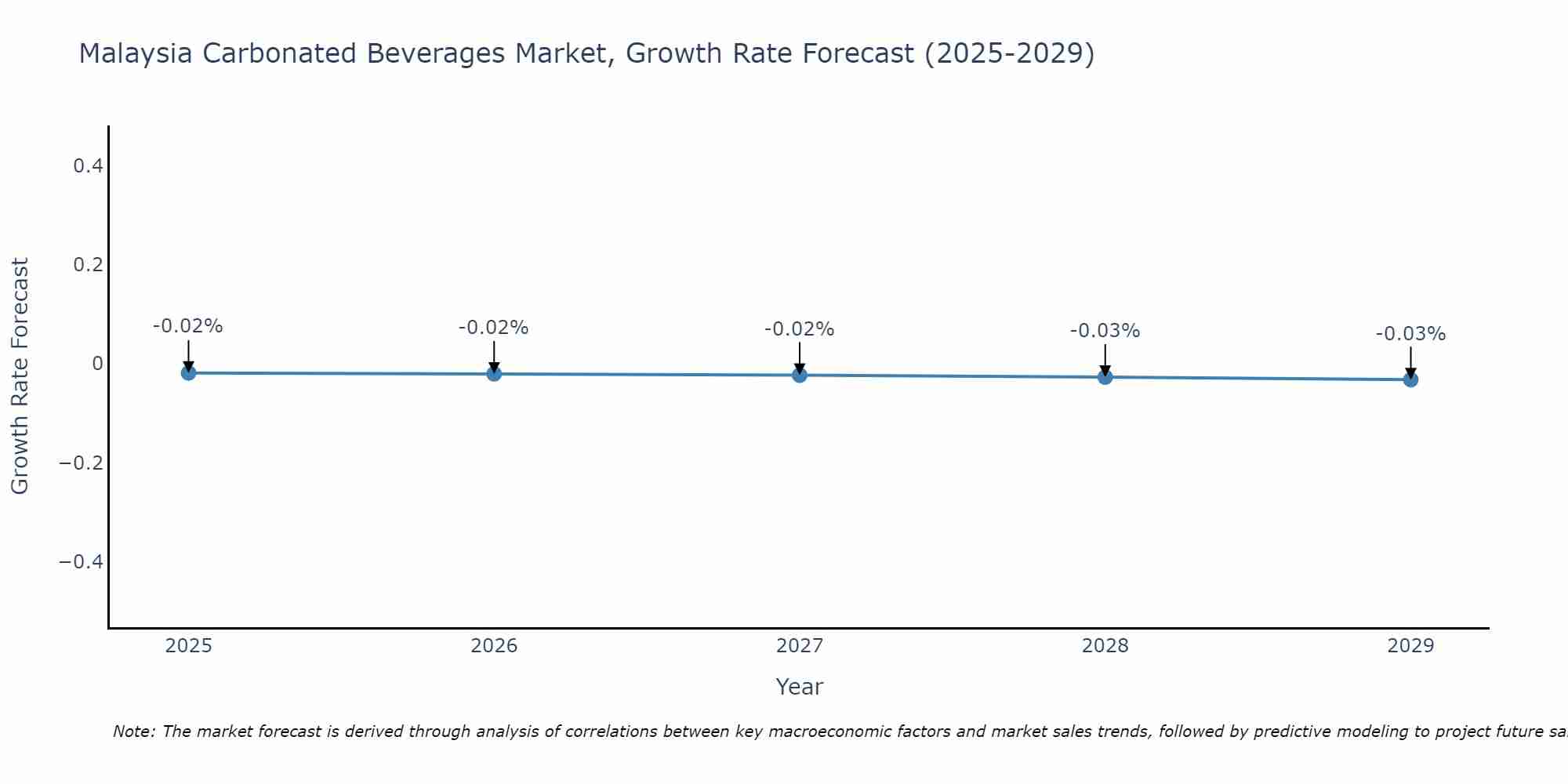
The Malaysia Carbonated Beverages Market could see a tapering of growth rates over 2025 to 2029. Although the growth rate starts strong at -0.02% in 2025, it steadily loses momentum, ending at -0.03% by 2029.
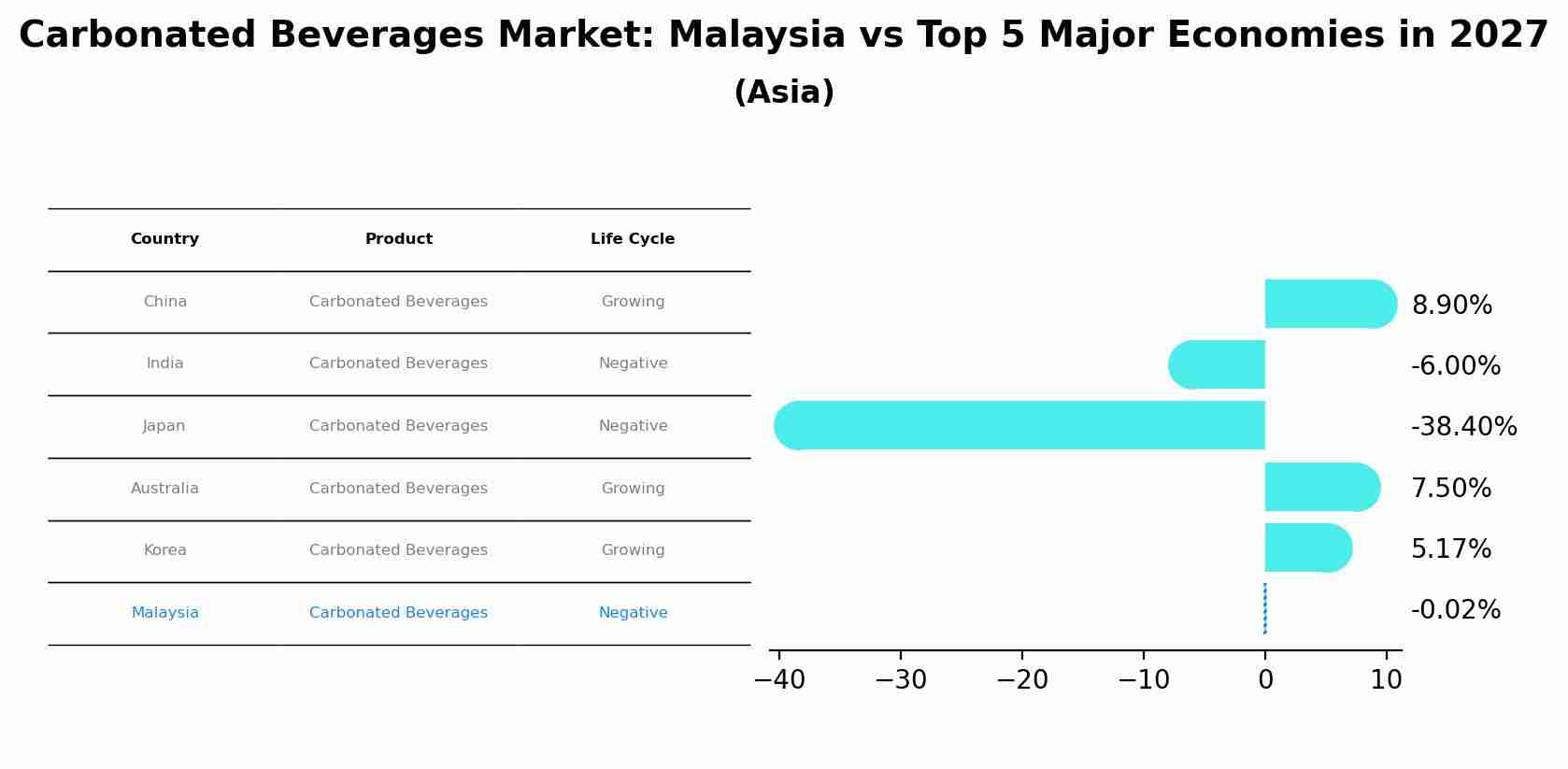
Carbonated Beverages Market: Malaysia vs Top 5 Major Economies in 2027 (Asia)
By 2027, the Carbonated Beverages market in Malaysia is anticipated to reach a growth rate of -0.02%, as part of an increasingly competitive Asia region, where China remains at the forefront, supported by India, Japan, Australia and South Korea, driving innovations and market adoption across sectors.
Malaysia Carbonated Beverages Market Synopsis
The Malaysia carbonated beverages market size was valued at USD 8.5 billion in 2020 and is expected to expand at a compound annual growth rate (CAGR) of 3.6% from 2020 to 2026. Rising health consciousness among consumers, the availability of new flavors and product innovations, and increasing demand for carbonated drinks are driving the market growth in this region. The emergence of low-calorie soft drinks has also led to an increase in demand for such products due to their various health benefits. Furthermore, manufacturers have been introducing innovative packaging designs that appeal to young consumers who prefer convenience foods over traditional offerings. This is likely to drive the overall market growth during the forecast period as well
Key Highlights of the Report:
- Malaysia Carbonated Beverages Market Outlook
- Market Size of Malaysia Carbonated Beverages Market, 2023
- Forecast of Malaysia Carbonated Beverages Market, 2030
- Historical Data and Forecast of Malaysia Carbonated Beverages Revenues & Volume for the Period 2020-2030
- Malaysia Carbonated Beverages Market Trend Evolution
- Malaysia Carbonated Beverages Market Drivers and Challenges
- Malaysia Carbonated Beverages Price Trends
- Malaysia Carbonated Beverages Porter's Five Forces
- Malaysia Carbonated Beverages Industry Life Cycle
- Historical Data and Forecast of Malaysia Carbonated Beverages Market Revenues & Volume By Product Types for the Period 2020-2030
- Historical Data and Forecast of Malaysia Carbonated Beverages Market Revenues & Volume By Soft Drinks for the Period 2020-2030
- Historical Data and Forecast of Malaysia Carbonated Beverages Market Revenues & Volume By Carbonated Water for the Period 2020-2030
- Historical Data and Forecast of Malaysia Carbonated Beverages Market Revenues & Volume By Sports & Energy Drinks for the Period 2020-2030
- Historical Data and Forecast of Malaysia Carbonated Beverages Market Revenues & Volume By Others for the Period 2020-2030
- Historical Data and Forecast of Malaysia Carbonated Beverages Market Revenues & Volume By Flavour for the Period 2020-2030
- Historical Data and Forecast of Malaysia Carbonated Beverages Market Revenues & Volume By Cola for the Period 2020-2030
- Historical Data and Forecast of Malaysia Carbonated Beverages Market Revenues & Volume By Fruit Based for the Period 2020-2030
- Historical Data and Forecast of Malaysia Carbonated Beverages Market Revenues & Volume By Others for the Period 2020-2030
- Historical Data and Forecast of Malaysia Carbonated Beverages Market Revenues & Volume By Distribution Channel for the Period 2020-2030
- Historical Data and Forecast of Malaysia Carbonated Beverages Market Revenues & Volume By Hypermarkets & Supermarkets for the Period 2020-2030
- Historical Data and Forecast of Malaysia Carbonated Beverages Market Revenues & Volume By Convenience Stores for the Period 2020-2030
- Historical Data and Forecast of Malaysia Carbonated Beverages Market Revenues & Volume By Food Service Outlets for the Period 2020-2030
- Historical Data and Forecast of Malaysia Carbonated Beverages Market Revenues & Volume By Transport Terminals for the Period 2020-2030
- Historical Data and Forecast of Malaysia Carbonated Beverages Market Revenues & Volume By Online Stores & D2C for the Period 2020-2030
- Malaysia Carbonated Beverages Import Export Trade Statistics
- Market Opportunity Assessment By Product Types
- Market Opportunity Assessment By Flavour
- Market Opportunity Assessment By Distribution Channel
- Malaysia Carbonated Beverages Top Companies Market Share
- Malaysia Carbonated Beverages Competitive Benchmarking By Technical and Operational Parameters
- Malaysia Carbonated Beverages Company Profiles
- Malaysia Carbonated Beverages Key Strategic Recommendations






































