Malaysia Cargo Shipping Market Size, Share & Growth Rate
The Malaysia Cargo Shipping Market was estimated at USD 295 Million in 2025 and is projected to reach USD 387 Million by 2032, growing at a CAGR of 4.0% from 2026 to 2032. This growth trajectory is primarily fueled by an increase in freight transport volume, driven by burgeoning international demand for Malaysian manufactured goods, particularly from key markets like China and India. In addition, enhanced logistics efficiency due to government infrastructure improvements positions the sector for continued upward momentum.
Malaysia Cargo Shipping Market Year-wise Growth Rate and Key Drivers
This graph highlights how the Malaysia Cargo Shipping Market has steadily grown over the years, supported by major growth factors.
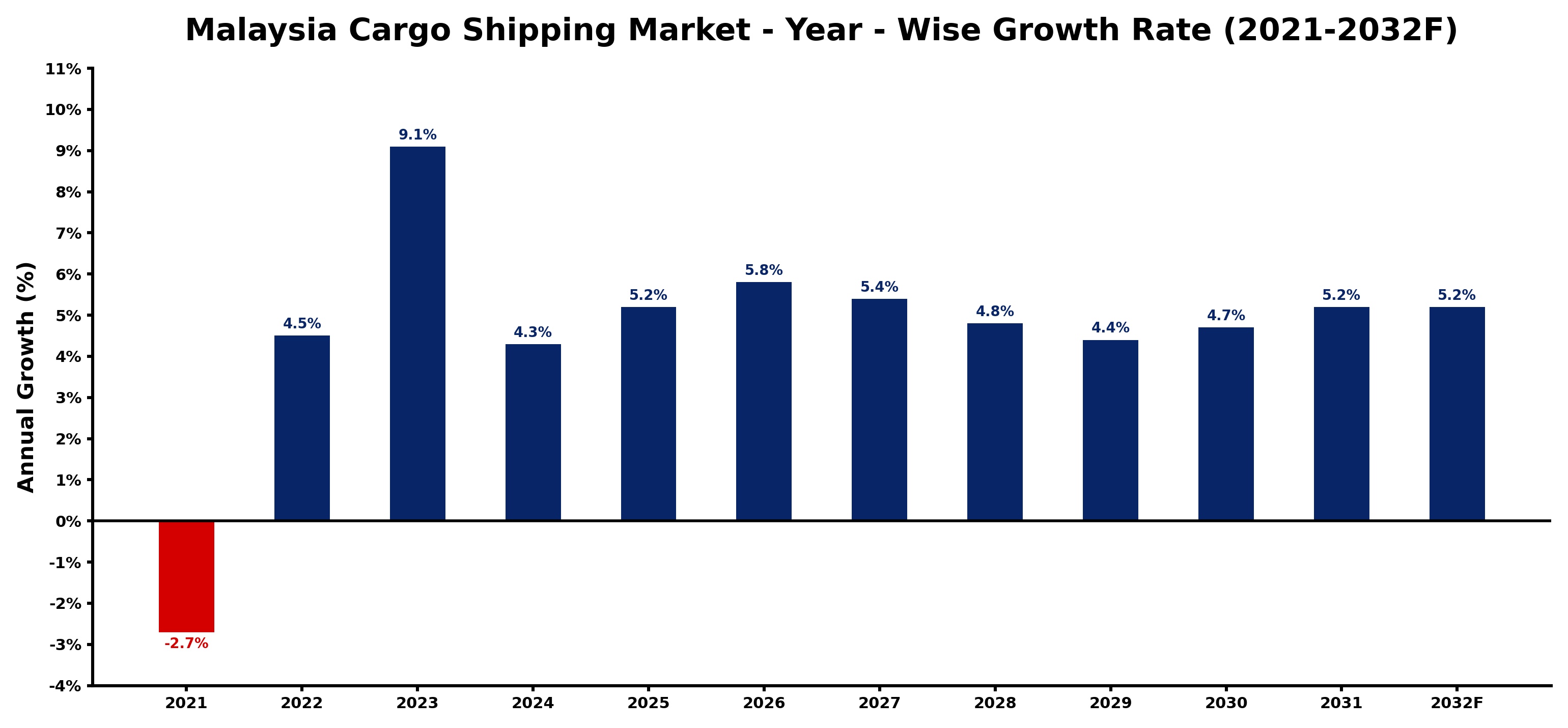
The table below presents the year‑wise growth rates along with the key drivers influencing the market
| Year | Growth Rate | Major Drivers |
| 2021 | -2.7% | Expansion of commercial construction activities |
| 2022 | 4.5% | Rapid growth in telecom and data center sectors |
| 2023 | 9.1% | Expansion of commercial construction activities |
| 2024 | 4.3% | Expansion of manufacturing activities |
| 2025 | 5.2% | Expansion of manufacturing activities |
| 2026 | 5.8% | Expansion of manufacturing activities |
| 2027 | 5.4% | Increasing industrial automation investments |
| 2028 | 4.8% | Increasing industrial automation investments |
| 2029 | 4.4% | Expansion of manufacturing activities |
| 2030 | 4.7% | Rapid growth in telecom and data center sectors |
| 2031 | 5.2% | Growing urbanization and commercial development |
| 2032 | 5.2% | Increasing industrial infrastructure investments |
Note - Market size estimations and growth projections presented in this report are based on 6Wresearch’s advanced forecasting approach, validated with industry datasets as of June 2026.
Malaysia Cargo Shipping Market Synopsis
The Malaysia cargo shipping market is experiencing robust demand for air cargo services, with freight transport volumes soaring to an estimated 4.5 million metric tons in 2018. This demand is largely attributed to the country's industrial hubs in regions like Penang and Johor Bahru, which serve as vital manufacturing centers.
Additionally, the evolving landscape of global trade has led to more efficient logistics operations. Government initiatives aimed at bolstering transport infrastructure further enhance connectivity and operational efficiency, creating an environment ripe for growth within the Malaysia cargo shipping market.
Malaysia Cargo Shipping Market Key Takeaways
- The market is projected to grow at a CAGR of 4.0% between 2026 and 2032.
- Government infrastructure improvements significantly enhance logistics capabilities.
- Major international markets, including China and India, are key demand drivers.
- Air cargo is becoming increasingly important, with volumes rising sharply.
- Strategic location in Southeast Asia serves as a competitive advantage for Malaysia.
Evaluation of Restraints in Malaysia Cargo Shipping Market
Despite its potential, the Malaysia cargo shipping market faces several constraints. One notable challenge is the regional competition from other Southeast Asian nations that are also enhancing their shipping capacities and infrastructural capabilities. This intensifying competition can lead to pricing pressures and may require Malaysian firms to invest more in service differentiation and operational efficiency. Additionally, fluctuating global trade dynamics can disrupt consistent cargo flow, posing risks to market stability.
Malaysia Cargo Shipping Market Trends
The landscape of the Malaysia cargo shipping market is currently shaped by several significant trends. There is a growing reliance on digital technologies, such as blockchain and AI, to streamline operations and enhance transparency across the supply chain. Furthermore, a shift towards sustainability is prompting shipping companies to adopt greener practices, aligning with global calls for environmental responsibility. Additionally, the rise of e-commerce is influencing logistics strategies, as companies adapt to increasing consumer demand for rapid delivery services.
Malaysia Cargo Shipping Market Opportunities
The opportunities within the Malaysia cargo shipping market are multifaceted. Companies can capitalize on the increasing freight volumes by expanding their operational capacities and optimizing supply chains. Moreover, investment in advanced logistics technologies presents a chance for firms to enhance efficiency and service offerings. Furthermore, as trade agreements evolve, new markets may open up, providing potential avenues for growth and diversification in service provision.
Government Initiatives in the Malaysia Cargo Shipping Market
The Malaysian government is actively pursuing initiatives aimed at strengthening the logistics sector. This includes investments in transport infrastructure, such as expanding airport capacities and improving road and rail connectivity. Additionally, programs designed to promote technological advancements in logistics are being implemented, enhancing overall operational efficiencies. These initiatives reflect the government's commitment to positioning Malaysia as a pivotal hub in the global shipping network.
Future Insights of the Malaysia Cargo Shipping Market
Looking forward to the period between 2026 and 2032, the Malaysia cargo shipping market is expected to continue its upward trajectory. The combination of increased international trade, ongoing infrastructure development, and the growing importance of air cargo will drive market growth. As logistical operations become increasingly digitized, companies that embrace technology and sustainability will likely emerge as leaders, solidifying Malaysia's role in the global shipping landscape.
Malaysia Cargo Shipping Market Latest Developments (May 2025 - June 2026)
In recent months, the Malaysia cargo shipping market has seen various developments that indicate its dynamic nature. There has been an increase in collaborative efforts between logistics firms and technology providers to enhance supply chain transparency and efficiency. Additionally, discussions on strategic partnerships aimed at expanding market reach are gaining momentum. These advancements showcase the sector's adaptability to changing market conditions and its readiness to leverage technology for future growth.
Malaysia Cargo Shipping Market - Key Attractiveness of the Report
- 10 Years of Market Numbers
- Historical Data Starting from 2022 to 2025
- Base Year: 2025
- Forecast Data until 2032
- Key Performance Indicators Impacting the Market
- Major Upcoming Developments and Projects
Key Highlights of the Report:
- Malaysia Cargo Shipping Market Outlook
- Market Size of Malaysia Cargo Shipping Market, 2025
- Forecast of Malaysia Cargo Shipping Market, 2032F
- Historical Data and Forecast of Malaysia Cargo Shipping Revenues & Volume for the Period 2022-2032F
- Malaysia Cargo Shipping Market Trend Evolution
- Malaysia Cargo Shipping Market Drivers and Challenges
- Malaysia Cargo Shipping Price Trends
- Malaysia Cargo Shipping Porter's Five Forces
- Malaysia Cargo Shipping Industry Life Cycle
- Historical Data and Forecast of Malaysia Cargo Shipping Market Revenues & Volume By Cargo Infrastructure for the Period 2022-2032F
- Historical Data and Forecast of Malaysia Cargo Shipping Market Revenues & Volume By Port Developments in Asia for the Period 2022-2032F
- Historical Data and Forecast of Malaysia Cargo Shipping Market Revenues & Volume By Port Developments in Europe for the Period 2022-2032F
- Historical Data and Forecast of Malaysia Cargo Shipping Market Revenues & Volume By Port Developments in North America for the Period 2022-2032F
- Historical Data and Forecast of Malaysia Cargo Shipping Market Revenues & Volume By Port Developments in South America for the Period 2022-2032F
- Historical Data and Forecast of Malaysia Cargo Shipping Market Revenues & Volume By Port Developments in Africa for the Period 2022-2032F
- Historical Data and Forecast of Malaysia Cargo Shipping Market Revenues & Volume By Cargo Type for the Period 2022-2032F
- Historical Data and Forecast of Malaysia Cargo Shipping Market Revenues & Volume By Container Cargo for the Period 2022-2032F
- Historical Data and Forecast of Malaysia Cargo Shipping Market Revenues & Volume By Bulk Cargo for the Period 2022-2032F
- Historical Data and Forecast of Malaysia Cargo Shipping Market Revenues & Volume By General Cargo for the Period 2022-2032F
- Historical Data and Forecast of Malaysia Cargo Shipping Market Revenues & Volume By Oil & Gas for the Period 2022-2032F
- Historical Data and Forecast of Malaysia Cargo Shipping Market Revenues & Volume By Industry Type for the Period 2022-2032F
- Historical Data and Forecast of Malaysia Cargo Shipping Market Revenues & Volume By Food, Manufacturing for the Period 2022-2032F
- Historical Data and Forecast of Malaysia Cargo Shipping Market Revenues & Volume By Oil & Ores for the Period 2022-2032F
- Historical Data and Forecast of Malaysia Cargo Shipping Market Revenues & Volume By Electrical & Electronics for the Period 2022-2032F
- Malaysia Cargo Shipping Import Export Trade Statistics
- Market Opportunity Assessment By Cargo Infrastructure
- Market Opportunity Assessment By Cargo Type
- Market Opportunity Assessment By Industry Type
- Malaysia Cargo Shipping Top Companies Market Share
- Malaysia Cargo Shipping Competitive Benchmarking By Technical and Operational Parameters
- Malaysia Cargo Shipping Company Profiles
- Malaysia Cargo Shipping Key Strategic Recommendations






































