Malaysia Cashmere Yarn Market Size, Share & Growth Rate
The Malaysia Cashmere Yarn Market was estimated at USD 450 Million in 2025 and is projected to reach USD 584 Million by 2032, growing at a CAGR of 3.8% from 2026 to 2032. This growth trajectory is primarily driven by the rising consumer inclination towards premium and luxury textiles, as well as an increasing focus on sustainable fashion practices. Furthermore, the integration of cashmere with other fibers enhances its appeal, making it an attractive option in the evolving Malaysian textile landscape.
Malaysia Cashmere Yarn Market Year-wise Growth Rate and Key Drivers
This graph highlights how the Malaysia Cashmere Yarn Market has steadily grown over the years, supported by major growth factors.
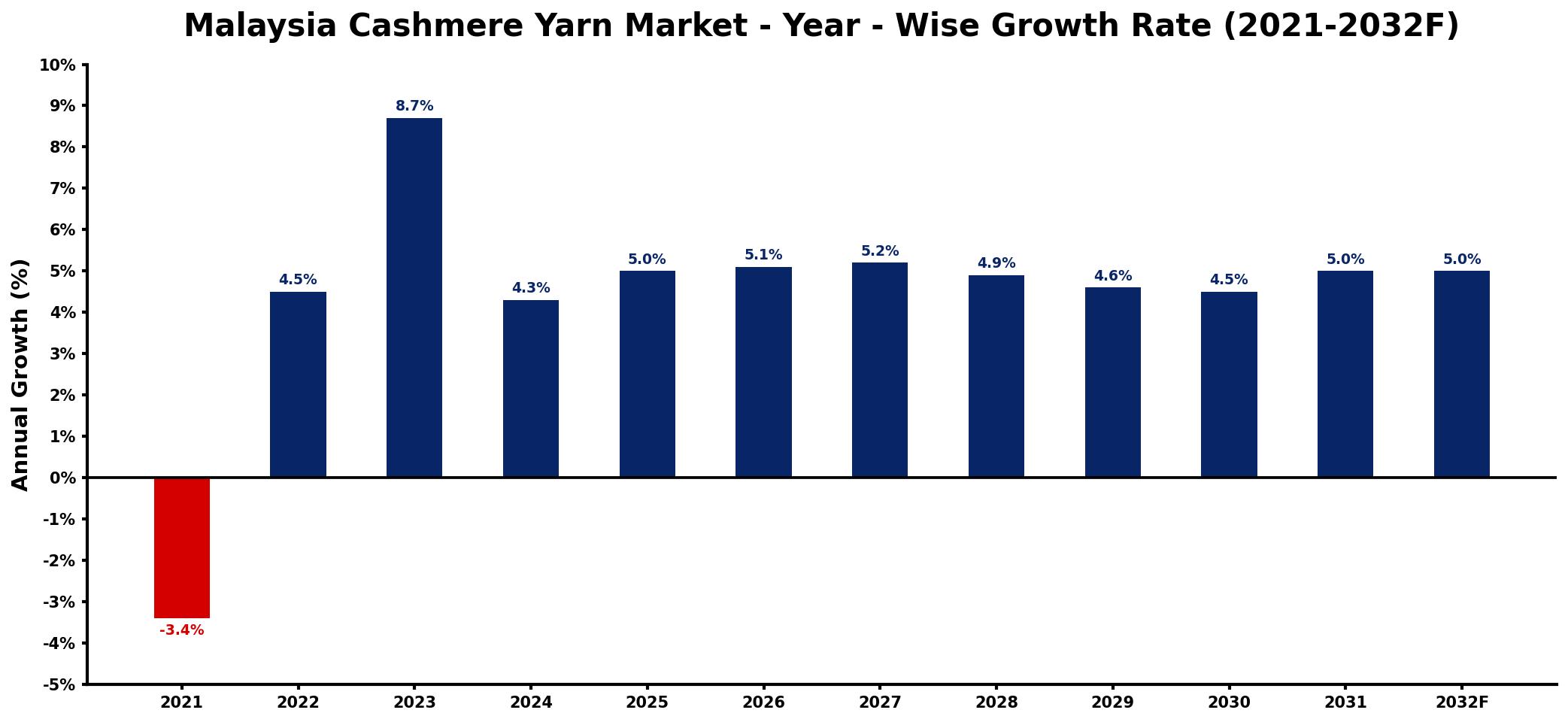
The table below presents the year‑wise growth rates along with the key drivers influencing the market
| Year | Growth Rate | Major Drivers |
| 2021 | -3.4% | decreased consumer spending on luxury |
| 2022 | 4.5% | rising interest in sustainable textiles |
| 2023 | 8.7% | increased fashion industry collaborations |
| 2024 | 4.3% | growing online retail presence |
| 2025 | 5.0% | expansion of eco-friendly brands |
| 2026 | 5.1% | higher demand from luxury markets |
| 2027 | 5.2% | increase in textile exports globally |
| 2028 | 4.9% | development of innovative blends |
| 2029 | 4.6% | growing popularity of artisanal products |
| 2030 | 4.5% | growing downstream application demand |
| 2031 | 5.0% | growing commercial sector adoption |
| 2032 | 5.0% | rising consumer awareness for luxury |
Note: Market size estimations and growth projections presented in this report are based on 6Wresearch's proprietary forecasting methodology, utilizing the latest available industry data, government publications, and primary research inputs.
Malaysia Cashmere Yarn Market Synopsis
The strongest force currently shaping the Malaysia cashmere yarn market is the escalating demand for high-quality, luxurious apparel. As disposable incomes rise, consumers are increasingly willing to invest in premium textiles, with cashmere being synonymous with comfort and elegance. This trend highlights a significant shift towards sustainability and ethical sourcing, further driving market growth.
Moreover, the limited domestic production of cashmere yarn presents both challenges and opportunities within the market. While most cashmere is imported, creating dependence on international supply chains, there remains a rich potential for local producers to cater to the discerning Malaysian consumer's desire for quality and sustainability.
Malaysia Cashmere Yarn Market Key Takeaways
- The market is witnessing an upward trend due to increased consumer spending on luxury textiles.
- Sustainable practices and ethical sourcing are becoming crucial drivers of demand.
- Limited domestic production creates opportunities for local manufacturers to enter the market.
- Innovation in fiber blending is enhancing the performance and affordability of cashmere products.
- The market is gradually recovering post-COVID-19, as consumer confidence returns.
Evaluation of Restraints in Malaysia Cashmere Yarn Market
Despite the optimistic outlook, the Malaysia cashmere yarn market faces significant restraints. The limited local production of cashmere fibers means that the market is highly dependent on imports, exposing it to fluctuations in international trade policies and currency volatility. Furthermore, the proliferation of counterfeit products can erode consumer trust and complicate efforts to maintain quality standards. Addressing these challenges will require a concerted effort from market players to emphasize authenticity and leverage marketing initiatives focused on the unique benefits of cashmere yarn.
Malaysia Cashmere Yarn Market Trends
Several current and emerging trends are shaping the Malaysia cashmere yarn market. Firstly, there is a notable shift towards blended cashmere products that incorporate other fibers to offer enhanced durability and affordability without compromising on luxury. Secondly, an increasing emphasis on sustainable production practices and transparency in sourcing is influencing consumer preferences. The rise of e-commerce platforms is also facilitating greater access to premium cashmere products, allowing consumers to explore a wider variety of offerings. Lastly, the cultural appreciation for artisanal craftsmanship is nurturing a growing segment that values handmade and ethically sourced cashmere items.
Malaysia Cashmere Yarn Market Opportunities
The opportunities for growth in the Malaysia cashmere yarn market are considerable. With a rise in consumer awareness surrounding ethical and sustainable fashion, there is a strong demand for cashmere products that are certified and transparently sourced. Local manufacturers can capitalize on this trend by establishing partnerships with cashmere producers, ensuring a steady supply of quality fibers. Furthermore, the advent of advanced textile technologies presents possibilities for innovation in cashmere product offerings, targeting niche markets and elevating consumer experience.
Government Initiatives in the Malaysia Cashmere Yarn Market
The Malaysian government has recognized the importance of the textile industry, including cashmere yarn, as a key sector for economic growth. Through various initiatives aimed at promoting sustainable practices and boosting local production, the government is working to provide support for artisans and manufacturers. This includes grants for innovation and funding for training programs aimed at enhancing skill sets within the textile sector. By fostering a conducive environment for the industry, these initiatives are expected to promote greater domestic production of cashmere yarn, aligning with global sustainability goals.
Future Insights of the Malaysia Cashmere Yarn Market
Looking ahead to 2026-2032, the Malaysia cashmere yarn market is poised for steady expansion. As consumer preferences shift further towards sustainability, the demand for ethically sourced cashmere will continue to rise. Innovations in production techniques and fiber blending will enhance product offerings, catering to both luxury and eco-conscious segments. Moreover, as the digital marketplace continues to grow, brands will find new avenues for engagement, allowing them to reach discerning customers more effectively. Overall, the market is set to evolve, bolstered by a commitment to quality and sustainability.
Malaysia Cashmere Yarn Market Latest Developments (2025 - 2026)
In recent months, the Malaysia cashmere yarn market has experienced a shift towards more sustainable sourcing practices, with several brands announcing initiatives to ensure ethically sourced fibers. Market players are increasingly engaging in collaborations to enhance product transparency and traceability. Additionally, there has been a notable increase in marketing campaigns focused on the luxurious qualities of cashmere, targeting the affluent consumer base. As retail channels diversify, the emphasis on e-commerce and online marketing strategies is strengthening brand presence in an increasingly competitive landscape.
Malaysia Cashmere Yarn Market - Key Attractiveness of the Report
- 10 Years of Market Numbers
- Historical Data Starting from 2022 to 2025
- Base Year: 2025
- Forecast Data until 2032
- Key Performance Indicators Impacting the Market
- Major Upcoming Developments and Projects
Key Highlights of the Report:
- Malaysia Cashmere Yarn Market Outlook
- Market Size of Malaysia Cashmere Yarn Market, 2025
- Forecast of Malaysia Cashmere Yarn Market, 2032
- Historical Data and Forecast of Malaysia Cashmere Yarn Revenues & Volume for the Period 2022-2032F
- Malaysia Cashmere Yarn Market Trend Evolution
- Malaysia Cashmere Yarn Market Drivers and Challenges
- Malaysia Cashmere Yarn Price Trends
- Malaysia Cashmere Yarn Porter's Five Forces
- Malaysia Cashmere Yarn Industry Life Cycle
- Historical Data and Forecast of Malaysia Cashmere Yarn Market Revenues & Volume By Type for the Period 2022-2032F
- Historical Data and Forecast of Malaysia Cashmere Yarn Market Revenues & Volume By Natural Cashmere Yarn for the Period 2022-2032F
- Historical Data and Forecast of Malaysia Cashmere Yarn Market Revenues & Volume By Processed Cashmere Yarn for the Period 2022-2032F
- Historical Data and Forecast of Malaysia Cashmere Yarn Market Revenues & Volume By Others for the Period 2022-2032F
- Historical Data and Forecast of Malaysia Cashmere Yarn Market Revenues & Volume By Application for the Period 2022-2032F
- Historical Data and Forecast of Malaysia Cashmere Yarn Market Revenues & Volume By Sweaters for the Period 2022-2032F
- Historical Data and Forecast of Malaysia Cashmere Yarn Market Revenues & Volume By Shawls for the Period 2022-2032F
- Historical Data and Forecast of Malaysia Cashmere Yarn Market Revenues & Volume By Suits for the Period 2022-2032F
- Historical Data and Forecast of Malaysia Cashmere Yarn Market Revenues & Volume By Socks for the Period 2022-2032F
- Historical Data and Forecast of Malaysia Cashmere Yarn Market Revenues & Volume By Others for the Period 2022-2032F
- Malaysia Cashmere Yarn Import Export Trade Statistics
- Market Opportunity Assessment By Type
- Market Opportunity Assessment By Application
- Malaysia Cashmere Yarn Top Companies Market Share
- Malaysia Cashmere Yarn Competitive Benchmarking By Technical and Operational Parameters
- Malaysia Cashmere Yarn Company Profiles
- Malaysia Cashmere Yarn Key Strategic Recommendations






































