Malaysia Casting Equipment Market Size, Share & Growth Rate
The Malaysia Casting Equipment Market was estimated at USD 159 Million in 2025 and is projected to reach USD 207 Million by 2032, growing at a CAGR of 3.8% from 2026 to 2032. This growth trajectory is primarily driven by an upsurge in construction and infrastructure development projects, particularly in urban areas. Additionally, the expansion of the automotive sector in Malaysia further boosts the demand for advanced casting equipment, making this market increasingly relevant as industrial diversification efforts intensify.
Malaysia Casting Equipment Market Year-wise Growth Rate and Key Drivers
This graph highlights how the Malaysia Casting Equipment Market has steadily grown over the years, supported by major growth factors.
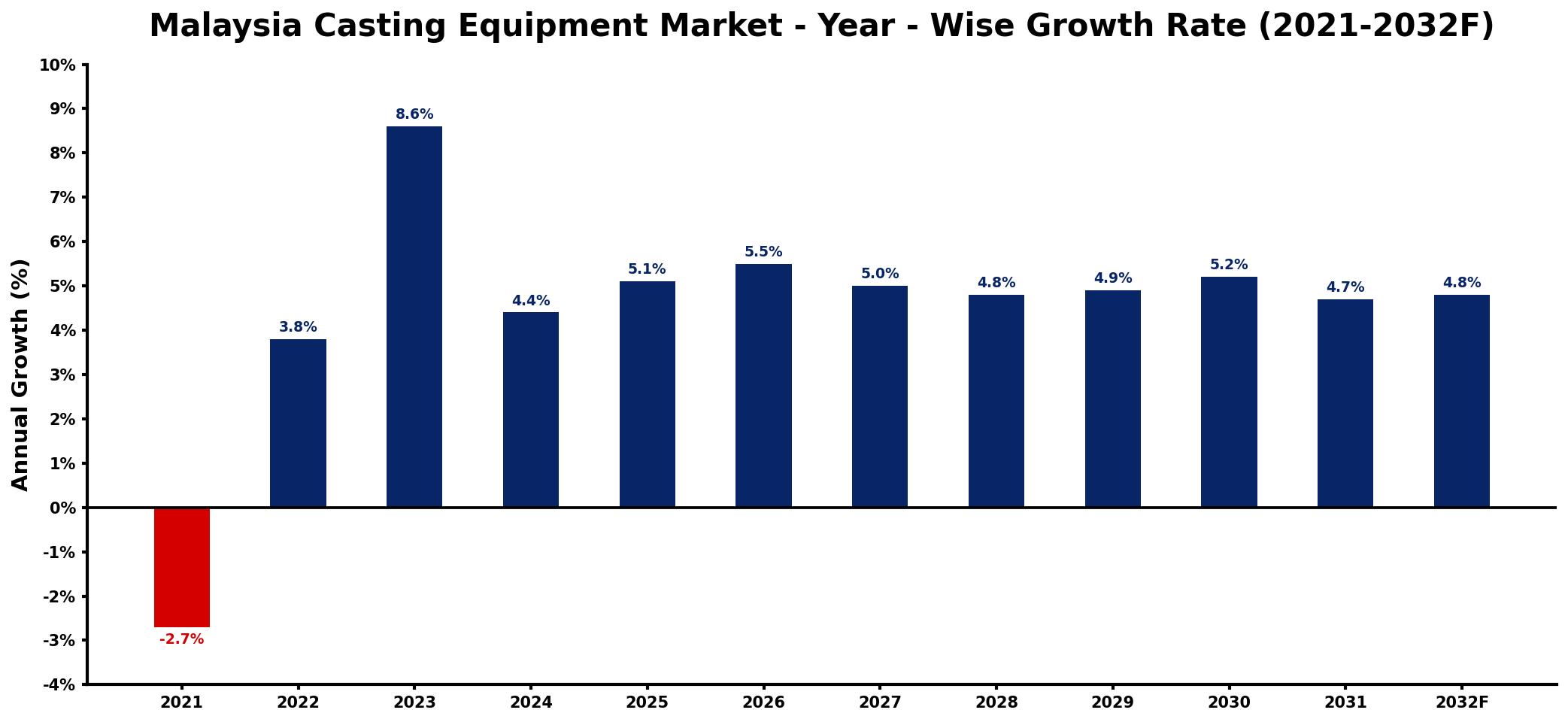
The table below presents the year‑wise growth rates along with the key drivers influencing the market
| Year | Growth Rate | Major Drivers |
| 2021 | -2.7% | decreased industrial project investments |
| 2022 | 3.8% | increased infrastructure development projects |
| 2023 | 8.6% | growing automotive production demand |
| 2024 | 4.4% | expansion in construction sector |
| 2025 | 5.1% | rising consumer electronics manufacturing |
| 2026 | 5.5% | enhanced energy sector investments |
| 2027 | 5.0% | higher demand from aerospace industry |
| 2028 | 4.8% | development of renewable energy projects |
| 2029 | 4.9% | increased focus on sustainability initiatives |
| 2030 | 5.2% | growth in medical device manufacturing |
| 2031 | 4.7% | rising demand for machinery parts |
| 2032 | 4.8% | rising infrastructure development spending |
Note: Market size estimations and growth projections presented in this report are based on 6Wresearch's proprietary forecasting methodology, utilizing the latest available industry data, government publications, and primary research inputs.
Malaysia Casting Equipment Market Synopsis
The strongest force currently shaping the Malaysia Casting Equipment Market is the robust investment in infrastructure and construction activities. This surge is not only vital for economic recovery post-COVID-19 but also acts as a catalyst for increased demand for casting equipment essential in producing concrete components and various other materials.
Moreover, the automotive industry in Malaysia is witnessing significant growth, further enhancing the market landscape for casting equipment. As local manufacturers look to innovate and improve production efficiency, the necessity for state-of-the-art casting technologies becomes more pronounced.
Malaysia Casting Equipment Market Key Takeaways
- The market is anticipated to grow steadily, reflecting a broader manufacturing sector recovery.
- Investment in infrastructure and construction is pivotal in driving demand for casting equipment.
- The automotive industry's growth creates significant opportunities for advanced casting solutions.
- Government initiatives aimed at stimulating manufacturing activities will bolster market expansion.
- Environmental compliance and sustainable practices are becoming increasingly crucial in equipment development.
Evaluation of Restraints in Malaysia Casting Equipment Market
While the Malaysia Casting Equipment Market shows promise, it is not without its challenges. The cyclical nature of industries that rely heavily on casting, such as automotive and manufacturing, can lead to fluctuations in demand. Economic downturns could potentially dampen growth prospects. Additionally, complying with environmental regulations and adopting cleaner production techniques poses a significant challenge for manufacturers, necessitating investment in more advanced and sustainable casting technologies.
Malaysia Casting Equipment Market Trends
A noticeable trend in the Malaysia Casting Equipment Market is the shift towards automation and smart manufacturing. Companies are increasingly investing in advanced technologies that enhance productivity and reduce waste. Moreover, there is a growing emphasis on developing eco-friendly casting processes, driven by regulatory requirements and market demand for sustainability. Additionally, the integration of digital technologies into manufacturing processes is becoming a focal point for enhancing operational efficiency.
Malaysia Casting Equipment Market Opportunities
The opportunities in the Malaysia Casting Equipment Market are significant, particularly in sectors such as construction and automotive, where the demand for high-quality components is increasing. Companies that invest in R&D to create innovative casting solutions stand to gain a competitive edge. Additionally, as Malaysia enhances its position as a manufacturing hub in Southeast Asia, foreign investments could create new avenues for collaboration and technology transfer, further propelling market growth.
Government Initiatives in the Malaysia Casting Equipment Market
The Malaysian government is actively promoting initiatives to boost the manufacturing sector, including incentives for foreign investments and policies aimed at enhancing technological advancements. Public spending on infrastructure projects is increasing, facilitating demand for casting equipment. Moreover, programs aimed at encouraging sustainable practices within the metalworking industry reflect the government's commitment to balancing economic growth with environmental responsibilities.
Future Insights of the Malaysia Casting Equipment Market
Looking ahead to 2026-2032, the Malaysia Casting Equipment Market is poised for continuous growth, fueled by a combination of industrial expansion and technological advancements. As companies adapt to the evolving landscape, particularly with the integration of smart manufacturing and sustainable practices, the demand for innovative casting solutions will only intensify. This dynamic environment will likely foster new partnerships and investments, solidifying Malaysia's role as a key player in the global manufacturing arena.
Malaysia Casting Equipment Market Latest Developments (2025 - 2026)
In the period between & and June 2026, the Malaysia casting equipment market has witnessed a surge in product development aimed at enhancing efficiency and reducing environmental impact. Companies are focusing on innovative casting technologies, including the adoption of 3D printing techniques and automation. Furthermore, collaborations between industry stakeholders and research institutions are becoming more common, fostering a culture of innovation within the sector.
Malaysia Casting Equipment Market - Key Attractiveness of the Report
- 10 Years of Market Numbers
- Historical Data Starting from 2022 to 2025
- Base Year: 2025
- Forecast Data until 2032
- Key Performance Indicators Impacting the Market
- Major Upcoming Developments and Projects
Key Highlights of the Report:
- Malaysia Casting Equipment Market Outlook
- Market Size of Malaysia Casting Equipment Market, 2025
- Forecast of Malaysia Casting Equipment Market, 2032
- Historical Data and Forecast of Malaysia Casting Equipment Revenues & Volume for the Period 2022-2032F
- Malaysia Casting Equipment Market Trend Evolution
- Malaysia Casting Equipment Market Drivers and Challenges
- Malaysia Casting Equipment Price Trends
- Malaysia Casting Equipment Porter's Five Forces
- Malaysia Casting Equipment Industry Life Cycle
- Historical Data and Forecast of Malaysia Casting Equipment Market Revenues & Volume By Casting type for the Period 2022-2032F
- Historical Data and Forecast of Malaysia Casting Equipment Market Revenues & Volume By Expendable mold casting for the Period 2022-2032F
- Historical Data and Forecast of Malaysia Casting Equipment Market Revenues & Volume By Non Expendable mold casting for the Period 2022-2032F
- Historical Data and Forecast of Malaysia Casting Equipment Market Revenues & Volume By End-user for the Period 2022-2032F
- Historical Data and Forecast of Malaysia Casting Equipment Market Revenues & Volume By Automotive for the Period 2022-2032F
- Historical Data and Forecast of Malaysia Casting Equipment Market Revenues & Volume By Aerospace for the Period 2022-2032F
- Historical Data and Forecast of Malaysia Casting Equipment Market Revenues & Volume By Defense for the Period 2022-2032F
- Historical Data and Forecast of Malaysia Casting Equipment Market Revenues & Volume By Pump & Valve for the Period 2022-2032F
- Historical Data and Forecast of Malaysia Casting Equipment Market Revenues & Volume By Energy & Power generation for the Period 2022-2032F
- Historical Data and Forecast of Malaysia Casting Equipment Market Revenues & Volume By Others for the Period 2022-2032F
- Historical Data and Forecast of Malaysia Casting Equipment Market Revenues & Volume By Machine Type for the Period 2022-2032F
- Historical Data and Forecast of Malaysia Casting Equipment Market Revenues & Volume By Vertical machine for the Period 2022-2032F
- Historical Data and Forecast of Malaysia Casting Equipment Market Revenues & Volume By Horizontal machine for the Period 2022-2032F
- Historical Data and Forecast of Malaysia Casting Equipment Market Revenues & Volume By Distribution Channel for the Period 2022-2032F
- Historical Data and Forecast of Malaysia Casting Equipment Market Revenues & Volume By Online for the Period 2022-2032F
- Historical Data and Forecast of Malaysia Casting Equipment Market Revenues & Volume By Offline for the Period 2022-2032F
- Malaysia Casting Equipment Import Export Trade Statistics
- Market Opportunity Assessment By Casting type
- Market Opportunity Assessment By End-user
- Market Opportunity Assessment By Machine Type
- Market Opportunity Assessment By Distribution Channel
- Malaysia Casting Equipment Top Companies Market Share
- Malaysia Casting Equipment Competitive Benchmarking By Technical and Operational Parameters
- Malaysia Casting Equipment Company Profiles
- Malaysia Casting Equipment Key Strategic Recommendations






































