Malaysia Cattle feeds and Feed Concentrates Market Summary
The malaysia cattle feeds and feed concentrates market was estimated at USD 301 Million in 2025 and is projected to reach USD 391 Million by 2032, growing at a CAGR of 5.5% from 2026 to 2032.
Malaysia Cattle feeds and Feed Concentrates Market Year-wise Growth Rate and Key Drivers
This graph highlights how the Malaysia Cattle feeds and Feed Concentrates Market has steadily grown over the past five years, supported by major growth factors.
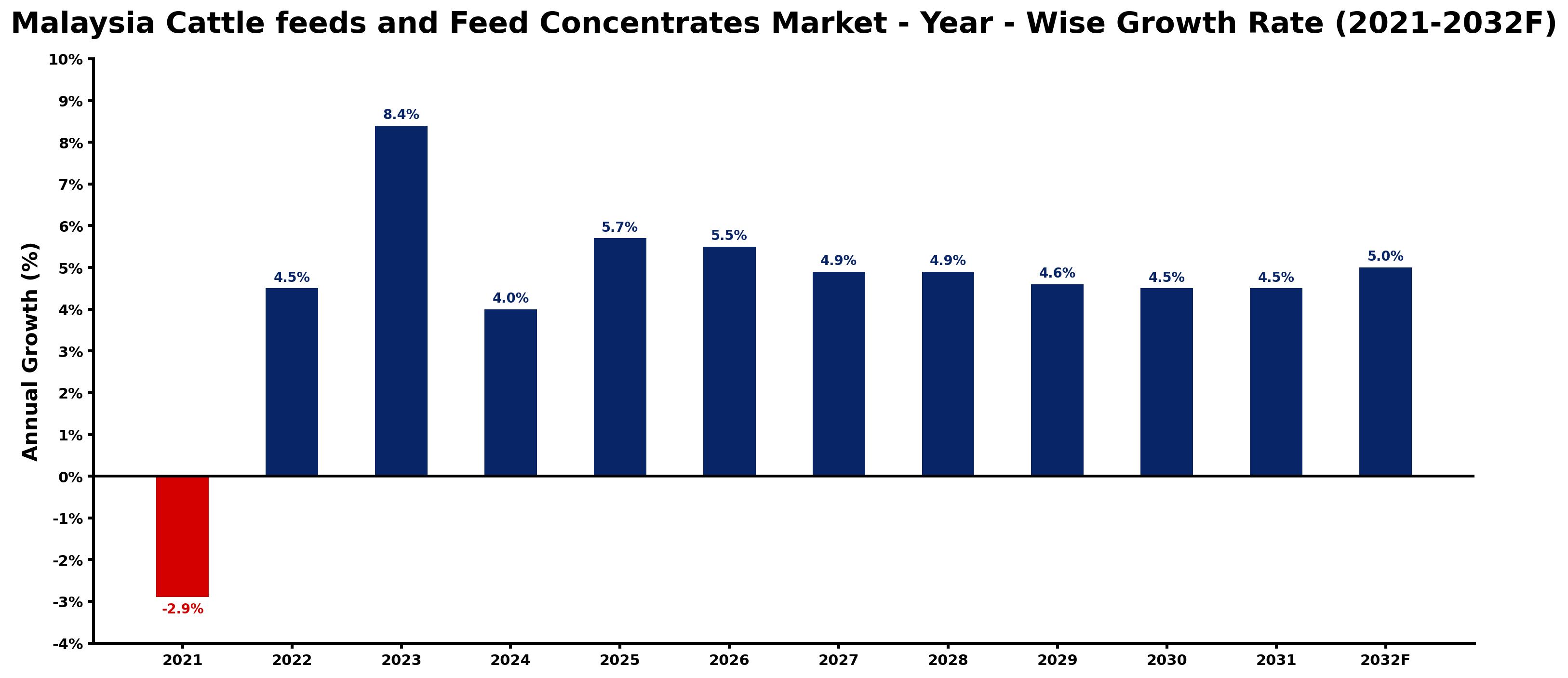
The table below presents the year wise growth rates along with the key drivers influencing the market
| Year | Growth Rate | Major Drivers |
| 2021 | -2.9% | Supply chain disruptions caused by the pandemic hindered cattle feed availability, negatively impacting livestock growth and market sales. |
| 2022 | 4.5% | Increased focus on sustainable farming practices influences feed concentrate formulation and sourcing. |
| 2023 | 8.4% | Rural infrastructure improvements enhance distribution capabilities for cattle feed suppliers across Malaysia. |
| 2024 | 4.0% | Technological advancements in feed production lead to higher efficiency and lower costs. |
| 2025 | 5.7% | Emerging health concerns prompt demand for organic and fortified cattle feed options. |
| 2026 | 5.5% | Global commodity price fluctuations impact local feed pricing and sourcing strategies significantly. |
| 2027 | 4.9% | Expansion of dairy farms drives higher requirements for specialized cattle feed formulations. |
| 2028 | 4.9% | Urbanization trends reshape consumer preferences, increasing demand for premium cattle products. |
| 2029 | 4.6% | Research collaborations between universities and companies foster innovative feed solutions in Malaysia. |
| 2030 | 4.5% | Climate challenges compel farmers to seek resilient feed alternatives that adapt to conditions. |
| 2031 | 4.5% | International trade agreements open new markets for Malaysian cattle feed exporters and producers. |
| 2032 | 5.0% | Consumer awareness of animal welfare shapes market trends for premium feed options. |
Note - Market size estimations and growth projections presented in this report are based on 6Wresearch's advanced forecasting approach, validated with industry datasets as of June 2026.
Malaysia Cattle feeds and Feed Concentrates Market Synopsis
The Malaysia Cattle feeds and Feed Concentrates Market is projected to reach 5.5% and witness significant growth during the forecast period (2026-2032). This growth trajectory is primarily fueled by the increasing consumption of dairy products, alongside an upswing in health consciousness among consumers. Additionally, rising import activities and the growing demand for animal proteins are key contributors to the expanding market landscape in Malaysia.
Malaysia Cattle feeds and Feed Concentrates Market Growth Drivers
Several factors are driving the dynamics of the Malaysia Cattle feeds and Feed Concentrates Market. The increase in health-conscious behaviors among consumers is central to this growth. Dairy products are being recognized for their numerous health benefits, which include:
- Strengthening bones and muscles, essential for physical development and longevity.
- Improving digestive system functioning, thus contributing to overall well-being.
- Providing essential nutrients that are often lacking in daily diets.
- Enhancing immune function through rich nutritional profiles found in dairy products.
- Meeting the rising consumer preference for organic and locally-sourced food items, reinforcing the demand for quality livestock.
Consequently, this significant increase in dairy consumption is driving production animals like cows, leading to an amplified demand for cattle feed and concentrates. This trend is expected to escalate revenues within the industry over the coming years.
Malaysia Cattle feeds and Feed Concentrates Market Trends and Opportunities
As the Malaysia Cattle feeds and Feed Concentrates Market evolves, various trends and opportunities emerge, creating avenues for growth. The increasing preference for organic and natural food options has shifted demand towards high-quality cattle feeds that promote better health outcomes for livestock. Furthermore:
- Technological advancements in feed formulation are leading to more efficient production processes.
- Research on sustainable practices is paving the way for eco-friendly cattle feed ingredients.
- Consumers are increasingly aware of animal welfare, prompting demand for ethically sourced feed.
- The rise of e-commerce is enhancing accessibility for farmers seeking quality feed products.
- Government policies promoting local agriculture are expected to bolster domestic feed production capabilities.
Malaysia Cattle feeds and Feed Concentrates Market Challenges and Restraints
Despite the promising growth prospects, the Malaysia Cattle feeds and Feed Concentrates Market faces certain challenges. These include:
- Fluctuations in raw material prices, impacting production costs and profit margins.
- Environmental concerns related to livestock farming, necessitating more sustainable feed solutions.
- Competition from alternative protein sources that may diminish the reliance on traditional animal feeds.
- Regulatory challenges regarding food safety and quality standards for feeds.
- The necessity for continuous innovation to meet changing consumer preferences and demands.
Malaysia Cattle feeds and Feed Concentrates Market Government Investment and Initiatives
The Malaysian government is actively involved in initiatives to support the cattle feeds and feed concentrates market. Various public investments and policies aim to ensure the sustainability and growth of the sector. These initiatives include:
- Financial incentives for farmers adopting modern feeding practices and sustainable cattle rearing.
- Support for research and development in feed technology to improve feed efficiency and nutritional value.
- Regulatory frameworks ensuring the quality of animal feeds and livestock welfare.
- Collaborative programs with agricultural institutions to educate farmers on best practices in feed usage.
- Investment in infrastructure to enhance logistics and distribution channels for raw materials and finished products.
Malaysia Cattle feeds and Feed Concentrates Market Latest Developments (May 2025 - June 2026)
In the period from May 2025 to June 2026, the Malaysia Cattle feeds and Feed Concentrates Market experienced notable developments that have shaped its current landscape. These developments reflect a response to both consumer trends and regulatory changes. Key highlights include:
- An increase in the introduction of organic and premium feed products to cater to health-conscious consumers.
- Enhanced government programs emphasizing sustainable farming practices and local sourcing of feed ingredients.
- Collaborations between agricultural bodies and private sector stakeholders to improve feed production technologies.
- Growing awareness among farmers about the importance of feed nutrition, leading to informed purchasing decisions.
- Emerging innovations in feed formulation, focusing on maximizing protein content and digestibility for livestock.
Malaysia Cattle feeds and Feed Concentrates Market - Key Attractiveness of the Report
- 10 Years of Market Numbers
- Historical Data Starting from 2022 to 2025
- Base Year: 2025
- Forecast Data until 2032
- Key Performance Indicators Impacting the Market
- Major Upcoming Developments and Projects
Key Highlights of the Report:
- Malaysia Cattle feeds and Feed Concentrates Market Outlook
- Market Size of Malaysia Cattle feeds and Feed Concentrates Market, 2025
- Forecast of Malaysia Cattle feeds and Feed Concentrates Market, 2032
- Historical Data and Forecast of Malaysia Cattle feeds and Feed Concentrates Revenues & Volume for the Period 2022-2032F
- Malaysia Cattle feeds and Feed Concentrates Market Trend Evolution
- Malaysia Cattle feeds and Feed Concentrates Market Drivers and Challenges
- Malaysia Cattle feeds and Feed Concentrates Price Trends
- Malaysia Cattle feeds and Feed Concentrates Porter's Five Forces
- Malaysia Cattle feeds and Feed Concentrates Industry Life Cycle
- Historical Data and Forecast of Malaysia Cattle feeds and Feed Concentrates Market Revenues & Volume By Product Type for the Period 2022-2032F
- Historical Data and Forecast of Malaysia Cattle feeds and Feed Concentrates Market Revenues & Volume By Straights for the Period 2022-2032F
- Historical Data and Forecast of Malaysia Cattle feeds and Feed Concentrates Market Revenues & Volume By Blends for the Period 2022-2032F
- Historical Data and Forecast of Malaysia Cattle feeds and Feed Concentrates Market Revenues & Volume By Compounds for the Period 2022-2032F
- Historical Data and Forecast of Malaysia Cattle feeds and Feed Concentrates Market Revenues & Volume By Distribution Channel for the Period 2022-2032F
- Historical Data and Forecast of Malaysia Cattle feeds and Feed Concentrates Market Revenues & Volume By Hypermarkets/Supermarkets for the Period 2022-2032F
- Historical Data and Forecast of Malaysia Cattle feeds and Feed Concentrates Market Revenues & Volume By Specialty Stores for the Period 2022-2032F
- Historical Data and Forecast of Malaysia Cattle feeds and Feed Concentrates Market Revenues & Volume By Retail Stores for the Period 2022-2032F
- Historical Data and Forecast of Malaysia Cattle feeds and Feed Concentrates Market Revenues & Volume By Online Stores for the Period 2022-2032F
- Historical Data and Forecast of Malaysia Cattle feeds and Feed Concentrates Market Revenues & Volume By End-Use for the Period 2022-2032F
- Historical Data and Forecast of Malaysia Cattle feeds and Feed Concentrates Market Revenues & Volume By Household (Retail) for the Period 2022-2032F
- Historical Data and Forecast of Malaysia Cattle feeds and Feed Concentrates Market Revenues & Volume By Commercial for the Period 2022-2032F
- Malaysia Cattle feeds and Feed Concentrates Import Export Trade Statistics
- Market Opportunity Assessment By Product Type
- Market Opportunity Assessment By Distribution Channel
- Market Opportunity Assessment By End-Use
- Malaysia Cattle feeds and Feed Concentrates Top Companies Market Share
- Malaysia Cattle feeds and Feed Concentrates Competitive Benchmarking By Technical and Operational Parameters
- Malaysia Cattle feeds and Feed Concentrates Company Profiles
- Malaysia Cattle feeds and Feed Concentrates Key Strategic Recommendations






































