Malaysia Ceiling Fan Market Size Growth Rate
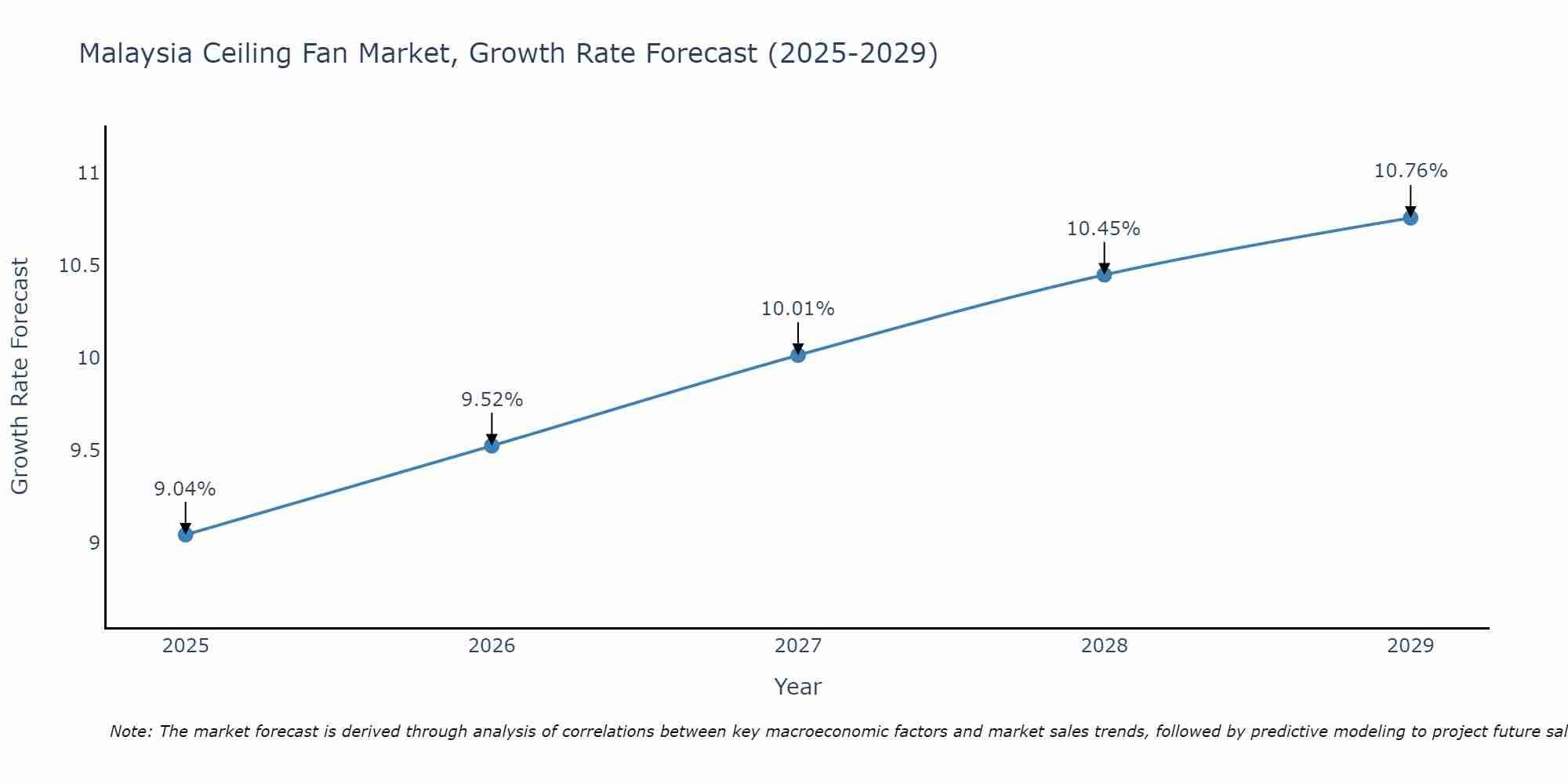
The Malaysia Ceiling Fan Market is likely to experience consistent growth rate gains over the period 2025 to 2029. The growth rate starts at 9.04% in 2025 and reaches 10.76% by 2029.
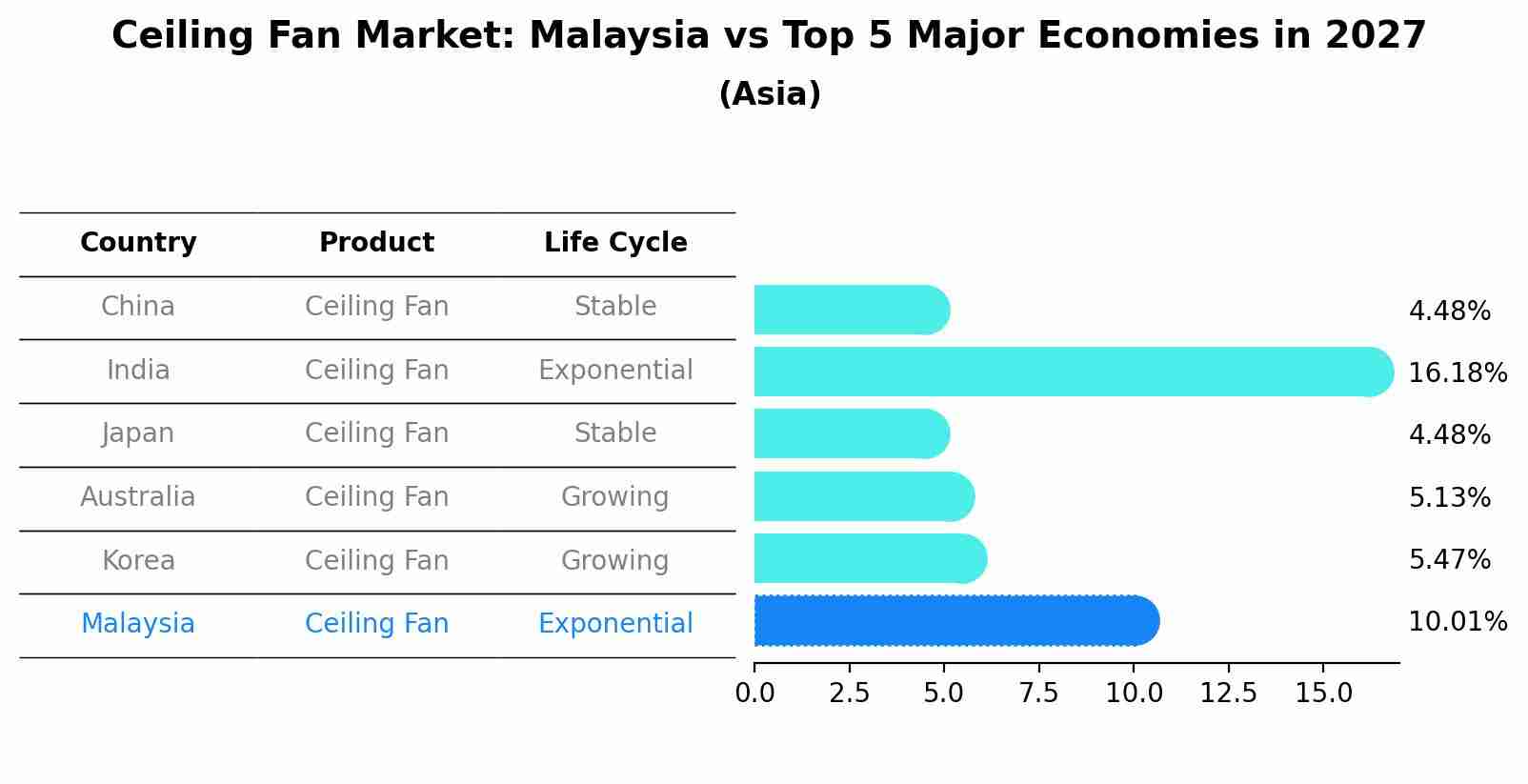
Ceiling Fan Market: Malaysia vs Top 5 Major Economies in 2027 (Asia)
By 2027, Malaysia's Ceiling Fan market is forecasted to achieve a high growth rate of 10.01%, with China leading the Asia region, followed by India, Japan, Australia and South Korea.
Malaysia Ceiling Fan Market Growth Rate
According to 6Wresearch internal database and industry insights, the Malaysia Ceiling Fan Market is estimated to grow at a compound annual growth rate (CAGR) of 6.1% during the forecast period (2026–2032).
Topics Covered in the Malaysia Ceiling Fan Market Report
The Malaysia Ceiling Fan Market report broadly covers the market by product type, fan size, distribution channel, and end use. The report provides a comprehensive analysis of ongoing market trends, opportunities/high-growth areas, and market drivers that will be pivotal for various stakeholders to align their strategies based on current and future market dynamics.
Malaysia Ceiling Fan Market Highlights
| Report Name | Malaysia Ceiling Fan Market |
| Forecast period | 2026-2032 |
| CAGR | 6.1% |
| Growing Sector | Energy-Efficient & Smart Ceiling Fans |
Malaysia Ceiling Fan Market Synopsis
Malaysia Ceiling Fan Market is expected to grow steadily in the coming years on account of rising demand for energy efficient cooling solutions in residential and commercial spaces. Generally, ceiling fans in Malaysia are widely used due to the country’s hot and humid tropical climate, making them an essential cooling solution. The expansion of housing developments and infrastructure projects is also contributing significantly to Malaysia ceiling fan market growth.
Evaluation of Growth Drivers in Malaysia Ceiling Fan Market
Given below are some of the major drivers and their influence on Malaysia Ceiling Fan Market dynamics:
| Drivers | Primary Segment Affected | Why It Matters (Evidence) |
| Rising Residential Construction | Standard & Decorative Fans | Increasing housing projects boost demand for ceiling fans. |
| Energy Efficiency Awareness | Energy Saving Fans | Consumers prefer low power consumption appliances to reduce electricity bills. |
| Smart Home Adoption | Decorative & Smart Fans | The use of Internet of Things makes it more convenient. |
| Commercial Infrastructure Growth | High Speed Fans | Fast moving fans in office, malls, and retail outlets are needed. |
| Climate Conditions | All Segments | Warm and wet climate ensures continuous demand for cooling solutions. |
Malaysia Ceiling Fan Market is expected to thrive, demonstrating a CAGR of 6.1% during the forecast period (2026–2032). Due to growing focus on sustainable energy consumption and the increasing popularity of smart home technologies, the growth of this industry is expected to proliferate in the upcoming years. Apart from this, manufacturers are introducing innovative designs and features such as BLDC motors and remote-controlled fans, which significantly improve energy efficiency and performance.
Evaluation of Restraints in the Malaysia Ceiling Fan Market
Some of the major restraints and their influence on Malaysia Ceiling Fan Market dynamics are mentioned below:
| Restraints | Primary Segment Affected | What This Means (Evidence) |
| Competition from Air Conditioners | All Segments | Consumers may prefer air conditioners for faster cooling and comfortable experience. |
| Price Sensitivity | Decorative Fans | Premium designs may curb adoption among cost-conscious buyers. |
| Import Dependency | Supply Chain | A high level of dependency on foreign components may affect cost and availability. |
| Maintenance Issues | High Speed Fans | The fans used in industry require continuous maintenance. |
| Limited Awareness in Rural Areas | Energy Saving Fans | Lack of awareness in rural areas and towns limits the uptake of advanced technology, like air conditioning. |
Malaysia Ceiling Fan Market Challenges
Despite promising growth prospects, the Malaysia Ceiling Fan Industry faces major obstacles such as intense competition and product differentiation. In addition, manufacturers have to innovate constantly in order to satisfy the preferences of consumers. Alongside that, the change in prices and disruptions within the supply chain affect the cost of production. Ensuring energy efficiency compliance and meeting regulatory standards also remains a challenge for industry players.
Malaysia Ceiling Fan Market Trends
The following are the prevailing trends in Malaysia Ceiling Fan Market:
- Fans with BLDC Motors: There is an increasing tendency among customers to purchase fans that come with BLDC motors and consume less power and have excellent efficiency.
- Smart Ceiling Fans: With the advancement in technology, there is a growing trend of smart ceiling fans that are IoT enabled, can be controlled via remote controls, through a mobile application, and through voice commands.
- Aesthetic Ceiling Fans: There is a growing preference among consumers for aesthetic and decorative ceiling fans.
- E-Commerce Sales: The use of online portals to buy ceiling fans is increasing owing to the easy access to a wide variety of products.
Investment Opportunities in the Malaysia Ceiling Fan Market
The following are the investment opportunities in Malaysia Ceiling Fan Market:
- Production of Energy-Efficient Fans: Investing in the production of energy-saving ceiling fans will address the growing demands of consumers.
- Development of Smart Ceiling Fans: Developing smart ceiling fans with IoT capabilities is an excellent investment opportunity.
- Online Sales Expansion: E-commerce portals give opportunities to increase sales and widen the market base.
- Business and Industrial Set-ups: Projects like malls, offices, and factories can yield substantial business growth.
Top 5 Leading Players in Malaysia Ceiling Fan Market
Given below is a list of leading companies dominating the Malaysia Ceiling Fan Market:
1. Panasonic
| Company Name | Panasonic |
| Established Year | 1972 |
| Headquarters | Shah Alam, Malaysia |
| Official Website | Click Here |
A leading electronics manufacturer offering a wide range of ceiling fans known for durability, energy efficiency, and advanced features.
2. KDK
| Company Name | KDK |
| Established Year | 1909 |
| Headquarters | Selangor, Malaysia |
| Official Website | Click Here |
Specializes in premium ceiling fans with innovative designs and high-performance motors, widely recognized in Malaysia.
3. Alpha Electric Co. (M) Bhd
| Company Name | Alpha Electric Co. (M) Bhd |
| Established Year | 1998 |
| Headquarters | Kuala Lumpur, Malaysia |
| Official Website | - |
Known for stylish and energy-efficient ceiling fans catering to residential and commercial markets.
4. Pensonic Holdings Berhad
| Company Name | Pensonic Holdings Berhad |
| Established Year | 1982 |
| Headquarters | Penang, Malaysia |
| Official Website | Click Here |
Offers a variety of affordable and reliable ceiling fans, focusing on mass-market consumers.
5. Milux Corporation Berhad
| Company Name | Milux Corporation Berhad |
| Established Year | 1977 |
| Headquarters | Selangor, Malaysia |
| Official Website | Click Here |
Provides a diverse range of home appliances including ceiling fans, emphasizing affordability and functionality.
Government Initiatives being implemented in the Malaysia Ceiling Fan Market
As per the data from the Malaysian Government, Various efforts have been initiated to encourage energy-efficient appliances’ usage. One example is the National Energy Efficiency Action Plan (NEEAP), which focuses on the adoption of energy-efficient appliances, for instance, the use of ceiling fans.
Examples include the energy labeling system of the Energy Commission of Malaysia (Suruhanjaya Tenaga) that encourages consumers to purchase energy-efficient appliances through its information provision to consumers. Additionally, there is an initiative called the Green Technology Financing Scheme (GTFS), which facilitates the development of energy-efficient appliances.
Future Outlook for the Malaysia Ceiling Fan Market
It is estimated that the Malaysia Ceiling Fan Market will register consistent growth due to growing urbanization, increasing consumer awareness of energy conservation, and technology innovation. The adoption of smart ceiling fans and energy-efficient models will become more prevalent. Additionally, the growing construction activities and residential projects in the country will create significant opportunities for Malaysia ceiling fan market growth.
Market Segmentation Analysis
The report offers a comprehensive study of the following market segments and their leading categories:
By Product Type – Energy Saving Fan Dominate the Market
According to Rishil, Senior Research Analyst, 6Wresearch, Energy Saving Fans are expected to hold the dominant position in Malaysia ceiling fan market due to increasing consumer awareness regarding electricity consumption and sustainability. These fans, particularly those equipped with BLDC motors, consume significantly less power while delivering high performance.
By Fan Size – Medium Segment to lead the Market
The medium fan segment is expected to gain momentum during the forecast period as the fans are compatible with room sizes and have the potential for offering efficient airflow. Medium fans can be used efficiently across various industries due to their flexibility and cost savings benefits.
By Distribution Channel – Offline Segment to lead the Market
Offline distribution channels are quite popular as consumers have a greater preference for physically inspecting and purchasing goods. Traditional retail stores, appliance stores, and supermarket chains continue playing a key role in sales.
By End Use – Residential Segment Dominate the Market
The residential segment dominates the Malaysia ceiling fan industry owing to high demand from households as a result of climate and construction activities taking place continuously. Ceiling fans have always been an important component in Malaysian homes due to their economical nature.
Key Attractiveness of the Report
- 10 Years of Market Numbers
- Historical Data Starting from 2022 to 2025
- Base Year: 2025
- Forecast Data until 2032
- Key Performance Indicators Impacting the Market
- Major Upcoming Developments and Projects
Key Highlights of the Report:
- Malaysia Ceiling Fan Market Outlook
- Market Size of Malaysia Ceiling Fan Market, 2025
- Forecast of Malaysia Ceiling Fan Market, 2032
- Historical Data and Forecast of Malaysia Ceiling Fan Revenues & Volume for the Period 2022- 2032
- Malaysia Ceiling Fan Market Trend Evolution
- Malaysia Ceiling Fan Market Drivers and Challenges
- Malaysia Ceiling Fan Price Trends
- Malaysia Ceiling Fan Porter's Five Forces
- Malaysia Ceiling Fan Industry Life Cycle
- Historical Data and Forecast of Malaysia Ceiling Fan Market Revenues & Volume By Product Type for the Period 2022- 2032
- Historical Data and Forecast of Malaysia Ceiling Fan Market Revenues & Volume By Standard Fan for the Period 2022- 2032
- Historical Data and Forecast of Malaysia Ceiling Fan Market Revenues & Volume By Decorative Fan for the Period 2022- 2032
- Historical Data and Forecast of Malaysia Ceiling Fan Market Revenues & Volume By High Speed Fan for the Period 2022- 2032
- Historical Data and Forecast of Malaysia Ceiling Fan Market Revenues & Volume By Energy Saving Fan for the Period 2022- 2032
- Historical Data and Forecast of Malaysia Ceiling Fan Market Revenues & Volume By Others for the Period 2022- 2032
- Historical Data and Forecast of Malaysia Ceiling Fan Market Revenues & Volume By for the Period 2022- 2032
- Historical Data and Forecast of Malaysia Ceiling Fan Market Revenues & Volume By Fan Size for the Period 2022- 2032
- Historical Data and Forecast of Malaysia Ceiling Fan Market Revenues & Volume By Small for the Period 2022- 2032
- Historical Data and Forecast of Malaysia Ceiling Fan Market Revenues & Volume By Medium for the Period 2022- 2032
- Historical Data and Forecast of Malaysia Ceiling Fan Market Revenues & Volume By Large for the Period 2022- 2032
- Historical Data and Forecast of Malaysia Ceiling Fan Market Revenues & Volume By Distribution Channel for the Period 2022- 2032
- Historical Data and Forecast of Malaysia Ceiling Fan Market Revenues & Volume By Offline for the Period 2022- 2032
- Historical Data and Forecast of Malaysia Ceiling Fan Market Revenues & Volume By Online for the Period 2022- 2032
- Historical Data and Forecast of Malaysia Ceiling Fan Market Revenues & Volume By for the Period 2022- 2032
- Historical Data and Forecast of Malaysia Ceiling Fan Market Revenues & Volume By End Use for the Period 2022- 2032
- Historical Data and Forecast of Malaysia Ceiling Fan Market Revenues & Volume By Residential for the Period 2022- 2032
- Historical Data and Forecast of Malaysia Ceiling Fan Market Revenues & Volume By Commercial for the Period 2022- 2032
- Historical Data and Forecast of Malaysia Ceiling Fan Market Revenues & Volume By Industrial for the Period 2022- 2032
- Malaysia Ceiling Fan Import Export Trade Statistics
- Market Opportunity Assessment By Product Type
- Market Opportunity Assessment By Fan Size
- Market Opportunity Assessment By Distribution Channel
- Market Opportunity Assessment By End Use
- Malaysia Ceiling Fan Top Companies Market Share
- Malaysia Ceiling Fan Competitive Benchmarking By Technical and Operational Parameters
- Malaysia Ceiling Fan Company Profiles
- Malaysia Ceiling Fan Key Strategic Recommendations
Market Covered
The report offers a comprehensive study of the following market segments:
By Product Type
- Standard Fan
- Decorative Fan
- High Speed Fan
- Energy Saving Fan
- Others
By Fan Size
- Small
- Medium
- Large
By Distribution Channel
- Offline
- Online
By End Use
- Residential
- Commercial
- Industrial






































