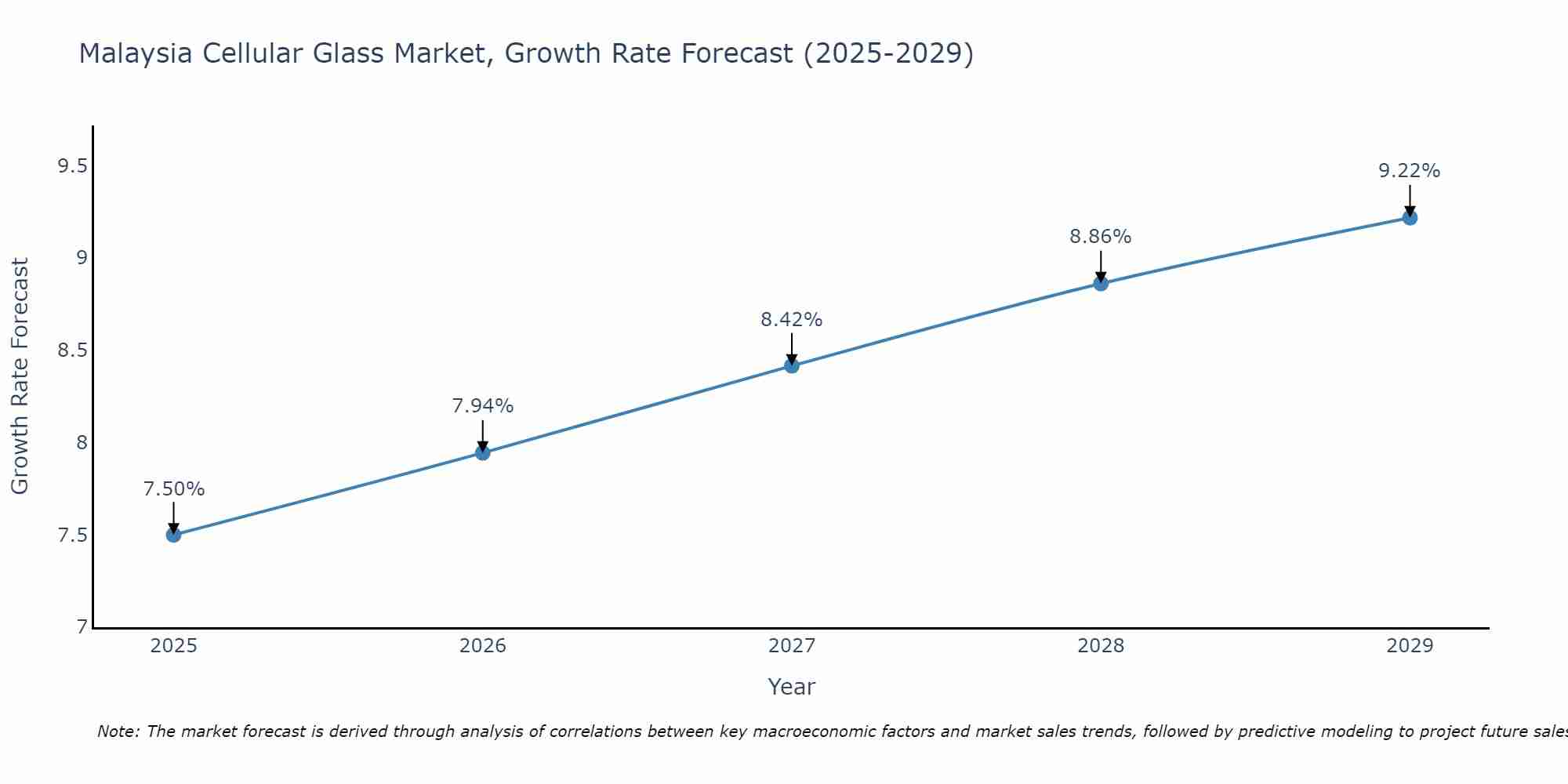
Malaysia Cellular Glass Market Size Growth Rate
The Malaysia Cellular Glass Market is likely to experience consistent growth rate gains over the period 2025 to 2029. From 7.50% in 2025, the growth rate steadily ascends to 9.22% in 2029.
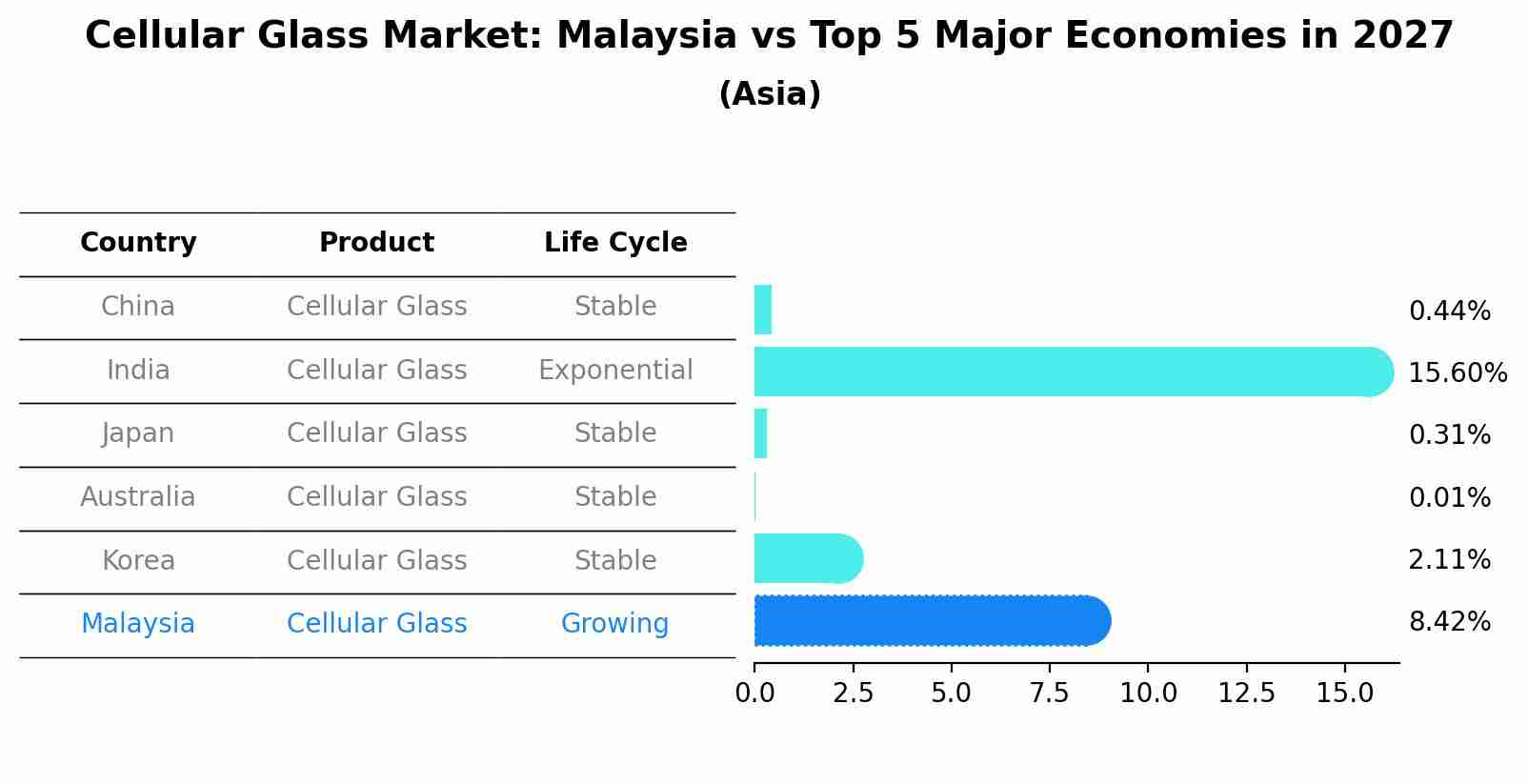
Cellular Glass Market: Malaysia vs Top 5 Major Economies in 2027 (Asia)
By 2027, the Cellular Glass market in Malaysia is anticipated to reach a growth rate of 8.42%, as part of an increasingly competitive Asia region, where China remains at the forefront, supported by India, Japan, Australia and South Korea, driving innovations and market adoption across sectors.
Malaysia Cellular Glass Market Synopsis
The cellular glass market in Malaysia is niche but promising, with applications in thermal insulation and construction materials. As energy efficiency becomes a focus, the demand for cellular glass is expected to grow steadily.
Drivers of the Market
Cellular glass, known for its insulation properties, plays a vital role in construction and industrial applications. The market outlook for cellular glass in Malaysia is promising, driven by the construction boom and the need for energy-efficient buildings. As sustainability becomes a priority, cellular glass is likely to witness increased adoption.
Challenges of the Market
Cellular glass, a niche construction material, faces challenges related to awareness among architects and builders, competition from traditional insulation materials, and regulatory compliance.
COVID-19 Impact on the Market
The cellular glass market in Malaysia may experience growth opportunities in construction and industrial applications post-pandemic, as there is a growing emphasis on energy efficiency and sustainable building materials. The pandemic has also highlighted the importance of resilient infrastructure.
Key Players in the Market
Cellular glass is an insulating material used in construction and industrial applications. "Malaysia Insulation Solutions" and "EcoTherm Glass" are leading companies in this market. As energy efficiency and sustainability become paramount in construction, the demand for cellular glass is expected to grow.
Key Highlights of the Report:
- Malaysia Cellular Glass Market Outlook
- Market Size of Malaysia Cellular Glass Market, 2024
- Forecast of Malaysia Cellular Glass Market, 2031
- Historical Data and Forecast of Malaysia Cellular Glass Revenues & Volume for the Period 2021-2031
- Malaysia Cellular Glass Market Trend Evolution
- Malaysia Cellular Glass Market Drivers and Challenges
- Malaysia Cellular Glass Price Trends
- Malaysia Cellular Glass Porter's Five Forces
- Malaysia Cellular Glass Industry Life Cycle
- Historical Data and Forecast of Malaysia Cellular Glass Market Revenues & Volume By Product Type for the Period 2021-2031
- Historical Data and Forecast of Malaysia Cellular Glass Market Revenues & Volume By Blocks & Shells for the Period 2021-2031
- Historical Data and Forecast of Malaysia Cellular Glass Market Revenues & Volume By Foam Glass Gravels for the Period 2021-2031
- Historical Data and Forecast of Malaysia Cellular Glass Market Revenues & Volume By Application for the Period 2021-2031
- Historical Data and Forecast of Malaysia Cellular Glass Market Revenues & Volume By Construction for the Period 2021-2031
- Historical Data and Forecast of Malaysia Cellular Glass Market Revenues & Volume By Industrial for the Period 2021-2031
- Historical Data and Forecast of Malaysia Cellular Glass Market Revenues & Volume By Consumer Abrasive for the Period 2021-2031
- Malaysia Cellular Glass Import Export Trade Statistics
- Market Opportunity Assessment By Product Type
- Market Opportunity Assessment By Application
- Malaysia Cellular Glass Top Companies Market Share
- Malaysia Cellular Glass Competitive Benchmarking By Technical and Operational Parameters
- Malaysia Cellular Glass Company Profiles
- Malaysia Cellular Glass Key Strategic Recommendations






































