Malaysia Cellulose Acetate Fiber Market Size, Share & Growth Rate
The Malaysia Cellulose Acetate Fiber Market was estimated at USD 425 Million in 2025 and is projected to reach USD 554 Million by 2032, growing at a CAGR of 3.9% from 2026 to 2032. This growth trajectory is primarily driven by the increasing consumer demand for sustainable textiles and the strong emphasis on eco-friendly practices within the fashion industry. As the awareness of the environmental impacts of synthetic fibers continues to rise, manufacturers are positioning cellulose acetate fibers as a viable alternative, thus fueling market expansion.
Malaysia Cellulose Acetate Fiber Market Year-wise Growth Rate and Key Drivers
This graph highlights how the Malaysia Cellulose Acetate Fiber Market has steadily grown over the years, supported by major growth factors.
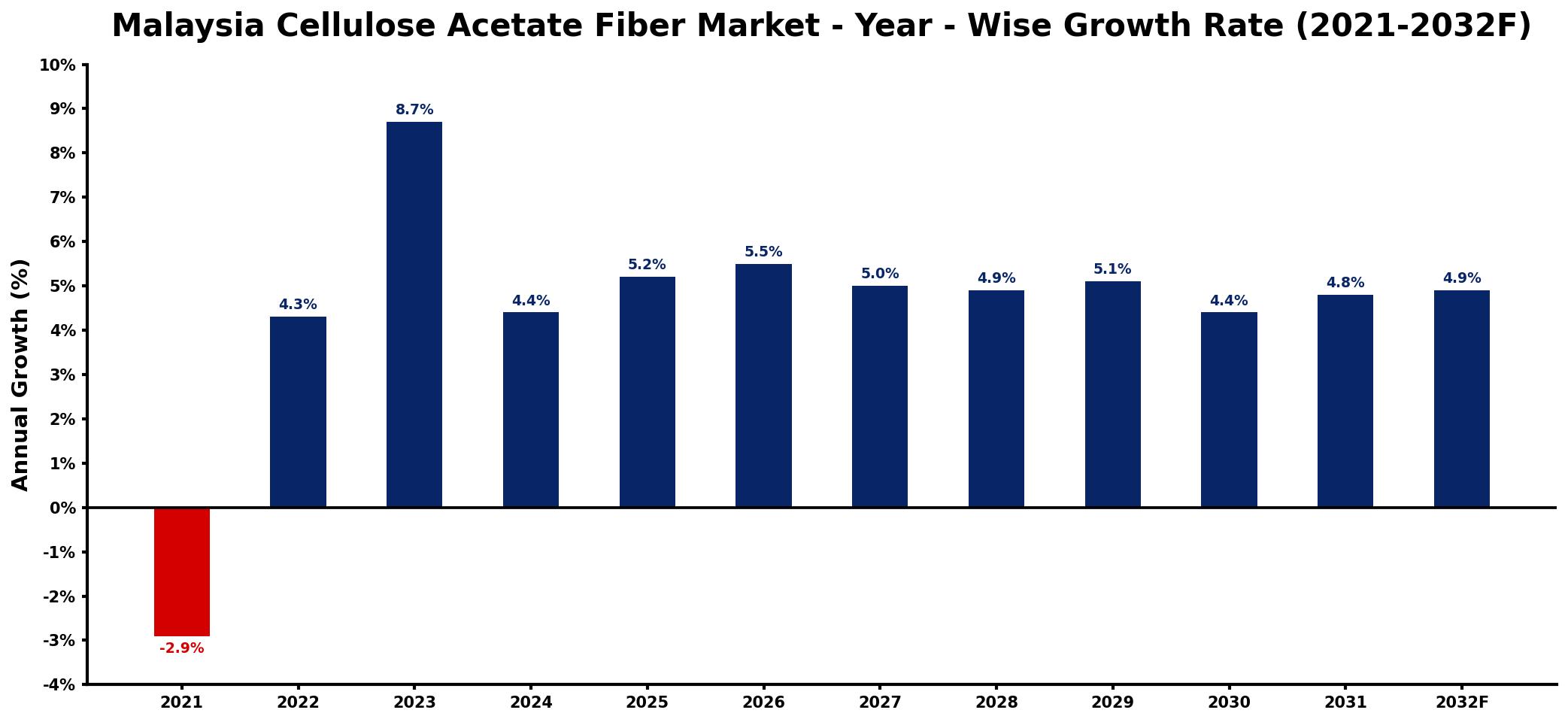
The table below presents the year‑wise growth rates along with the key drivers influencing the market
| Year | Growth Rate | Major Drivers |
| 2021 | -2.9% | decrease in textile production capacity |
| 2022 | 4.3% | growing demand for sustainable materials |
| 2023 | 8.7% | rapid expansion in fashion industry |
| 2024 | 4.4% | increased investments in textile innovation |
| 2025 | 5.2% | rising demand from electronics |
| 2026 | 5.5% | stronger focus on biodegradable alternatives |
| 2027 | 5.0% | growing applications in automotive sector |
| 2028 | 4.9% | expansion of home textile market |
| 2029 | 5.1% | increased demand from packaging industry |
| 2030 | 4.4% | growth in nonwoven materials usage |
| 2031 | 4.8% | rising popularity of technical textiles |
| 2032 | 4.9% | increased overall sector activity |
Note: Market size estimations and growth projections presented in this report are based on 6Wresearch's proprietary forecasting methodology, utilizing the latest available industry data, government publications, and primary research inputs.
Malaysia Cellulose Acetate Fiber Market Synopsis
In Malaysia, cellulose acetate fibers are gaining traction across various sectors, particularly in textiles and cigarette filters. The transition towards biodegradable materials is reshaping production strategies, compelling manufacturers to innovate while maintaining eco-conscious methods. This shift is not only enhancing product appeal but also aligning with global sustainability trends.
As companies invest in advanced production technologies, the quality of cellulose acetate fibers is improving, offering softness and versatility ideal for multiple applications. Collaborations with fashion brands focused on sustainability serve as strategic partnerships, further boosting the market's potential. Such alliances are critical for tapping into the growing consumer base eager for eco-friendly alternatives.
Malaysia Cellulose Acetate Fiber Market Key Takeaways
- There is a growing consumer preference for eco-friendly textiles, driving demand for cellulose acetate fibers.
- Manufacturers are innovating to improve the quality and sustainability of their products.
- Strategic partnerships with fashion brands focusing on sustainability can enhance market presence.
- Awareness of environmental impacts of materials influences purchasing decisions.
- The cellulose acetate fiber market is poised for growth as the textile industry shifts towards sustainable solutions.
Evaluation of Restraints in Malaysia Cellulose Acetate Fiber Market
Despite the promising growth trajectory, the Malaysia cellulose acetate fiber market faces certain restraints that could hinder its expansion. The environmental implications associated with the chemical processing of wood pulp remain a concern, prompting manufacturers to navigate the balance between cost efficiency and ecological responsibility. Additionally, the competition from other synthetic and natural fibers, often marketed as sustainable, poses a significant challenge, compelling manufacturers to differentiate their offerings through enhanced marketing strategies that emphasize unique properties and production practices.
Malaysia Cellulose Acetate Fiber Market Trends
The textile industry is witnessing a notable shift toward sustainable materials, with cellulose acetate fibers positioned as a viable option due to their biodegradability. Innovations in fiber technology are emerging, focusing on enhancing comfort and durability while minimizing environmental impact. Furthermore, digital marketing strategies are increasingly utilized to engage consumers, emphasizing the eco-conscious narrative and sustainability credentials of cellulose acetate fibers. This alignment with consumer values is shaping market demand significantly.
Malaysia Cellulose Acetate Fiber Market Opportunities
The push for sustainability in consumer products presents significant growth opportunities within the Malaysia cellulose acetate fiber market. Investment in research and development can lead to new applications and improved product features, thus appealing to a broader customer base. Additionally, exploring international partnerships could further enhance market access and product distribution, particularly in regions with heightened sustainability standards and consumer expectations.
Government Initiatives in the Malaysia Cellulose Acetate Fiber Market
The Malaysian government has expressed support for sustainable practices within the textile industry through various initiatives aimed at promoting eco-friendly materials. Policies focused on green technology adoption and sustainable manufacturing processes are expected to incentivize investment in cellulose acetate fiber production. Furthermore, public awareness campaigns aimed at educating consumers about the benefits of sustainable materials can foster a favorable market environment.
Future Insights of the Malaysia Cellulose Acetate Fiber Market
Looking ahead to the period from 2026 to 2032, the Malaysia cellulose acetate fiber market is anticipated to evolve significantly. As sustainability continues to gain traction, manufacturers will likely adapt their strategies to focus more on environmentally responsible sourcing and production. The expected resurgence in demand post-COVID-19, alongside an increasing shift in consumer preferences toward eco-friendly alternatives, will provide a strong foundation for market growth. Innovating products and forming strategic alliances will be crucial for players aiming to capture emerging opportunities.
Malaysia Cellulose Acetate Fiber Market Latest Developments (2025 - 2026)
Recent developments in the Malaysia cellulose acetate fiber market highlight a growing commitment to sustainability. Companies are making strides in enhancing fiber quality while adopting practices that lessen environmental impact. There is also a notable trend of partnerships between fiber manufacturers and eco-conscious fashion brands, aiming to introduce collections that emphasize sustainability. These collaborative efforts are projected to elevate the market's profile and meet the rising consumer demand for green textiles.
Malaysia Cellulose Acetate Fiber Market - Key Attractiveness of the Report
- 10 Years of Market Numbers
- Historical Data Starting from 2022 to 2025
- Base Year: 2025
- Forecast Data until 2032
- Key Performance Indicators Impacting the Market
- Major Upcoming Developments and Projects
Key Highlights of the Report:
- Malaysia Cellulose Acetate Fiber Market Outlook
- Market Size of Malaysia Cellulose Acetate Fiber Market, 2025
- Forecast of Malaysia Cellulose Acetate Fiber Market, 2032
- Historical Data and Forecast of Malaysia Cellulose Acetate Fiber Revenues & Volume for the Period 2022-2032F
- Malaysia Cellulose Acetate Fiber Market Trend Evolution
- Malaysia Cellulose Acetate Fiber Market Drivers and Challenges
- Malaysia Cellulose Acetate Fiber Price Trends
- Malaysia Cellulose Acetate Fiber Porter's Five Forces
- Malaysia Cellulose Acetate Fiber Industry Life Cycle
- Historical Data and Forecast of Malaysia Cellulose Acetate Fiber Market Revenues & Volume By Type for the Period 2022-2032F
- Historical Data and Forecast of Malaysia Cellulose Acetate Fiber Market Revenues & Volume By Plastic for the Period 2022-2032F
- Historical Data and Forecast of Malaysia Cellulose Acetate Fiber Market Revenues & Volume By Fiber for the Period 2022-2032F
- Historical Data and Forecast of Malaysia Cellulose Acetate Fiber Market Revenues & Volume By Application for the Period 2022-2032F
- Historical Data and Forecast of Malaysia Cellulose Acetate Fiber Market Revenues & Volume By Photographic Films for the Period 2022-2032F
- Historical Data and Forecast of Malaysia Cellulose Acetate Fiber Market Revenues & Volume By Cigarette Filters for the Period 2022-2032F
- Historical Data and Forecast of Malaysia Cellulose Acetate Fiber Market Revenues & Volume By Tapes & Labels for the Period 2022-2032F
- Historical Data and Forecast of Malaysia Cellulose Acetate Fiber Market Revenues & Volume By Textiles & Apparel for the Period 2022-2032F
- Malaysia Cellulose Acetate Fiber Import Export Trade Statistics
- Market Opportunity Assessment By Type
- Market Opportunity Assessment By Application
- Malaysia Cellulose Acetate Fiber Top Companies Market Share
- Malaysia Cellulose Acetate Fiber Competitive Benchmarking By Technical and Operational Parameters
- Malaysia Cellulose Acetate Fiber Company Profiles
- Malaysia Cellulose Acetate Fiber Key Strategic Recommendations






































