Malaysia Cloud CRM Market Size & Growth Rate (2026-2032)
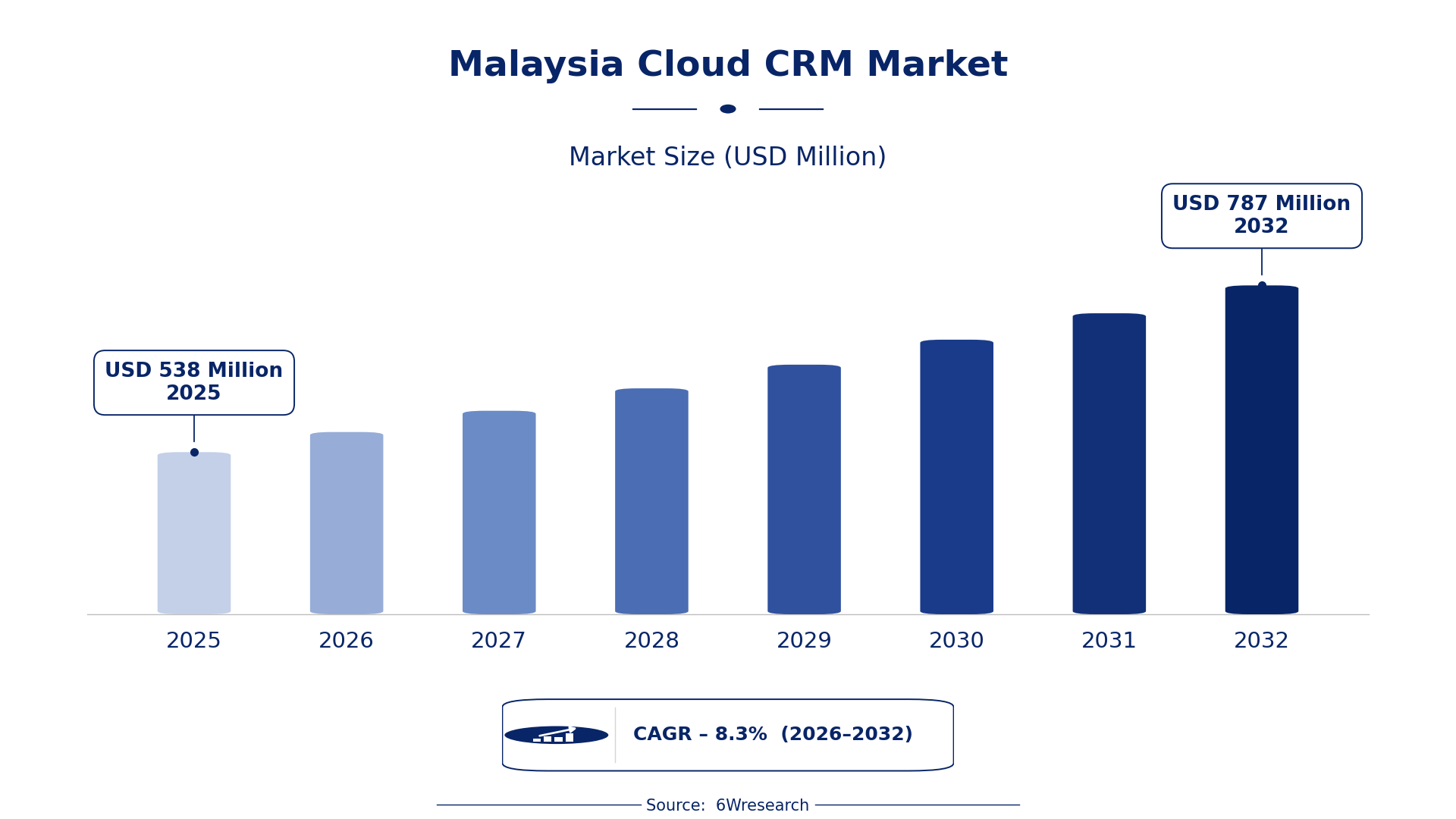
The Malaysia Cloud CRM Market was estimated at USD 538 Million in 2025 and is projected to reach USD 787 Million by 2032, growing at a CAGR of 8.3% from 2026 to 2032.
Malaysia Cloud CRM Market Synopsis
The driving force behind the Malaysia Cloud CRM Market is the increasing necessity for businesses to enhance customer interactions and optimize sales processes. With companies across various sectors adopting cloud-based CRM solutions, the focus on improving customer engagement has never been more pronounced.
As organizations shift towards mobile and remote work environments, the demand for scalable and accessible CRM systems is intensifying. This trend reflects a broader commitment to customer-centric strategies, allowing businesses to not only gather insights but also to act on them in real time.
Malaysia Cloud CRM Market Year-wise Growth Rate and Key Drivers
This graph illustrates the annual growth rates of the Malaysia Cloud CRM Market from 2021 to 2032, highlighting a steady upward trajectory and projected expansion over the forecast period.
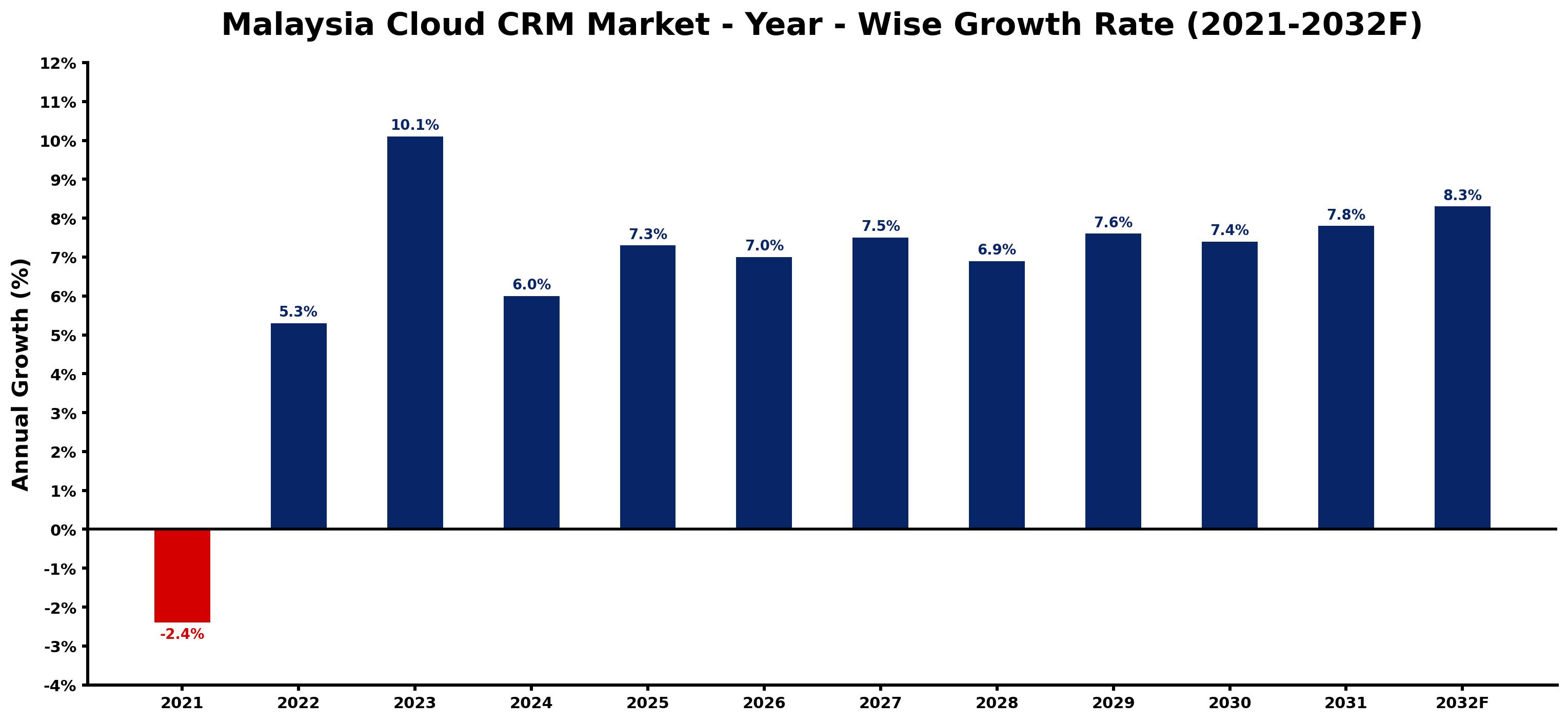
The table below presents the year‑wise growth rates along with the key drivers influencing the market
| Year | Growth Rate | Major Drivers |
| 2021 | -2.4% | Data privacy regulations from MCMC stifling growth |
| 2022 | 5.3% | Boost from SMEs adopting cloud-based customer solutions. |
| 2023 | 10.1% | Increased funding from Malaysian digital economy initiatives. |
| 2024 | 6.0% | Telekom Malaysia enhancing cloud infrastructure reliability. |
| 2025 | 7.3% | Rise in subscription-based models among local businesses. |
| 2026 | 7.0% | Growing mobile internet penetration driving CRM access. |
| 2027 | 7.5% | Digital payment adoption fostering integrated customer relationships. |
| 2028 | 6.9% | Government incentives for tech start-ups boosting CRM usage. |
| 2029 | 7.6% | Improved data privacy regulations enhancing consumer trust. |
| 2030 | 7.4% | Local enterprises seeking comprehensive analytics solutions. |
| 2031 | 7.8% | Enhanced training programs for digital CRM capabilities. |
| 2032 | 8.3% | Rising interest in AI-driven customer engagement tools. |
Note: Market size estimations and growth projections presented in this report are based on 6Wresearch's proprietary forecasting methodology, utilizing the latest available industry data, government publications, and primary research inputs.
Malaysia Cloud CRM Market Key Takeaways
Below are some of the specific key takeaways from the market, including:
- The shift towards cloud solutions is driven by the need for better data accessibility and customer relationship management.
- AI-driven insights are becoming integral, helping businesses tailor their customer interactions effectively.
- Concerns around data security are a significant barrier, affecting migration decisions for many organizations.
- The impact of the COVID-19 pandemic has accelerated the adoption of cloud CRM solutions across industries.
- Local players are carving out market share by offering tailored solutions that meet specific Malaysian business needs.
Evaluation of Restraints in Malaysia Cloud CRM Market
Several factors are limiting the growth of the Malaysia Cloud CRM Market. Chief among these is the pervasive concern regarding data security and privacy. Organizations are often hesitant to transfer sensitive customer data to cloud platforms, fearing potential breaches and compliance issues. This apprehension creates a challenging environment for CRM providers, who must work diligently to instill confidence in their security measures.
Malaysia Cloud CRM Market Trends
The market is witnessing a notable trend towards integration of AI and machine learning within CRM systems. Companies are increasingly utilizing these technologies to gain deeper customer insights and automate processes. Additionally, the emphasis on mobile accessibility is reshaping how businesses deploy CRM solutions, making them more user-friendly and adaptable to remote work settings.
on top of that, a shift toward subscription-based pricing models is becoming prevalent, allowing businesses of all sizes to access powerful CRM tools without the burden of hefty upfront costs. This trend supports wider adoption, especially among smaller enterprises looking to enhance their customer engagement strategies.
Malaysia Cloud CRM Market Opportunities
The growth potential in the Malaysia Cloud CRM Market is substantial, particularly for solutions that prioritize customer-centric features. Businesses are keen on investing in systems that offer personalized experiences for their customers. on top of that, the increasing digitization of various sectors presents a ripe opportunity for CRM providers to capture new clients.
Additionally, partnerships between technology providers and local enterprises can foster innovation and tailor services to the unique needs of the Malaysian market. Focusing on vertical-specific CRM solutions can further drive growth, as businesses look for tools that align closely with their operational requirements.
Government Initiatives in the Malaysia Cloud CRM Market
The Malaysian government is actively fostering an environment conducive to the growth of cloud technologies, including CRM solutions. By prioritizing digital transformation and supporting innovation, public policy is shaping the landscape for businesses looking to adopt cloud-based systems. Regulatory frameworks aimed at protecting consumer data are also crucial, as they help establish trust in cloud services.
- A recent initiative focused on enhancing cybersecurity measures was launched to build confidence in cloud solutions among businesses.
- Current government programs are underway to provide funding and resources for SMEs to adopt digital technologies, including cloud CRM systems.
- A planned public-private partnership aims to create a cloud infrastructure that will support local businesses in deploying CRM solutions effectively by 2028.
- The government is developing a regulatory framework that will enhance transparency and security in cloud transactions, expected to be implemented in 2026.
Future Insights of the Malaysia Cloud CRM Market
Looking ahead to 2026-2032, the Malaysia Cloud CRM Market is set to expand as businesses increasingly recognize the importance of effective customer relationship management. The trend towards integrated solutions that combine CRM with other business functions will likely gain momentum, providing organizations with comprehensive tools to enhance customer engagement. As the regulatory environment stabilizes and more businesses embrace digital transformation, the market is expected to flourish.
Malaysia Cloud CRM Market Latest Developments
Recent activity in the Malaysia Cloud CRM Market reflects a dynamic environment with numerous developments. Over the past year, companies have been keenly focused on enhancing their offerings and expanding their reach within the region. This trend indicates a commitment to innovation and responsiveness to evolving market needs.
- A major technology vendor launched a new CRM platform tailored for SMEs, which began rollout in early 2025 and was completed by mid-2025.
- A partnership between a local enterprise and a global CRM provider is currently underway, aimed at developing region-specific features to better serve Malaysian businesses.
- In early 2025, a cloud infrastructure upgrade initiative was completed, enhancing the capacity and reliability of CRM services for local businesses.
- A planned product upgrade focused on integrating AI capabilities is expected to begin development in late 2025.
Malaysia Cloud CRM Market - Key Attractiveness of the Report
- 10 Years of Market Numbers
- Historical Data Starting from 2022 to 2025
- Base Year: 2025
- Forecast Data until 2032
- Key Performance Indicators Impacting the Market
- Major Upcoming Developments and Projects
Key Highlights of the Report:
- Malaysia Cloud CRM Market Outlook
- Market Size of Malaysia Cloud CRM Market, 2025
- Forecast of Malaysia Cloud CRM Market, 2032
- Historical Data and Forecast of Malaysia Cloud CRM Revenues & Volume for the Period 2022-2032F
- Malaysia Cloud CRM Market Trend Evolution
- Malaysia Cloud CRM Market Drivers and Challenges
- Malaysia Cloud CRM Price Trends
- Malaysia Cloud CRM Porter's Five Forces
- Malaysia Cloud CRM Industry Life Cycle
- Historical Data and Forecast of Malaysia Cloud CRM Market Revenues & Volume By Vertical for the Period 2022-2032F
- Historical Data and Forecast of Malaysia Cloud CRM Market Revenues & Volume By Nonprofit for the Period 2022-2032F
- Historical Data and Forecast of Malaysia Cloud CRM Market Revenues & Volume By Higher Education for the Period 2022-2032F
- Historical Data and Forecast of Malaysia Cloud CRM Market Revenues & Volume By Nonprofit Sub Vertical for the Period 2022-2032F
- Historical Data and Forecast of Malaysia Cloud CRM Market Revenues & Volume By Education for the Period 2022-2032F
- Historical Data and Forecast of Malaysia Cloud CRM Market Revenues & Volume By Research and Innovation for the Period 2022-2032F
- Historical Data and Forecast of Malaysia Cloud CRM Market Revenues & Volume By Social Affairs for the Period 2022-2032F
- Historical Data and Forecast of Malaysia Cloud CRM Market Revenues & Volume By Children and Youth for the Period 2022-2032F
- Historical Data and Forecast of Malaysia Cloud CRM Market Revenues & Volume By Art and Culture for the Period 2022-2032F
- Historical Data and Forecast of Malaysia Cloud CRM Market Revenues & Volume By Others for the Period 2022-2032F
- Malaysia Cloud CRM Import Export Trade Statistics
- Market Opportunity Assessment By Vertical
- Market Opportunity Assessment By Nonprofit Sub Vertical
- Malaysia Cloud CRM Top Companies Market Share
- Malaysia Cloud CRM Competitive Benchmarking By Technical and Operational Parameters
- Malaysia Cloud CRM Company Profiles
- Malaysia Cloud CRM Key Strategic Recommendations






































