Malaysia Coated Fabric Market Size, Share & Growth Rate
The Malaysia Coated Fabric Market was estimated at USD 334 Million in 2025 and is projected to reach USD 434 Million by 2032, growing at a CAGR of 3.8% from 2026 to 2032. This growth trajectory is largely driven by the increasing demand from diverse sectors including automotive and apparel, where coated fabrics are valued for their durability and water resistance. Additionally, the rising disposable incomes and evolving consumer preferences for high-quality, multifunctional textiles contribute significantly to the market's expansion.
Malaysia Coated Fabric Market Growth Rate Analysis (2021-2032)
The Malaysian coated fabric market has shown notable fluctuations over recent years, starting with a decline of 3.4% in 2021, largely attributed to pandemic-related disruptions. However, consumer demand surged in 2022, leading to a revitalizing growth of 3.9%. The trend continued to accelerate in 2023, with an impressive growth rate of 9.0%, fueled by increased investments in industrial applications and advancements in coating technologies. As we look ahead, the market is projected to maintain robust growth rates, averaging around 5% annually through 2032. This expansion is driven by ongoing digitalization efforts, infrastructure improvements, and a strategic shift in energy policies aimed at sustainability, positioning Malaysia's coated fabric sector for a resilient future.
Malaysia Coated Fabric Market Year-wise Growth Rate and Key Drivers
This graph highlights how the Malaysia Coated Fabric Market has steadily grown over the past five years, supported by major growth factors.
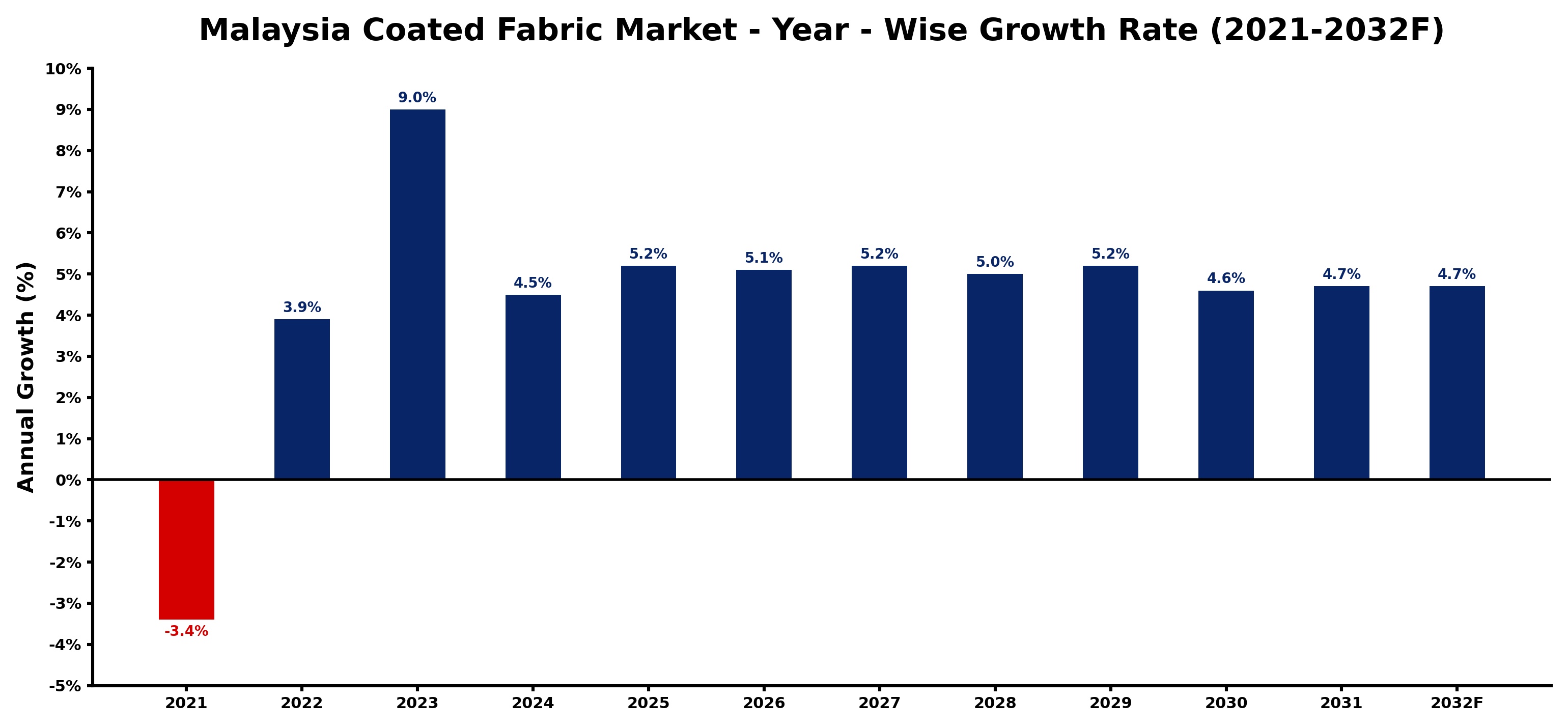
The table below presents the year‑wise growth rates along with the key drivers influencing the market
| Year | Growth Rate | Major Drivers |
| 2021 | -3.4% | Expansion of manufacturing activities |
| 2022 | 3.9% | Expansion of transportation and logistics networks |
| 2023 | 9.0% | Growing renewable energy integration projects |
| 2024 | 4.5% | Growing urbanization and commercial development |
| 2025 | 5.2% | Government infrastructure modernization initiatives |
| 2026 | 5.1% | Expansion of transportation and logistics networks |
| 2027 | 5.2% | Expansion of transportation and logistics networks |
| 2028 | 5.0% | Expansion of commercial construction activities |
| 2029 | 5.2% | Increasing industrial automation investments |
| 2030 | 4.6% | Expansion of manufacturing activities |
| 2031 | 4.7% | Increasing adoption of advanced technologies |
| 2032 | 4.7% | Rapid growth in telecom and data center sectors |
Note - Market size estimations and growth projections presented in this report are based on 6Wresearch’s advanced forecasting approach, validated with industry datasets as of June 2026.
Malaysia Coated Fabric Market Synopsis
In recent years, the coated fabric market in Malaysia has witnessed remarkable growth, fueled by the robust demand from various sectors. However, the market is on the brink of a transformation, as shifting consumer preferences and increased environmental consciousness shape future demand.
As the market continues to evolve, opportunities lie in the adoption of sustainable practices and innovative materials. The combination of rising urbanization and changes in lifestyle will likely drive the next phase of growth, as consumers seek more sophisticated and eco-friendly options.
Malaysia Coated Fabric Market Key Takeaways
- The market is poised for steady growth, driven by diverse applications across multiple sectors.
- Increased consumer spending and urbanization play significant roles in the rising demand for coated fabrics.
- Environmental concerns pose challenges, necessitating a shift toward sustainable practices in production.
- Innovations in coatings and materials are crucial to addressing evolving consumer needs and enhancing market offerings.
- The recovery from COVID-19 is leading to renewed investment in automotive, fashion, and home furnishing sectors.
Evaluation of Restraints in Malaysia Coated Fabric Market
Despite its promising growth, the Malaysia coated fabric market faces notable restraints, particularly concerning environmental sustainability. The manufacturing processes associated with coated fabrics can generate significant waste, raising concerns among consumers and regulators alike. Furthermore, the market encounters competition from both natural and synthetic alternatives, which may appeal to eco-conscious consumers. Addressing these challenges is critical for long-term growth, as the industry shifts towards more sustainable materials and practices.
Malaysia Coated Fabric Market Trends
Several trends are emerging within the Malaysia coated fabric market that are reshaping its dynamics. Notably, the increasing adoption of eco-friendly materials is gaining momentum, spurred by consumer demand for sustainability. Additionally, the rise of smart textiles and advanced coating technologies is propelling innovations that enhance functionality, such as UV protection and self-cleaning surfaces. These trends not only cater to consumer preferences but also position manufacturers for competitive advantages in a rapidly evolving market landscape.
Malaysia Coated Fabric Market Opportunities
The market presents genuine growth opportunities through the expansion of applications in sectors like medical equipment and outdoor gear. As these industries increasingly seek materials that combine performance with durability, coated fabrics are well-positioned to meet their demands. Moreover, investments in R&D focused on sustainable production methods can further elevate market potential, aligning with global sustainability goals while attracting environmentally conscious consumers.
Government Initiatives in the Malaysia Coated Fabric Market
The Malaysian government has been actively promoting initiatives aimed at enhancing the textile and fabric manufacturing sector, including coated fabrics. Supportive policies encouraging technological innovation and sustainable practices are being implemented to elevate industry standards. Additionally, public investments in infrastructure and export incentives are designed to bolster the market's competitiveness on an international scale, providing a favorable environment for growth.
Future Insights of the Malaysia Coated Fabric Market
Looking ahead to 2026-2032, the Malaysia coated fabric market is expected to continue on its growth path, driven by a combination of innovation and sustainability. As industries adapt to post-pandemic realities, the focus will shift toward more resilient supply chains and sustainable production methods. The integration of advanced technologies, coupled with the rising demand for multifunctional fabrics, will likely redefine market dynamics and create new avenues for investment.
Malaysia Coated Fabric Market Latest Developments (May 2025 - June 2026)
In the latest industry developments, a notable shift toward innovative and eco-friendly manufacturing practices is taking place. Companies are increasingly investing in R&D to enhance the functionality of coated fabrics, addressing consumer preferences for durability and sustainability. Concurrently, collaboration between manufacturers and technology providers is fostering advancements in smart textile solutions, reflecting a broader trend towards integrating functionality with fashion in the coated fabric market.
Malaysia Coated Fabric Market - Key Attractiveness of the Report
- 10 Years of Market Numbers
- Historical Data Starting from 2022 to 2025
- Base Year: 2025
- Forecast Data until 2032
- Key Performance Indicators Impacting the Market
- Major Upcoming Developments and Projects
Key Highlights of the Report:
- Malaysia Coated Fabric Market Outlook
- Market Size of Malaysia Coated Fabric Market, 2025
- Forecast of Malaysia Coated Fabric Market, 2032F
- Historical Data and Forecast of Malaysia Coated Fabric Revenues & Volume for the Period 2022-2032F
- Malaysia Coated Fabric Market Trend Evolution
- Malaysia Coated Fabric Market Drivers and Challenges
- Malaysia Coated Fabric Price Trends
- Malaysia Coated Fabric Porter's Five Forces
- Malaysia Coated Fabric Industry Life Cycle
- Historical Data and Forecast of Malaysia Coated Fabric Market Revenues & Volume By Product for the Period 2022-2032F
- Historical Data and Forecast of Malaysia Coated Fabric Market Revenues & Volume By Polymer-coated Fabric for the Period 2022-2032F
- Historical Data and Forecast of Malaysia Coated Fabric Market Revenues & Volume By Rubber-coated Fabric for the Period 2022-2032F
- Historical Data and Forecast of Malaysia Coated Fabric Market Revenues & Volume By Fabric-backed Wall Coverings for the Period 2022-2032F
- Historical Data and Forecast of Malaysia Coated Fabric Market Revenues & Volume By Application for the Period 2022-2032F
- Historical Data and Forecast of Malaysia Coated Fabric Market Revenues & Volume By Transportation for the Period 2022-2032F
- Historical Data and Forecast of Malaysia Coated Fabric Market Revenues & Volume By Protective Clothing for the Period 2022-2032F
- Historical Data and Forecast of Malaysia Coated Fabric Market Revenues & Volume By Industrial for the Period 2022-2032F
- Historical Data and Forecast of Malaysia Coated Fabric Market Revenues & Volume By Roofing, Awnings & Canopies for the Period 2022-2032F
- Historical Data and Forecast of Malaysia Coated Fabric Market Revenues & Volume By Furniture & Seating for the Period 2022-2032F
- Historical Data and Forecast of Malaysia Coated Fabric Market Revenues & Volume By Others for the Period 2022-2032F
- Malaysia Coated Fabric Import Export Trade Statistics
- Market Opportunity Assessment By Product
- Market Opportunity Assessment By Application
- Malaysia Coated Fabric Top Companies Market Share
- Malaysia Coated Fabric Competitive Benchmarking By Technical and Operational Parameters
- Malaysia Coated Fabric Company Profiles
- Malaysia Coated Fabric Key Strategic Recommendations






































