Malaysia Coaxial Cables Market Summary
The malaysia coaxial cables market was estimated at USD 406 Million in 2025 and is projected to reach USD 526 Million by 2032, growing at a CAGR of 5.0% from 2026 to 2032.
Malaysia Coaxial Cables Market Year-wise Growth Rate and Key Drivers
This graph highlights how the Malaysia Coaxial Cables Market has steadily grown over the past five years, supported by major growth factors.
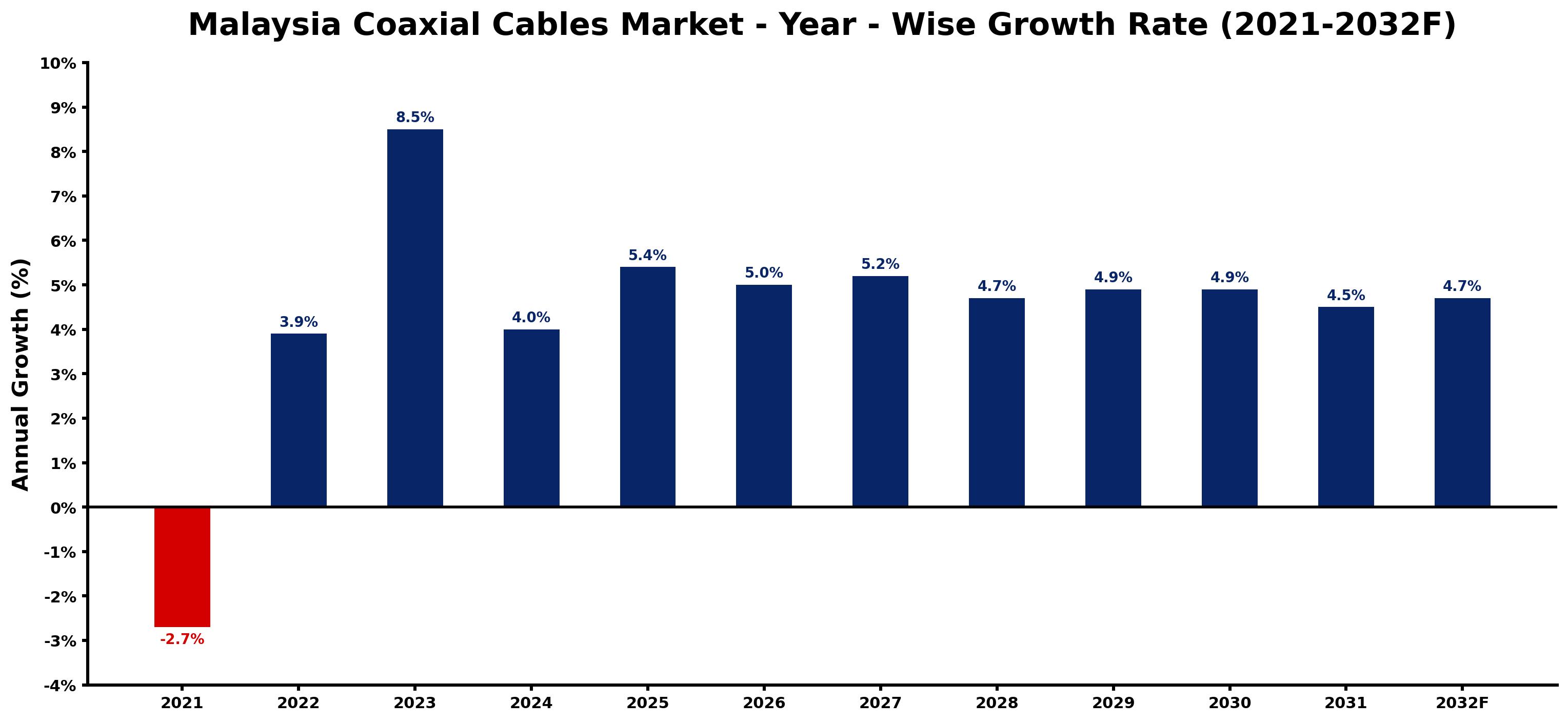
The table below presents the year wise growth rates along with the key drivers influencing the market
| Year | Growth Rate | Major Drivers |
| 2021 | -2.7% | Decreased construction activity significantly reduced the demand for coaxial cables in the telecommunications sector. |
| 2022 | 3.9% | Legacy copper grid failures underscored a need for more reliable coaxial cable solutions. |
| 2023 | 8.5% | Corporate shifts toward digital transformation emphasized upgraded connectivity solutions for businesses. |
| 2024 | 4.0% | Urbanization trends prompted infrastructure upgrades, necessitating enhanced cable deployments in cities. |
| 2025 | 5.4% | Telecommunications operators expanded fiber-optic networks, improving demand for hybrid coaxial cable systems. |
| 2026 | 5.0% | The rise of smart homes and IoT devices drove higher standards in cabling technology. |
| 2027 | 5.2% | Construction sector growth stimulated substantial requirements for coaxial cables in commercial spaces. |
| 2028 | 4.7% | The popularity of streaming services led to increased bandwidth demands on cable infrastructures. |
| 2029 | 4.9% | Rural electrification programs incorporated coaxial cables to enhance communication accessibility nationwide. |
| 2030 | 4.9% | Corporate mergers among tech firms consolidated market positions, intensifying competition for cables. |
| 2031 | 4.5% | Emerging green initiatives pushed manufacturers to develop eco-friendly coaxial cable alternatives. |
| 2032 | 4.7% | Regional connectivity projects aimed to integrate various telecommunications systems throughout Malaysia. |
Note - Market size estimations and growth projections presented in this report are based on 6Wresearch's advanced forecasting approach, validated with industry datasets as of June 2026.
Malaysia Coaxial Cables Market Synopsis
The Malaysia Coaxial Cables Market is projected to reach 5.0% and witness significant growth during the forecast period (2026-2032). This anticipated expansion is driven by a confluence of factors, including an increase in demand for high-speed internet services, the growing penetration of fiber optics, and government initiatives aimed at enhancing broadband connectivity throughout the nation. Moreover, the rising demand for data centers and the increased use of audio/video applications are expected to provide substantial momentum for the market. The ongoing development of emerging technologies, particularly 5G, further augments the growth prospects of the Malaysia coaxial cables market.
Malaysia Coaxial Cables Market Growth Drivers
Several key drivers underlie the growth of the Malaysia coaxial cables market. Firstly, the relentless demand for high-speed internet services is reshaping the telecommunications landscape. The proliferation of digital devices, along with a shift toward remote working, has catalyzed this demand, compelling service providers to invest in robust infrastructure. Secondly, the penetration of fiber optics continues to rise, which in turn boosts the need for effective coaxial cables to manage broadband signals efficiently.
- The Malaysian government's commitment to improving national broadband connectivity is a pivotal factor driving market growth.
- Increased data center construction reflects the growing reliance on cloud services, necessitating high-quality coaxial cables for optimal performance.
- Audio and video applications, including streaming services, are experiencing unprecedented demand that relies heavily on advanced coaxial infrastructure.
- The advent of 5G technology is expected to propel innovation and demand for coaxial cables equipped to support next-generation communication networks.
- Consumer behavior shifts, increasingly favoring high-definition content consumption, further contribute to the need for reliable coaxial cable solutions.
Malaysia Coaxial Cables Market Trends and Opportunities
The Malaysia coaxial cables market is poised to witness several noteworthy trends that may present lucrative opportunities for stakeholders. A significant trend is the steady shift towards hybrid connectivity solutions, where coaxial cables complement fiber-optic systems to deliver enhanced data transmission capabilities. Another trend is the integration of smart technology in coaxial cable networks, optimizing performance and efficiency for both commercial and residential applications.
- Innovation in coaxial cable materials and designs is leading to products with better durability and performance characteristics.
- Investment in smart city initiatives is likely to foster demand for advanced coaxial infrastructure to support various applications.
- Corporate responsibility and sustainability are driving manufacturers to adopt eco-friendly materials and practices in coaxial cable production.
- The proliferation of Internet of Things (IoT) devices necessitates advanced coaxial solutions that support high-bandwidth applications.
- Increased collaboration between telecom operators and technology providers will likely create opportunities for bundled service offerings, enhancing overall market appeal.
Malaysia Coaxial Cables Market Challenges and Restraints
Despite its growth potential, the Malaysia coaxial cables market faces several challenges and restraints. The rapid technological advancements in the communications industry necessitate continuous innovation, which can impose financial burdens on manufacturers. Additionally, competition from alternative technologies, such as fiber optics, poses a significant challenge in terms of market share retention.
- The market is vulnerable to fluctuations in raw material prices, which can impact overall production costs and profit margins.
- Regulatory hurdles related to installation and safety standards may delay project timelines and increase compliance costs.
- Rapidly evolving consumer preferences complicate forecasting and product development timelines.
- The high initial investment costs associated with upgrading existing infrastructure can deter potential market entrants.
- Global supply chain disruptions can affect the timely availability of critical components needed for coaxial cable production.
Malaysia Coaxial Cables Market Government Investment and Initiatives
The Malaysian government has undertaken several initiatives to bolster the coaxial cables market as part of its broader economic development strategy. These initiatives generally focus on enhancing national connectivity and supporting technological advancements across industries. Through various funding programs and development plans, the government encourages investments in telecommunications infrastructure.
- Government policies promoting broadband expansion underscore the importance of coaxial cables in achieving connectivity goals.
- Public-private partnerships are being fostered to drive improvements in telecommunications infrastructure, including coaxial networks.
- Investment incentives are offered to companies that prioritize technological innovation in the production of coaxial cables.
- Support for research and development activities within the telecommunications sector is paving the way for new product innovations.
- Strategic initiatives aimed at improving disaster recovery capabilities will likely increase demand for resilient coaxial cable solutions.
Malaysia Coaxial Cables Market Latest Developments (May 2025 - June 2026)
The Malaysia coaxial cables market has witnessed significant developments in the period from May 2025 to June 2026. Key industry players have focused on enhancing product offerings to meet the growing demand for higher-quality and more versatile coaxial cables. Investments in new manufacturing technologies and modernization efforts have been notable, aiming to improve efficiency and reduce production costs.
- Collaborations between technology firms and telecommunications providers have yielded advancements in coaxial cable design, further enhancing performance.
- Emerging trends indicate a pivot towards eco-friendly manufacturing practices, aligning with global sustainability goals.
- Increased participation in trade fairs and industry exhibitions reflects a growing interest in the latest innovations within the coaxial cable sector.
- Enhanced focus on customer feedback has led to tailored solutions that cater specifically to the evolving needs of end-users.
- Regulatory updates have proposed new standards aimed at improving the safety and reliability of coaxial cable installations.
Malaysia Coaxial Cables Market - Key Attractiveness of the Report
- 10 Years of Market Numbers
- Historical Data Starting from 2022 to 2025
- Base Year: 2025
- Forecast Data until 2032
- Key Performance Indicators Impacting the Market
- Major Upcoming Developments and Projects
Key Highlights of the Report:
- Malaysia Coaxial Cables Market Outlook
- Market Size of Malaysia Coaxial Cables Market, 2025
- Forecast of Malaysia Coaxial Cables Market, 2032F
- Historical Data and Forecast of Malaysia Coaxial Cables Revenues & Volume for the Period 2022-2032F
- Malaysia Coaxial Cables Market Trend Evolution
- Malaysia Coaxial Cables Market Drivers and Challenges
- Malaysia Coaxial Cables Price Trends
- Malaysia Coaxial Cables Porter's Five Forces
- Malaysia Coaxial Cables Industry Life Cycle
- Historical Data and Forecast of Malaysia Coaxial Cables Market Revenues & Volume By Types for the Period 2022-2032F
- Historical Data and Forecast of Malaysia Coaxial Cables Market Revenues & Volume By Hard-line Cable for the Period 2022-2032F
- Historical Data and Forecast of Malaysia Coaxial Cables Market Revenues & Volume By Triaxial Cable for the Period 2022-2032F
- Historical Data and Forecast of Malaysia Coaxial Cables Market Revenues & Volume By Twin Axial Cable for the Period 2022-2032F
- Historical Data and Forecast of Malaysia Coaxial Cables Market Revenues & Volume By Applications for the Period 2022-2032F
- Historical Data and Forecast of Malaysia Coaxial Cables Market Revenues & Volume By Internet Data Transfer for the Period 2022-2032F
- Historical Data and Forecast of Malaysia Coaxial Cables Market Revenues & Volume By Video Distribution for the Period 2022-2032F
- Historical Data and Forecast of Malaysia Coaxial Cables Market Revenues & Volume By Radio Distribution Frequency Transfer for the Period 2022-2032F
- Historical Data and Forecast of Malaysia Coaxial Cables Market Revenues & Volume By Others for the Period 2022-2032F
- Historical Data and Forecast of Malaysia Coaxial Cables Market Revenues & Volume By End-users for the Period 2022-2032F
- Historical Data and Forecast of Malaysia Coaxial Cables Market Revenues & Volume By Cable Television Industry for the Period 2022-2032F
- Historical Data and Forecast of Malaysia Coaxial Cables Market Revenues & Volume By Military and Aerospace for the Period 2022-2032F
- Historical Data and Forecast of Malaysia Coaxial Cables Market Revenues & Volume By Internet Service Providers for the Period 2022-2032F
- Historical Data and Forecast of Malaysia Coaxial Cables Market Revenues & Volume By Telephone Network Operators for the Period 2022-2032F
- Historical Data and Forecast of Malaysia Coaxial Cables Market Revenues & Volume By Communication Equipment Manufactures for the Period 2022-2032F
- Malaysia Coaxial Cables Import Export Trade Statistics
- Market Opportunity Assessment By Types
- Market Opportunity Assessment By Applications
- Market Opportunity Assessment By End-users
- Malaysia Coaxial Cables Top Companies Market Share
- Malaysia Coaxial Cables Competitive Benchmarking By Technical and Operational Parameters
- Malaysia Coaxial Cables Company Profiles
- Malaysia Coaxial Cables Key Strategic Recommendations






































