Malaysia Coffee Maker Market Size Growth Rate
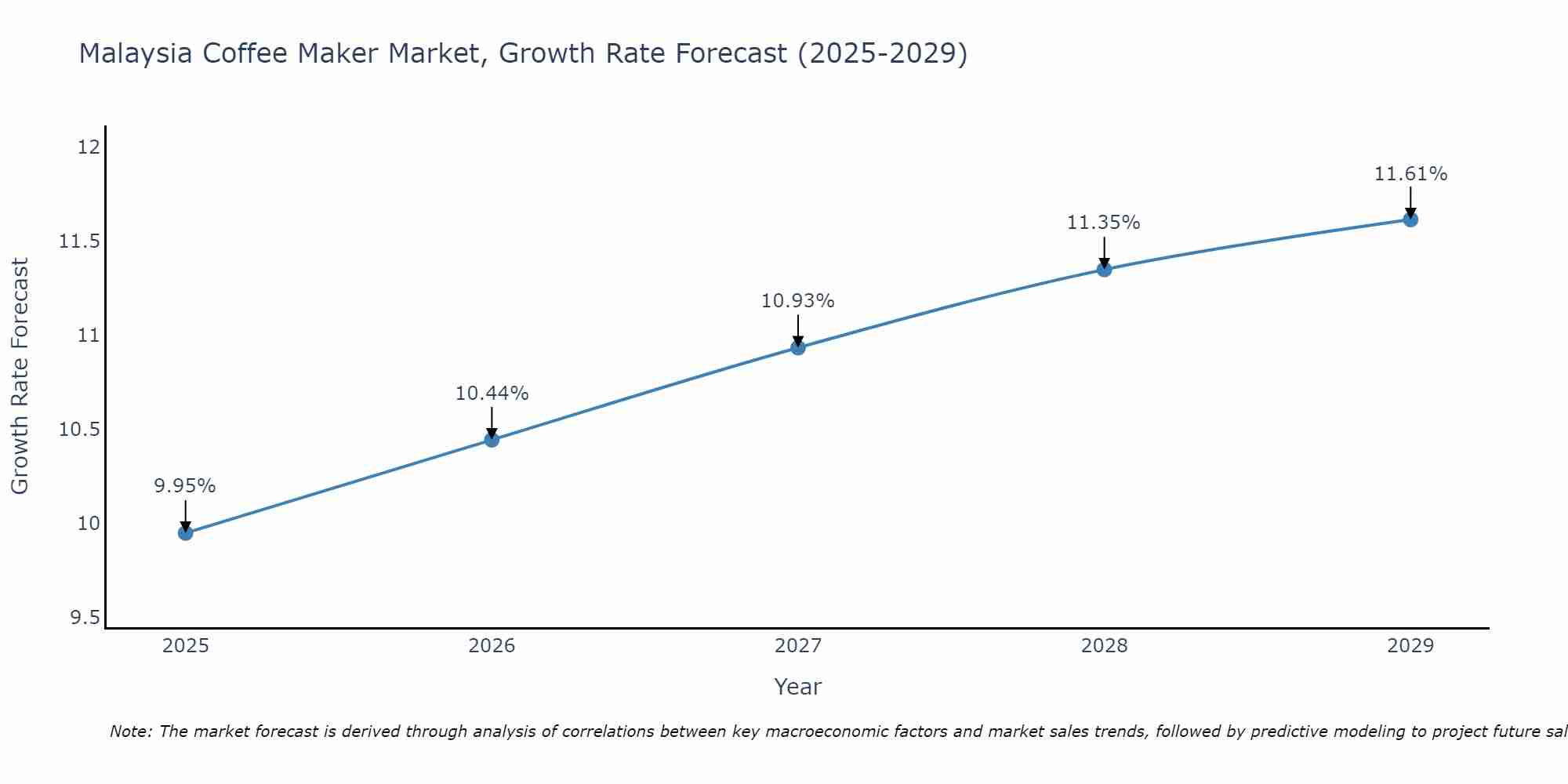
The Malaysia Coffee Maker Market is poised for steady growth rate improvements from 2025 to 2029. Commencing at 9.95% in 2025, growth builds up to 11.61% by 2029.
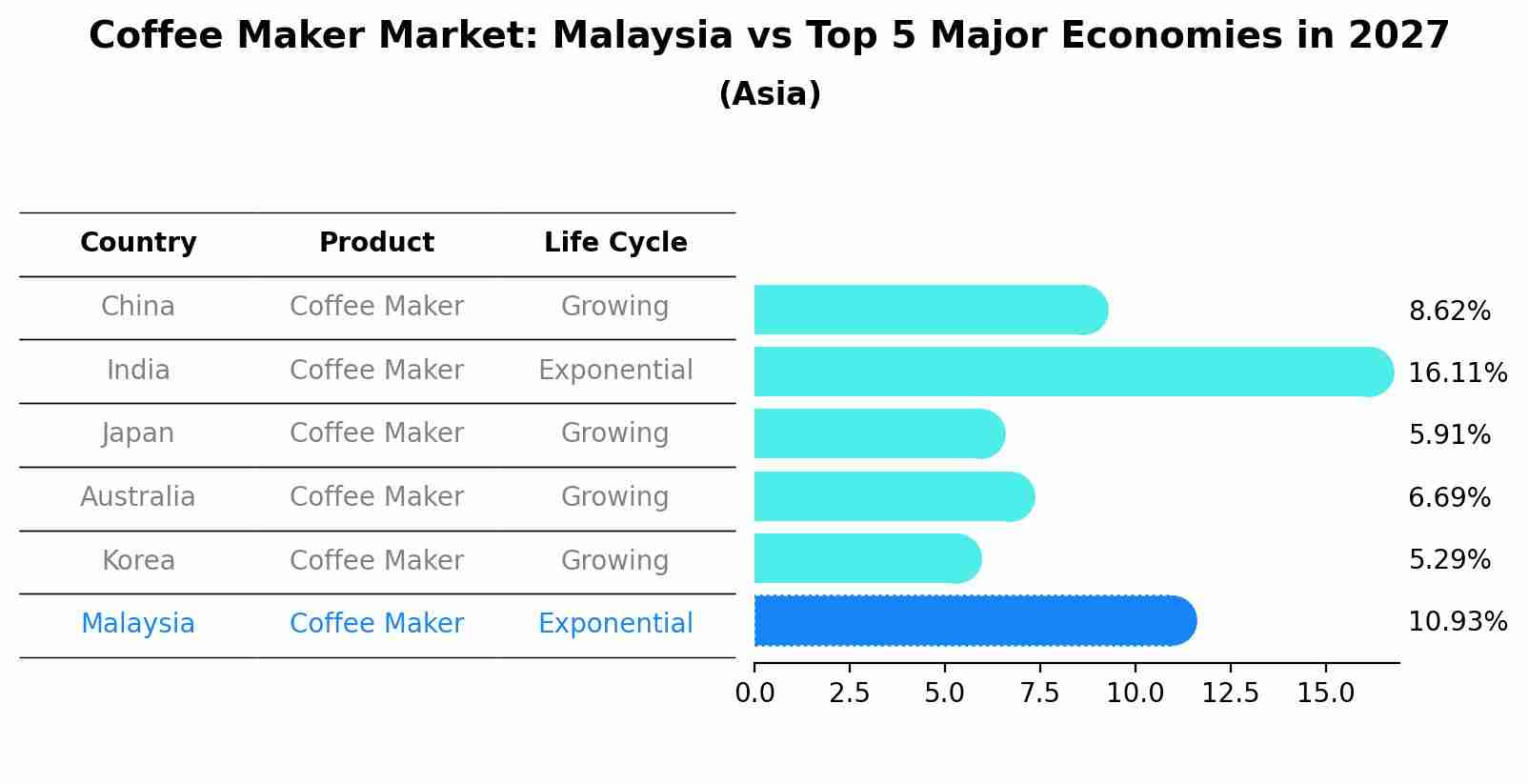
Coffee Maker Market: Malaysia vs Top 5 Major Economies in 2027 (Asia)
Malaysia's Coffee Maker market is anticipated to experience a high growth rate of 10.93% by 2027, reflecting trends observed in the largest economy China, followed by India, Japan, Australia and South Korea.
Malaysia Coffee Maker Market Highlights
| Report Name | Malaysia Coffee Maker Market |
| Forecast period | 2026-2032 |
| CAGR | 5.3% |
| Growing Sector | Steam Coffee Machine |
Malaysia Coffee Maker Market Synopsis
The majority of this growth is attributed to the increasing number of households in Malaysia and their changing lifestyle preferences that include coffee-making appliances such as automatic drip machines, espresso makers, manual brewers, pour-over devices and other types. Consumers are also becoming more health conscious and therefore prefer cold brews over traditional hot brewed coffees due to its purported higher levels of antioxidants. Additionally, the emergence of digitalisation has seen increased demand for smart connected brewing systems that allow users greater convenience, control and customisation in their beverage choices than ever before. A wide variety of brands from both local (eg: Kaffi) international (eg: Nespresso) players have emerged in recent years serving different price points depending upon product quality and customer needs. Specialty stores have also been established nationwide offering customers access to premium beans from all over the world as well as speciality brewing equipment which further drive the growth trajectory for this market segment.
According to 6Wresearch internal database and industry insights the Malaysia Coffee Maker Market is expected to grow at a CAGR of 5.3% during the forecast period (2026-2032). Market expansion is driven by demand for advanced appliances, premium brewing technologies, and increasing exposure to global coffee trends, boosting adoption across residential and hospitality segments.
Key Attractiveness of the Report
- 10 Years of Market Numbers.
- Historical Data Starting from 2022 to 2025.
- Base Year: 2025
- Forecast Data until 2032.
- Key Performance Indicators Impacting the market.
- Major Upcoming Developments and Projects.
Key Highlights of the Report:
- Malaysia Coffee Maker Market Outlook
- Market Size of Malaysia Coffee Maker Market, 2025
- Forecast of Malaysia Coffee Maker Market, 2032
- Historical Data and Forecast of Malaysia Coffee Maker Revenues & Volume for the Period 2022-2032
- Malaysia Coffee Maker Market Trend Evolution
- Malaysia Coffee Maker Market Drivers and Challenges
- Malaysia Coffee Maker Price Trends
- Malaysia Coffee Maker Porter's Five Forces
- Malaysia Coffee Maker Industry Life Cycle
- Historical Data and Forecast of Malaysia Coffee Maker Market Revenues & Volume By Types for the Period 2022-2032
- Historical Data and Forecast of Malaysia Coffee Maker Market Revenues & Volume By Drip Coffee Machine for the Period 2022-2032
- Historical Data and Forecast of Malaysia Coffee Maker Market Revenues & Volume By Steam Coffee Machine for the Period 2022-2032
- Historical Data and Forecast of Malaysia Coffee Maker Market Revenues & Volume By Capsule Coffee Machine for the Period 2022-2032
- Historical Data and Forecast of Malaysia Coffee Maker Market Revenues & Volume By Others for the Period 2022-2032
- Historical Data and Forecast of Malaysia Coffee Maker Market Revenues & Volume By End-users for the Period 2022-2032
- Historical Data and Forecast of Malaysia Coffee Maker Market Revenues & Volume By Commercial for the Period 2022-2032
- Historical Data and Forecast of Malaysia Coffee Maker Market Revenues & Volume By Industrial for the Period 2022-2032
- Historical Data and Forecast of Malaysia Coffee Maker Market Revenues & Volume By Distribution Channel for the Period 2022-2032
- Historical Data and Forecast of Malaysia Coffee Maker Market Revenues & Volume By Online for the Period 2022-2032
- Historical Data and Forecast of Malaysia Coffee Maker Market Revenues & Volume By Offline for the Period 2022-2032
- Malaysia Coffee Maker Import Export Trade Statistics
- Market Opportunity Assessment By Types
- Market Opportunity Assessment By End-users
- Market Opportunity Assessment By Distribution Channel
- Malaysia Coffee Maker Top Companies Market Share
- Malaysia Coffee Maker Competitive Benchmarking By Technical and Operational Parameters
- Malaysia Coffee Maker Company Profiles
- Malaysia Coffee Maker Key Strategic Recommendations
By Types
- Drip Coffee Machine
- Steam Coffee Machine
- Capsule Coffee Machine
- Others
By End-users
- Commercial
- Industrial
By Distribution Channel
- Online
- Offline






































