Malaysia Commercial Boiler Market Size, Share & Growth Rate
The Malaysia Commercial Boiler Market was estimated at USD 454 Million in 2025 and is projected to reach USD 592 Million by 2032, growing at a CAGR of 3.9% from 2026 to 2032. This growth trajectory is largely fueled by the expansion of various sectors including hospitality and manufacturing, which are increasingly adopting energy-efficient heating solutions. Moreover, as the focus on environmental sustainability intensifies, businesses are more inclined to invest in modern boiler systems that minimize their carbon footprint.
Malaysia Commercial Boiler Market Year-wise Growth Rate and Key Drivers
This graph highlights how the Malaysia Commercial Boiler Market has steadily grown over the years, supported by major growth factors.
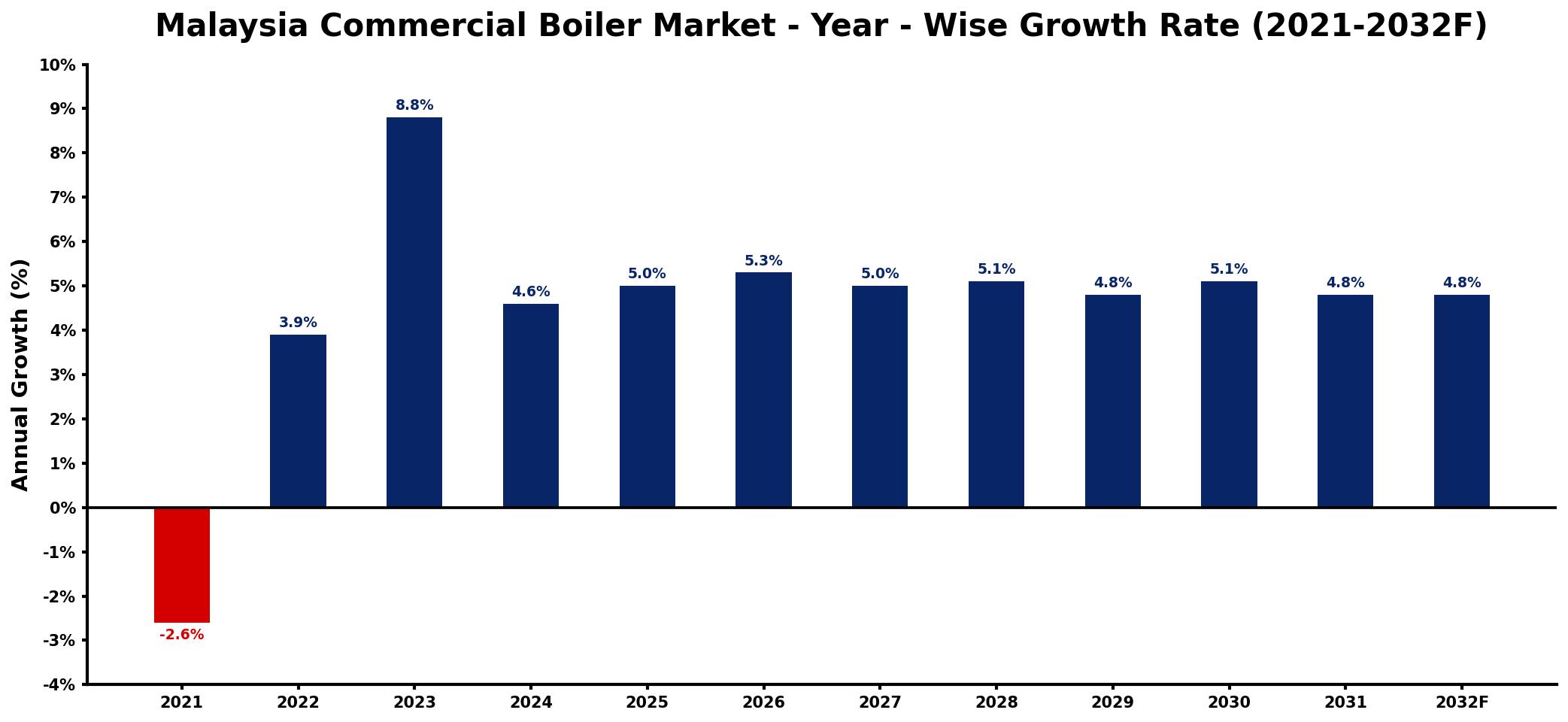
The table below presents the year‑wise growth rates along with the key drivers influencing the market
| Year | Growth Rate | Major Drivers |
| 2021 | -2.6% | decreased energy sector investments |
| 2022 | 3.9% | increased industrial production activities |
| 2023 | 8.8% | growing demand for energy efficiency |
| 2024 | 4.6% | rising construction sector projects |
| 2025 | 5.0% | expansion of manufacturing facilities |
| 2026 | 5.3% | surge in renewable energy adoption |
| 2027 | 5.0% | enhanced regulatory compliance requirements |
| 2028 | 5.1% | growth in food processing sector |
| 2029 | 4.8% | increase in residential developments |
| 2030 | 5.1% | technology advancements in energy |
| 2031 | 4.8% | higher demand for sustainable solutions |
| 2032 | 4.8% | rising export shipment volumes |
Note: Market size estimations and growth projections presented in this report are based on 6Wresearch's proprietary forecasting methodology, utilizing the latest available industry data, government publications, and primary research inputs.
Malaysia Commercial Boiler Market Synopsis
The strongest force shaping the Malaysia Commercial Boiler Market is the growing demand for energy-efficient heating solutions across diverse sectors. As businesses prioritize sustainability, there is a clear shift towards eco-friendly boiler systems that comply with stringent environmental regulations.
Additionally, the recovery from the COVID-19 pandemic has accelerated investments in modern infrastructure and heating systems. With companies eager to enhance operational efficiencies, the market is witnessing a surge in demand for reliable and advanced boiler technologies.
Malaysia Commercial Boiler Market Key Takeaways
- The market is poised for growth driven by the expansion of industrial and commercial sectors.
- Energy efficiency and sustainability are central to purchasing decisions.
- Key players are investing in eco-friendly boiler systems to remain competitive.
- Post-pandemic recovery is leading to increased investments in modern heating solutions.
- Proper maintenance and safety standards are critical for operational success.
Evaluation of Restraints in Malaysia Commercial Boiler Market
Despite the positive outlook, several restraints hinder the growth of the Malaysia Commercial Boiler Market. A pressing concern is the need for improved energy efficiency, particularly as regulations become increasingly stringent. Companies are challenged to upgrade or replace older, less efficient boilers to meet these new standards. Additionally, fluctuations in fuel prices can impact operational costs significantly, creating a demand for more flexible solutions. Lastly, ensuring proper maintenance and adhering to safety protocols remains vital for preventing accidents and system failures, posing a challenge for many businesses.
Malaysia Commercial Boiler Market Trends
Several trends are currently shaping the Malaysia Commercial Boiler Market. First, there is a noticeable shift towards smart boiler technologies that allow for better monitoring and control of heating systems. This integration of Internet of Things (IoT) technologies is enhancing operational efficiency. Second, the demand for biomass and alternative fuel boilers is on the rise, aligning with the broader sustainability goals of the nation. Lastly, the trend toward comprehensive maintenance services is gaining traction, as businesses seek to ensure longevity and reliability in their heating systems.
Malaysia Commercial Boiler Market Opportunities
Significant growth and investment opportunities lie within the Malaysia Commercial Boiler Market, particularly in the realm of eco-friendly technologies. As industries prioritize sustainability, companies that innovate in the development of energy-efficient and low-emission boilers will likely capture substantial market share. Moreover, as businesses increasingly focus on infrastructure upgrades, the demand for advanced maintenance services will present another avenue for growth. Additionally, the potential for public-private partnerships in developing energy-efficient solutions represents a promising opportunity for market players.
Government Initiatives in the Malaysia Commercial Boiler Market
The Malaysian government is actively promoting sustainability through various policies and initiatives aimed at enhancing energy efficiency. Public spending on green technologies and incentives for adopting energy-efficient systems are helping to drive market growth. Furthermore, government programs designed to educate businesses about compliance with environmental regulations are fostering a supportive environment for the commercial boiler market.
Future Insights of the Malaysia Commercial Boiler Market
Looking ahead to the period from 2026 to 2032, the Malaysia Commercial Boiler Market is expected to evolve significantly. The acceleration towards energy-efficient technologies will continue to be a primary driver of growth, propelled by ongoing regulatory support and corporate commitment to sustainability. In addition, innovations in boiler technologies will provide enhanced solutions that address the specific needs of various industries. As a result, businesses that adapt and integrate advanced solutions will likely position themselves favorably in this dynamic market landscape.
Malaysia Commercial Boiler Market Latest Developments (2025 - 2026)
Recent developments in the Malaysia Commercial Boiler Market indicate a strong trend towards energy-efficient solutions. Businesses are increasingly implementing hybrid heating systems that combine conventional and renewable energy sources. Moreover, there has been a noticeable increase in partnerships between technology providers and commercial sectors, focusing on creating integrated heating solutions. The emphasis on safety and compliance has led to heightened investments in maintenance and training programs to ensure operational excellence.
Malaysia Commercial Boiler Market - Key Attractiveness of the Report
- 10 Years of Market Numbers
- Historical Data Starting from 2022 to 2025
- Base Year: 2025
- Forecast Data until 2032
- Key Performance Indicators Impacting the Market
- Major Upcoming Developments and Projects
Key Highlights of the Report:
- Malaysia Commercial Boiler Market Outlook
- Market Size of Malaysia Commercial Boiler Market, 2025
- Forecast of Malaysia Commercial Boiler Market, 2032
- Historical Data and Forecast of Malaysia Commercial Boiler Revenues & Volume for the Period 2022-2032F
- Malaysia Commercial Boiler Market Trend Evolution
- Malaysia Commercial Boiler Market Drivers and Challenges
- Malaysia Commercial Boiler Price Trends
- Malaysia Commercial Boiler Porter's Five Forces
- Malaysia Commercial Boiler Industry Life Cycle
- Historical Data and Forecast of Malaysia Commercial Boiler Market Revenues & Volume By Fuel Type for the Period 2022-2032F
- Historical Data and Forecast of Malaysia Commercial Boiler Market Revenues & Volume By Natural Gas for the Period 2022-2032F
- Historical Data and Forecast of Malaysia Commercial Boiler Market Revenues & Volume By Oil for the Period 2022-2032F
- Historical Data and Forecast of Malaysia Commercial Boiler Market Revenues & Volume By Coal for the Period 2022-2032F
- Historical Data and Forecast of Malaysia Commercial Boiler Market Revenues & Volume By Others for the Period 2022-2032F
- Historical Data and Forecast of Malaysia Commercial Boiler Market Revenues & Volume By Technology for the Period 2022-2032F
- Historical Data and Forecast of Malaysia Commercial Boiler Market Revenues & Volume By Condensing for the Period 2022-2032F
- Historical Data and Forecast of Malaysia Commercial Boiler Market Revenues & Volume By Non-Condensing for the Period 2022-2032F
- Historical Data and Forecast of Malaysia Commercial Boiler Market Revenues & Volume By Capacity for the Period 2022-2032F
- Historical Data and Forecast of Malaysia Commercial Boiler Market Revenues & Volume By Less than 10 MMBtu/hr for the Period 2022-2032F
- Historical Data and Forecast of Malaysia Commercial Boiler Market Revenues & Volume By 10-50 MMBtu/hr for the Period 2022-2032F
- Historical Data and Forecast of Malaysia Commercial Boiler Market Revenues & Volume By Others for the Period 2022-2032F
- Historical Data and Forecast of Malaysia Commercial Boiler Market Revenues & Volume By End User for the Period 2022-2032F
- Historical Data and Forecast of Malaysia Commercial Boiler Market Revenues & Volume By Offices for the Period 2022-2032F
- Historical Data and Forecast of Malaysia Commercial Boiler Market Revenues & Volume By Hospitals for the Period 2022-2032F
- Historical Data and Forecast of Malaysia Commercial Boiler Market Revenues & Volume By Educational Institutions for the Period 2022-2032F
- Historical Data and Forecast of Malaysia Commercial Boiler Market Revenues & Volume By Lodging for the Period 2022-2032F
- Historical Data and Forecast of Malaysia Commercial Boiler Market Revenues & Volume By Others for the Period 2022-2032F
- Malaysia Commercial Boiler Import Export Trade Statistics
- Market Opportunity Assessment By Fuel Type
- Market Opportunity Assessment By Technology
- Market Opportunity Assessment By Capacity
- Market Opportunity Assessment By End User
- Malaysia Commercial Boiler Top Companies Market Share
- Malaysia Commercial Boiler Competitive Benchmarking By Technical and Operational Parameters
- Malaysia Commercial Boiler Company Profiles
- Malaysia Commercial Boiler Key Strategic Recommendations






































