Malaysia Communications Equipment Market Summary
The malaysia communications equipment market was estimated at USD 331 Million in 2025 and is projected to reach USD 427 Million by 2032, growing at a CAGR of 5.0% from 2026 to 2032.
Malaysia Communications Equipment Market Year-wise Growth Rate and Key Drivers
This graph highlights how the Malaysia Communications Equipment Market has steadily grown over the past five years, supported by major growth factors.
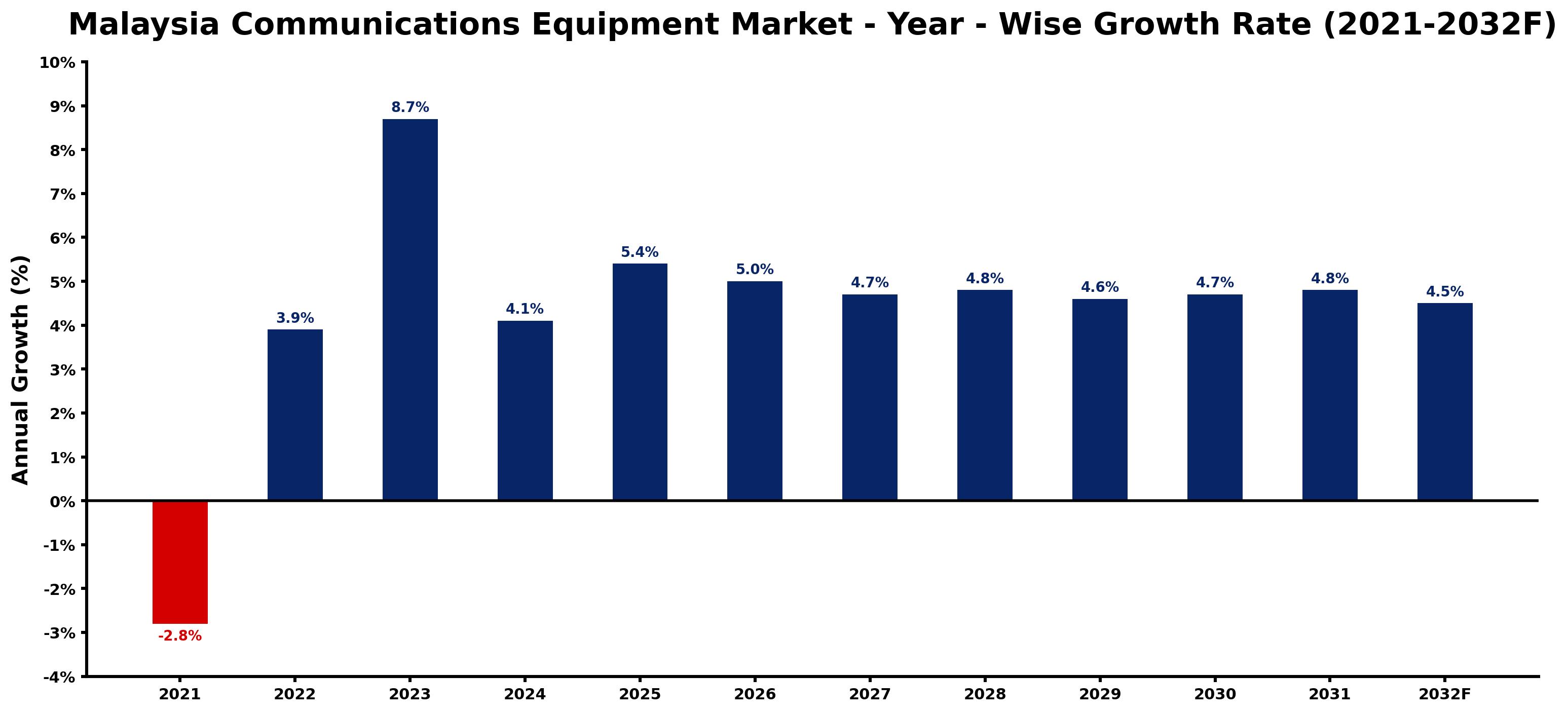
The table below presents the year wise growth rates along with the key drivers influencing the market
| Year | Growth Rate | Major Drivers |
| 2021 | -2.8% | Intensified competition from imported lowcost alternatives eroded the market share of local communications equipment manufacturers. |
| 2022 | 3.9% | Investment in 5G infrastructure began reshaping the competitive landscape of telecommunications. |
| 2023 | 8.7% | Consumers increasingly rely on high-speed internet, pushing demand for advanced communication devices. |
| 2024 | 4.1% | Local manufacturers are enhancing capabilities to meet rising standards of connectivity and reliability. |
| 2025 | 5.4% | Smart city projects across Malaysia drive the integration of IoT and communication technologies. |
| 2026 | 5.0% | Corporate sector upgrades legacy systems to improve operational efficiency and connectivity solutions. |
| 2027 | 4.7% | Emerging startups focus on innovative communication solutions tailored for diverse industries. |
| 2028 | 4.8% | Youth-driven trends influence mobile technology, prompting manufacturers to innovate rapidly. |
| 2029 | 4.6% | E-commerce growth stimulates demand for robust logistics and communication infrastructure investments. |
| 2030 | 4.7% | Sustainability considerations are shaping product development in the communications equipment market. |
| 2031 | 4.8% | Cross-border collaborations enhance technology exchange, fostering a more competitive local market. |
| 2032 | 4.5% | Consumer preferences shift towards seamless connectivity experiences, igniting further market expansion. |
Note - Market size estimations and growth projections presented in this report are based on 6Wresearch's advanced forecasting approach, validated with industry datasets as of June 2026.
Malaysia Communications Equipment Market Synopsis
The Malaysia Communications Equipment Market is projected to reach 5.0% and witness significant growth during the forecast period (2026-2032). This anticipated growth is primarily driven by the introduction of 5G networks and advancements in communication technologies. As Malaysia continues to enhance its digital infrastructure, the demand for sophisticated communications equipment is expected to rise. Investments by telecom operators focused on improving communication frameworks further bolster the potential for market expansion. Additionally, government initiatives like the Digital Malaysia initiative are channeling funds into fiber broadband and related technologies, which creates ample opportunities for telecommunications providers in the region.
Malaysia Communications Equipment Market Growth Drivers
Several critical factors are propelling the growth of the Malaysia communications equipment market. Firstly, there is an increasing demand for high-speed wireless internet across diverse sectors, driving the adoption of advanced 4G and 5G networks. This surge in demand is not limited to consumers; businesses are also seeking enhanced connectivity to support their operations. Secondly, investments from leading telecom operators are directed towards creating robust communication infrastructures, which are essential for accommodating growing data traffic. Furthermore, the Malaysia Communications and Multimedia Commission (MCMC) has initiated substantial funding programs aimed at fostering technological advancements among small businesses, thus widening the market scope. The integration of technologies such as big data analytics, artificial intelligence, and robotics will further accelerate the digitization process among local enterprises. Lastly, the government's push for digital transformation aligns with global trends, ensuring that the communications equipment market remains a focal point for both domestic and international stakeholders.
Malaysia Communications Equipment Market Challenges and Restraints
Despite the promising outlook, the Malaysia communications equipment market faces several challenges and constraints. One major hurdle is the high initial investment required for advanced communication infrastructure, which can deter smaller operators from entering the market. Additionally, the rapid pace of technological change necessitates continuous upgrades, leading to potential obsolescence of existing equipment. Furthermore, regulatory hurdles and complexities can pose significant barriers for new entrants looking to establish a foothold in the market. Another concern is the cybersecurity risks associated with the increasing interconnectivity of devices, which could lead to potential breaches and loss of consumer trust. Lastly, the competition among existing players can create price pressures, affecting profit margins across the industry.
Malaysia Communications Equipment Market Government Investment and Initiatives
The Malaysian government has been proactive in fostering the growth of the communications equipment market through various initiatives and investments. A cornerstone of this effort is the Digital Malaysia initiative, aimed at advancing the country's digital infrastructure and ensuring that technology becomes an integral part of daily life. This initiative includes plans for expanding fiber broadband services and supporting the deployment of 5G networks across urban and rural areas. The government also collaborates with the MCMC to allocate funds for projects that enhance technological capabilities, particularly for small and medium-sized enterprises (SMEs). Financial assistance programs are designed to encourage the adoption of advanced communication technologies and boost local businesses' competitive edge. By creating a supportive regulatory environment and investing in modern infrastructure, the government is laying the groundwork for sustained growth in the Malaysia communications equipment market.
Malaysia Communications Equipment Market Latest Developments (May 2025 - June 2026)
Recent developments in the Malaysia communications equipment market indicate a dynamic shift towards enhanced connectivity solutions. During the noted period, substantial investments have been made in the rollout of 5G technology, with increased collaborations between public and private sectors to improve infrastructure. There have been advancements in fiber optic network expansions, which are crucial for supporting the increased data demands of consumers and businesses alike. Regulatory bodies have introduced new guidelines aimed at streamlining processes for telecom providers, facilitating quicker deployment of services. Additionally, innovative partnerships have formed among technology providers and local enterprises, fostering a collaborative environment conducive to digital transformation. These developments reflect a strategic commitment to establishing Malaysia as a competitive player in the global communications landscape.
Malaysia Communications Equipment Market - Key Attractiveness of the Report
- 10 Years of Market Numbers
- Historical Data Starting from 2022 to 2025
- Base Year: 2025
- Forecast Data until 2032
- Key Performance Indicators Impacting the Market
- Major Upcoming Developments and Projects
Key Highlights of the Report:
- Malaysia Communications Equipment Market Outlook
- Market Size of Malaysia Communications Equipment Market, 2025
- Forecast of Malaysia Communications Equipment Market, 2032
- Historical Data and Forecast of Malaysia Communications Equipment Revenues & Volume for the Period 2022-2032F
- Malaysia Communications Equipment Market Trend Evolution
- Malaysia Communications Equipment Market Drivers and Challenges
- Malaysia Communications Equipment Price Trends
- Malaysia Communications Equipment Porter's Five Forces
- Malaysia Communications Equipment Industry Life Cycle
- Historical Data and Forecast of Malaysia Communications Equipment Market Revenues & Volume By Type for the Period 2022-2032F
- Historical Data and Forecast of Malaysia Communications Equipment Market Revenues & Volume By Optical Communication Equipment for the Period 2022-2032F
- Historical Data and Forecast of Malaysia Communications Equipment Market Revenues & Volume By Network Communication Equipment for the Period 2022-2032F
- Historical Data and Forecast of Malaysia Communications Equipment Market Revenues & Volume By Mobile Communication Device for the Period 2022-2032F
- Historical Data and Forecast of Malaysia Communications Equipment Market Revenues & Volume By Component for the Period 2022-2032F
- Historical Data and Forecast of Malaysia Communications Equipment Market Revenues & Volume By WANs (Wide Area Network) for the Period 2022-2032F
- Historical Data and Forecast of Malaysia Communications Equipment Market Revenues & Volume By Transceiver for the Period 2022-2032F
- Historical Data and Forecast of Malaysia Communications Equipment Market Revenues & Volume By Switch for the Period 2022-2032F
- Historical Data and Forecast of Malaysia Communications Equipment Market Revenues & Volume By Routers for the Period 2022-2032F
- Historical Data and Forecast of Malaysia Communications Equipment Market Revenues & Volume By LANs (Local Area Network) for the Period 2022-2032F
- Historical Data and Forecast of Malaysia Communications Equipment Market Revenues & Volume By Exchanges for the Period 2022-2032F
- Historical Data and Forecast of Malaysia Communications Equipment Market Revenues & Volume By Application for the Period 2022-2032F
- Historical Data and Forecast of Malaysia Communications Equipment Market Revenues & Volume By Telecom Operators for the Period 2022-2032F
- Historical Data and Forecast of Malaysia Communications Equipment Market Revenues & Volume By Data Center for the Period 2022-2032F
- Historical Data and Forecast of Malaysia Communications Equipment Market Revenues & Volume By End-users for the Period 2022-2032F
- Historical Data and Forecast of Malaysia Communications Equipment Market Revenues & Volume By Banking, Financial Services and Insurance (BFSI) for the Period 2022-2032F
- Historical Data and Forecast of Malaysia Communications Equipment Market Revenues & Volume By Personal for the Period 2022-2032F
- Historical Data and Forecast of Malaysia Communications Equipment Market Revenues & Volume By Healthcare for the Period 2022-2032F
- Historical Data and Forecast of Malaysia Communications Equipment Market Revenues & Volume By Government for the Period 2022-2032F
- Historical Data and Forecast of Malaysia Communications Equipment Market Revenues & Volume By Enterprise for the Period 2022-2032F
- Historical Data and Forecast of Malaysia Communications Equipment Market Revenues & Volume By Energy & Utilities for the Period 2022-2032F
- Historical Data and Forecast of Malaysia Communications Equipment Market Revenues & Volume By Education for the Period 2022-2032F
- Historical Data and Forecast of Malaysia Communications Equipment Market Revenues & Volume By Cloud for the Period 2022-2032F
- Malaysia Communications Equipment Import Export Trade Statistics
- Market Opportunity Assessment By Type
- Market Opportunity Assessment By Component
- Market Opportunity Assessment By Application
- Market Opportunity Assessment By End-users
- Malaysia Communications Equipment Top Companies Market Share
- Malaysia Communications Equipment Competitive Benchmarking By Technical and Operational Parameters
- Malaysia Communications Equipment Company Profiles
- Malaysia Communications Equipment Key Strategic Recommendations






































