Malaysia Computer Network Equipment Market Summary
The malaysia computer network equipment market was estimated at USD 241 Million in 2025 and is projected to reach USD 314 Million by 2032, growing at a CAGR of 5.3% from 2026 to 2032.
Malaysia Computer Network Equipment Market Year-wise Growth Rate and Key Drivers
This graph highlights how the Malaysia Computer Network Equipment Market has steadily grown over the past five years, supported by major growth factors.
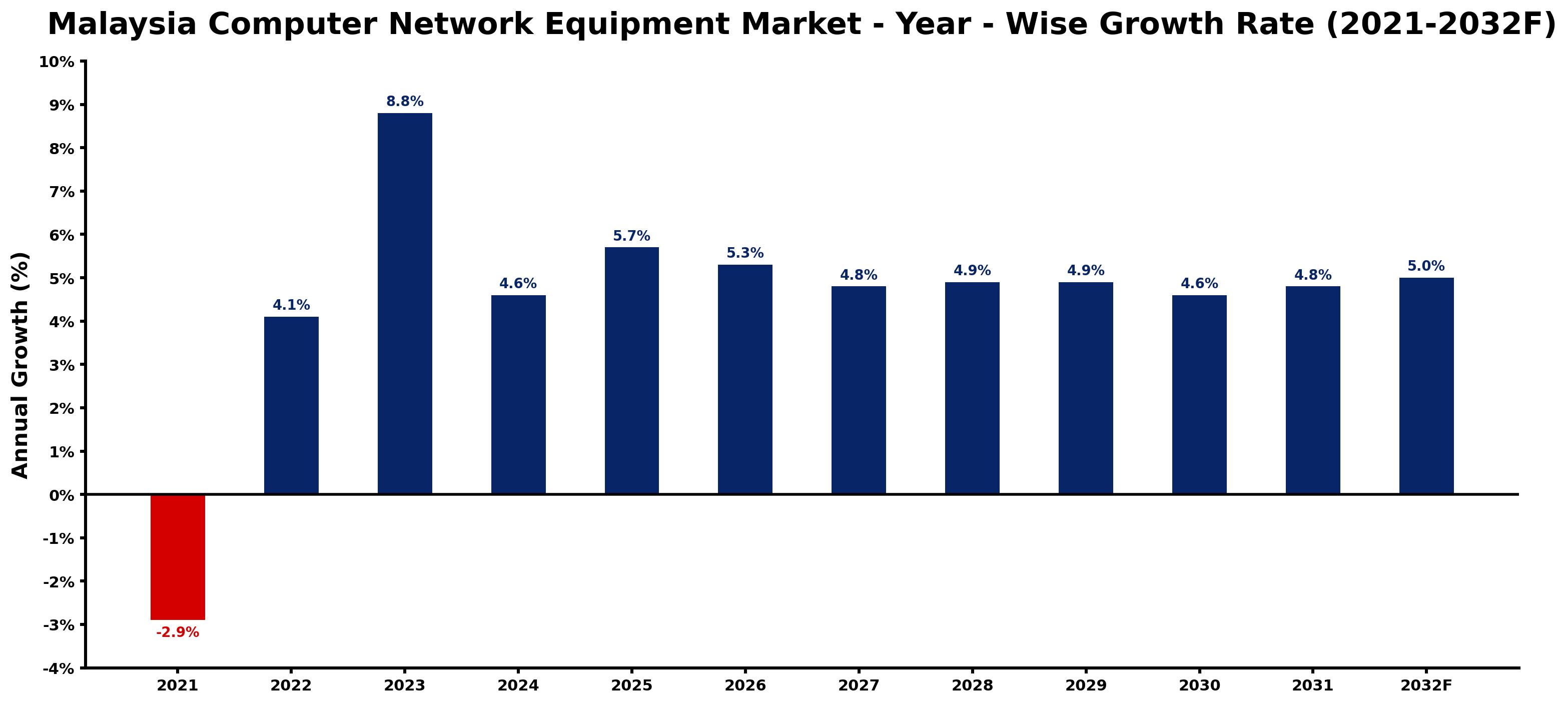
The table below presents the year wise growth rates along with the key drivers influencing the market
| Year | Growth Rate | Major Drivers |
| 2021 | -2.9% | Increased competition from lowcost alternatives diminished demand for premium computer network equipment in Malaysia. |
| 2022 | 4.1% | Legacy copper grid failures prompted enterprises to explore advanced networking solutions urgently. |
| 2023 | 8.8% | Corporate shifts towards cloud computing created new demands for robust network equipment. |
| 2024 | 4.6% | Increased remote work culture highlighted vulnerabilities in existing network setups and security. |
| 2025 | 5.7% | Telecommunications players expanded fiber optics reach, enhancing connectivity for various sectors. |
| 2026 | 5.3% | Competition among service providers led to innovative product offerings and pricing strategies. |
| 2027 | 4.8% | Cybersecurity concerns prompted organizations to invest heavily in secure network infrastructure upgrades. |
| 2028 | 4.9% | Growth in IoT devices significantly contributed to the complexity of network management demands. |
| 2029 | 4.9% | Enterprises increasingly recognized the importance of scalable networks for future-proofing their operations. |
| 2030 | 4.6% | Smart city projects underway in Malaysia catalyzed the need for advanced networking solutions. |
| 2031 | 4.8% | Partnerships with global technology firms facilitated knowledge transfer and innovation in network equipment. |
| 2032 | 5.0% | Emerging trends in AI and machine learning prompted interest in next-gen networking technologies. |
Note - Market size estimations and growth projections presented in this report are based on 6Wresearch's advanced forecasting approach, validated with industry datasets as of June 2026.
Malaysia Computer Network Equipment Market Synopsis
The Malaysia Computer Network Equipment Market is projected to reach 5.3% and witness significant growth during the forecast period (2026-2032). This growth trajectory is largely attributed to the rising adoption of cloud computing solutions and an escalating demand for digital transformation initiatives among enterprises. The quest for high-performance networking solutions by various sectors, including businesses, government bodies, and educational institutions, is also a pivotal factor influencing market expansion. Additionally, increased investments from telecommunications companies aimed at enhancing their wireless network capabilities are expected to further elevate the growth potential of the computer network equipment market in Malaysia.
Malaysia Computer Network Equipment Market Growth Drivers
Several key drivers are propelling the growth of the Malaysia Computer Network Equipment Market. These include:
- An increase in internet penetration rates across Malaysia is enhancing connectivity options for businesses and consumers alike, necessitating the proliferation of computer network equipment.
- Declining hardware prices, driven by fierce competition among vendors, are making robust networking solutions more accessible to a wider audience. This trend is expected to stimulate demand further.
- The growing popularity of advanced technologies such as software-defined networking (SDN) is transforming how networks are built and managed, creating opportunities for innovative networking solutions.
- The deployment of 5G technology is opening new avenues for growth, facilitating the entry of new players and enhancing the overall market landscape.
- Increasing investments in infrastructure development by both public and private sectors are expected to contribute to the market's upward momentum, particularly as digital transformation becomes a strategic priority.
Malaysia Computer Network Equipment Market Challenges and Restraints
Despite the promising outlook, certain challenges may hinder the growth of the Malaysia Computer Network Equipment Market. Key concerns include:
- Potential supply chain disruptions, particularly in the wake of global events, could affect the availability of critical components needed for computer network equipment.
- Rapid technological advancements necessitate continual investment in research and development, placing financial pressure on smaller firms unable to compete with larger organizations.
- The rising complexity of network management may pose challenges for enterprises lacking in-house expertise, potentially leading to difficulties in implementation and maintenance.
- Security concerns related to data breaches and cyberattacks remain a significant barrier, influencing businesses' willingness to invest in advanced networking solutions.
- Regulatory challenges and compliance requirements can create additional hurdles in the procurement and deployment of network equipment, particularly for foreign entities.
Malaysia Computer Network Equipment Market Government Investment and Initiatives
The role of government investment and initiatives is pivotal in shaping the Malaysia Computer Network Equipment Market. The government has recognized the importance of digital transformation and has implemented policies to stimulate growth in the technology sector. Public spending on infrastructure aimed at enhancing connectivity, especially in rural areas, is expected to support the market development. Additionally, various development plans, including the Malaysia Digital Economy Blueprint, outline strategic initiatives to bolster the digital landscape, significantly benefiting computer network infrastructure. Incentives aimed at attracting foreign investments into the technology sector are also a crucial component of the government's strategy, fostering innovation and competitiveness within the market.
Malaysia Computer Network Equipment Market Latest Developments (May 2025 - June 2026)
Recent developments in the Malaysia Computer Network Equipment Market, from May 2025 to June 2026, have underscored significant shifts in industry direction. The rollout of 5G technology has gained momentum, facilitating connectivity improvements and paving the way for advanced networking solutions. There has been a marked increase in public-private partnerships aimed at enhancing digital infrastructure, with several initiatives launched to address gaps in connectivity. Additionally, the adoption of SDN and network virtualization technologies is becoming prevalent, allowing organizations to optimize their network performance and reduce costs. Furthermore, as organizations prioritize cybersecurity, investments in secure networking equipment have surged, reflecting an increasing awareness of cyber threats. Overall, these developments signal a dynamic period for the computer network equipment sector in Malaysia, promising continued growth and innovation.
Malaysia Computer Network Equipment Market - Key Attractiveness of the Report
- 10 Years of Market Numbers
- Historical Data Starting from 2022 to 2025
- Base Year: 2025
- Forecast Data until 2032
- Key Performance Indicators Impacting the Market
- Major Upcoming Developments and Projects
Key Highlights of the Report:
- Malaysia Computer Network Equipment Market Outlook
- Market Size of Malaysia Computer Network Equipment Market, 2025
- Forecast of Malaysia Computer Network Equipment Market, 2032
- Historical Data and Forecast of Malaysia Computer Network Equipment Revenues & Volume for the Period 2022-2032F
- Malaysia Computer Network Equipment Market Trend Evolution
- Malaysia Computer Network Equipment Market Drivers and Challenges
- Malaysia Computer Network Equipment Price Trends
- Malaysia Computer Network Equipment Porter's Five Forces
- Malaysia Computer Network Equipment Industry Life Cycle
- Historical Data and Forecast of Malaysia Computer Network Equipment Market Revenues & Volume By Types for the Period 2022-2032F
- Historical Data and Forecast of Malaysia Computer Network Equipment Market Revenues & Volume By Switches for the Period 2022-2032F
- Historical Data and Forecast of Malaysia Computer Network Equipment Market Revenues & Volume By Routers for the Period 2022-2032F
- Historical Data and Forecast of Malaysia Computer Network Equipment Market Revenues & Volume By Wireless for the Period 2022-2032F
- Historical Data and Forecast of Malaysia Computer Network Equipment Market Revenues & Volume By End-Users for the Period 2022-2032F
- Historical Data and Forecast of Malaysia Computer Network Equipment Market Revenues & Volume By Business for the Period 2022-2032F
- Historical Data and Forecast of Malaysia Computer Network Equipment Market Revenues & Volume By Medical/Healthcare for the Period 2022-2032F
- Historical Data and Forecast of Malaysia Computer Network Equipment Market Revenues & Volume By Banking for the Period 2022-2032F
- Historical Data and Forecast of Malaysia Computer Network Equipment Market Revenues & Volume By Government for the Period 2022-2032F
- Historical Data and Forecast of Malaysia Computer Network Equipment Market Revenues & Volume By Educational for the Period 2022-2032F
- Historical Data and Forecast of Malaysia Computer Network Equipment Market Revenues & Volume By Others for the Period 2022-2032F
- Malaysia Computer Network Equipment Import Export Trade Statistics
- Market Opportunity Assessment By Types
- Market Opportunity Assessment By End-Users
- Malaysia Computer Network Equipment Top Companies Market Share
- Malaysia Computer Network Equipment Competitive Benchmarking By Technical and Operational Parameters
- Malaysia Computer Network Equipment Company Profiles
- Malaysia Computer Network Equipment Key Strategic Recommendations






































