Malaysia Computer Software Market Size, Share & Growth Rate
The Malaysia Computer Software Market was estimated at USD 366 Million in 2025 and is projected to reach USD 477 Million by 2032, growing at a CAGR of 3.9% from 2026 to 2032. This growth trajectory is fueled by the ongoing digital transformation across various sectors, with businesses increasingly adopting software solutions for enhanced operational efficiency and customer engagement. Moreover, government initiatives aimed at fostering technology adoption further bolster this expanding market.
Malaysia Computer Software Market Year-wise Growth Rate and Key Drivers
This graph highlights how the Malaysia Computer Software Market has steadily grown over the years, supported by major growth factors.
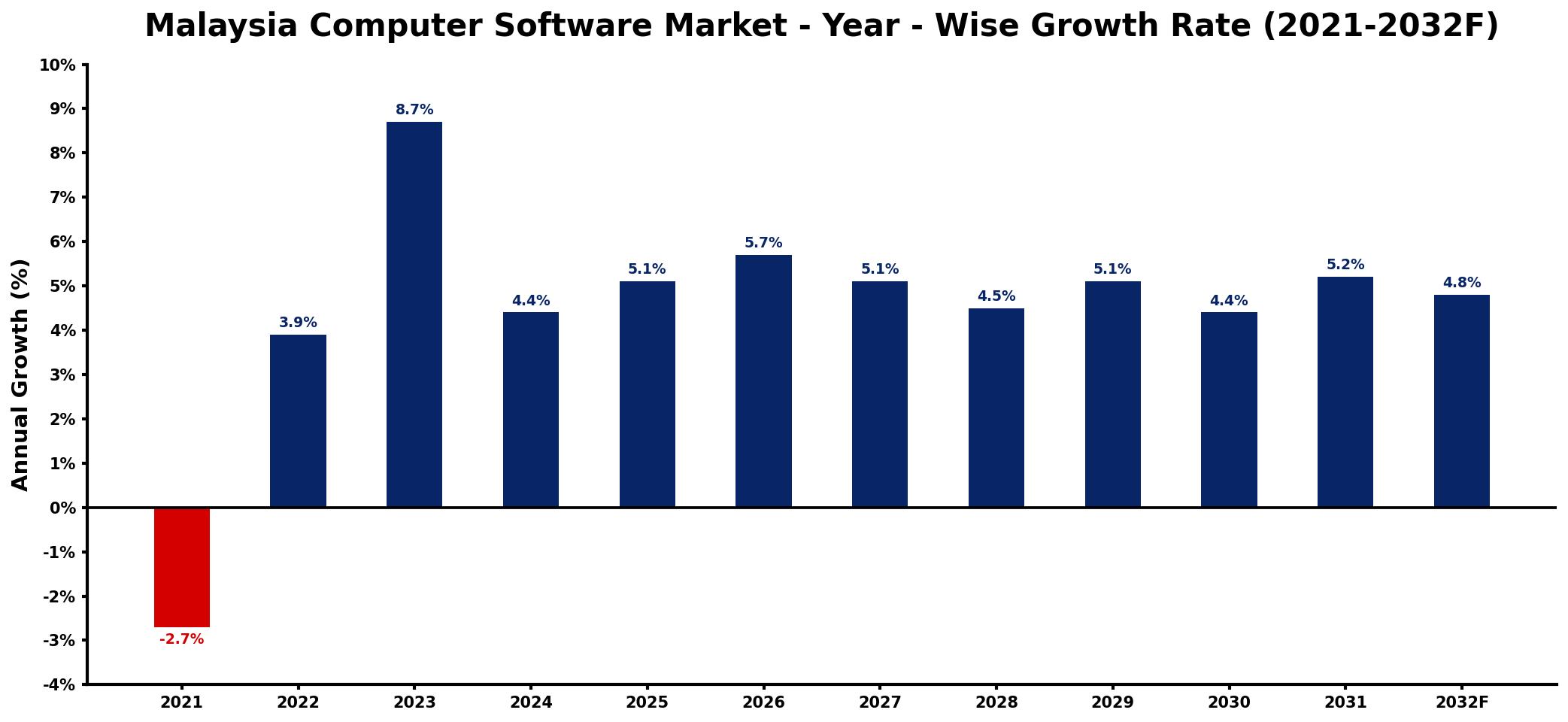
The table below presents the year‑wise growth rates along with the key drivers influencing the market
| Year | Growth Rate | Major Drivers |
| 2021 | -2.7% | decrease in enterprise technology investments |
| 2022 | 3.9% | rise in digital transformation initiatives |
| 2023 | 8.7% | growing adoption of cloud solutions |
| 2024 | 4.4% | increased focus on cybersecurity measures |
| 2025 | 5.1% | expansion of e-commerce platforms |
| 2026 | 5.7% | surge in remote working tools |
| 2027 | 5.1% | advancements in artificial intelligence applications |
| 2028 | 4.5% | growth in data analytics services |
| 2029 | 5.1% | enhanced user experience expectations |
| 2030 | 4.4% | development of mobile application ecosystems |
| 2031 | 5.2% | increased integration of IoT devices |
| 2032 | 4.8% | investment in sustainable technology solutions |
Note: Market size estimations and growth projections presented in this report are based on 6Wresearch's proprietary forecasting methodology, utilizing the latest available industry data, government publications, and primary research inputs.
Malaysia Computer Software Market Synopsis
The strongest force shaping the Malaysia Computer Software Market right now is the rapid digitalization of both businesses and government operations. As Malaysian companies look to modernize their processes, they are investing heavily in software solutions that address specific industry needs, particularly in sectors like cybersecurity, cloud computing, and data analytics.
Another significant influence on the market is the growing demand for customized software offerings tailored to unique business challenges. As organizations embrace innovative technologies, the landscape is evolving, with a clear focus on collaborative, efficient solutions that can integrate seamlessly into existing frameworks.
Malaysia Computer Software Market Key Takeaways
- Digital transformation initiatives are driving substantial investment in software solutions.
- Customized software offerings are becoming essential as businesses seek specific technological solutions.
- The market is witnessing a significant shift towards cloud-based software and enhanced cybersecurity measures.
- Government support for tech adoption is fostering a conducive environment for market growth.
- Remote work trends, initiated during the pandemic, continue to influence software demand dynamics.
Evaluation of Restraints in Malaysia Computer Software Market
Despite the promising growth outlook, the Malaysia Computer Software Market faces notable restraints. One of the most pressing issues is software piracy, which undermines the profitability and innovation of legitimate developers. Efforts to strengthen intellectual property rights and enforce anti-piracy measures are critical to safeguarding the interests of software creators. Additionally, as cyber threats evolve, ensuring robust cybersecurity and maintaining data privacy in software applications has become increasingly challenging. Building user trust through transparent security measures is essential for long-term market stability.
Malaysia Computer Software Market Trends
Several current and emerging trends are shaping the Malaysia Computer Software Market. A notable trend is the growing inclination towards cloud-based solutions, driven by their scalability and cost-effectiveness. Furthermore, organizations are increasingly investing in advanced analytics and artificial intelligence to extract valuable insights from their data. This trend highlights a shift from traditional software to innovative, data-driven solutions that enhance decision-making capabilities. Companies are also prioritizing user experience and interface design, focusing on creating intuitive and engaging applications.
Malaysia Computer Software Market Opportunities
The genuine growth and investment opportunities in the Malaysia Computer Software Market lie in developing niche software solutions tailored to specific industries. As sectors such as healthcare, finance, and education increasingly turn to technology, there is a rising demand for specialized applications that address unique operational challenges. Additionally, the growing emphasis on cybersecurity presents opportunities for software developers to create robust security solutions that cater to both corporate and personal users. Startups that focus on innovation and user-centric design are likely to thrive in this dynamic landscape.
Government Initiatives in the Malaysia Computer Software Market
The Malaysian government has been proactive in promoting the computer software sector through various initiatives. Policies aimed at enhancing digital literacy, fostering innovation, and supporting local tech startups are crucial to creating a vibrant ecosystem. Furthermore, public spending on technology infrastructure and R&D provides the necessary foundation for sustained growth in the software market. These initiatives not only encourage technology adoption but also position Malaysia as a competitive player in the Southeast Asian tech landscape.
Future Insights of the Malaysia Computer Software Market
Looking ahead to 2026-2032, the Malaysia Computer Software Market is expected to experience significant advancements, driven by technological innovation and increased digital adoption. The convergence of technologies, including the Internet of Things (IoT) and artificial intelligence, will reshape software development and deployment. As businesses continue to prioritize agility and responsiveness, the demand for software solutions that can integrate seamlessly across various platforms will grow. This evolution will not only enhance operational efficiency but will also foster a culture of continuous improvement within organizations.
Malaysia Computer Software Market Latest Developments (2025 - 2026)
In recent months, the Malaysia Computer Software Market has seen a noticeable shift towards more collaborative software solutions, responding to the increasing prevalence of remote work. Companies are enhancing their product offerings to include features that support virtual collaboration and communication. Additionally, there has been a marked rise in partnerships between local software firms and international tech companies, aimed at leveraging advanced technologies and expertise. These developments signal a strong commitment to innovation and adaptability within the Malaysian software landscape.
Malaysia Computer Software Market - Key Attractiveness of the Report
- 10 Years of Market Numbers
- Historical Data Starting from 2022 to 2025
- Base Year: 2025
- Forecast Data until 2032
- Key Performance Indicators Impacting the Market
- Major Upcoming Developments and Projects
Key Highlights of the Report:
- Malaysia Computer Software Market Outlook
- Market Size of Malaysia Computer Software Market, 2025
- Forecast of Malaysia Computer Software Market, 2032
- Historical Data and Forecast of Malaysia Computer Software Revenues & Volume for the Period 2022-2032F
- Malaysia Computer Software Market Trend Evolution
- Malaysia Computer Software Market Drivers and Challenges
- Malaysia Computer Software Price Trends
- Malaysia Computer Software Porter's Five Forces
- Malaysia Computer Software Industry Life Cycle
- Historical Data and Forecast of Malaysia Computer Software Market Revenues & Volume By Type for the Period 2022-2032F
- Historical Data and Forecast of Malaysia Computer Software Market Revenues & Volume By Operating Systems & Productivity Software Publishing for the Period 2022-2032F
- Historical Data and Forecast of Malaysia Computer Software Market Revenues & Volume By Database, Storage & Backup Software Publishing for the Period 2022-2032F
- Historical Data and Forecast of Malaysia Computer Software Market Revenues & Volume By Business Analytics & Enterprise Software for the Period 2022-2032F
- Historical Data and Forecast of Malaysia Computer Software Market Revenues & Volume By Video Game Software for the Period 2022-2032F
- Historical Data and Forecast of Malaysia Computer Software Market Revenues & Volume By Design for the Period 2022-2032F
- Historical Data and Forecast of Malaysia Computer Software Market Revenues & Volume By Editing & Rendering Software for the Period 2022-2032F
- Historical Data and Forecast of Malaysia Computer Software Market Revenues & Volume By Application for the Period 2022-2032F
- Historical Data and Forecast of Malaysia Computer Software Market Revenues & Volume By Personal for the Period 2022-2032F
- Historical Data and Forecast of Malaysia Computer Software Market Revenues & Volume By Business/Commercial for the Period 2022-2032F
- Historical Data and Forecast of Malaysia Computer Software Market Revenues & Volume By Industrial for the Period 2022-2032F
- Historical Data and Forecast of Malaysia Computer Software Market Revenues & Volume By Industry Verticals for the Period 2022-2032F
- Historical Data and Forecast of Malaysia Computer Software Market Revenues & Volume By BFSI for the Period 2022-2032F
- Historical Data and Forecast of Malaysia Computer Software Market Revenues & Volume By Media & Entertainment for the Period 2022-2032F
- Historical Data and Forecast of Malaysia Computer Software Market Revenues & Volume By IT & Telecommunications for the Period 2022-2032F
- Historical Data and Forecast of Malaysia Computer Software Market Revenues & Volume By Energy & Utilities for the Period 2022-2032F
- Historical Data and Forecast of Malaysia Computer Software Market Revenues & Volume By Government & Public Sector for the Period 2022-2032F
- Historical Data and Forecast of Malaysia Computer Software Market Revenues & Volume By Retail & Consumer Goods for the Period 2022-2032F
- Historical Data and Forecast of Malaysia Computer Software Market Revenues & Volume By Manufacturing for the Period 2022-2032F
- Historical Data and Forecast of Malaysia Computer Software Market Revenues & Volume By Others for the Period 2022-2032F
- Malaysia Computer Software Import Export Trade Statistics
- Market Opportunity Assessment By Type
- Market Opportunity Assessment By Application
- Market Opportunity Assessment By Industry Verticals
- Malaysia Computer Software Top Companies Market Share
- Malaysia Computer Software Competitive Benchmarking By Technical and Operational Parameters
- Malaysia Computer Software Company Profiles
- Malaysia Computer Software Key Strategic Recommendations






































