Malaysia Concrete Aggregate Market Size, Share & Growth Rate
The Malaysia Concrete Aggregate Market was estimated at USD 394 Million in 2025 and is projected to reach USD 512 Million by 2032, growing at a CAGR of 3.8% from 2026 to 2032. This growth is primarily driven by increased construction activities fueled by ongoing urbanization and significant government infrastructure investments. As the demand for sustainable and high-quality building materials rises, the market will likely see a shift toward innovative sourcing practices and environmental stewardship.
Malaysia Concrete Aggregate Market Year-wise Growth Rate and Key Drivers
This graph highlights how the Malaysia Concrete Aggregate Market has steadily grown over the years, supported by major growth factors.
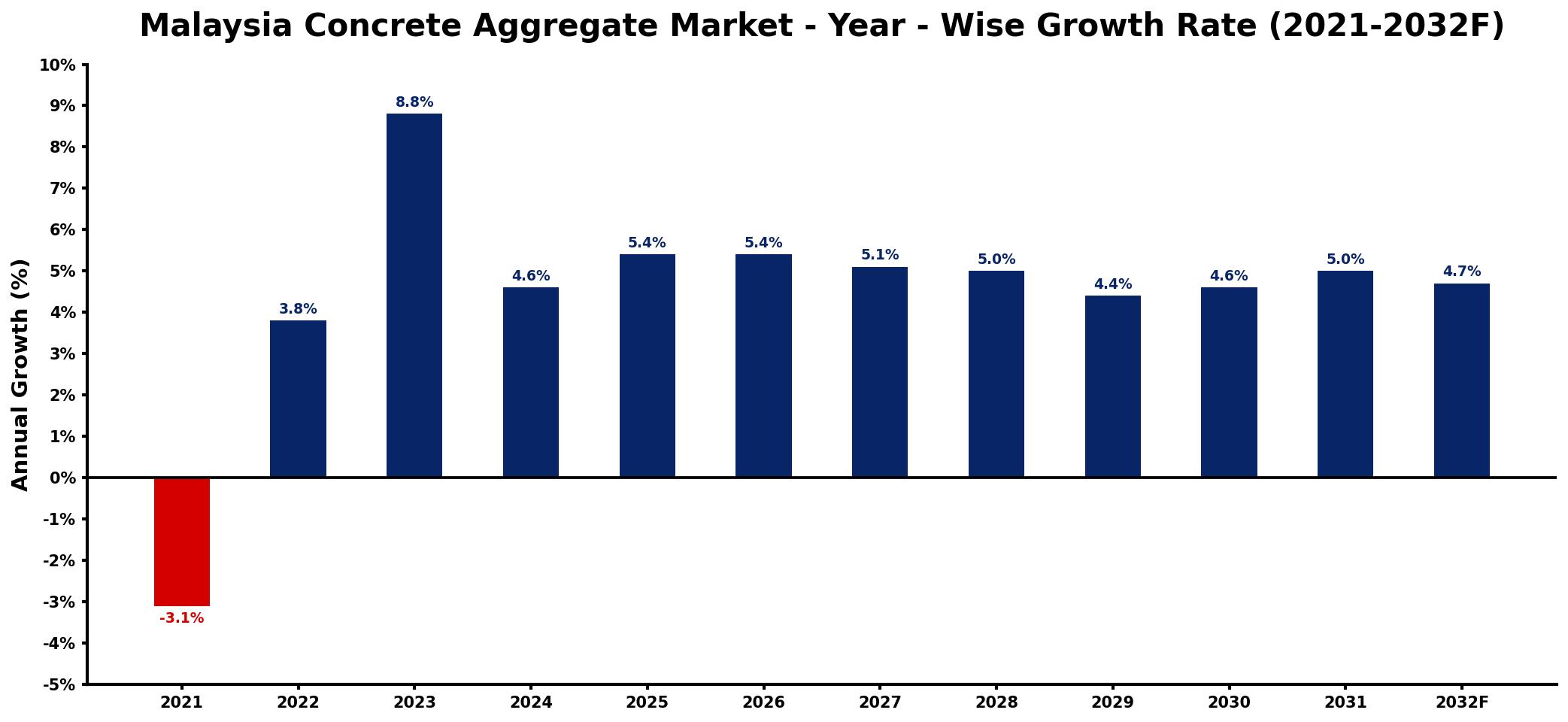
The table below presents the year‑wise growth rates along with the key drivers influencing the market
| Year | Growth Rate | Major Drivers |
| 2021 | -3.1% | construction projects faced delays |
| 2022 | 3.8% | increased infrastructure development initiatives |
| 2023 | 8.8% | rising residential housing demand |
| 2024 | 4.6% | government funding for public works |
| 2025 | 5.4% | expansion of commercial real estate |
| 2026 | 5.4% | growing urbanization and population |
| 2027 | 5.1% | increased foreign direct investment |
| 2028 | 5.0% | sustainable building practices adopted |
| 2029 | 4.4% | enhanced transportation network upgrades |
| 2030 | 4.6% | renewed focus on green construction |
| 2031 | 5.0% | rising demand for renewable materials |
| 2032 | 4.7% | increased domestic production output |
Note: Market size estimations and growth projections presented in this report are based on 6Wresearch's proprietary forecasting methodology, utilizing the latest available industry data, government publications, and primary research inputs.
Malaysia Concrete Aggregate Market Synopsis
In Malaysia, the concrete aggregate market is witnessing a robust trajectory fueled by the nations ambitious infrastructure development plans. With ongoing urban migration and rising population figures, the need for concrete aggregates—including sand, gravel, and crushed stone—remains high as cities expand and evolve.
Moreover, as environmental considerations come to the forefront, there is a growing emphasis on sustainable sourcing and recycling of aggregates. This shift aligns with the global push for greener construction practices, providing a unique opportunity for innovation within the sector.
Malaysia Concrete Aggregate Market Key Takeaways
- The market is poised for steady growth due to ongoing infrastructure and urbanization projects.
- Environmental sustainability is becoming increasingly important, influencing sourcing and production practices.
- Government initiatives in infrastructure spending are significant demand drivers for concrete aggregates.
- There is a rising interest in recycled aggregates as a response to environmental concerns.
- Quality control and adherence to construction standards remain critical factors for market players.
Evaluation of Restraints in Malaysia Concrete Aggregate Market
Despite the positive outlook, several restraints challenge the Malaysia Concrete Aggregate Market. Environmental concerns about the sourcing and extraction of raw materials are prominent; issues such as habitat disruption and resource depletion are increasingly scrutinized. Additionally, maintaining consistent quality and meeting construction standards are vital, yet can be challenging amid rising demands. The balancing act of ensuring ecological responsibility while pursuing profitability presents a real dilemma for many stakeholders within the industry.
Malaysia Concrete Aggregate Market Trends
Current trends indicate a significant shift toward sustainable practices in the concrete aggregate market. More companies are exploring the use of recycled materials, which not only minimizes environmental impacts but also caters to a growing segment of eco-conscious consumers. Technological advancements in processing and sourcing are also shaping the market, facilitating better quality control and efficiency. Moreover, the rise of prefabricated construction techniques is influencing aggregate requirements, driving demand for specialized aggregates.
Malaysia Concrete Aggregate Market Opportunities
Investment opportunities abound in the Malaysia Concrete Aggregate Market, particularly in the realm of sustainable aggregate production. Companies that can innovate in recycling methods or develop new materials stand to gain a competitive edge. Additionally, regions with underdeveloped infrastructure may present lucrative opportunities for growth as government spending is directed toward enhancements. The ongoing urbanization trend also opens avenues for market players to diversify their offerings and tap into niche markets.
Government Initiatives in the Malaysia Concrete Aggregate Market
The Malaysian government plays a pivotal role in shaping the concrete aggregate market through various policies and initiatives aimed at bolstering infrastructure development. Public spending on projects such as roads, bridges, and urban facilities is substantial, driving demand for concrete aggregates. Initiatives focusing on sustainable construction practices also encourage companies to adopt eco-friendly sourcing methods, aligning with national environmental goals.
Future Insights of the Malaysia Concrete Aggregate Market
Looking ahead to 2026-2032, the Malaysia Concrete Aggregate Market is set to evolve substantially. Continued urbanization, coupled with government incentives for infrastructure development, will serve as key drivers of growth. Additionally, the rising emphasis on sustainability will likely reshape sourcing strategies and production methods. Companies that proactively adapt to these changes, embracing both technological advancements and eco-friendly practices, will be well-positioned to capitalize on emerging opportunities.
Malaysia Concrete Aggregate Market Latest Developments (2025 - 2026)
Recent developments in the Malaysia Concrete Aggregate Market indicate a strong focus on innovation and sustainability. Industry players are increasingly investing in advanced technology to enhance the quality and efficiency of aggregate production. Furthermore, there is a marked shift towards incorporating recycled materials, driven by both regulatory changes and consumer demand for sustainable construction practices. These trends are expected to shape the future landscape of the market significantly.
Malaysia Concrete Aggregate Market - Key Attractiveness of the Report
- 10 Years of Market Numbers
- Historical Data Starting from 2022 to 2025
- Base Year: 2025
- Forecast Data until 2032
- Key Performance Indicators Impacting the Market
- Major Upcoming Developments and Projects
Key Highlights of the Report:
- Malaysia Concrete Aggregate Market Outlook
- Market Size of Malaysia Concrete Aggregate Market, 2025
- Forecast of Malaysia Concrete Aggregate Market, 2032
- Historical Data and Forecast of Malaysia Concrete Aggregate Revenues & Volume for the Period 2022-2032F
- Malaysia Concrete Aggregate Market Trend Evolution
- Malaysia Concrete Aggregate Market Drivers and Challenges
- Malaysia Concrete Aggregate Price Trends
- Malaysia Concrete Aggregate Porter's Five Forces
- Malaysia Concrete Aggregate Industry Life Cycle
- Historical Data and Forecast of Malaysia Concrete Aggregate Market Revenues & Volume By Production for the Period 2022-2032F
- Historical Data and Forecast of Malaysia Concrete Aggregate Market Revenues & Volume By Natural for the Period 2022-2032F
- Historical Data and Forecast of Malaysia Concrete Aggregate Market Revenues & Volume By Artificial for the Period 2022-2032F
- Historical Data and Forecast of Malaysia Concrete Aggregate Market Revenues & Volume By Processed for the Period 2022-2032F
- Historical Data and Forecast of Malaysia Concrete Aggregate Market Revenues & Volume By Glass Ceramics for the Period 2022-2032F
- Historical Data and Forecast of Malaysia Concrete Aggregate Market Revenues & Volume By Manufactured Marbles for the Period 2022-2032F
- Historical Data and Forecast of Malaysia Concrete Aggregate Market Revenues & Volume By Bulk Density for the Period 2022-2032F
- Historical Data and Forecast of Malaysia Concrete Aggregate Market Revenues & Volume By ASTM C33 for the Period 2022-2032F
- Historical Data and Forecast of Malaysia Concrete Aggregate Market Revenues & Volume By mechanical properties for the Period 2022-2032F
- Historical Data and Forecast of Malaysia Concrete Aggregate Market Revenues & Volume By Abrasive power for the Period 2022-2032F
- Historical Data and Forecast of Malaysia Concrete Aggregate Market Revenues & Volume By Particle Size for the Period 2022-2032F
- Historical Data and Forecast of Malaysia Concrete Aggregate Market Revenues & Volume By Fine Aggregates for the Period 2022-2032F
- Historical Data and Forecast of Malaysia Concrete Aggregate Market Revenues & Volume By Coarse Aggregate for the Period 2022-2032F
- Malaysia Concrete Aggregate Import Export Trade Statistics
- Market Opportunity Assessment By Production
- Market Opportunity Assessment By Bulk Density
- Market Opportunity Assessment By mechanical properties
- Market Opportunity Assessment By Particle Size
- Malaysia Concrete Aggregate Top Companies Market Share
- Malaysia Concrete Aggregate Competitive Benchmarking By Technical and Operational Parameters
- Malaysia Concrete Aggregate Company Profiles
- Malaysia Concrete Aggregate Key Strategic Recommendations






































