Malaysia Confectionery Processing Equipment Market Size, Share & Growth Rate
The Malaysia Confectionery Processing Equipment Market was estimated at USD 192 Million in 2025 and is projected to reach USD 249 Million by 2032, growing at a CAGR of 3.8% from 2026 to 2032. This growth trajectory is primarily driven by the increasing innovation within the confectionery sector, which is adapting to meet diverse consumer preferences. As consumers seek out novel and high-quality confectionery products, manufacturers are enhancing their production capabilities with advanced processing technologies.
Malaysia Confectionery Processing Equipment Market Year-wise Growth Rate and Key Drivers
This graph highlights how the Malaysia Confectionery Processing Equipment Market has steadily grown over the years, supported by major growth factors.
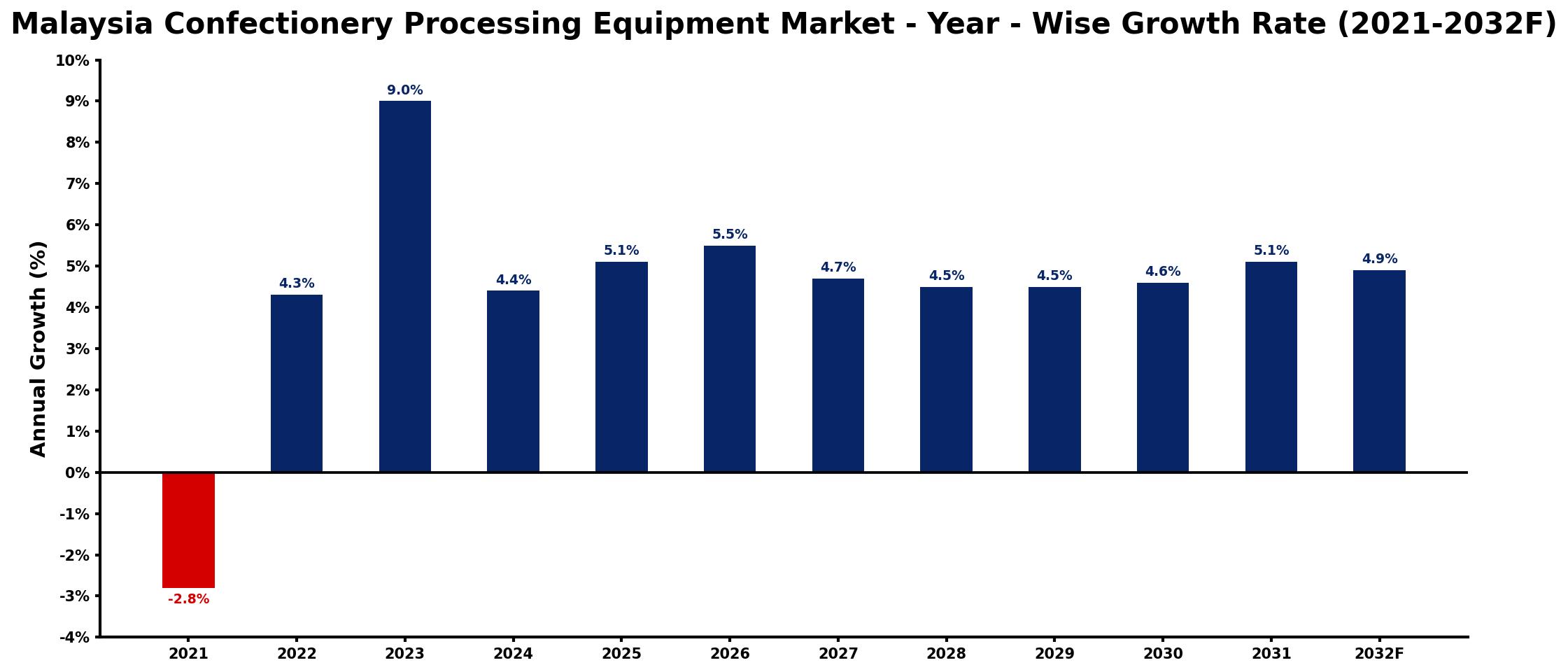
The table below presents the year‑wise growth rates along with the key drivers influencing the market
| Year | Growth Rate | Major Drivers |
| 2021 | -2.8% | decrease in consumer demand |
| 2022 | 4.3% | rise in health-conscious trends |
| 2023 | 9.0% | expansion of retail channels |
| 2024 | 4.4% | increased demand for automation |
| 2025 | 5.1% | growth in export markets |
| 2026 | 5.5% | emergence of new technologies |
| 2027 | 4.7% | enhanced focus on sustainability |
| 2028 | 4.5% | growing popularity of premium products |
| 2029 | 4.5% | increased investments in R&D |
| 2030 | 4.6% | development of innovative flavors |
| 2031 | 5.1% | growing regional consumption patterns |
| 2032 | 4.9% | rising disposable income levels |
Note: Market size estimations and growth projections presented in this report are based on 6Wresearch's proprietary forecasting methodology, utilizing the latest available industry data, government publications, and primary research inputs.
Malaysia Confectionery Processing Equipment Market Synopsis
In recent years, the Malaysia confectionery processing equipment market has seen a surge in demand fueled by a robust confectionery industry that continuously innovates. With consumers gravitating toward a variety of confectionery products, manufacturers are compelled to modernize their processing equipment to enhance efficiency and product quality.
Looking ahead, the market is poised for sustained growth, driven by export opportunities that necessitate compliance with international standards. As consumer preferences evolve toward healthier and more unique products, the equipment market must keep pace with these changes by integrating advanced technologies.
Malaysia Confectionery Processing Equipment Market Key Takeaways
- The market is characterized by significant investment in state-of-the-art processing technologies.
- Increasing demand for healthier confectionery options is prompting innovation in equipment design.
- The growth in export potential is pushing manufacturers to adopt international quality standards.
- Automation trends are reshaping the processing landscape, enhancing production efficiency.
- Consumer interest in diverse confectionery flavors is driving the introduction of specialized processing equipment.
Evaluation of Restraints in Malaysia Confectionery Processing Equipment Market
Despite the positive outlook, the Malaysia confectionery processing equipment market faces challenges that could hinder growth. Strict compliance with food safety and hygiene regulations remains a pressing concern for manufacturers. The ongoing demand for healthier and more natural products means that companies must be agile in developing new technologies. Additionally, fluctuations in the economy may influence consumer spending habits, making it essential for the industry to adapt and remain resilient amidst changing market dynamics.
Malaysia Confectionery Processing Equipment Market Trends
A notable trend in the Malaysia confectionery processing equipment market is the growing integration of automation technologies. Manufacturers are increasingly adopting automated solutions to streamline their production processes, reduce labor costs, and enhance overall efficiency. Additionally, there is a shift towards sustainability, with equipment designed for energy efficiency and reduced waste. Innovations in equipment that cater to unique consumer preferences, such as artisanal and specialty products, are also becoming prevalent, aligning with the broader market trends.
Malaysia Confectionery Processing Equipment Market Opportunities
The Malaysian market offers substantial growth and investment opportunities for confectionery processing equipment. With the increasing export of local confectionery products, manufacturers can capitalize on the demand for advanced equipment that meets international production standards. Moreover, the trend towards health-conscious products presents an opportunity for the development of processing technologies that cater to this growing consumer segment. Collaborations with tech firms for automation and sustainability initiatives can also enhance competitive advantage in this expanding market.
Government Initiatives in the Malaysia Confectionery Processing Equipment Market
The Malaysian government plays a supportive role in fostering growth within the confectionery processing sector through various initiatives. Policies aimed at improving food safety standards and encouraging innovation in food processing technologies are crucial. Additionally, public spending on infrastructure development and export facilitation programs enhances the ability of local manufacturers to compete in international markets. Government incentives for research and development in food technology further bolster the industry's potential for growth.
Future Insights of the Malaysia Confectionery Processing Equipment Market
From 2026 to 2032, the Malaysia confectionery processing equipment market is expected to evolve significantly, driven by technological advancements and changing consumer demands. As manufacturers focus on automating processes and enhancing product quality, investment in state-of-the-art processing equipment will become a priority. Moreover, the trend towards healthier confectionery options will likely stimulate further innovation, requiring manufacturers to adapt to meet these emerging preferences. Overall, the market is set to thrive, buoyed by ongoing demand and a commitment to quality.
Malaysia Confectionery Processing Equipment Market Latest Developments (2025 - 2026)
Recent developments in the Malaysia confectionery processing equipment market reflect a continued emphasis on automation and efficiency. Manufacturers are exploring new technological partnerships to enhance their processing capabilities, focusing on sustainability and reducing their carbon footprint. The industry is also witnessing increased participation in international trade shows, where local companies showcase innovative products and equipment designed to cater to evolving consumer preferences.
Malaysia Confectionery Processing Equipment Market - Key Attractiveness of the Report
- 10 Years of Market Numbers
- Historical Data Starting from 2022 to 2025
- Base Year: 2025
- Forecast Data until 2032
- Key Performance Indicators Impacting the Market
- Major Upcoming Developments and Projects
Key Highlights of the Report:
- Malaysia Confectionery Processing Equipment Market Outlook
- Market Size of Malaysia Confectionery Processing Equipment Market, 2025
- Forecast of Malaysia Confectionery Processing Equipment Market, 2032
- Historical Data and Forecast of Malaysia Confectionery Processing Equipment Revenues & Volume for the Period 2022-2032F
- Malaysia Confectionery Processing Equipment Market Trend Evolution
- Malaysia Confectionery Processing Equipment Market Drivers and Challenges
- Malaysia Confectionery Processing Equipment Price Trends
- Malaysia Confectionery Processing Equipment Porter's Five Forces
- Malaysia Confectionery Processing Equipment Industry Life Cycle
- Historical Data and Forecast of Malaysia Confectionery Processing Equipment Market Revenues & Volume By Product for the Period 2022-2032F
- Historical Data and Forecast of Malaysia Confectionery Processing Equipment Market Revenues & Volume By Soft Confectionery for the Period 2022-2032F
- Historical Data and Forecast of Malaysia Confectionery Processing Equipment Market Revenues & Volume By Hard Candies for the Period 2022-2032F
- Historical Data and Forecast of Malaysia Confectionery Processing Equipment Market Revenues & Volume By Chewing Gums for the Period 2022-2032F
- Historical Data and Forecast of Malaysia Confectionery Processing Equipment Market Revenues & Volume By Gummies & Jellies for the Period 2022-2032F
- Historical Data and Forecast of Malaysia Confectionery Processing Equipment Market Revenues & Volume By Others for the Period 2022-2032F
- Historical Data and Forecast of Malaysia Confectionery Processing Equipment Market Revenues & Volume By Type for the Period 2022-2032F
- Historical Data and Forecast of Malaysia Confectionery Processing Equipment Market Revenues & Volume By Thermal for the Period 2022-2032F
- Historical Data and Forecast of Malaysia Confectionery Processing Equipment Market Revenues & Volume By Mixers for the Period 2022-2032F
- Historical Data and Forecast of Malaysia Confectionery Processing Equipment Market Revenues & Volume By Blenders And Cutters for the Period 2022-2032F
- Historical Data and Forecast of Malaysia Confectionery Processing Equipment Market Revenues & Volume By Extrusion for the Period 2022-2032F
- Historical Data and Forecast of Malaysia Confectionery Processing Equipment Market Revenues & Volume By Cooling for the Period 2022-2032F
- Historical Data and Forecast of Malaysia Confectionery Processing Equipment Market Revenues & Volume By Coating for the Period 2022-2032F
- Historical Data and Forecast of Malaysia Confectionery Processing Equipment Market Revenues & Volume By Others for the Period 2022-2032F
- Historical Data and Forecast of Malaysia Confectionery Processing Equipment Market Revenues & Volume By Mode Of Operation for the Period 2022-2032F
- Historical Data and Forecast of Malaysia Confectionery Processing Equipment Market Revenues & Volume By Automatic for the Period 2022-2032F
- Historical Data and Forecast of Malaysia Confectionery Processing Equipment Market Revenues & Volume By Semi-automatic for the Period 2022-2032F
- Malaysia Confectionery Processing Equipment Import Export Trade Statistics
- Market Opportunity Assessment By Product
- Market Opportunity Assessment By Type
- Market Opportunity Assessment By Mode Of Operation
- Malaysia Confectionery Processing Equipment Top Companies Market Share
- Malaysia Confectionery Processing Equipment Competitive Benchmarking By Technical and Operational Parameters
- Malaysia Confectionery Processing Equipment Company Profiles
- Malaysia Confectionery Processing Equipment Key Strategic Recommendations






































